Abstract

Although Europe and North America breathed a collective sigh of relief when the Cold War ended a dozen years ago, for much of the world there was no celebration. Instead, many long-simmering ethnic rivalries, border disputes, and internal divisions turned into bloody conflicts, causing the deaths of hundreds of thousands of civilians and combatants.
Since the mid-1980s, the Department of Peace and Conflict Research at Sweden's Uppsala University (www.pcr.uu.se) has undertaken the unpleasant task of counting the dead. As part of its Conflict Data Project, the department scours press accounts, publications from international aid agencies, government reports, and the pronouncements of warring parties to determine the status of the world's conflicts, identify the goals of combatants, and detect any patterns and trends that might prove useful to the international community. The result is one of the most comprehensive datasets on conflict available.
Uppsala researchers define armed conflict as “a contested incompatibility which concerns government and/or territory where the use of armed force between two parties, of which at least one is the government of a state, results in at least 25 battle-related deaths.” A conflict that has resulted in fewer than 1,000 battle-related deaths is defined as a “minor armed conflict”; one with more than 1,000 total deaths, but fewer than 1,000 per year, is termed an “intermediate armed conflict”; and a conflict resulting in at least 1,000 deaths each year is considered a “war.”
According to the department's study, States in Armed Conflict 2000, since 1989 there have been 111 armed conflicts—22 of which have ended in peace accords and 34 in cease-fires. Although there were 22 “victories” during the Cold War, says Uppsala, the complexity of conflict in the post-Cold War period makes it unlikely that any victories will be quick or easy. “To disseminate this knowledge to parties contemplating armed action may … be the peacemaker's most important task.”
On the map
Armed conflicts took place in 27 countries in 2001. Red denotes war; orange, intermediate conflict; and green, minor conflict. In the cases of Russia and the United States, only the locations where their militaries were engaged in combat are shaded—the Republic of Chechnya and Afghanistan, respectively.

WHO, WHERE & WHY IN 2001

Margareta Sollenberg et al., States in Armed Conflict 2000 (Uppsala: Uppsala University, 2001).
Year by year
In 2001, there were 34 conflicts, the lowest number since the end of the Cold War. The year with the most conflicts, 55, was 1992.

Who's involved?
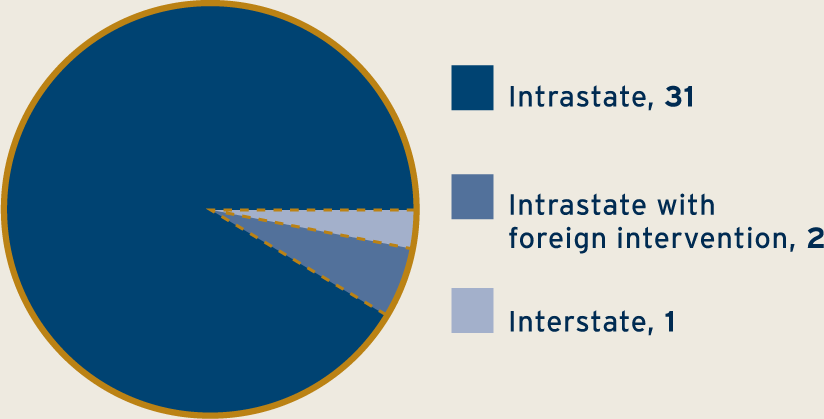
Two conflicts involving foreign intervention occurred in 2001: In Afghanistan, where the United Islamic Alliance and a coalition of troops from 13 countries opposed the Taliban government; and in the Democratic Republic of Congo, whose military was opposed by three indigenous rebel groups and troops from Rwanda and Uganda. The only interstate conflict, as defined by Uppsala, was between India and Pakistan.