




Abstract

The Democratic People's Republic of Korea has a population of nearly 20 million people, but only two citizens— and one of them is dead.
The Soviet Union under Stalin tried hard to erase any vestige of civil society and the important people in it, but failed. Russia was known for its famous people, even as they fell under the blade of Stalinism. But no one in North Korea is famous except for the Kims. Led by the Great Leader, Kim Il Sung, who died in 1994, the family also includes the Dear Leader, Kim Jong Il, and the mother of all Korea, Kim Jong Suk. (Kim Jong Suk's picture crops up from time to time and place to place, but she is of little or no importance.)
So two Kims, one alive and one dead, control all aspects of life in this tiny, impoverished country, where Kim Il Sungism is the reigning ideology. Questioning that ideology brings banishment from the cities, imprisonment, or public execution.
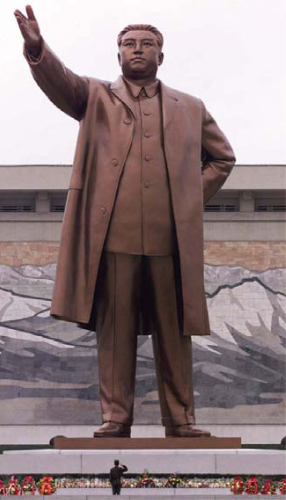
All visits to North Korea start with an obligatory visit to Mansudae Hill and the 20-meter-tall statue of the Great Leader. Built in 1982 to celebrate his seventieth birthday, the statue is now the focal point for all pilgrimages to Pyongyang. Each person or delegation is expected to bring flowers to lay at the feet of the giant bronze, and bowing is mandatory. On either side of the statue are massive statues of workers, peasants, and especially soldiers fighting against Japanese or U.S. soldiers in the struggle for liberation.
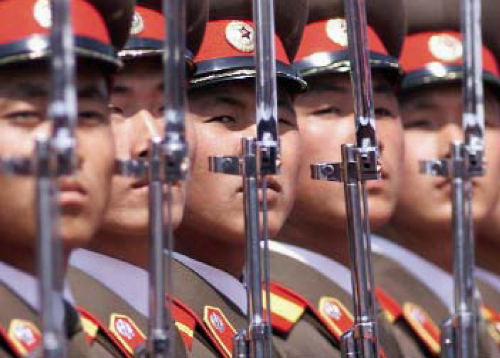
A military honor guard stands at attention at Pyongyang's airport
Two basic images of the Great Leader can be found everywhere. The standard image, displayed on all government buildings and in all homes, is the stern portrait that glares down upon the population. The new image, the “smiling portrait,” was painted after Kim's death, and has become very popular.
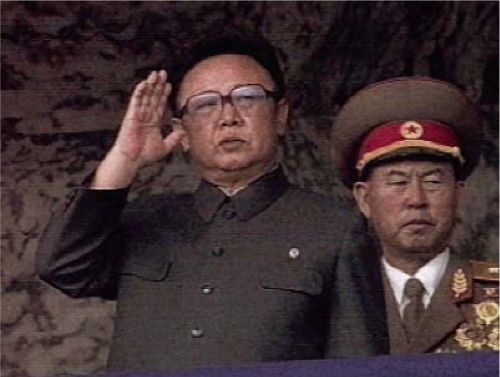
The official portrait of the younger Kim emphasizes his seriousness while de-emphasizing his Elvis-style hair and excess weight. It hangs everywhere beside the portrait of his father, including inside railway carriages and subway cars. Hotel rooms for foreigners seem to be an exception to the ubiquity of these official portraits, but staff areas are never with out them. Pictures of Kim Jong Suk show her wearing the army uniform she is said to have worn during the fight against the Japanese.
September 9, 1998: Kim Jong II salutes during the country's fiftieth anniversary celebration in Pyongyang.
The national art gallery displays numerous paintings of the Great Leader and the Dear Leader giving “on-the-spot guidance” to happy workers, peasants, and soldiers. One of the newest additions to the collection is a massive work showing the Dear Leader with his Mercedes.
There are only two public pictures in Pyongyang of people who do not belong to the Kim family—in the main square are two smallish images, one of Marx and one of Lenin.
President for all eternity
After Kim Il Sung's death, the constitution was altered to enshrine him as the eternal president of Korea. This is why Kim Jong Il has not assumed the title of president, ruling instead as chairman of the National Defense Commission.
In keeping with Kim Il Sung's posthumous position as permanent president, the presidential palace has been converted to the world's largest mausoleum. His former home and office were sealed up with granite and marble, and the world's longest moving sidewalk was installed to take visitors past his body. Dead-leader-visiting junkies will be disappointed to learn that they may not get in to see Kim as easily as when they visited Lenin, Mao, or Ho Chi Minh: Only ideologically appropriate people are invited to gaze upon the eight-year-old corpse and father of “juche” (pronounced “joo-chay”).
According to the official line, juche “means that the masters of the revolution and construction are the masses of the people and they are also the motive force of the revolution and construction. In other words, one is responsible for one's own destiny.” More succinctly, juche refers to the idea that the state must be totally self-reliant. North Koreans abhor what they call “flunkeyism,” or reliance on foreigners. In fact, no mention is ever made of the role of either the Soviet Union or the People's Republic of China in building or defending North Korea. Those countries are apparently of no importance to the past, present, or future of Korea.
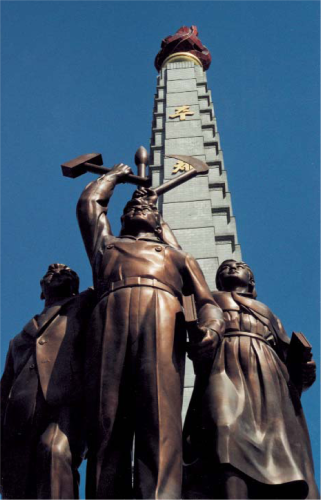
The “Tower of the Juche Idea” is a massive glass flame, lit in a way to appear to be burning with the red flame of revolutionary idealism. But the word “juche” also appears everywhere else—on all buildings and in every workplace.
Another obligatory stop is at the shrine at Mangyongdae, the birthplace of the Great Leader. Koreans are obliged to visit this place on a regular basis. But it is one of the nicer parks in Pyongyang, so many Koreans visit of their own free will. One is unlikely ever to see anything as obviously fake, however, as the alleged childhood home of the Great Leader, the “original” peasant house on the edge of a former graveyard. A wooden and thatch shack, it is beautifully kept and adorned with family photographs.
Even more completely fake is the legendary birthplace of Dear Leader Kim Jong Il, who is said to have been born in a humble log cabin at sacred Mount Paektu in the northernmost reaches of Korea during the anti-imperialist war against the Japanese. He was actually born in the Soviet Union.
Other fakes in the northern areas include slogans gouged into tree trunks. More of these carvings, said to have been made by anti-imperialist fighters led by comrade Kim Il Sung between 1925 and 1945, seem to be discovered every day. They appear amazingly fresh, free from weathering or overgrowth. When found, they are preserved behind Plexiglass. Their message: that there has always been only one true leader of all Korea, the Great Leader, who almost single-handedly defeated the Japanese Imperial Army.
Understanding the depth of yearning for international recognition comes with a visit to the International Friendship Exhibitions at the Myohyangsan Mountains. There one repository is dedicated to Kim Il Sung, and another to Kim Jong Il. Both exhibits, housed inside a mountain, contain tens of thousands of gifts—impressive ones from world leaders and silly little gifts from ordinary people. Many items look odd displayed behind glass, particularly common household goods like a working-class dining room table or small trinkets from souvenir shops around the world. The display is apparently intended to show both foreigners and Koreans that the world recognizes how important the Great and Dear Leaders are. And there is, in fact, an almost religious quality to the way the collection of relics is displayed.
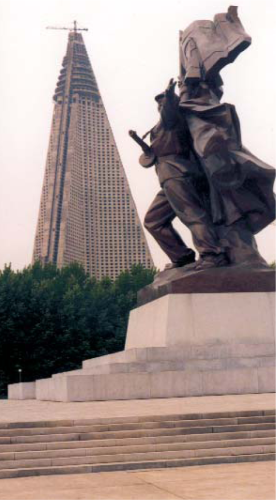
The abandoned 105-story hotel with the Fatherland Liberation War Memorial in the foreground.
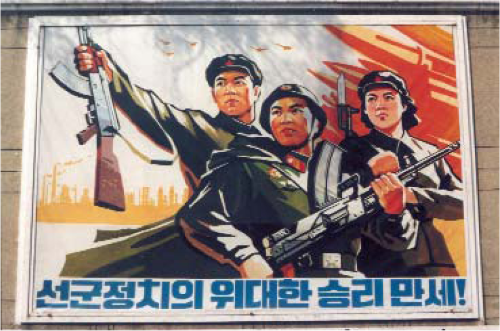
The streets of Pyongyang—and everywhere else—are filled with posters. There is no advertising in a commercial sense, but there is a great deal of advertising telling Koreans how to think about the Great and Dear Leaders. Newly painted posters regularly replace older ones, and most carry socialist-realist images; the rest carry pictures of the Great Leader and his edifying words, urging the population on to greater feats of revolutionary heroism.
Things really are engraved in stone, too. The words of the Great Leader are frequently carved in chunks of granite, which may range in size from small monuments at the roadside right up to massive letters carved into the side of a hill or a mountain.
Adding to the two Kims' deification is the constant reference to them in song and dance. One need only listen to a few minutes of radio or television to hear each one mentioned several times.
While the two Kims have not named places after themselves (other than Kim Il Sung University) they have had various items named in their honor. Both men have flowers named after them, and these flowers are always prominently displayed.
The drought
Everywhere in the country, and at regular intervals throughout the cities, there are large sign boards on which pictures and charts and text are prominently displayed. These glass-covered boards display the same message and photos no matter where they are located. Sometimes photos dating back to the Japanese occupation are shown, but the photos that have been displayed most frequently in recent years show the food aid that North Korea sent to the victims of flooding in South Korea in the late 1960s. The population is constantly told that the North was the first to send food aid to their brothers in the South, so there is obviously no problem, historically or ideologically, with receiving it in return years later.
The effects of the years of drought are visible everywhere. Riverbeds are nearly empty, with only small trickles of brown water. Even in Pyongyang there is an endless supply of trucks carrying 50-kilogram bags of rice and wheat donated by the United Nations or the United States. The Koreans do not remove the labels announcing that the food is a U.N. or U.S. gift.
Life in Pyongyang
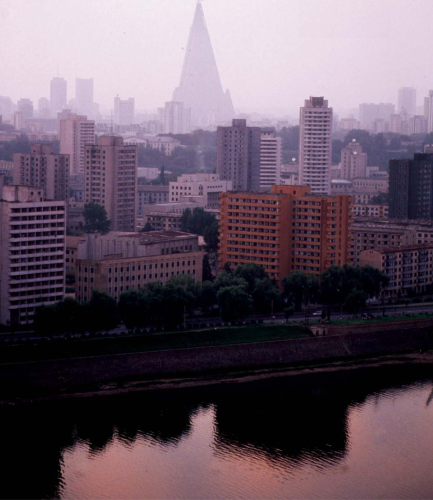
Housing in Pyongyang is of surprising quality. In the past 30 years— and mostly in the past 20—hundreds of huge apartment houses have been built. Pyongyang is a city of high-rises, with probably the highest average building height of any city in the world. Although the quality is below that of the West, it is far above that found in the former Soviet Union. Buildings are finished and painted and there is at least a pretense of maintenance; even older buildings do not look neglected. Nothing looks as though it is on the verge of falling down. (There is one exception, however—an unfinished hotel, begun in the 1980s, which rises to 105 stories. This poured-concrete pyramidal tower is visible from the train 30 minutes from Pyongyang. Upon closer inspection, one sees that large chunks of concrete have broken away.)
The statue of Kim Il Sung at Mansudae Hill is 65 feet tall.
Although a bit dreary, the shops in Pyongyang are far from empty. Each apartment building has some sort of shop on the main floor, and food shops can usually be found within one or two buildings from any given home. Apart from these basic, Soviet-style shops, there are a few department stores carrying a wide range of goods. The department stores are not particularly busy, but then there is no real consumer culture urging people to buy anything but necessities.
The Tower of the Juche Idea.
Grocery shops stock standard Korean fare, with an emphasis on rice, noodles, kimchi, and pickled vegetables. Every North Korean is supposed to receive a monthly ration of rice, but that ration can be supplemented with purchases from a local farming co-operative. Co-op farms are now allowed to sell their excess production in street markets—although those markets are generally kept well out of sight of foreigners. Private shops are banned, but there is a growing number of street vendors who sell official goods and food.
While not snappy dressers, North Koreans are certainly clean and tidy, and exceptionally well dressed. Women almost always wear the traditional Korean dress with the waist just under the arms and flowing skirt. Men tend toward dark blue suits, or in some cases jackets like those worn by Kim Jong Il. Another style made popular by Kim are massive sunglasses, which many men wear at all hours. There is no shortage of clothing, and clothing stores and fabric shops are open daily.
Pyongyang is one of the quietest cities on the planet, due to the near total absence of automobiles. The population of more than 2 million has fewer cars than any town in the west. Mostly, the cars are left-hand-drive Mercedes or used right-hand-drive cars and trucks from Japan. Although North Koreans drive on the right, there may be more right-than left-hand-drive cars.
Unlike other Asian countries, Korea eschewed bicycles for decades. Only recently have they been allowed, and only now are they beginning to become a major mode of transportation. Most people must still walk or wait for public transport.
Pyongyang's public system consists of trolleys, electric buses, and a two-line subway. All are terribly overcrowded, but somehow keep on running. For every 50,000 kilometers it travels, a bus in Pyongyang has a red star painted on its side. Some buses are completely covered with red stars.
The subway stations are extremely deep, modeled on the Moscow system. With their triple blast doors, they are designed to be used as bomb shelters. The stations are true showplaces, with beautiful art work and rousing names like “Reconstruction” and “Victory.”
A typical street poster.
Because the public transport system is hopelessly inadequate, most Pyong-yangers must walk to and from work each day. It is common to see locals walking at all hours. They often march in regimented groups to and from various activities.
The economy is in tatters with over half of industry idle—the population is much larger than the number of jobs remaining. Many Koreans spend much of their time squatting on the ground, as if they are waiting for a moment when they can spring into action. Yet there is little likelihood that their services will ever be needed, and squatting seems more like an adaptation to imposed idleness—and a symbol of loss.
The next generation
Children are said to be kings in North Korea. That's a strange analogy in a communist country, but there is a great deal of truth in the assertion. The best facilities to be found are commonly the local “Children's Palaces” where children can go after school for extracurricular activities. The largest of these in Pyongyang features music, singing, dancing, weaving, sewing, swimming, chess, athletics, ballet, gymnastics, computer science, and a host of other activities. These classes enhance the social and cultural education of children in a way that would be the envy of almost any parent.
What is odd about the children, though, is the way they look—or more often do not look—at an outsider. Either a foreigner is subjected to a hate-filled stare, or he is invisible.
Many younger children believe their lessons—that all Westerners are imperialists who want to crush Korea. They stare with unbounded hatred at Caucasian foreigners. Many older children look right through a foreigner, as though the offending person is not even there.
A sense of history
After the war in Vietnam ended in 1975, the Vietnamese eventually discarded their war mentality and moved on with developing their economy and their relations with the outside world. The Korean War ended in 1953, but North Korea lives as though the war were yesterday. Nowhere is this more evident than at the Great Fatherland Liberation War Victory Museum, and the Memorial to the Victors of the Fatherland Liberation War, just outside. In the museum's basement are “merited weapons” used to fight the imperialists. The most prominent is a MiG-15 fighter, numbered 009. So important is this aircraft that a replica appears in bronze among the memorial park statuary outside, yet it has no kills to its credit. The aircraft's only claim to fame is that Kim Il Sung crawled up the ladder, now preserved with the aircraft, peered into the cockpit, and gave “helpful advice” to the pilots.
The future
When Kim Il Sung died in 1994, many analysts and media commentators predicted that the country would soon collapse. South Korea began feverish preparations for a potentially disastrous and unplanned unification, with perhaps millions of economic refugees streaming across the Demilitarized Zone.
It didn't happen. In fact, totalitarian rule in Pyongyang is as strong as ever, and it has additionally weathered the “arduous march” of drought and famine.
The country will continue to take advantage of all foreign food and funding, no matter the source. Slowing deliveries would only bring with it the risk of increased weapons production and “saber-rattling.”
There is no threat to the regime other than the lack of food. Because the famine is largely contained in areas with completely marginalized populations, and because there is a very strong security presence at all levels, there is no danger that the hungry or disaffected will topple the government or the ruling Korean Workers Party.
The one thing that brings foreign diplomats and international organizations to North Korea is nuclear weapons, or at least the threat of nuclear weapons. Without a nuclear program North Korea would be seen as nothing more than a tiny, sparsely populated, hermit kingdom with a totalitarian regime. Although it is starving, there would be little outcry and little attention would be paid.
But with a nuclear program in place, North Korea can command the attention of the world, or at least those parts of it willing to trade aid for nonproliferation. Pyongyang's hotels, like the Koryo and the Yanggak-do, are regular haunts for diplomats in town discussing nuclear matters. The nuclear deal's problem is that oil deliveries are far behind, construction of the reactors is delayed, and the Bush administration is unwilling to work constructively with Pyongyang, so there is now a greater chance that Kim Jong Il will resurrect the nuclear program for political purposes.
Kim Jong Il is firmly in charge of the military through family connections, patronage, and the replacement of significant officials. His “army-centered” policy of governing ensures that the military will be no threat to him as long as the army gets first call, as it now does, on economic resources. There is a great deal of life left in this repressive regime, and it seems unlikely that any outside force can exert much influence on the form or nature of the government. •