



Abstract

Nuevo emperador, Pana-ma: Jorge Luis Martinez farms the land outside Panama City the same way his grandfather and father always have, by slashing and burning down jungle.
On a recent afternoon, a fire smoldered as he cleared his plot planted with yams, yucca, plantains, beans, and sugar cane. With no steady work, Martinez, 51, feeds his family with whatever he can coax from the soil.
The road from town that leads to his two acres dead-ends at one of Panama's three former U.S. firing ranges. Following the U.S. military pullout at the end of 1999, Panama's government had to place off-limits 44,000 acres that cut through the isthmus.
The unexploded grenades, bombs, and other ordnance on the Pina, Empire, and Balboa West ranges are the explosive legacy of a near-century of the U.S. presence in Panama.
Since 1979, accidents with U.S. munitions have killed at least 24 people, according to a former official at Panama's foreign ministry. Definitive records are unavailable because various agencies, American and Panamanian, tracked accidents differently.
Now, negotiations have stalled between Panama and the United States over responsibility for the cleanup, and urbanization is crowding close to 100,000 people onto the firing ranges, which border on the country's fastest growing areas.
“A lot of people need land, so the government needs to do something,” Martinez said in Spanish, while taking a break under a palm-thatched hut. Since 1999, he has farmed fewer than 50 yards from the guarded entrance of the Empire Range.
In the last 20 years, the weathered campesino has watched his village's population double to nearly 3,000. Where there was dense jungle a generation ago, signs now read “Lots Sold,” and billboards advertise tract homes for sale.
Over the years, the U.S. military used the firing ranges for live-fire training and testing of weapons ranging from land mines to cluster bombs. Panamanian forces participated in occasional joint exercises until relations soured with then-dictator Manuel Noriega in the mid-1980s.
Because 10 to 15 percent of all munitions do not explode on impact, the former training areas contain at least 100,000 “duds”—unexploded ordnance known in military parlance as UXO.
Even though the government has increased security since the U.S. withdrawal in 1999, Panamanian officials say they cannot keep determined people from entering the ranges and that they lack the technology and funds to remove the un-exploded munitions. They want Washington to finish the cleanup job it started.
Warning sign at a former U.S. military firing range.

A 1977 Panama Canal Treaty “says distinctly that the U.S. has responsibility for turning over previously held territory free of every hazard to human life, health, and safety,” says Juan Mendez, director of the foreign ministry's Office of Treaty Affairs.
The cleanup in Panama is only part of the larger debate over former U.S. military sites around the world. In the Philippines, activists are asking the United States to clean up unex-ploded bombs and the contaminated water supply left after Subic Bay Naval Station and Clark Air Base were closed in the early 1990s. The Pentagon refuses to clean the sites, which U.S. officials deem the responsibility of the Philippine government.
Opponents charge that the United States has a double standard—that it is concerned with sites at home, but not abroad, where domestic laws do not apply and there is scant political pressure.
“The U.S. government has the money to develop weapons,” said Conrado Sanjur, a Catholic priest who heads a human rights group in Panama that has counseled victims of explosives. “They should use money to decontaminate the world.”
But unlike other nations that hosted U.S. military bases, Panama's 1977 treaty stipulates that the United States must return the land in a safe condition “insofar as may be practicable.”
U.S. officials contend that it is impossible to clear the former firing ranges of all explosives because of steep hills and thick jungle. They say they never guaranteed a 100 percent cleanup and that they have fulfilled their requirements under the treaty. They argue that further efforts would endanger workers and damage the watershed that feeds the Panama Canal.
“The difference in opinion is over whether we met the obligation, and we think we have,” says Charles Barclay, spokesman for the State Department's Bureau of Western Hemisphere Affairs. “Our sense is that we have bent over backward to meet the terms of the treaty.”
Fernando Manfredo, former co-chair of a U.S.-Panama group working on the cleanup negotiations, disagrees. “This has left in Panama a very bad taste. We find every time we negotiate with the United States, we get screwed.”
The explosion that killed Jenny de Villareal's teenage son Alival ripped out the heart of the narrow street where she has lived for almost two decades.
The blast in Cerro Silvestre, a Panama City suburb, also killed her niece's husband and maimed a nephew, who lost his lower left leg. The two men had gone to a nearby U.S. firing range to collect metal to sell for scrap. Alival, 13, was examining their haul when a rusty mortar shell they brought back exploded.
Sitting on her concrete patio, which looks onto a jungle-covered hill, Villareal, who helps run the family's tiny grocery, began calmly recounting the accident. But she broke down as she recalled how her son's death devastated her husband, who rarely left the house for years after the accident.
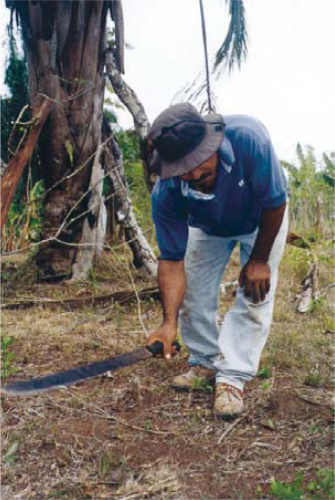
Gregorio Murillo, who farms near a former firing range.
The United States, which admitted no guilt, settled with Villareal for $5,000, half of which went to lawyer's fees and the other to pay for a college education for her daughter, Jenny, 21.
The United States posted signs warning people not to go into the ranges, but why wasn't there more security? Villareal asked. Why not the same safety measures, as when she worked on a U.S. military installation, which required her to show special identification to enter?
Panamanians worry that the munitions left behind will kill and injure more people as lack of land and a growing population force people onto the former firing ranges.
“The problem here, really, is rural people without alternatives,” said Sayda de Grimaldi, who oversees security and public education programs for the Interoceanic Authority, the agency in charge of developing areas returned from U.S. control.
Many locals who hunted and planted for years inside the ranges without incident believe it is safe and do not understand why the government is keeping them out, she added. “As the demand for land increases, people are anxious and hard to control.”
Since the Interoceanic Authority assumed control in 1999, there have been no accidents, in part because of more patrols and public education. The agency's campaign, aimed at schoolchildren, includes a coloring book that identifies explosives and a story of a frog named Carorrana, who dies after hopping onto a glittery bomb she believes is a “shiny stone” that brings good luck.
Accidents may have been reduced, but all of the ranges' potential for development—for agriculture, commercial use, or tourism—remain on hold until they can be made safe.
In 1999, Panama hired Arnold & Porter, a Washington, D.C., law firm, to argue its case with the U.S. government. To date, the Bush administration has not answered the latest request to go to arbitration.
Panama also is awaiting a U.S. decision about cleanup on San Jose Island, where the United States tested mustard gas during World War II. [See “Panama: Bombs on the Beach,” page 55.]
Critics say Panama should take a more aggressive stand on cleanup. “I don't think Panama is wise to wait and see about the canal area ranges,” says John Lindsay-Poland, coordinator of the Fellowship of Reconciliation's Task on Latin America and the Caribbean. The Fellowship, a San Francisco activist group, has researched the munitions issue. Lindsay-Poland says Panama could bolster its case by supplying more evidence of the hazardous mess left behind. It should work with the United Nations to create a multilateral solution, he adds.
As Eric Jackson, publisher of the Panama News, an English-language newspaper, told me, “I think it's servile for Panama to just say it's a problem that the U.S. has to solve, and not take the common sense steps needed to protect public safety.” Jackson, a dual U.S.-Panamanian citizen, grew up near the Pina firing range and writes often about cleanup.
However, environmentalists caution that a too-extensive cleanup could destroy the resources that people seek to use. Some crude methods, which they liken to strip mining, would entail cutting down trees and sifting through dirt. With human presence restricted on the ranges, animal populations have thrived and tropical forests have flourished. The forests are home to jungle cats such as ocelots and jaguars, as well as capybara, toucans, parrots, and capuchin and howler monkeys.
A better strategy would be to wait for improved technology or to reserve certain areas for lighter cleanup, says Lider Sucre, executive director of the National Association for the Conservation of Nature, Panama's leading conservation group: “We want to balance how to clean up and be safe with the desire to conserve the species who found refuge there.”
Meanwhile, Villareal has seen her town expanding every day, the streets going from dirt to gravel to paved. She worries that new arrivals will not know about the dangers on the ranges. She says she will continue to speak out to anyone who will listen: “I have to keep fighting so this doesn't happen to someone else.” •