




Abstract

On February 16, the Davis-Besse nuclear plant in Ohio went offline for its thirteenth refueling and maintenance outage. During the shutdown, plant operators were inspecting the top of the vessel that houses the reactor core when they found more boric acid accumulation than they expected. Later, while making repairs to a nozzle that passes through the vessel head, they found something completely unexpected—a hole.
The worst damage ever
Davis-Besse is a 25-year-old, single-unit pressurized water reactor located in Oak Harbor on the shore of Lake Erie, about 30 miles east of Toledo. Inside its containment building is the reactor pressure vessel, and inside that is the core. Sixty-nine hollow nozzles stretch through the vessel head down into the core; through the nozzles, control rods can be lowered to stop reactions. The carbon steel walls of the reactor vessel are 6 inches thick and internally lined with noncorrosive stainless steel cladding, and designed to withstand up to 2,500 pounds of pressure per square inch.
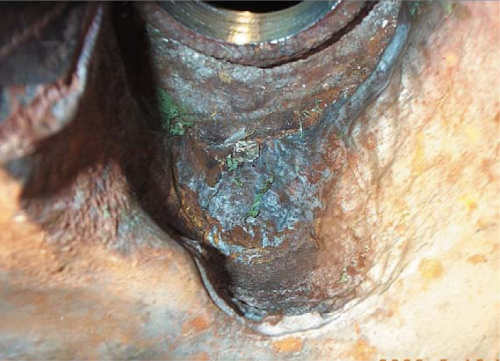
On the vessel head, boric acid corrosion had eaten through the 6 inches of carbon steel and carved out a cavity 4 inches by 7 inches wide. Between 35-40 pounds of carbon steel were simply missing, and the only thing that contained the radioactive, highly pressurized coolant water inside the vessel was the thin skin of stainless steel cladding. Not designed to endure such pressure, the lining had started to bulge outward. If the lining had been breached, a loss of coolant accident would have resulted. This could have led to a severe accident.
Outside the Davis-Besse nuclear power plant.
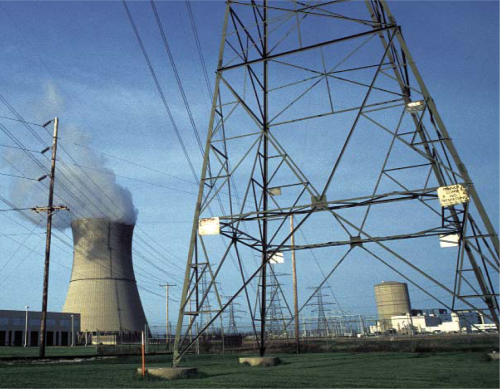
The damage was the worst of its kind ever seen, and it had taken years to develop. Warning signs of the corrosion, and the leaking nozzle cracks that made it possible, had gone repeatedly undetected by FirstEnergy Corp., the plant operator.
An acceptable risk
“It shouldn't have happened; it was preventable. FirstEnergy failed on several fronts to detect and prevent this corrosion,” says Jack Grobe of the Nuclear Regulatory Commission (NRC).
The inspections that led to the discovery of the corrosion had been requested by the NRC in August 2001 after unusual circumferential cracking was found on nozzles at two units of South Carolina's Oconee nuclear station. After that incident, the NRC asked that inspections for the same kind of cracks be completed before December 31, 2001, at the 13 pressurized water reactors that it deemed most susceptible to similar cracking. Davis-Besse was one of these plants, but the NRC agreed that inspections there could be postponed until mid-February.
After the corrosion at Davis-Besse was discovered, the granting of that extension looked to some like a lapse in judgment on the NRC's part. David Lochbaum, a nuclear safety engineer with the Union of Concerned Scientists, says the NRC's response to the problems at Oconee was timely and appropriate, but allowing Davis-Besse to postpone inspections was questionable. “After the Oconee follow-up, they drew a line in the sand and they then allowed Davis-Besse to cross it,” Lochbaum says. “That seems a concern.” Lochbaum also wants to know why FirstEnergy wanted to push back the inspection date.
At the same time FirstEnergy was telling the NRC that it was safe to postpone inspections, they were negotiating to buy a new replacement vessel head, giving the appearance that the plant may have been aware of problems and wanted to put off inspections as long as possible, Lochbaum says. “There's a concern that they might not have provided the NRC with a full set of information.”
FirstEnergy says it had no indication of either circumferential cracking or corrosion until it carried out the recent inspections. The utility wanted to buy a new vessel head, says spokesman Richard Wilkins, because it planned on applying for license renewal and because it wanted to avoid nozzle cracking in the future.
“Although we didn't see any indications of a problem, we knew because of industry experience that eventually we probably would,” says Wilkins. “And if that was the case, we would continually have to be doing these inspections, replacing these nozzles, which is time consuming and expensive. We didn't want to have to deal with this chronic issue.” In October 2001 FirstEnergy decided to buy a new vessel head, and ordered one in early 2002.
The postponement of inspections at Davis-Besse is a non-issue, according to Brian Sheron of the NRC's office of nuclear reactor regulation. “People keep saying, ‘Oh, you let them go an extra six weeks,’ but it had no effect on the fact that they found corrosion,” Sheron says. “That corrosion was there on December 31, that corrosion was there [in May 2001].”
There was “a fair amount of uncertainty” about the technical issues of circumferential cracks, like crack growth rates. But when the NRC calculated the risk factors associated with letting the plant operate until February 16—and got FirstEnergy's commitment to take on extra safety precautions to offset those factors— the agency decided the risk was acceptable. In fact, says Sheron, the results of the inspections ultimately bore out the assumption the NRC made when assessing the risk: that no major circumferential cracks would be found on the nozzles. “Notwithstanding the corrosion part of it, the plant was in fact safe,” he says.
Boric acid problems
It's the “corrosion part of it” that's got folks wondering. How was it that such severe, long-term degradation could go unnoticed by the utility? In its own root cause analysis report to the NRC, dated March 22, FirstEnergy estimates that the crack that allowed the leakage of coolant water, which led to the boric acid deposits and corrosion, could have started as long ago as 1990.
Simple boric acid accumulation on reactor vessel heads is not terribly meaningful. A tiny amount of boric acid, between 1,000-2,000 parts per million, is dissolved into reactor coolant water, which is not corrosive. Because coolant leaks at high temperatures (500-600 degrees Fahrenheit) as steam, and because the vessel head is also very hot, the steam quickly evaporates and leaves behind boric acid crystals, which look like sugar. It is common for pressurized water reactors to have small amounts of boric acid crystals on vessel heads.
“That's expected on a regular basis,” says Grobe of the NRC. “It's normally cleaned up with a brush and a vacuum—not a big deal.”
But at Davis-Besse, the boric acid was allowed to accumulate until it became “substantive.” Beginning in approximately 1996, the boric acid deposits grew and changed in consistency until about 70 percent of the vessel head was covered with a hard, lava-like coating ranging from 1-3 inches thick. Somehow, in this environment—no one understands the mechanics of it yet—a pit in the carbon steel began to corrode rapidly.
The NRC documented boric acid corrosion of carbon steel components as early as 1979. In 1987 the NRC issued an information notice to operators of pressurized water reactors about an incident at the Turkey Point 4 reactor: “Another severe instance of boric acid-induced corrosion of ferritic [carbon] steel components on the pressure boundary of a [pressurized water reactor].” More than 500 pounds of boric acid accumulation had to be removed in that case. (Nine-hundred pounds of deposits were removed at Davis-Besse.)
After the Turkey Point and other incidents, in 1988 the NRC requested that all operators of pressurized water reactors implement a program to monitor and control boric acid.
FirstEnergy admits that if it had properly implemented its boric acid control program, it would have found the corrosion earlier.
“We didn't do adequate inspections,” says FirstEnergy's Wilkins.
Missed opportunities
Failing to catch the buildup on the vessel head was the most significant warning sign FirstEnergy missed, says Grobe, but it was not the only one.
Nozzle leakage on the reactor vessel head at Oconee led to inspections at other plants.
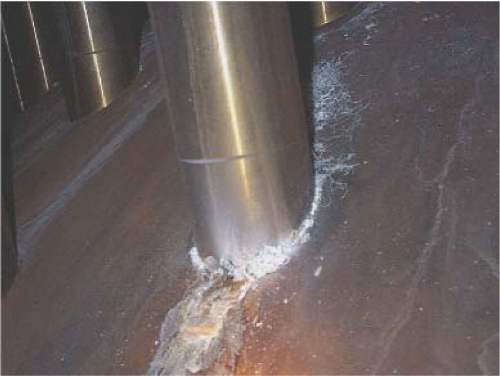
There were two other “telling” indications that should have tipped off operators to the problem, Grobe says. The first was when filters in the airborne radiation monitors in the containment building began showing unusual coloration and content, including boric acid and rust, and needed more frequent changing. The second was when boric acid and rust began accumulating in the coils of the containment air coolers. A more oblique indicator, Grobe says, was an unusual pattern of coolant leakage over the years.
But none of these factors, says Wilkins, is necessarily indicative of a serious problem. “We noted all these things,” he says. “There were no really overt signs that pointed to a cracked nozzle issue.” The boric acid buildup could have stemmed from a leaking flange, not a cracked nozzle; the coolant leakage was too insignificant to detect; and the rust in the filters could have come from a number of sources besides the vessel head, he says.
Still, “We had some opportunities to find this problem earlier,” Wilkins says. “We missed those opportunities.”
Bad design, bad decisions
Part of the problem, he says, was the design of the service structure above the reactor pressure vessel. The structure is built above the vessel head with only two inches of clearance between it and the head's curved dome, making inspection difficult. The boric acid buildup made matters worse.
“It makes it very difficult to maintain and clean the reactor head,” says Wilkins. “So one of the things we've done already to fix that is to modify the service structure.” By cutting openings for service ports into the side of the service structure, inspecting and cleaning the vessel head will be much easier and more effective.
March 16: The unexpected “hole,” caused by boric acid, near a nozzle in the vessel head.
These modifications were first considered at Davis-Besse more than a decade ago, only to be repeatedly deferred. Installation of “multiple access ports” was proposed in March 1990, after boric acid was found to have leaked from flanges onto the reactor head. In September 1993, the request was voided. The next year the idea was put forward again. The reasons, from FirstEnergy records: “There is no access to the reactor vessel head or the [nozzles] without installation of the modification. Inspections of the reactor vessel head for boric acid corrosion following an operating cycle is difficult and not always adequate. Video inspections of the head …do not encompass a 100 percent inspection. Cleaning of excessive boric acid residue from the reactor vessel head also does not encompass 100 percent. Installation of these inspection openings would allow a thorough inspection and cleaning of the head.”
Ten months later, in March 1995, the modification was deferred at the request of the plant engineering manager, who was “waiting for additional information prior to concluding that the $250K cost is worth the increased degree of assurance.” The decision to defer modification was, according to FirstEnergy's March 22 root-cause report, a “contributing cause” to the corrosion.
Lessons learned?
To repair the corrosion, FirstEnergy made two proposals to the NRC: The damaged area could be cut out and capped with a six-inch thick metal weld, or FirstEnergy could replace the entire vessel head. The NRC decided the replacement option was better, and on May 23 the utility announced it had bought an unused vessel head from an unfinished nuclear plant in Michigan. (The new vessel head that FirstEnergy ordered earlier this year will not be ready until 2004.) Refurbishing and installing the Michigan head is expected to cost between $55 million and $75 million, and FirstEnergy hopes to be ready for restart before the end of the year.
Being ready to restart and getting the NRC's approval to do so, however, are two different things. Immediately after it learned of the corrosion, the NRC initiated a special panel to oversee and assess the plant's performance during its extended shutdown. Grobe, who chairs the panel, says that the panel will stay in existence after it gives Davis-Besse the green light to restart, until it judges the plant ready to return to the routine oversight process.
Other changes may be on the way, and events at Davis-Besse may permanently alter the way the NRC regulates its licensees. The agency is now reviewing the industry's proposal for changes to the way reactor pressure vessel heads and nozzles are inspected.
“There are definitely going to have to be permanent changes in the [vessel head] inspection program,” says the NRC's Sheron. Those changes will come about largely as a result of the discovery of the circumferential cracks at Oconee.
In the aftermath of Davis-Besse, “Whether there's going to be other changes in terms of how the NRC inspects, or whether we need to put additional requirements on licensees making sure they do thorough inspections, that's for the Lessons Learned Task Force,” says Sheron. The NRC task force, announced May 20, is comprised of agency managers and staff independent of operations at Davis-Besse. Its job is to figure out what needs to change at the NRC to make sure something like Davis-Besse doesn't happen again. Its conclusions are expected in early September.
“We're planning on learning from this opportunity,” says Grobe.
Oversight and investigations
To many, the events at Davis-Besse raise concerns not only about FirstEnergy, but also about whether the NRC is an effective regulator. Cong. Marcy Kaptur of Ohio and Cong. Edward Markey of Massachusetts were among those asking questions—a long list of questions, in fact. In a joint May 1 letter to NRC Chairman Richard Meserve, Kaptur and Markey state that “These events indicate that we only very narrowly averted a nuclear catastrophe of the magnitude of Three Mile Island or worse.” The letter requests responses to 22 main questions—about five pages-worth— including questions on the adequacy of the safety systems that would have been used if the corrosion had caused a breach in the vessel head. The NRC has said it will answer the questions before mid-June. Kaptur, whose district is home to Davis-Besse, has said she thinks the plant should remain offline.
That outcome would please Terry Lodge, an attorney and anti-nuclear activist who lives in Kaptur's district. Lodge, who co-founded the Toledo Coalition for Safe Energy more than 25 years ago in response to the planning and construction of Davis-Besse, has been “mildly impressed” with the NRC's response so far, but he doesn't trust it to last. “I'm seriously wondering if the NRC is going to wait until a time, six months or a year from now, when this thing is going to be old news, and then cave in and simply allow the utility to run through some shallow technical fixes and put that thing back online,” Lodge says. “The NRC's complicity is so grave that there absolutely has to be an outside, credible scientific and engineering review of whether Davis-Besse should be allowed to continue.”
And the Toledo Coalition for Safe Energy, along with 14 other local, national, and international organizations, petitioned the NRC on April 24 to allow an independent team of four experts to do just that. Lochbaum of the Union of Concerned Scientists wrote the petition on behalf of the groups.
“Our concern in the petition we submitted was that the NRC had tunnel vision,” Lochbaum says. “The reactor vessel head and its situation is getting all of the NRC's attention, and [FirstEnergy's] attention as well. We're somewhat concerned that since over a quarter of a million gallons of borated water leaked out through the hole since 1998, it may have damaged things other than just the reactor vessel head.”
The experts would ensure that the corrosion was an isolated event and was “the only big issue they missed.” The NRC has accepted the petition, but has not yet made a decision on whether it will be granted. Loch-baum hopes for a decision sometime in June.
Granting the petition could be one way the NRC demonstrates to the public that it's taking Davis-Besse seriously. And the public has shown interest: When the NRC team left Davis-Besse after its initial investigation, between 400-500 citizens showed up.
“That's a fairly large turnout, and I don't think they turned up to cheer,” Lochbaum says. “In some respects, the NRC has a chance to improve its public image. If it does a responsible job at Davis-Besse—asks all the right questions and shows that it's a tough regulator—then I think the broader public will feel better. If it looks like it's putting the company's schedule ahead of safety, then that will hurt its public image down the road.”
The NRC seems acutely aware of the need for openness. Its Web site (www.nrc.gov) now features a link dedicated to providing the public with information on the Davis-Besse incident, including extensive links to related documents, correspondence, and news updates. And the NRC's Office of Investigations is looking into possible criminal violations committed by FirstEnergy.
“We have initiated an investigation because the circumstances of the case appear that there could be more than just a normal oversight or error,” Grobe says, although he declined to comment on what the specific violations might be. •