




Abstract

In September 1941, Werner Heisenberg, Germany's foremost physicist, and his close friend and protege, Carl Friedrich von Weizsäcker, paid a visit to occupied Copenhagen. They gave talks under the aegis of the Nazi cultural propaganda authorities–which covered the price of their tickets–something both did regularly during the war. But the main purpose was to afford an occasion for Heisenberg to meet with his mentor, friend, and surrogate father, Niels Bohr.
After the war, von Weizsäcker and Heisenberg encouraged or permitted the story to get around that their objective was to get Bohr to broker an informal international pact among physicists to forgo the development of nuclear weapons. That view has always been disputed, and now, with the release in February of draft letters Bohr wrote Heisenberg in the 1950s and 1960s, it is simply indefensible.
“Why has the Copenhagen visit continued to attract passionate attention? Basically, as science writer and physicist Jeremy Bernstein recently observed, it's a matter of “the very natural human tendency to try to reduce large events down to human dimensions.” 1 Were Germany's leading physicists working to develop atomic weaponry in Hitler's Germany? Did they truly want to succeed, and could they have? And would it not have been better if everybody had agreed not to develop nuclear weapons in the first place? Could something like that have actually happened?
The magnitude of what was at stake, together with the human material at hand, have made the Copenhagen meeting irresistible. There is Bohr, the founder of atomic physics, almost universally considered, like Einstein, not merely a great physicist but also a great person–although known for many idiosyncrasies and inconsistencies. Then there is Heisenberg, the inventor of the matrix mathematics that explained atomic behavior in the finest detail and the formulator of the famous “uncertainty principle”–also, a wily, brave, and slippery fellow, capable of pursuing several agendas at once. Not least, in the wings we have von Weizsäcker, son of the top professional diplomat in Hitler's foreign ministry and a budding theoretical physicist of the first order, who had almost the same kind of surrogate-son relationship to Heisenberg that Heisenberg had to Bohr–who was, to boot, the brother of the equally formidable Richard von Weizsäcker, a man of commanding moral vision who, as Germany's president in the 1980s, would deliver on the fortieth anniversary of World War IPs end a great speech about the imperative to remember honestly. 2
With such material to work with, Heisenberg's visit to Copenhagen has been a fertile field for journalists, playwrights, and historians.
In 1956, Robert Jungk, a capable German journalist of leftist inclinations, published the first major account of the building of the atomic bomb, in which he put forth the view–seeded in his mind by von Weizsäcker–that the German physicists had failed to build an atomic bomb for Hitler not because they couldn't, but because they wouldn't.
This alibi, to explain their failure to develop atomic weapons under the Nazis, was a story von Weizsäcker developed with colleagues while in captivity at the British estate Farm Hall right after the war (in conversations that were recorded by their captors). The tale was disparagingly (and correctly) characterized by fellow detainee Max von Laue as the Farm Hall Lesart or “version of events.” 3
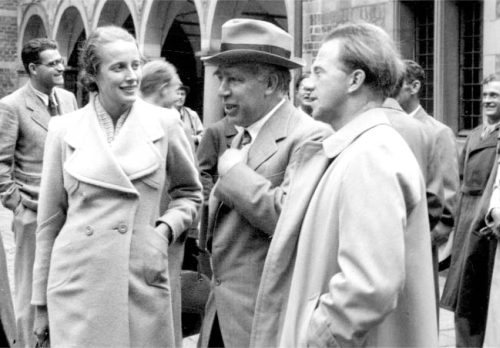
Elisabeth Heisenberg, Niels Bohr, and Werner Heisenberg at a conference in Copenhagen in 1937.
Heisenberg gently chided Jungk for portraying him as a “resister” after Brighter than a Thousand Suns appeared in 1956, but did not dispute the dubious claim that he had deliberately withheld atomic weaponry from Hitler. Jungk soon got wind from other sources, however, that the story was questionable, and recanted.
Bohr's version
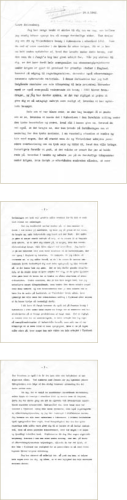
“… Naturally, we understand that it may be difficult for you to keep track of how you thought and expressed yourselves at the various stages of the war, the course of which changed as time passed so that the conviction of German victory gradually had to weaken and finally end with the certainty of defeat.
“However, what I am thinking of in particular is the conversation we had in my office at the Institute, during which, because of the subject you raised, I carefully fixed in my mind every word that was uttered. It had to make a very strong impression on me that at the very outset you stated that you felt certain that the war, if it lasted sufficiently long, would be decided with atomic weapons. I had at that time no knowledge at all of the preparations that were under way in England and America. You added, when I perhaps looked doubtful, that I had to understand that in recent years you had occupied yourself almost exclusively with this question and did not doubt that it could be done. It is therefore quite incomprehensible to me that you should think that you hinted to me that the German physicists would do all they could to prevent such an application of atomic science. During the conversation, which was only very brief, I was naturally very cautious but nevertheless thought a lot about its content, and my alarm was not lessened by hearing from the others at the Institute that Weizsäcker had stated how fortunate it would be for the position of science in Germany after the victory that you could help so significantly towards this end. In your letter to Jungk you also mention Jensen's visits to Copenhagen in 1943 during his journeys to Norway to participate in the efforts to increase the production of heavy water. It is true that Jensen emphasized to us that this work was only aimed at the production of energy for industrial purposes, but although we were inclined to trust his sincerity, we felt in no way certain regarding how much he himself knew about the whole effort in Germany….”
Nobody much blamed Jungk for his gullibility. At a time when global concern about nuclear weapons was sharply mounting, it was easy for a journalist of pacifist and leftist sympathies to fall prey to the ironic view that German scientists had taken the high moral ground while their friends from England, France, Canada, and the United States busily built the weapons of mass destruction that destroyed Hiroshima and Nagasaki.
More strangely, in the early 1990s, journalist Thomas Powers resuscitated the Farm Hall Lesart and gave it a couple of extra twists for good measure in his book Heisenberg's War. Not content to repeat the claim that Heisenberg, von Weizsäcker, and others had not really wanted to build a bomb for Hitler, and therefore never quite figured out how to do so, Powers argued that Heisenberg basically knew all along exactly how to build the bomb, deliberately withheld and obscured that knowledge from the Nazis, and–at Copenhagen–was actually on a dangerous counter-intelligence mission to let Bohr in on what the Nazis were up to.
Powers's treatment of Heisenberg got the attention of Michael Frayn, a brilliant and brilliantly successful British playwright, who popularized the meeting in his 1998 play Copenhagen. Although Frayn specifically disassociated himself from Powers's most extreme claims in a postscript to the published play, the staged version–a surprise hit, first in London and then in New York–left untutored audience members with the impression that Heisenberg was a pretty fine fellow and Bohr rather embarrassingly dense.
I appreciate the way Frayn conveyed the spirit if not the literal truth of the Copenhagen meeting, and I can even join him in applauding Powers's book for “the generosity of its tone” and “the wide sweep of its canvas.” But in the end, I must side with historians Paul Rose, Mark Walker, and David Cassidy, and insist on the following points 4 :
• Heisenberg did not know how to build a bomb, so could not have withheld that knowledge.
• He did not want Germany to lose the war, and there is no evidence whatsoever that he pretended to support the war effort while secretly trying to undermine it.
• If he went to Copenhagen with the notion of proposing a mutual non-aggression pact between physicists, there is no evidence that he or any other wartime visitors to Bohr ever made such a proposal.
• Although memories fade and Heisenberg and von Weizsäcker surely talked themselves into believing that what they said after the war about Copenhagen was really true, just about everything either one of them ever said on the subject–right down to von Weizsäckers latest comments upon release of the draft Bohr letters–has been flatly untrue.
Several years ago, at a symposium held in conjunction with performances of Copenhagen in New York City, Harvard historian emeritus Gerald Holton let slip that there was an unsent and unpublished letter in the Bohr archive in which Bohr sharply took issue with Heisenberg about the famous visit. At the beginning of February, under increasing pressure from historians, the archive released several versions of the letter, which are best reviewed in all their subtlety and complexity at the archive's Web site (www.nbi.dk/NBA/papers/introduction.htm).
The letters prompted an avalanche of commentary in Germany, the United States, and Britain. Regrettably, there are still plenty of voices saying the letters are not really inconsistent with Heisenberg's account, they ultimately prove nothing, the debate about Copenhagen will go on forever, and so on.
I must agree with the historians: with Rose that Bohr's draft letters are convincing; and with Walker and Cassidy that Heisenberg's post-war claims are not corroborated by anything else we know about him. But the best thing, as Holton himself has recommended, is for readers to judge for themselves by closely comparing at least one of Bohr's draft letters with Heisenberg's accounts.
Without belaboring points that readers will recognize on their own, let me just briefly mention several aspects of the letters that seem especially noteworthy.
The German version
Before the visit, Carl Friedrich von Weizsäcker had said, “It would be good, if you could somehow talk with Niels in Copenhagen about everything. It would mean a great deal to me, if Niels for example came to the view that we are doing it wrong [dass wir es hier falsch machen], that we had better give up this work on uranium.”
–Heisenberg's memoir, Der Teil und das Ganze (1973)
Having learned that it would be possible to build a bomb from decay products of uranium 239 produced in nuclear reactors, albeit very large ones operating for a long time, it was decided to pay Bohr a visit, Heisenberg told Robert Jungk:
“Being aware that Bohr was under the surveillance of the German political authorities and that his assertions about me would probably be reported to Germany, I tried to conduct this talk in such a way as to preclude putting my life into immediate danger. This talk probably started with my question as to whether or not it was right for physicists to devote themselves in wartime to the uranium problem–as there was the possibility that progress in this sphere could lead to grave consequences in the technique of war. Bohr understood the meaning of this question immediately, as I realized from his slightly frightened reaction. He replied as far as I can remember with a counter question: ‘Do you really think that uranium fission could be utilized for the construction of weapons?’ I may have replied: ‘I know that this is in principle possible, but it would require a terrific technical effort, which, one can only hope, cannot be realized in this war.’ Bohr was shocked by my reply, obviously assuming that I had intended to convey to him that Germany had made great progress in the direction of manufacturing atomic weapons.”
–in a letter to Jungk, quoted in the English edition of Brighter than a Thousand Suns
“Jungk argued that the German physicists would have decided … not to build the bomb…. However, that is absolutely false, it was Jungk's own idea. I have never claimed that we would have decided to hinder the construction of the bomb…. Rather, I have always said we were happy when we realized that we could not do it.
“The true goal of the visit by Heisenberg with Bohr was … to discuss with Bohr whether physicists all over the world might not be able to join together in order that the bomb not be built.”
–quoted in Nazi Science, by Mark Walker
First, what Bohr found most repugnant were statements by Heisenberg and von Weizsäcker expressing confidence in an imminent German victory, without any expression of regret.
Second, Bohr and his colleagues felt bullied by Heisenberg's and von Weizsäcker's entreaties to Danish colleagues to cooperate with German science–and this impression was aggravated by the confidence they expressed in German atomic weapons work and Heisenberg's statement that nuclear arms would ultimately decide the war, if it went on long enough.
Third, Bohr and his colleagues were acutely suspicious that the two Germans were really on an intelligence mission–by no means an unreasonable concern, even in hindsight.
And finally, there is the unmistakable sharpness of tone throughout. Consider not only the letter reproduced here, but a draft birthday congratulation Bohr almost sent Heisenberg, in which he implicitly takes Heisenberg to task for leading a bomb project: “Margrethe and I send you many heartfelt congratulations on the occasion of your birthday, when you can look back on such a rich life's work in the service of the physical sciences. In particular, I think of all you achieved in the years when it was our great pleasure to have you as a colleague at the Institute in Copenhagen…. That does not mean that I have forgotten everything that has happened since, in which you have always played such a leading role.”
Though Bohr was considered a good man by everybody who knew him, he was capable of wielding not just an iron fist in a velvet glove, but a stiletto.
The release of Bohr's draft letters prompted reams of commentary in the German press, much of it wishy-washy and mealy-mouthed, but some quite pointed. Heisenberg and von Weizsäcker still are seen, justly, as heroes of German science, which makes it hard for Germans to accept their flaws. What may be less well known, at least on this side of the Atlantic, is that they also are revered on the German left as leading lights of the post-war anti-nuclear weapons movement. In 1957, when the United States was preparing to place tactical nuclear weapons on German soil and members of the Adenauer government openly flirted with the acquisition of nuclear weapons, even as the Social Democratic Party was still wedded to neutrality as the most likely path to reunification, 18 scientists issued a manifesto in which they opposed deployment of tactical nukes, deplored any effort to make Germany a nuclear weapon state, and promised not to work on nuclear weapons development in any way. The principal author of the Göttingen Appeal, the founding document of the German peace movement, was von Weizsäcker, and his most distinguished co-signatory was Heisenberg. 5
Bohr, Bernstein, and the diagram
Thomas Powers argued in his 1993 book Heisenberg's War that Heisenberg was actively trying to subvert the Nazi atomic bomb effort, to the point of bordering on treasonable conduct. A key piece of evidence that he trotted out in support of that argument was the claim that while at Copenhagen Heisenberg had given Bohr a diagram of a reactor being developed by his team. Bohr, said Powers, mistook the diagram for an actual atomic explosive and took it to Los Alamos, where he showed it to Hans Bethe, leader of the Manhattan Project's theoretical division, and other top scientists.
But Bohr's son Aage always categorically denied the existence of such a diagram, and no version of it has been found in the Manhattan Project archives or anywhere else.
The first to draw attention to all the issues connected with the diagram was Jeremy Bernstein, who thoroughly analyzed them in Scientific American in a May 1995 article. Now Bernstein has drafted a follow-up paper, which he is hoping to see published in a book of essays, in which he argues convincingly the diagram had another source.
In essence, it is clear from Los Alamos reports that the diagram Bohr took to Los Alamos (or reconstructed from memory there) described a reactor in which horizontal layers of metallic uranium were immersed in a cylinder of heavy water.
At the time Heisenberg visited Copenhagen, he was not working on such a reactor, which was being developed by a different German team. So it is implausible that Heisenberg would have told Bohr this was the reactor they were developing, even apart from the fact both agreed they never got to talking about the German work at this level of detail.
By mid-1943, however, Heisenberg had in fact started to work on such a reactor, and at just this time another member of the German effort, Peter Jensen, visited Bohr in Copenhagen. Jensen had been working in Hamburg with Paul Harteck–one of the most capable members of Germany's group–on just the design described in the diagram. This was the second visit Jensen paid to Bohr, both with Heisenberg's encouragement, apparently to try to calm the waters stirred up by Heisenberg's September 1941 visit.
As with Heisenberg's visit, the effect of Jensen's second visit was the opposite of what was hoped. Bohr, in the meantime, according to secret correspondence he was conducting with the great British physicist James Chadwick, had convinced himself that an atomic bomb could not be built soon enough to be used in the war. What Jensen now told him, instead of putting him at ease, convinced him that things were getting really serious after all.
Bohr told Chadwick he had changed his mind about the feasibility of the bomb. Soon he was spirited out of Denmark, whereupon he debriefed British intelligence officials in London, and then took a long train ride with Gen. Leslie R. Groves across the United States to Los Alamos. On that ride, Bernstein surmises, Bohr showed Groves the diagram or something very much like it, and by the time they had reached the New Mexico mesa, Groves too was convinced that things were even more serious than they had imagined.
Thus, the two scientists can be said to have made honest men of themselves. What began at Farm Hall as a thin and repugnant effort at rationalization–“History will record that the Americans and the English made a bomb, and that at the same time the Germans under the Hitler regime produced a workable nuclear reactor…. The peaceful development of the nuclear reactor was made in Germany under the Hitler regime, whereas the Americans and English developed this ghastly weapon of war”–had transmuted into a sincere commitment to oppose the nuclear arms race.
So is it any wonder that Germans of pacifist persuasion find it hard to see their founding fathers appearing in a harsh light? German conservatives were quick to seize on just this sore point. Writing in the business-oriented Die Welt on February 9, commentator Alan Posener observed, “Heisenberg himself postulated after the war a moral inexactness: Everybody made themselves guilty, on all sides, by acting or not acting. From here leads a straight line to the ‘equivalence’ of the German anti-atomic-death and peace movements, in whose births Heisenberg and … von Weizsäcker were significantly involved.”
But one may recognize Heisenberg and von Weizsäcker as visionary anti-nuclear weapon activists, as well as fine physicists, without also condoning their work on nuclear weapons during the Nazi years and their whitewashing of that activity afterwards.
Heisenberg is dead, but von “Weizsäcker, at 89, continues to misrepresent those years. Upon release of the Bohr letters, he immediately gave an interview to the German Press Agency, the DPA, in which he claimed Bohr had it all wrong, and that yes, while he and Heisenberg had done exploratory work on the bomb earlier in the war, by the time of the Copenhagen visit they had recognized it would be impossible to make a bomb by war's end.
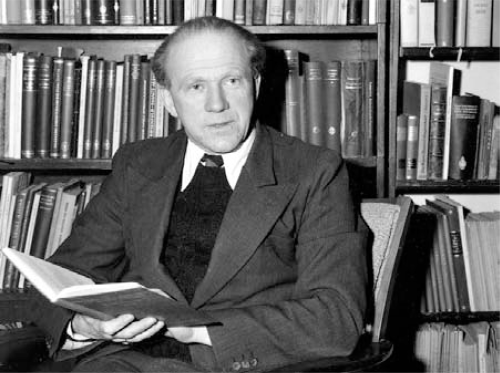
Heisenberg at home in Göttingen, Germany, in February 1947.
In point of fact, as Cassidy has explained, at the time of the visit, von “Weizsäcker and Fritz Houtermans had just conclusively shown that a reactor could be used to produce plutonium, which in turn could be used to make an atomic bomb, bypassing the much harder problem of separating uranium 235 from 238 to obtain the requisite fissionable material. 6 (Heisenberg would later hail that work as having demonstrated an “open road” to the bomb.) In February 1942, five months after the Copenhagen visit, Heisenberg spelled out the plutonium route, just that open road, in a speech given to German science leaders. 7
Yet the insidious and alluring rationalization so brilliantly formulated at Farm Hall by von Weizsäcker–the one quoted above–continues to do its work. In an otherwise well-balanced and modest appraisal of how the Bohr letters affected his thinking about Copenhagen, Frayn made the following statement in defense of the way he portrayed Heisenberg in his play:
“Bohr will continue to inspire respect and love, in spite of his involvement in the building of the Hiroshima and Nagasaki bombs, and [Heisenberg] will continue to be regarded with distrust in spite of his failure to kill anybody.” 8
The problem with this statement is a simple one: Bohr continues to inspire respect and love, not despite his involvement in the Manhattan Project, but exactly to the contrary, because of his clear-sighted and unequivocal grasp of what was a stake in World War II. Once he was convinced a German atomic bomb project was under way and might actually make a decisive difference, he made his way to England and then to the United States, told intelligence officials everything he thought he knew about the German project, and proceeded to involve himself directly in the work of seeing to it that Hitler would not be the first to have the bomb.
“What Frayn somehow has lost sight of is the elemental fact that the Manhattan Project bomb was conceived and largely built by refugees from fascist Europe, who were motivated entirely by a zeal to preempt a Nazi bomb. What happened when they began to realize the bomb would be of no use against Hitler, and might be used differently, is another story–and one much more important and interesting, I may say, than the fables told in Powers's Heisenberg's War and Frayn's Copenhagen.
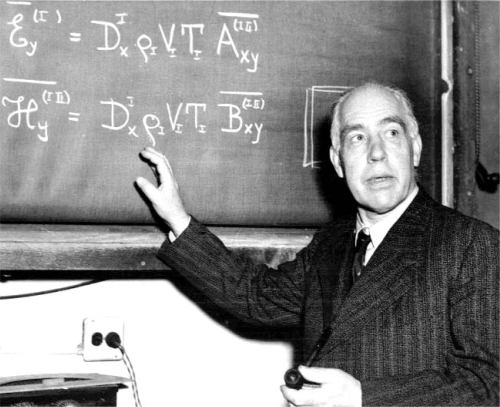
Niels Bohr at Princeton in 1950.
Upon arriving in Los Alamos in 1943 in the company of the Manhattan Project's overseer, Gen. Leslie R. Groves, one of the first things Bohr did was show project leaders a diagram of what he apparently took to be Heisenberg's concept for an atomic bomb, but which was soon diagnosed as a diagram of a reactor. It was not clear at the time that the diagram actually came from Heisenberg, and on the face of it, one wonders how Heisenberg could possibly have given Bohr such a sketch while meeting in Copenhagen under the suspicious eyes of the Gestapo. Bernstein, who was the first to catch on to the issue of the diagram, which in turn became a prime piece of (pseu-do) evidence in Powers's hands, has now shown that the diagram almost certainly came from a different source [see “Bohr, Bernstein, and the Diagram,” page 24].
At Los Alamos, Bohr offered strategic guidance to Robert Oppen-heimer and became directly involved in the technical work. He served with Hans Bethe, Robert Christy, and Enrico Fermi on a committee overseeing the design of the initiator for the implosion bomb, working in parallel with the so-called Cowpunchers Committee, formed to “ride herd” on the whole implosion program, the lab's top priority. He went by the whimsical code name Uncle Nick. 9
Bohr's main concern, once he was spirited out of Denmark, however, was to interest Franklin Roosevelt and Winston Churchill in the problem of post-war control of nuclear energy, which he thought required establishing some basis of trust with the Soviet Union. Thus, Bohr advocated not using the atomic bomb without notifying Stalin, anticipating the logic of the Franck report prepared by dissenting project scientists toward the end of the war. Unbeknownst to Bohr, Roosevelt and Churchill had already secretly agreed to maintain a joint monopoly on the bomb, and neither had any interest in seriously entertaining alternative notions, especially from wooly-headed scientists.
Working through the good offices of Felix Frankfurter, Bohr met first with Roosevelt, and then, with the help of Lord Cherwell in England, with Churchill. Both meetings were completely unsuccessful, and the one with Churchill, in particular, was a disaster. Bohr was well known to be a difficult interlocutor anyway–a feature Frayn captures nicely in his play–and Churchill had no patience with him. He gave him barely any opening to talk, and when, at the end of the meeting, Bohr asked if he could communicate his thoughts in writing, Churchill warned him to make sure they were about physics, not politics.
Churchill complained afterwards to Cherwell: “I did not like the man when you showed him to me, with his hair all over his head, at Downing Street. How did he come into this business? He is a great advocate of publicity. … It seems to me Bohr ought to be confined or at any rate made to see that he is very near the edge of mortal crimes.” 10
Thus, Bohr's efforts at high-level political intervention set what would soon be a pattern in the dawning nuclear age. Two years later, when Op-penheimer burst into President Truman's office exclaiming that he had blood on his hands, Truman suggested he wash them, and then told a subordinate he never wanted to see Oppenheimer again. In the late 1950s, when Andrei Sakharov sought to advance the cause of a nuclear test ban, he got a public dressing down from Khrushchev, who told him in effect that he would not be a dog-catcher, let alone Soviet premier, if he listened to the likes of him.” 11
Of the literal truth of what transpired at Copenhagen, I believe there is no real doubt. Whatever Heisenberg's ultimate intentions may have been, what he managed to convey was only that the Germans had an atomic bomb project, and they knew what they were doing. Nuclear weaponry might decide the war; and under the circumstances, the Danes had better go along.
After Copenhagen, Bohr–knowing the Germans were up to something, and that it might be serious–threw himself seriously into the work of the Manhattan Project. He did not make any effort to stop the project–and, in fact, he seems to have been curiously indifferent to the question of whether or how the Manhattan Project bomb might be used in the war. But what he also launched was an energetic effort to broker an international political agreement to establish a system of nuclear control, setting the stage for work scientist-activists like Heisenberg and von Weizsäcker would try to carry on after the war.
Heisenberg, for his part, having failed to obtain any reassurances from Bohr, let alone the “absolution” Bohr suspected he wanted, went back to Germany and continued with atomic research. He made no special effort to promote the idea of a Nazi nuclear weapon, and, as he revealed at Farm Hall, never bothered to calculate the critical mass needed for an atomic bomb or even to figure out how the calculation would be done correctly. When German military authorities decided during the winter after the Copenhagen meeting to continue the German nuclear program strictly as a research project, not as a weaponization effort, he may well have been relieved, as he later claimed. There is no evidence, however, of his formally recommending to higher authorities in the crucial 1941-42 period that they not proceed with a crash weaponization program.
Had the decision gone the other way in 1941-42–had the Nazis launched an all-out bomb development program–there is absolutely no reason to think Heisenberg would not have dutifully contributed. Then, had the war gone on long enough and the Manhattan Project failed, a German atomic bomb might indeed have been the deciding factor in the war, just as Heisenberg told Bohr it would be at Copenhagen.
Footnotes
1.
Bernstein's commentary on the Bohr material appeared in the Süddeutsche Zeitung (Munich) on February 15, 2002, along with short commentaries by Mark Walker, Gerald Holton, Paul Lawrence Rose, and Thomas Powers.
2.
Richard von Weizsäckers speech started with a learned disquisition of the meaning of the number 40 in the (Jewish) Old Testament and proceeded to a discourse on why it was imperative, more than ever, for Germans to remember and face what their country did under the Nazi regime. Amazingly, this erudite, subtle, and challenging talk became a runaway success among German youth, sold millions of copies on audiocassettes, and came to be known simply as “die Rede”–the speech.
3.
The letters to Paul Rosbaud in which von Laue referred to the Farm Hall Lesart are reproduced as Appendix 2 in Hitler's Uranium Club: The Secret Recordings at Farm Hall, edited by Jeremy Bernstein with an introduction by David Cassidy, rev. ed. (New York: Copernicus Press, 2001).
4.
“‘Copenhagen’ Revisited,” New York Review of Books, March 28, 2002, p. 22; David Cassidy, Uncertainty: The Life and Science of Werner Heisenberg (New York: Freeman, 1992); Paul Rose, Heisenberg and the Nazi Atomic Bomb Project, 1939-1945: A Study in German Culture (Berkeley: University of California Press, 1998); and Mark Walker, German National Socialism and the Quest for Nuclear Power, 1939-1949 (Oxford: Oxford University Press, 1989).
5.
See Lawrence S. Winner, Resisting the Bomb: A History of the World Nuclear Disarmament Movement, 1954-1970 (Stanford: Stanford University Press, 1997), pp. 62,104.
6.
Cassidy, Heisenberg, pp. 434-36. See also David Cassidy, “Historical Perspective on Copenhagen,” Physics Today, July 2000.
7.
My translation of Heisenberg's speech is Appendix 1 in Uranium Club, pp. 373-84.
8.
Ibid., p. 23. In an interview with the New York Times published on February 9, Frayn went further: “Heisenberg didn't, in fact, kill anyone,” but Bohr “did actually contribute to the death of many people.” Both Holton and Jonathan Logan zeroed in on just this point in their responses to Frayn, which were published in the New York Review of Books on April 11.
9.
Lillian Hoddeson et al., Critical Assembly: A Technical History of Los Alamos during the Oppenheimer Years, 1943-1945, (Cambridge: Cambridge University Press, 1993), p. 248.
10.
Quoted in Martin J. Sherwin, A World Destroyed: The Atomic Bomb and the Grand Alliance (New York: Knopf, 1975), p. 110.
11.
See Herbert F. York, “Sakharov and the Nuclear Test Ban,” Bulletin of the Atomic Scientists, November 1981, pp. 35-36.