



Abstract

August 18, 1943: Canada's Prime Minister Mackenzie King (left) and Governor General Earl of Athlone (right) pose with Franklin D. Roosevelt and Winston Churchill at the Quebec Conference in Quebec, Canada.

Despite grumbling, Canada seems likely to go along with U.S. missile defense plans, just as it is currently cooperating with the United States by testing the use of a small amount of U.S. nuclear weapons plutonium in a government-owned power reactor. In both cases, Canada will continue its long tradition of nuclear cooperation with the United States–even as it strides the international stage as a leading proponent of nuclear disarmament.
Canada, after all, was on the ground floor in the development of the first atomic bomb, even though it was decidedly a junior partner to the British and the Americans. There were two important reasons for Canada's inclusion in the atomic project.
First, Canada could supply uranium. At the time, there were only two known sources of uranium outside Nazi-controlled continental Europe–one in the Belgian Congo, the other on the shores of Great Bear Lake in the Northwest Territories. In addition, the only uranium refinery in North America was in Port Hope, Ontario.
The second reason was location–Canada was far from the fighting in Europe and Asia, which allowed scientists to work in peace away from Nazi bombing raids.
In August 1942, a research laboratory was established at the Université de Montréal, where Canadian scientists were joined by a team of British scientists who had been working on the secrets of the atom at the Cavendish Laboratory at Cambridge University. The Americans had labs at the University of California, Berkeley; at the University of Chicago; and at Columbia University in New York. A core of European scientists who had fled the Nazis assisted all three teams. The Montreal lab conducted research into the measurements and theoretical analyses of the nuclear properties of heavy water, uranium, and graphite. In addition, there were frequent scientific exchanges between all of the allied scientists.
In August 1943, Canadian Prime Minister Mackenzie King hosted Prime Minister Winston Churchill and U.S. President Franklin D. Roosevelt at the Quebec Conference, which formalized Anglo-Canadian-American nuclear cooperation. The conference also established a Combined Policy Committee made up of three Americans, two Britons, and Canada's “Minister of Everything,” C. D. Howe, to supervise nuclear cooperation. On April 13, 1944, the committee decided that a heavy-water reactor, which could produce plutonium for atomic bombs, should be built in Canada.
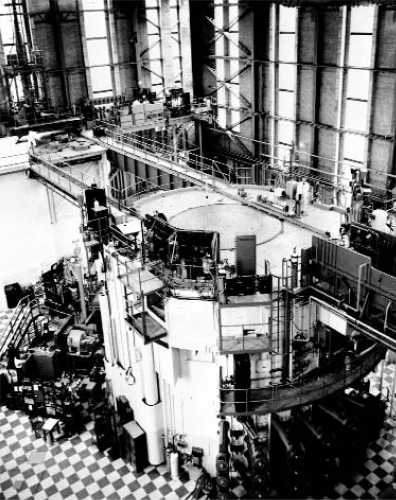
A pilot-scale research reactor, the Zero Energy Experimental Pile (ZEEP), was designed in 1944-45. It became operational in 1945. ZEEP was built at Chalk River Laboratories, about 200 kilometers northwest of Ottawa on the Ottawa River, on the Ontario-Quebec border. When ZEEP went critical on September 5, 1945, it was the first reactor outside the United States to do so.
A full-scale heavy-water research reactor, the Nuclear Research Experimental (NRX), was built in 1947. At the time, it was widely considered to be the most powerful research reactor in the world, and it would continue to serve the needs of nuclear scientists and engineers for the next four decades.
At the end of World War II, Canada had not only vast uranium reserves, but also the industrial and technical basis to fully exploit the atom.
Despite its experience and expertise with nuclear technology, however, there was a tacit consensus–with almost no public discussion or opposition–that Canada would not build or acquire nuclear weapons. The earliest, and most famous, public renunciation was delivered by Howe during Question Period in the House of Commons on December 5, 1945: “We have not manufactured atomic bombs; we have no intention of manufacturing atomic bombs.”
But why didn't Canada develop atomic weapons in the years immediately following World War II? On the other hand, if Canada decided to forswear nuclear weapons, why did it allow the United States to deploy nuclear weapons on its bases in the Canadian Arctic and Newfoundland? Why did Canada eventually decide to equip its forces with U.S. nuclear weapons, only to later remove them? Finally, why has Canada actively promoted nuclear nonproliferation on the international stage, yet remained a member of NATO, an international organization that retains the right to use nuclear weapons?
Purified uranium concentrate, in aqueous solution, was called “O.K. Liquor” at the Eldorado Uranium Refinery in Blind River, Ontario. Right: At Port Hope, Ontario, the liquid concentrate was converted into gas.

The recent declassification of many crucial defense documents from the 1940s, 1950s, and 1960s has made possible a more thorough examination of Canada's historical policy toward nuclear weapons.
One of the recent books to emerge, Canada's Early Nuclear Policy by Brian Buckley, is an attempt to explain why, during the formative years 1945 to 1955, “Canada evidently choose to forgo its own independent nuclear arsenal.” 1
Buckley argues that Canada not only decided not to “go nuclear” in the late 1940s and early 1950s, it never considered the option. There is, he writes, “no direct or indirect evidence that the military case for the acquisition of an independent atomic arsenal was ever seriously debated, publicly or privately, in any of the major policy-making mechanisms of government.” 2
The conventional explanation, as expressed by Canadian-born U.N. official and disarmament advocate William Epstein, is that Canada's policy “reflected nationwide abhorrence of these weapons, the desire to prevent their proliferation, and to see them entirely eliminated, and the hope to benefit from the promising peaceful uses of nuclear energy.”
This may be the commonly held view after decades of building an anti-nuclear myth, says Buckley, but it does not answer the question of why Canada ignored the bomb at the start.
Buckley argues that countries pursue nuclear weapons to address a perceived security threat or as a matter of national prestige, and neither of these prerequisites was relevant to Canada. Canada felt relatively secure. Its government knew that any threat to Canada–and the most likely at the time seemed to be a world war involving the Soviet Union–would automatically affect the United States. And since the Americans had nuclear weapons, there was little need for Canada to possess an independent capability. As to perceptions of prestige, in 1945 Canada had only just shaken off its self-image as a small, quasi-colony with a population of 13 million.
A comparison of Canada with Britain illustrates the point. As renowned Canadian foreign policy commentator John Holmes has written: “It was taken for granted that a country of Britain's assumed stature in the world would have [the bomb]. The Canadian situation was the reverse. At no time was serious consideration given to producing Canada's own bomb…. There is no evidence of Canadian anxiety to have a finger on the control of such a weapon. Canadians were beginning to refer to themselves as a middle power, but few had ambitions for the responsibilities of great-power status.” With no pressing need to acquire nuclear weapons, there was little desire to pay the substantial financial costs of building nuclear weapons.
Although it is true that Canada neither designed, nor even desired, an indigenous nuclear weapons capability, Canada did debate, and then acquire, U.S. nuclear weapons.
John Clearwater, a former civilian analyst with the Department of National Defence, is the author of two books on the presence of American nuclear weapons in Canada. In Canadian Nuclear Weapons, he details the period from 1963 to 1984, when Canadian weapon systems were equipped with U.S. nuclear warheads. During this period, Canadian bases at home and in West Germany possessed a nuclear capability. Canada deployed four nuclear weapons systems–the Bomarc surface-to-air missile, the CF-104 Starfighter nuclear bomber, the Honest John short-range battlefield rocket, and the Genie air-to-air unguided rocket. Clearwater estimates that “at the height of the Canadian nuclear deployments, the greatest number of weapons which could have been available to Canada would have been between 250 (low estimate) and 450 (high estimate).” 3
Although Clearwater's study highlights the dates when weapons systems became operational and when they were removed, his book offers little political analysis. Its strength is in the primary source material it reprints from Cabinet and Defence Department documents. Among these documents is a 1964 letter from the U.S. State Department, “Authorization for the Operational Use of Nuclear Weapons.”
Clearwater's second book, U.S. Nuclear Weapons in Canada, describes the nuclear weapons that the United States stored at its bases in Newfoundland and the Canadian arctic from 1950 until 1971: “The first known presence of nuclear weapons in Canada came in September 1950, when the [U.S. Air Force] stationed eleven Mk4 ‘Fat Man’-style atomic bombs at Goose Bay, Newfoundland.” 4
Key Lake Mine's Gaertner pit, a uranium mine in northern Saskatchewan, Canada.

U.S. bombers equipped with nuclear weapons also made overflights of Canadian territory, a practice authorized as early as 1948. A major focus of U.S. Nuclear Weapons in Canada is command and control. Washington was not committed to consulting with Ottawa, let alone obtaining its consent to use nuclear weapons; its only obligation was to inform. This second book also includes reprints of important documents like the 1967 Argentia Agreement and Arrangement concerning “the storage of airborne nuclear anti-submarine weapons in Canada for the use of United States forces” at the American base in Argentia, Newfoundland.
Canada's decision to acquire American nuclear weapons was consistent with the decisions of its NATO allies. In fact, as University of Alberta political scientist Tom Keating has persuasively argued, although “Canada's struggle with American nuclear strategy and nuclear weapons has been viewed in bilateral terms, the country's multilateral security connections have been most influential in shaping the direction of Canadian policy.”
In 1957, NATO decided to adopt tactical nuclear weapons as part of its effort to deter Soviet aggression. An article in the November/December 1999 Bulletin, “Where They Were,” provides significant evidence of “where, when, and under what circumstances the United States deployed nuclear bombs overseas.” During the 1950s and 1960s, it reports, West Germany, Italy, Turkey, Netherlands, Greece, Belgium, and Denmark (in Greenland), all hosted U.S. nuclear weapons. Even Britain and France, which had independent nuclear capabilities, stored U.S. nuclear warheads. At the peak of U.S. overseas nuclear deployments, there were more than 7,000 U.S. nuclear weapons in Europe. Clearwater's research expands on this earlier accounting by systematically detailing where, when, and under what circumstances the United States deployed nuclear bombs in Canada.
Although Clearwater describes the extent of nuclear weapons in Canada, he does not explain why Canada acquired, and then purged, the bomb. That question is examined by Erika Simpson, a political scientist at the University of Western Ontario, who explores Canada's frequently contradictory stance toward NATO's nuclear policy.
Canadian policy-makers held two competing views of nuclear weapons from 1957 to 1989. “Defenders,” as Simpson calls them, emphasized the Soviet threat, feared that Canada would be abandoned by the Americans and its other allies, and believed that the doctrine of nuclear deterrence was suitable and reliable. Prominent defenders included Progressive Conservative cabinet ministers Douglas Harkness and Perrin Beatty; Liberal cabinet ministers Paul Martin Sr., Paul Hellyer, and Mitchell Sharp; and senior bureaucrats in external affairs Leo Cadieux, Ross Campbell, and Alan Gotlieb.
Pierre Trudeau was responsible for ridding Canadian soil of nuclear weapons.

“Critics,” on the other hand, believed the Soviet threat was exaggerated, feared that Canada would be trapped into a war by its allies, and doubted the suitability and reliability of the doctrine of nuclear deterrence. Prominent critics included Liberal cabinet ministers Walter Gordon, Eric Kierans, and Donald Macdonald; and Pierre Trudeau's foreign policy adviser, Ivan Head.
As Simpson says, however, it is a good deal harder to categorize the three major prime ministers of the era–John Diefenbaker, Lester Pearson, and Trudeau–as defenders or critics. 5
During Diefenbaker's first years in office, he was a firm defender. He was the one who initially ordered the Starfighters and the Bomarc missiles, and inquired about the Lacrosse and Honest John missile systems. However, by June 1959, he had begun to shift toward critic–mainly as a result of the issue of joint control of warheads.
By 1963, in the aftermath of the Cuban Missile Crisis and amid rising anti-American sentiment, Diefenbaker had moved firmly into the critic camp. He reversed the decision on the acquisition of nuclear weapons, campaigned in 1963 on a platform opposed to nuclear weapons, and condemned the Pearson government when it signed an agreement with the Americans that led to Canadian forces obtaining the Bomarc, VooDoo/Genie, CF-104, and Honest John weapons systems in 1963. Lester Pearson, says Simpson, “walked a fine line between the roles of defender and critic” throughout his career.
Trudeau was probably the most articulate and fiercest critic of NATO and nuclear weapons, but the demands of being prime minister forced him to compromise on many issues–for instance, he allowed the United States to test cruise missiles over Canadian territory in 1979. In the end, however, Trudeau did oversee a significant downsizing of Canada's military contribution to NATO, was responsible for the eventual withdrawal of all nuclear weapons from Canada, and undertook his famous peace initiative in 1983-84 aimed at initiating a dialogue on nuclear disarmament.
On the domestic front, Canada has aspired to exploit the peaceful benefits of nuclear technology, while refraining from using it for military purposes. In the international realm it has been one of the strongest advocates of the nuclear nonproliferation regime. It was a member of two U.N. commissions in which nuclear negotiations were conducted, helped to negotiate the statute of the International Atomic Energy Agency, was an original signatory to the Nuclear Non-Proliferation Treaty (NPT), and was a charter member of the Nuclear Suppliers Group.
Canada has tried to ensure that its nuclear exports do not contribute to the spread of nuclear weapons. Since India conducted a “peaceful” nuclear explosion in 1974–which was inadvertently assisted by Canadian nuclear cooperation–Canada has maintained stringent safeguards on the export of both uranium and CANDU power reactors. It has demanded that recipients of Canadian nuclear technology either ratify the NPT or accept full-scope nuclear safeguards.
Canada has paid a price. The unilateral strengthening of its nuclear safeguards in 1974-76 was a factor in the loss of CANDU sales to Argentina and Japan. But in its most recent nuclear policy statement in 1999, Ottawa once again reiterated its view that the “preservation and enhancement of the NPT and the nuclear disarmament and nonproliferation regime is integral to Canada's national security and to the human security of future generations of Canadians.”
Some aspects of Canadian policy have been, and remain, at odds with this policy. Canadian uranium exports were initially used to fuel the nuclear weapons programs of both Britain and the United States. Chalk River, which contained the NRX and the Nuclear Research Universal reactors, was designed both to advance Canada's civilian nuclear program and to assist the U.S. military program by producing plutonium for American bombs.
This strategy reflected the contradictory nature of Canada's nuclear policy. Ottawa would keep its own nuclear heart pure by investing only in civilian applications of the atom, but it would also play its role in the Western alliance by assisting and supporting the strategy of nuclear deterrence against the Soviet Union.
There may be some controversy over whether any Canadian uranium fueled the bombs that landed on Hiroshima and Nagasaki, but there is no dispute that Canadian uranium was an integral part of the Manhattan Project. In fact, the major architects of Canada's civilian nuclear program, Wilfrid Bennett Lewis and C. J. Mackenzie, believed that Canada's development of nuclear power could be financed, in part, by the sale of plutonium (at about $5,000 an ounce) to the United States. By 1959, Canada's annual uranium ore exports had reached more than 15,000 metric tons and were worth more than $300 million. Historian Ron Finch, in his 1986 book Exporting Danger, estimated that Canada provided the Americans and the British with enough uranium for 15,000 nuclear bombs. It was not until 1965 that Ottawa adopted the policy that uranium could be exported for peaceful purposes only.
Second, the Chalk River facility, beyond supplying plutonium, contributed in other ways to the American and British nuclear weapons programs. Throughout the 1940s and early 1950s, the Canadian program did not totally abandon its military origins. To prove the point, Buckley quotes Howe's many references in the House of Commons to the military role of Canada's civilian nuclear program. In 1953, Howe remarked that “we in Canada are not engaged in military development, but the work that we are doing at Chalk River is of importance to military devel-opments.” 6 A year later, Howe explained that “while the reactor was primarily a research tool, much of the information obtained in its design and operation has been of great value to the military program.” 7
As O. M. Solandt, a senior civilian analyst in the Department of National Defence, said during the Korean War: “There is no question that other friendly countries have always regarded the Chalk River Project as a major Canadian contribution to defense.” 8
In 1955, the United States amended its Atomic Energy Act, formaliziing scientific collaboration on atomic energy for civilian purposes in Canada, and for both peaceful and defense purposes in the United States.
It is impossible to separate pure research into the properties and potential of the atom into peaceful and defense purposes, and civilian and military uses of that research cannot be divorced. For example, in the early 1950s, the U.S. Navy used Canadian technology to design a small reactor for powering its nuclear submarines. A final bit of evidence of Chalk River's military role was the fact that the United States continued to station a military liaison officer there into the 1950s.
Third, as Clearwater systematically details, both Canadian and American forces on bases in Canadian territory were equipped with nuclear weapons. Solandt made the case for the Canadian use of American nuclear weapons in the early 1950s, arguing that “it becomes increasingly obvious that should there be another total war it will be predominantly atomic. It will not be so many years before no first-class armed force, no matter how small, will be able to engage in battle unless it has atomic weapons…. We must begin now to lay a foundation of knowledge that will ultimately enable the Canadian Forces to use atomic weapons.” 9
1955: Canada's NRX reactor at the Chalk River Laboratories.
Ten years later, the Pearson government implemented Solandt's recommendations. But the actual result was that American nuclear weapons, under American command and control, could be launched from Canada. In fact, “Canadian deployments were little more than extensions of U.S. military deployments and strategy.” 10
Eventually, Canada did reverse course, and began, in 1968, to remove nuclear weapons systems from its bases. The process of nuclear weapon removal allowed Pierre Trudeau to give his famous “nuclear suffocation” speech to the U.N. General Assembly in 1978. During this speech, Trudeau bragged that Canada was “not only the first country with the capability to produce nuclear weapons that chose not to do so, we are also the first nuclear-armed country to have chosen to divest itself of nuclear weapons.” What Trudeau did not mention in his speech is that it would not be until 1984 that Canada was completely free of nuclear weapons.
Despite removing U.S. nuclear weapons from its forces and its territory, Canada remains firmly under the protection of the American nuclear umbrella. It participates in the nuclear defense of North America not only through membership in NATO, but also in NORAD. And even if Canada were not a member of these alliances, it is likely that Washington would continue to view an attack against its northern neighbor as an attack against the United States. Thus, it can be argued that American nuclear deterrence would extend to include Canadian territory regardless of Ottawa's nuclear policy.
Canadians genuinely believe in nuclear nonproliferation, and Canada was the first country capable of building nuclear weapons that decided not to. It has continued to refrain from developing nuclear weapons and, in a precedent-setting move that Ukraine and Kazakhstan later followed, removed all nuclear weapons from its soil. Canada also implemented a policy of not assisting in any country's production of nuclear weapons through either CANDU or uranium exports.
However, Canada continues to accept the protection of the American nuclear umbrella. There is a certain logic to the Canadian position, but one can also understand why countries like India and Pakistan, who may not live in such a secure environment, view the Canadians as hypocrites for preaching against the development of nuclear weapons while at the same time accepting their protection.
The four recent books cited here examine Canada's contradictory policy towards nuclear weapons as a matter of historical record–but that same contradictory policy continues today. On the nonproliferation front, Canada played a key role in the indefinite extension of the Nuclear Non-Proliferation Treaty in 1995. And when India and Pakistan conducted nuclear tests in May 1998, Canada applied diplomatic and economic sanctions.
But despite the absence of nuclear weapons on Canadian soil, Canada continues to belong to NATO, which refuses to abandon its first-use policy. In 1998, the U.N. General Assembly voted on a resolution to eliminate nuclear weapons that called upon the nuclear weapon states to fulfill their disarmament obligations under the NPT. Although Canada agreed with the resolution in principle, it supported its NATO alliance partners by abstaining on the vote.
Finally, there are strong indications that Canada will, in the end, support the U.S. national missile defense system. Whether it makes a financial contribution or allows the use of its territorial airspace, in doing so Canada will act in support of a defense system that jeopardizes two important planks of the nonproliferation regime: the Anti-Ballistic Missile Treaty and the NPT.
What explains Canada's contradictory policy toward nuclear weapons? Erika Simpson argues that it can be explained in large part by opposing belief systems. For over half a century, there has been an internal battle between Canadian “realists” and “idealists.” Realists recognize that Canada's security is dependent on its relationship with the United States, and that nuclear weapons are a critical plank in American defense doctrine. Idealists believe that arms races are futile, nuclear deterrence theory ineffective, and nuclear accidents a clear possibility.
Canada's policy towards nuclear weapons, then, is not really contradictory. It is entirely rational to be both realist and idealist. Canada will continue to abstain from designing or possessing nuclear weapons, it will promote international nuclear disarmament, and it will take steps to ensure that its uranium and CANDU exports do not contribute to nuclear proliferation. But it will continue to be a member of nuclear-equipped alliances, NORAD and NATO, and it will continue to rely on the American nuclear umbrella for the defense of Canada.
Footnotes
1.
Brian Buckley, Canada's Early Nuclear Policy: Fate, Chance, and Character (Montreal and Kingston: McGill-Queen's, 2000), p. 3.
2.
Ibid., p. 43.
3.
John Clearwater, Canadian Nuclear Weapons: The Untold Story of Canada's Cold War Arsenal (Toronto: Dundurn, 1998), p. 23.
4.
John Clearwater, U.S. Nuclear Weapons in Canada (Toronto: Dundurn, 1999), p. 12.
5.
Erika Simpson, NATO and the Bomb: Canadian Defenders Confront Critics (Montreal and Kingston: McGill-Queen's, 2001), pp. 224-25.
6.
Buckley, Canada's Early Nuclear Policy, p. 109.
7.
Ibid., p. 124.
8.
Ibid., p. 8.
9.
Ibid., p. 113.
10.
Clearwater, Canadian Nuclear Weapons, p. 23.