




Abstract

With control of both the Senate and House up for grabs in the mid-term elections, the two parties will spend the next year maneuvering to gain political advantage.
Traditionally, American elections are decided over domestic issues, and the November 2002 elections will be no exception. Most of the legislative and rhetorical fights will be waged over the state of the economy, taxes, an economic stimulus package, education, Social Security, Medicare and prescription drug benefits–and the Enron scandal.
The political impact of the war on terrorism is unknown. Traditionally, the American public has viewed the Republican Party as the party of military strength–and an early January “battleground” poll conducted by pollsters from both parties found that the public gave the Republican Party a 60 to 15 percent advantage over Democrats when it comes to “safeguarding America from a terrorist threat.” President Bush's quick–and almost U.S.-casualty-free–victory over the Taliban reinforced that image. Meanwhile, Democrats have been sticking to a bipartisan “We-are-joined-at-the-hip-on-the-war” line.
Karl Rove, top political adviser to President George W. Bush, suggested at a January meeting of the Republican National Committee that the party would use the successful prosecution of the war to score political points. But there is no reason to believe that Bush 43 will be any more successful than Bush 41 in turning military conquest into political triumph.
The Republican's muscular image was reinforced by the president's request for a defense budget of about $380 billion, with another $38 billion for homeland security. Most observers were stunned by this $48 billion increase for a Pentagon budget already swelled by new anti-terrorist funding. This news came hand-inhand with the revelation that recent budget surpluses had been transformed into steep deficits by the recession, the 2001 tax cut, and rising military spending.
With deficits looming, proposals for new military spending and tax cuts will lead to months of skirmishing over budget issues. Unfortunately, while Democrats will argue that the United States is returning to fiscally irresponsible Reaganomics, few of them will have the courage to press for military budget cuts. More than ever, they are afraid of being called “weak on defense,” a label they heard often during the Cold War. In April 2001, only 14 of 50 Democrats voted against an amendment offered by Virginia Republican Sen. John Warner to add $8.5 billion to the military budget–and that was five months before the September 11 terrorist attacks.
The debate over national missile defense will be colored by two developments in 2001: the Senate Democrats' decision after September 11 to postpone any fight over missile defense until 2002, and the president's announcement last December that the United States will withdraw from the Anti-Ballistic Missile (ABM) Treaty. Democrats appear to have little appetite to formally challenge the president on this treaty issue; even senior Democrat and noted institutionalist Robert Byrd of West Virginia doubts that Congress has the constitutional standing to block the withdrawal in court.
Instead, missile defense critics are likely to focus on blocking the administration's drive toward deployment before the end of the first Bush term. Democrats are likely to attempt to trim the funding and require realistic testing and oversight. Some may even go so far as to require national missile defense to work before it can be deployed. Yet Congress does not always seem to care about effectiveness when buying new weapons.
Congressional critics of the program will also point out the continuing failures in missile defense. Three separate missile defense programs suffered setbacks toward the end of 2001: The Pentagon canceled the Navy Theater Wide mid-range missile defense system because it was over budget and behind schedule, and Congress trimmed funding for the underper-forming space-based infrared radar system (SBIRS-low) and space-based lasers.
There will also be congressional skirmishes over U.S. nuclear weapons policy. At the time of the BushPutin summit meeting in November 2001, the two presidents promised deep cuts in each country's strategic nuclear weapons. However, the Pentagon's Nuclear Posture Review released in January 2002 left many ambiguities. It was not clear whether the nuclear weapons to be retired would be destroyed or placed in storage, what kind of counting rules and verification would be put in place, what the pace of nuclear reductions would be, and most important, whether a U.S.-Russian accord will be formalized in a written agreement.
January 29, 2002: President Bush delivers his State of the Union address.
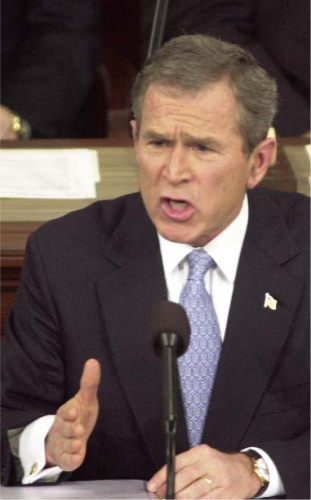
With Senate Democrats chairing the key Armed Services, Foreign Relations, and Appropriations committees, these and other issues will be explored in Senate hearings and subject to possible legislative action. Two dictums should be kept in mind. First, any challenges on national security issues will be made in the Democratic-controlled Senate. The Republicans only narrowly control the House of Representatives, but they can use House rules and assertive party discipline to block significant challenges to Bush policies. Second, members of Congress will do plenty of grousing, but they are unlikely to overturn Bush policies.
Members can be expected to protest the administration's rejection of formal arms control agreements. While calling for multilateral cooperation to combat terrorism, Bush withdrew from the international negotiations to strengthen the Biological Weapons Convention, abandoned the ABM Treaty, and moved toward entombing the Comprehensive Nuclear Test Ban Treaty and resuming nuclear testing. Bush has reiterated that he remains opposed to the test ban treaty, but will continue the moratorium on nuclear testing for the time being. However, the Nuclear Posture Review suggested shortening the time between a decision to resume nuclear testing and an actual test. A few nuclear weapons lab officials were advancing plans for new, small nuclear weapons to dig deep into bunkers. Members will use hearings to criticize and try to influence the direction of administration policies.
One of the few areas where there is agreement is funding for nonprolifer-ation, particularly for programs to help Russia secure its nuclear materials and dismantle its nuclear weapons complex. Funding for these programs is primarily contained in the Pentagon and Energy Department budgets. The Bush administration came into office more than a year ago with a jaundiced attitude toward these programs, launched a review, and proposed a 10 percent cut. It ignored a powerful report by a commission headed by former Tennessee Republican Sen. Howard Baker and Washington lawyer Lloyd Cutler recommending tripling funding.
However, by the end of the legislative process, Congress had added about $250 million to the administration's original request. Moreover, in January the administration concluded its policy review with a positive assessment and proposed substantial increases for certain Energy Department programs. Bipartisan agreement is likely on steps to ensure that U.S. and Russian nuclear weapons and nuclear, chemical, and biological weapons materials are safe, secure, and accounted for.
There could also be broad agreement on what is now called homeland defense–securing the nation's borders, harbors, nuclear power plants, chemical factories, bridges, tunnels, dams, food supplies, computer networks, and other infrastructure from terrorist attack. Because anthrax was sent through the U.S. mail, there will be additional funding for vaccines and antidotes, as well as for bio-hazard fast-reaction teams.
Overall, 2002 does not promise to be full of accomplishments. With an administration hostile to arms control, a timid Congress more focused on domestic issues and reelection, and the ongoing war on terrorism, little progress is expected. It will take new elections for Congress in 2002, and a presidential election in 2004, to bring about any significant change.