




Abstract
Before the September 11 terror attacks in Washington and New York, it seemed unlikely that the United States would undertake a serious re-examination of its role in the conflicts of the twentieth century. But the attacks shattered the country's post-Cold War triumphal attitude, prompting many bewildered Americans to begin questioning the way their country did business with the rest of the world. Unilateralism, a particular hallmark of the Bush administration's foreign policy, no longer seemed a reasonable approach to global affairs.
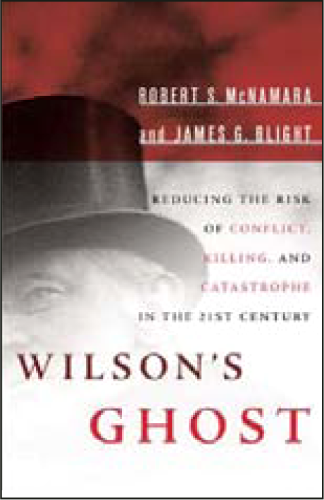
In Wilson's Ghost, Robert McNamara and James Blight offer a timely and much needed critique of uni-lateralism–that particularly “American disease,” as the authors put it. To avoid the carnage of the last century, McNamara, the U.S. defense secretary during the Vietnam War, and Blight, a professor of international relations at Brown University, argue that the direction of international affairs must undergo a fundamental change. The United States and the rest of the world must replace unilateralism, they write, with a “thoroughly multilateral approach to issues of international security.”
The authors highlight Woodrow Wilson's attempt to establish the League of Nations and the opposition of Sen. Henry Cabot Lodge. Like many Americans, Lodge opposed the League because it required its members to subordinate themselves to multilateral obligations. By choosing national sovereignty over multilateralism, the United States undermined the League, which indirectly contributed to the outbreak of World War II. Wilson's failure, write McNamara and Blight, should serve as a sober lesson: “In the absence of a firm commitment to multilateral decision making, preferably institutionalized in credible international and regional organizations, sustainable peace is illusory.”
Multilateralism, say the authors, must also be combined with a concerted effort by U.S. leaders to adopt policies designed to avoid Great Power conflict. According to the authors, the outlook so far this century is not promising. Russia already feels aggrieved by the U.S. failure to deliver economic assistance, betrayed by the U.S. decision to pursue NATO expansion, and threatened by NATO's attack on Yugoslavia. And in Beijing, continued U.S. support of Taiwan is seen by Chinese leaders as a betrayal of the 1972 agreement to ultimately withdraw all U.S. forces and military institutions from that island.
The authors also recommend multilateral intervention to prevent communal violence and ethnic conflict. “The citizens and governments of the West, led by the United States, [should] develop and sustain in the 21st century an imperial zeal for preventing and resolving conflicts, and restoring order, that is akin to the zeal they displayed in previous centuries for economic exploitation.”
Finally, the authors argue that the United States should lead the world toward the elimination of nuclear weapons, citing the argument made by the 1996 Canberra Commission: “The proposition that nuclear weapons can be retained in perpetuity and never be used–accidentally or by decision–defies credibility.”
McNamara and Blight indict the United States and Russia for retaining their nuclear arsenals and continuing to adhere to “deterrence-based thinking.” They also denounce the missile defense system sought by the Bush administration as a prelude to another arms race and thus a “cure … certain to be worse than the disease.”
But while President Ronald Reagan's “Star Wars” program provoked the Soviet Union to develop (and Russia to deploy) the TOPOL-M missile, the Bush administration's pursuit of national missile defense helped divert attention away from non-state terrorism. Nearly three months before the attacks in New York and Washington, Cong. Curt Weldon–a staunch supporter of missile defense–denigrated the threat posed by “weapons of mass destruction brought in by terrorist groups,” arguing that missiles, the rogue states' “weapons of choice,” posed the greatest danger. Unfortunately, McNamara and Blight, like missile defense enthusiasts, pay little attention to the threat of terrorism, addressing it only in the context of a discussion about “loose nukes” in Russia. No doubt, future analyses of U.S. and global security won't make the same mistake.