




Abstract

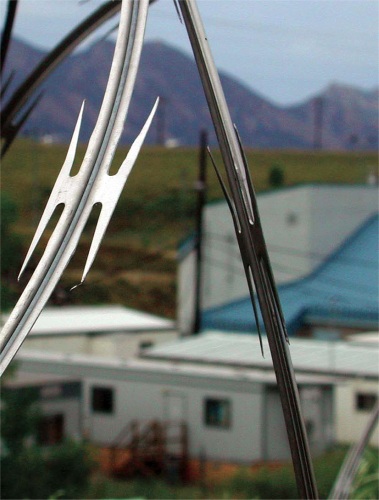
John “J. R.” Marschall was standing at the former Rocky Flats nuclear weapons plant in what would have been dead man's land just a few weeks earlier. Fifty yards away from this flat, barren spot sits one of the massive, win-dowless concrete buildings that for nearly four decades processed plutonium and made the fission bombs used primarily to trigger U.S. hydrogen bombs. Until August, to get here an unauthorized person would have had to scale a high, barbed-wire-topped chain link fence; crawl through rolled razor wire; get past closed-circuit television cameras, seismic monitors, alarms, guard towers; and then still face a second fence.
Now, however, all of the easily retrievable weapons-grade plutonium at Rocky Flats has been consolidated into the newly fortified and fenced-off Building 371, located in a 30-acre corner of the plant's former “protected area”–a portion of the plant always given extra security. And Marschall, deeply tanned and wearing a hard hat and orange and yellow vest, was supervising crews removing fences around the other 150 acres of the former plutonium production area.
“I'll tell you one thing,” Marschall said as a giant backhoe nearby ripped out a concrete pylon previously attached to steel anti-vehicle cables, “it doesn't seem like 20 years have passed.” In 1981 he managed the construction of the $6 million security system–updating the security in place since the plant's establishment in 1951–that he was now tearing down.
The removal of security fences around three of the four major plutonium buildings at Rocky Flats, located 16 miles northwest of Denver, Colorado, is as symbolic as it is real. To old timers who spent their Cold War working lives making nuclear weapons at this mesa site on the edge of the Rocky Mountains, it signifies the end of an era.
To Energy Department officials and executives of Kaiser-Hill, the major plant contractor, it signifies that the past six years of building cleanup–or decontamination and decommissioning in agency jargon–have been successful. “If there were any doubters before, there's no doubt now that this bomb plant is closing,” said Alan Parker, Kaiser-Hill's hands-on president. He noted that Building 771, the former plutonium production building that just seven years ago was labeled “the most dangerous building in America,” is well on its way to being demolished. Parker exuded confidence that his company can make the 2006 deadline for closing the site, pointing out that the pace will speed up now that work crews in most of the plutonium areas will no longer be delayed by security fences, guard posts, or metal detectors.
Changes in the plutonium area have not lessened overall security at the site, according to plant officials. It had remained tight even before the September 11 terrorist attacks on the East Coast. Heavily armed Wacken-hut Corporation guards patrol the 10-square-mile (6,550-acre) site. Anyone driving into the 385-acre “industrial area”–half occupied by the plutonium units and half by support facilities and buildings that processed uranium and non-radioactive bomb parts–must have security badges and pass through guarded checkpoints. Officials have frequently called Building 371, with its several underground stories for plutonium storage, “the strongest building in Colorado.” But after September 11 they declined to discuss scenarios such as the possibility of a large jet loaded with fuel crashing into the plant and dispersing plutonium into the Denver area, which is populated by more than two million people. “That scenario is another good reason to move this stuff,” said Steve Gunderson, who oversees the Rocky Flats cleanup for the Colorado Department of Public Health and Environment.
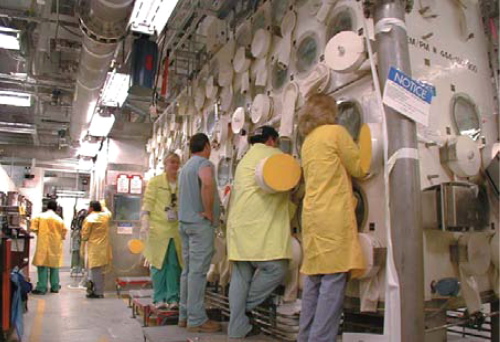
August 22: Workers process plutonium waste in Building 371's gloveboxes. Left: Much of the razor fencing has been removed as Kaiser-Hill continues cleanup at Rocky Flats, scheduled to close in 2006.
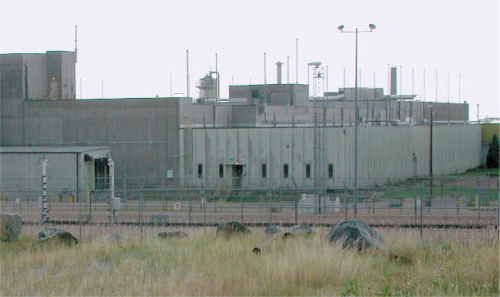
Building 371, newly fortified, is now home to most of Rocky Flat's weapons-grade plutonium.
Security aside, a number of still-unresolved issues will affect the future of Rocky Flats, recently termed “the flagship” of the Energy Department closure program by a department official in Washington. The precise meaning and details of plant “closure” are still elusive, as are plans for long-term stewardship and use of the federally owned land where the site is located. Citizen groups and plant officials continue to argue about the level of plutonium that will be allowed to remain in the soil after cleanup–an issue related to a bipartisan proposal by two Colorado politicians to designate Rocky Flats a wildlife refuge. Other issues include the following:
• Continuing Energy Department concern about safety and procurement violations at the site. Over the past two years the department has fined Kaiser-Hill $795,000–not trivial, but a fraction of the firm's renewed February 2000 cleanup contract worth an estimated $3.9 billion. In one incident last year, 11 workers doing cleanup in Building 771 received unexpected levels of internal plutonium exposure.
• Unknowns about the extent of contamination at the site, particularly beneath the plutonium buildings.
Other challenges include decommissioning 42,000 feet of underground process lines, according to an Energy Department report released earlier this year. The report also noted that the site contains eight groundwater plumes contaminated with, among other things, volatile organic compounds, uranium, and nitrates.
• South Carolina's complaints about plutonium. Gov. Jim Hodges declared last summer that his state, home to Energy's Savannah River plant, will no longer receive shipments of weapons-grade plutonium–many of which are scheduled to come from Building 371–until he is guaranteed that South Carolina will not become a permanent nuclear disposal site.
“Removing the plutonium from 371 is the long pole in the tent,” said Barbara Mazurowski, Energy's Rocky Flats manager and an experienced nuclear waste expert. “If we don't get the plutonium off site, we can't meet the objectives of closure.” She is optimistic that officials in the Energy Department's headquarters, including her Rocky Flats predecessor Jesse Roberson, who is now Energy's assistant secretary for environmental management, will work out the South Carolina problems. At Savannah River the weapons-grade plutonium is to be turned into either mixed-oxide (MOX) reactor fuel and burned, or mixed with other elements and glassi-fied or vitrified–so the plutonium will be almost impossible to retrieve. When the Bush administration's draft Energy Department budget last April didn't include any funding for vitrification, and the administration also backed away from MOX, South Carolina's governor raised a stink that drifted to Colorado.
In September, Colorado's Gov. Bill Owens and Sen. Wayne Allard, both Republicans, and Cong. Mark Udall, a Democrat, sent Energy Secretary Spencer Abraham a letter underlining their concern that delays in plutonium shipments could adversely affect Energy Department plans to close Rocky Flats. Citizen groups are also worried that this site could end up permanently storing plutonium. “It would be incongruous to have a plutonium Fort Knox in the middle of a wildlife refuge,” commented Ken Korkia, coordinator of the Rocky Flats Citizens Advisory Board.
Kaiser-Hill's Parker said the Savannah River dispute won't affect work at Rocky Flats, at least in the near term. Noting that the first shipment is scheduled to take place before November, he added, “I'm not particularly interested about when the first shipment goes, just the last one.” Parker said it will take about 18 months for workers to stabilize the weapons-grade plutonium and package stainless steel containers, the size of large fruit juice cans, for shipment. Using a housing metaphor, he said, “Our job right now is to package up this material and get it into the moving boxes. And then all that has to happen is that the moving van's got to show up and take it.” He won't say how much needs to be packaged and shipped because the Energy Department has reclassified that information.
In 1993, during an era of openness under former Energy Secretary Hazel O'Leary, Energy did reveal that Rocky Flats held 14.2 tons of plutonium. Nearly half of that was plutonium metal in various forms, including the finished “pits” used to detonate hydrogen bombs. The Energy Department has reported that the pits and most scrub alloy have been shipped off site, leaving a secret amount of weapons-grade plutonium metal and oxides in Building 371. Much still requires stabilization and packaging by a system that was more than a year behind schedule when it began operating last summer.
More than 3 tons of the plutonium reported at Rocky Flats in 1993 was in residual, dissolved, or other such forms. (Residues were once considered reusable but are now considered waste.) The site also held 7 tons of highly enriched uranium, 281 tons of depleted uranium, and 65 tons of beryllium along with large amounts of toxic chemicals such as carbon tetrachloride. In addition to all that material and waste, the process of destroying and packaging equipment and more than 700 buildings is generating a mountain of new waste. Kaiser-Hill estimates that by the time Rocky Flats is closed the demolition process will generate 273,500 cubic meters of nuclear waste, enough to fill 1.3 million 55-gallon drums.
By category, that waste will include 15,400 cubic meters of trans-uranic waste; 61,200 cubic meters of low-level, mixed waste; and 196,900 cubic meters of low-level waste. So far, the plant has shipped about 15 percent of the total low-level waste to the Nevada Test Site, 28 percent of the low-level mixed waste to Envi-rocare in Utah or to Oak Ridge, Tennessee, and 8 percent of the trans-uranic waste to the Waste Isolation Pilot Project in New Mexico.
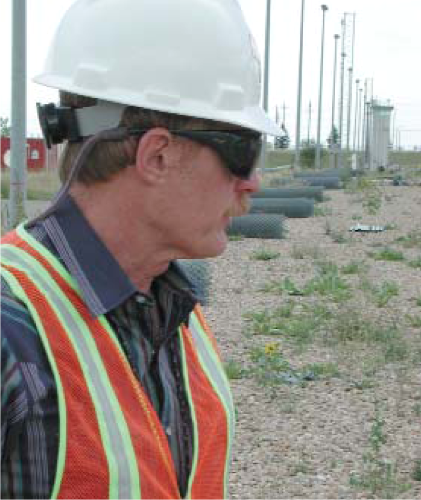
J. R. Marschall supervises the removal of security fences.
July 2001 was the first time that Rocky Flats shipped more waste than it created, said Parker, who was appointed president of Kaiser-Hill last spring after his predecessor Robert Card was named Under Secretary of Energy. Parker, a mining engineer by training who worked on energy projects in the 1980s and at the Idaho National Environmental & Engineering Laboratory in the early 1990s, was no stranger at Rocky Flats when he was given the reins. He first came here as part of the consortium that collaborated with Kaiser-Hill–a partnership of the environmental remediation firms ICF Kaiser International and CH2M Hill–when it won the Energy Department's cleanup contract and took over in July 1995. Parker began working on environmental remediation projects and was stunned at what had, or hadn't, been occurring under previous contractor EG&G Technical Services Inc. “There was a lot of money being spent–hundreds of millions of dollars in planning…. When I came here I was shocked that there was no plan, no strategy to close this site and that's what this site was all about–closure,” Parker recalled. “I can tell you it was the most shocking thing I had ever seen.”
In the absence of any detailed plan, Energy–the nation's bomb builder with a bad environmental reputation–had estimated in 1995 that the plant's cleanup would take 70 years and come with a $36.6 billion price tag. After Kaiser-Hill came in, the company quickly proposed an “accelerated” cleanup that would take just seven years and cost $6 billion. Citizen and environmental groups condemned the company's first proposal as “dirty closure” because it called for many contaminated buildings to simply be razed and buried. Kaiser-Hill and Energy backed off and in August 1997 came up with the current plan to close Rocky Flats by 2006 at a cost of about $7 billion. Parker, who had left the plant to work on projects in South America and Britain, returned to Rocky Flats in late 1997 and was put in charge of decontamination and decommissioning projects, waste management, and environmental remediation. After being assigned to Hanford in March 2000, he returned to Rocky Flats last March.
Parker said that in contrast to Hanford, Rocky Flats has a definite long-term plan. And he is clearly happy to be back and in charge of implementing it. He frequently begins discussions of the plant's cleanup by popping a short music video into the VCR in his conference room. Workers are shown wielding plasma arc torches to cut metal equipment or packaging plutonium in gloveboxes to the tune of lyrics like “the walls are coming down” and “some hot stuff baby” and “do you believe in magic?” But Parker isn't counting on magic at Rocky Flats. “The real risk here is the plutonium,” he said. “So we're getting rid of the risk.”
Whether Kaiser-Hill has been doing so with proper attention to safety has been a point of contention with Energy's Mazurowski. Last January 5, she sent a blistering memo to Card, then Kaiser-Hill's president. She ticked off several concerns including “inadequate management–at every level and in each project–to ensure safe, productive operations.” She listed the $410,000 in fines (“fee reduction penalties”) that the Energy Department levied against the company during the previous 11 months. She demanded that the company develop a “comprehensive corrective action plan.”
“Back in January and previously, everybody was pretty much doing their own thing here,” Mazurowski explained in her direct, soft-spoken manner during a recent interview. “We as a site were not focused on safety measures that would improve our performance.” And that troubled Mazurowski, who ran an Energy Department high-level nuclear waste vitrification project in West Valley, New York, before becoming Rocky Flats manager in June 2000. “At West Valley I learned that without a good safety program you can't achieve peak performance.” While the Energy Department fines didn't get Kaiser-Hill's attention, the January 5 memo did, she said. And today, “Kaiser-Hill and [Energy] are perfectly aligned in what we have to do to be successful here.”
Parker echoed that sentiment, attributing some of the problems between Energy and Kaiser-Hill to mis-communication. “There were a series of very small events going on that were really irritating and troubling to [Energy]. We were watching those and letting them know we had it under control but they wanted more significant action,” he said. “After the January 5th letter we gave them exactly what they wanted.”
If everything was cleared up early this year, why then did the Energy Department hit Kaiser-Hill in July with a $385,000 fine, the biggest to date? Mazurowski explained that the fine resulted from violations of the Price-Anderson Act, which regulates nuclear issues such as procurement, procedural compliance, and process control. She noted that all the events cited occurred before her January 5 memo to Kaiser-Hill, that the timing of the fine resulted from a typical lag in paperwork processing, and that the findings did not indicate worker injury. Indeed, Energy's announcement of the fine stated, “While none of the violations presented a serious threat to worker health and safety, the events could serve as precursors to more serious incidents.”
The last serious safety incident reported by Kaiser-Hill occurred in October 2000, when 11 workers in Building 771 were found to have elevated levels of internal plutonium. Results of a company investigation released last March couldn't pinpoint the exposure and concluded that “the most likely cause of the positive bioassay results was exposure to low levels of airborne plutonium radioactivity from radiological work operations exacerbated by [decontamination and decommissioning] operations.” Although the estimated worker doses (6 to 60 mil-lirem over a 50-year period) were well within regulatory limits, “we look at that incident very seriously,” said Jeff Stevens, the Kaiser-Hill planning and controls manager for Building 771. He said that one of the safety enhancements instituted last spring was that managers have de-emphasized work deadlines so that workers focus on doing jobs safely.
Stevens said that “771 is one of the most contaminated and hazardous buildings we have.” He said that about seven of the 45 miles of pipes in the building once carried plutonium nitrate and that although they have been drained, some weapons-grade plutonium is still “held up” in the building. “The high quality, good stuff is all in 371,” he said. A lingering question is how much contamination remains under the building. Stevens said that perimeter soil tests of the building have shown surprisingly low levels of plutonium, indicating that once the building is demolished the land can be restored rather than capped.
When the site is closed, Kaiser-Hill plans to cap two former landfills, and perhaps the solar ponds, which held plutonium waste. Asked if any former plutonium buildings will also be capped, company president Parker responded, “I don't know that yet. I think there's still some discussion between [Energy], the stakeholders, and the regulators.” He added that while the perimeter testing hasn't revealed problems, a decision on capping will depend on exactly what is found beneath the individual buildings. A decision on capping doesn't have to be made until 2004, he said.
What will remain in the soil after plant closure has been disputed for years. Plant officials were roundly criticized after announcing that plutonium contamination could remain as high as 651 picocuries per gram (pCi/g) of dry soil, a concentration 40 times higher than Energy allowed when cleaning up island test sites in the Pacific Ocean. Last year a study by Radiological Assessments Corporation recommended cleanup to a level of 35 pCi/g. While safety is the issue, cost is the subtext. Using a sample contaminated area, Kaiser-Hill produced figures showing that cleaning up a 50-acre area to 35 pCi/g would cost about $75,000, some $30,000 more than the 65 pCi/g standard would cost. The Environmental Protection Agency countered with its own study showing a cost of about $50,000 for a 50-acre, 35 pCi/g cleanup. “It makes sense to clean up to that level or close to it, just to make sure there is no surface water contamination,” said Tim Rehder, the Environmental Protection Agency's Rocky Flats team leader.
LeRoy Moore of the Rocky Mountain Peace and Justice Center supports the 35 pCi/g cleanup and has urged Senator Allard and Congressman Udall to get behind that level for the wildlife refuge bill they have introduced in Congress. “If we cannot now remove all contaminants from the Rocky Flats environment, we nevertheless have a responsibility to clean the site as thoroughly as possible today, for the sake of unborn, unsuspecting, perhaps uniquely vulnerable future generations,” Moore recently wrote Udall.
An Energy Department decision on soil cleanup levels is expected in November. And it is just one in a series of decisions that must still be made about Rocky Flats. “We have no end to challenges here and every day we're only as good as the day before,” Mazurowski observed.