




Abstract

For more than a decade China has been developing a supersonic fighter-bomber, the JH-7 (or B-7), at the Xian Aircraft Company. Engine problems have limited its use to a few dozen serving the Chinese Navy. The plane is not thought to have a nuclear mission.
China has been modernizing its air force by buying from Russia. In 1999, China bought 40 Su-30 multi-role aircraft for $2 billion and received the first 10 late last December. After Russia and China signed a new treaty in July, it was reported that Chinese officials signed another $2 billion contract for Su-30s; one Russian report put the number at 38. The 22 Su-27s China ordered in 1995 for $710 million are now based at Suixi, Guangdong Province. China bought 24 Su-27SKs and two Su-27UBK Flanker fighters in the early 1990s for $1 billion; these planes are with the Third Air Division at Wuhu airfield, 250 kilometers west of Shanghai.
Russia sold production rights to China in 1996 to assemble and produce Su-27s at China's Shenyang plant, with Russian engineers ensuring quality control. The first two Chinese-built Su-27s flew in December 1998; as many as 10 have been completed so far. China's air force has requested 200 Su-27s. Under existing schedules, however, it will take at least until 2015 to build them. The Su-27 has air-to-ground capability, although there is no evidence that it is being modified for a nuclear role, and it is not thought to have in-flight refueling capability.
The nuclear capability of the 600-kilometer range DF-15 (CSS-6) and the 300-kilometer range DF-11 (CSS-7) is unconfirmed. Taiwan's defense minister has referred to the DF-15 and DF-11 (export versions are designated M-9 and M-ll, respectively) as nuclear capable. The regimental-sized DF-15 unit in southeastern China may soon be augmented by an additional unit. An improved DF-11 Mod 2 was displayed at a Beijing military parade on October 1, 1999. China also has a 150-kilometer range mobile CSS-8 (M-7) missile with a solid-fuel first stage and a liquid-fuel second stage. According to Taiwanese officials, China has increased its missile count in its three southern provinces from 30-50 to 160-200 over the past four years.
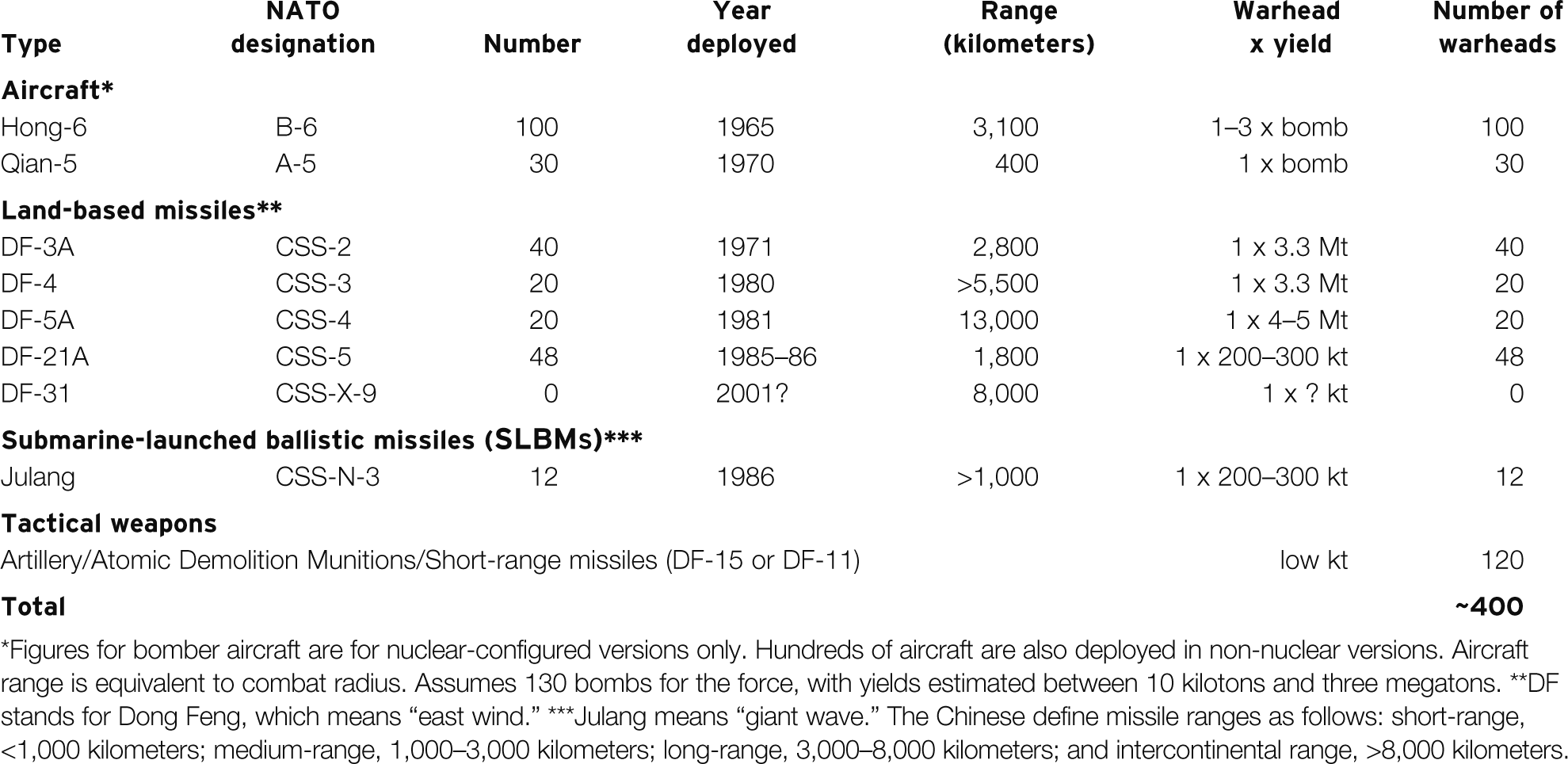
Figures for bomber aircraft are for nuclear-configured versions only. Hundreds of aircraft are also deployed in non-nuclear versions. Aircraft range is equivalent to combat radius. Assumes 130 bombs for the force, with yields estimated between 10 kilotons and three megatons.
DF stands for Dong Feng, which means “east wind.”
Julang means “giant wave.” The Chinese define missile ranges as follows: short-range, <1,000 kilometers; medium-range, 1,000-3,000 kilometers; long-range, 3,000-8,000 kilometers; and intercontinental range, >8,000 kilometers.
The two-stage, solid-propellant DF-21 (CSS-5) is carried in a canister on a towed erector-launcher; it is deployed in five locations. An improved Mod 2 version has not been deployed.
The DF-31 is believed to be in the final stages of development. Initial deployment may begin later this year or in 2002. The DF-31 (CSS-X-9) is a three-stage, solid-fueled, mobile ballistic missile with an estimated range of 8,000 kilometers and an accuracy, or circular error probable, of 1,000-2,000 feet. The most recent of three DF-31 flight tests was conducted last November. The test involved decoy warheads, and the flight path was shorter than the missile's estimated range. Garrison deployments are expected between 2005 and 2010. DF-31s will be targeted primarily at Asian bases and facilities. According to one report, the DF-31 was tested in 1997 for possible submarine launch. A variation of the DF-31 is thought to be under development to arm the new Type 094-class nuclear sub.
The DF-41 missile program is believed to have been canceled. A new mobile, solid-propellant intercontinental ballistic missile (icbm) is in development instead. The cia estimates it will be targeted against the United States and may be tested “within the next several years,” although deployment is at least a decade away.
China has had the technical capability to develop multiple reentry vehicles (mrv) for 20 years. A mrv system releases two or more RVs along the missile's flight path at a single target; they land in a confined area at approximately the same time. The more sophisticated and flexible multiple independently targetable reentry vehicle (mirv) system releases two or more RVs to independent targets over a wider area and at different times. The cia speculates that if China needed near-term mrv capability, it would take only a few years to develop and deploy a simple mrv or mirv on the DF-5 using a DF-31-type RV. But MiRving a future mobile missile would take several years. Many expect that U.S. deployment of a missile defense system would stimulate Chinese efforts to deploy multiple-warhead systems to ensure the effectiveness of its nuclear deterrent.
China has begun work on a new ssbn program called Project 094. The new ssbns, of which four to six will likely be built, are expected to carry 16 three-stage Julang II slbms, a variant of the DF-31 missile that may have intercontinental range and be capable of carrying multiple warheads. Deployment of the Project 094 system is most likely many years away.
China is developing land-attack cruise missiles with a range of 1,500-2,500 kilometers for aircraft, ships, and subs. A missile program known as X-600 appears partly based on Russian and U.S. cruise missile designs. An air-launched version may be operational within the next few years; whether they will be nuclear capable is unknown. When it bought two Russian-built Sovremenny-class destroyers, China also obtained the SS-N-22 Sunburn anti-ship cruise missiles that were deployed on them. While the SS-N-22 is credited with a nuclear capability in the Russian navy, there are no reports that China plans to equip the missile with a nuclear warhead. ∗