




Abstract

In april 1987, mikhail gorbachev took his country's first step toward chemical weapons disarmament, announcing that the Soviet Union had halted production, and that a facility was being built to destroy the weapons that had been stockpiled. International delegations were invited to visit the closed chemical weapons testing ground at Shikh-any the following October.
In 1989, the Soviet Union and the United States signed the Wyoming Memorandum of Understanding, agreeing to the exchange of confidential data on the two countries' chemical weapons inventories. That understanding was followed by a bilateral agreement signed in June 1990 in which both sides agreed to begin destroying existing stocks by the end of 1992.
With the Soviet/Russian military tightly guarding the skeletons in the cupboard, however, most of Russia's good intentions failed to materialize. The military's intransigence and secretiveness undercut these agreements—as did circumstantial evidence that, despite earlier denials, the Soviet Union had developed and experimented with “binary weapons,” munitions in which the lethal agent is formed by two relatively harmless compounds that are combined only after the weapon is fired or launched. Binary weapons can be stored and moved relatively safely, becoming lethal only when the precursors are combined. Their existence was revealed at about the same time that President Boris Yeltsin admitted that the military had also been developing offensive biological weapons in violation of the 1972 Biological Weapons Convention.
A few accomplishments
When the Soviet Union was dissolved, Russia inherited the entire Soviet stockpile of chemical weapons, as well as most of its former production facilities. But Yeltsin quickly assured the world that Russia would carry out the international obligations of the Soviet Union. He specifically affirmed Russia's commitment to the Chemical Weapons Convention (cwc), the final text of which was then nearing completion. Moscow made an unsuccessful effort to involve other former Soviet republics in chemical demilitarization, but when that effort failed, Russia took on the entire burden.
Russia signed the CWC in January 1993 and ratified it in November 1997, affirming its commitment to destroy its stockpile by 2007 and renouncing chemical weapons development, manufacture, stockpiling, and future use. A national system of export controls over chemical weapons and their precursors was introduced, and significant steps were taken to convert former production facilities. The Moscow-based State Scientific Research Institute for Organic Chemistry and Technology, which was responsible for chemical R&D in the Soviet period, was scaled down. It now appears to be concentrating on providing technological support for chemical stockpile destruction, legitimate chemical defense research, and civilian R&D.
Russia's chemical weapons storage sites
Russia's efforts have nonetheless been bedeviled by continuing political and economic uncertainty. The “chemdemil” program is a formidable administrative and technical task and a massive financial burden.
Without substantial assistance from abroad, Russian stockpiles will be around for a very long time. The first deadline imposed by the cwc— destruction of 1 percent of stockpiles by April 29, 2000—has already been missed. Under the revised program approved by the Russian government in July, this milestone will not be achieved until 2003, while the entire destruction process is scheduled to last until 2012. Setting up safe and reliable disposal technologies, meeting local demands for housing and related needs, and carrying out destruction are likely to take another decade at least. In the absence of massive foreign assistance, without which even the extended period may not be enough to complete destruction, some Russian officials and analysts suggest the country should withdraw from the cwc so it can pursue its own timetable.
The scope of the problem
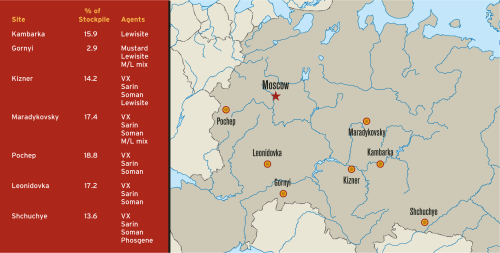
Russia has a declared stockpile of 40,000 tons of chemical agents, stored at seven sites (see below). About 80 percent is weaponized and consists mostly of organophosphorus nerve agents. The remainder of the material is stored in bulk at two sites—Kam-barka in the Udmurt Republic and Gornyi in the Saratov district.
No one knows how many tons of chemical weapons or agents were produced by the Soviet Union. But some independent analysts believe that the 40,000 tons formally declared by Russia is only a fraction of a total of 100,000 to 200,000 tons, the rest of which were probably disposed of in some manner. Both the U.S. administration and the Congress are skeptical about the accuracy of Russia's numbers and keep requesting clarifications as a precondition of any resumption of assistance.
Chemical demilitarization is a costly undertaking. The price tag for destroying U.S. stocks is estimated at more than $18 billion, and most estimates for Russia's costs are in the $6 billion to $8 billion range.
Disposing of nuclear weapons is much more costly, but that process has some tangible benefits. For instance, weapon uranium can be blended down and sold as reactor fuel, which has been implemented in practice under a bilateral U.S.-Russian agreement.
Apart from long-term gains for human health and environmental security, chemical weapons disposal is not cost effective. Neither the use of the bituminization products (the tars or asphalts that will be produced in the second stage, after neutralization) nor the reprocessing of lewisite into pure arsenic for use in the electronics industry (the supply would far outstrip demand) is economically rational. Destruction facilities will have to be built from scratch and are unlikely to serve any useful purpose after the program is over. (In the United States, there was until recently a legislative ban on using the facilities for any other purpose.)
The civilian v. military tug-of-war
At first, the government decided to take the most economical approach. It would build a few chemical weapon destruction centers and transport munitions to them. But the idea had to be abandoned after it was rejected by local communities, which had not been consulted. The first center, planned for Chapaevsk in the Samara district, was halted in the late 1980s midway through construction. The other, at Novocheboksarsk in the Chuvash Republic—where nerve agents had until recently been produced—was canceled before construction could begin. In March 1995, Yeltsin announced that chemical weapon stockpiles would be destroyed at their storage sites.
The first disposal efforts were coordinated by the Presidential Committee for Convention-Related Problems of Chemical and Biological Weapons, established in April 1992. The controversy over Soviet compliance with the 1972 bioweapons treaty made it advisable to establish a body apart from the ministries and agencies that had been in place before 1991.
The committee served for several years as the leading civilian agency, but in the end, neither it, nor the In-teragency Commission on Chemical Disarmament, was able to challenge military control.
Chemicals one, military zero
Finally, in March 1996, the Russiar government approved a new plan foi destroying all chemical weapon stockpiles by 2007. Destruction wouk take place near the storage facilities with minimal transportation. The highest priority would be disposing of the lewisite, the mustard, and compounds of these agents that are storec in bulk at Kambarka and Gornyi.
The Defense Ministry was designated the lead agency for developing and implementing the program. It was charged with selecting destruction technologies, building and operating destruction facilities, and constructing necessary housing and medical facilities at the sites.
With the military back in charge, Russia stopped submitting data called for under the Wyoming understanding, and it did not respond to U.S. efforts to move toward finalizing the 1990 bilateral destruction agreement. The military's reluctance to cooperate complicated the Pentagon's role in allocating funds for the Russian effort. The Defense Ministry consistently failed to meet the conditions for the release of Cooperative Threat Reduction Program funds.
The Russian players—especially those in the military—believed the world community would respond with great generosity as soon as Russia ratified the chemical treaty. As the first session of the Organization for the Prohibition of Chemical Weapons was convened in The Hague in spring 1997, the Duma circulated a document urging the industrialized countries to increase their assistance as a prerequisite for speedy ratification.
As it turned out, however, most non-U.S. assistance, with the exception of German funds, were provided for small projects that were beyond Defense's immediate purview, and Cooperative Threat Reduction money was meticulously supervised and carefully audited.
Meanwhile, the destruction program was running behind. The government provided barely enough money to support the Radiation, Chemical, and Biological Protection Troops assigned to guard the storage sites—sources recently told us that 60 percent of funding went for that purpose.
In 1996 the federal budget allocated only 1.3 percent of the amount stipulated for the program; in the following three years only 2.3, 3.9, and less than 2 percent was allocated. As senior officials now admit, all through the 1990s the government lacked a firm commitment to chemical weapons disposal and failed to understand the scale of the program.
In October 1997, an investigation into the program revealed a number of improprieties. For example, Defense had spent more than $1 million on unrelated facilities and services. Another $100,000 was wasted on an R&D project that contributed nothing to the development of environmentally safe destruction technologies.
The Defense Ministry's record in public relations, for which it had little experience or taste, was also poor.
In 1999, the military decided to use vintage “kuasi” units—mobile chemical weapon destruction systems developed in the 1970s to dispose of damaged munitions—in a futile effort to meet the first treaty deadline. One unit had been originally manufactured for each storage site, and one had been demonstrated for Western experts at the Shikhany test range in the late 1980s. But the units operated inside the storage facilities, in secret, and had never been subject to an environmental impact assessment. Environmentalists strongly opposed their use, and in the end the Russian government requested an extension of the destruction deadline rather than risk the wrath of local communities and environmental organizations.
The military checkmated
In the absence of close cooperation and understanding between the Defense Ministry and Pentagon officials in charge of the chemical disposal project, the U.S. assistance program foundered. Gen. Stanislav Petrov criticized the U.S. program's organization and structure, comparing its system-wide approach unfavorably with the looser rules favored by Germany, the second largest donor, which enabled the Russian military to avoid meeting high standards of accountability. The ministry also failed to build housing and related facilities at the Shchuchye site, which would have cleared the way for construction of the destruction facility that the United States had agreed to fund.
Congress, on the other end, decided that the Russian stockpile posed no military threat to U.S. national security. Instead of paying for disposal, it preferred to upgrade security at storage facilities as a precautionary measure against possible terrorist attack.
In April 1999 the General Accounting Office issued a report expressing doubt that the Shchuchye project would accelerate the destruction of chemical weapons at other depots or help Russia comply with its treaty obligations. In August 1999, Congress cut the Shchuchye project from the budget. In fiscal 2001, Congress terminated the chemdemil assistance program altogether.
In the meantime, as the complexity of various disposal projects grew— they required sophisticated engineering support and environmental protection arrangements—the military began to lose enthusiasm.
In May 1998, the Ministry of Atomic Energy (Minatom) took over the responsibility for dismantling and disposing of nuclear-powered submarines, a program funded from a number of foreign sources including the U.S. government. As “state procurer and coordinator” of that project, Minatom controlled budget allocations and could assign specific tasks to other ministries and agencies. Meanwhile, the Russian Aerospace Agency was assigned important functions for dismantling, conversion, and disposal of strategic missiles. Transferring these and other non-defense missions from the Defense Ministry to civilian players was also seen as consistent with a trend toward a more professional army.
The Defense Ministry, already overwhelmed by the need to restructure the armed forces, finally realized the futility of waiting for funding from a parsimonious government or from foreign donors who were unwilling to make large-scale investments unless they were subject to careful oversight. Pressure from the government also played a part in moving the program from the military. A civilian entity would be more likely to give foreign donors the transparency they needed, providing evidence that their money was not being diverted to other purposes.
A new beginning
Last November, the government designated a new body to oversee disposal, the Munitions Agency. This agency will coordinate the destruction program and act as Russia's national authority in matters connected with the cwc. The agency will be responsible for storage and disposal of stockpiles as well as destruction and/or conversion of former manufacturing facilities. Zinovii Pak, a former minister of the defense industries and a senior government figure, was appointed to head the agency and lend it weight. The Presidential Committee has been subsumed by the agency, with many of its staff transferred. The agency has also hired some now-retired military officers with experience in the disposal program.
Most important, the agency will control and allocate funds from the federal budget and from donors.
The agency's Directorate for the Safe and Secure Storage and Destruction of Chemical Weapons, established in February, will be in charge of chemical weapon storage, transportation, and destruction; oversight of buildings, facilities, and operations; and interactions with treaty-related international inspection teams and foreign donors.
The Defense Ministry's role is much reduced. It will participate on a contractual basis in R&D projects and the protection of personnel. And it will play a supporting role in dealing with emergency situations. The Protection Troops will continue to do their job, but in a significant development, many of them—Pak says around 10,500—have been transferred to the Munitions Agency under Lt.-Gen. Valery Kapashin, thereby avoiding potential chain-of-command conflicts. Details are still being worked out, but the troops will oversee the safety and security of facilities for the duration of the program. The State Scientific Research Institute for Organic Chemistry and Technology, where the Central Analytical Laboratory opened in April 2000, has been moved from the jurisdiction of Defense to the Munitions Agency.
Dark clouds still
Despite his legally defined powers, Pak could experience the same difficulties that the leaders of the Presidential Committee faced in dealing with heavyweight interagency players. In the Russian bureaucracy the winners are not always those backed by the letter of the law, but those who can rely on tradition and the patronage of influential people.
Another key player will be the new interagency “State Commission for Chemical Disarmament,” chaired by Sergei Kirienko, a former prime minister under Yeltsin and now Putin's representative in the Volga Federal Region (one of seven Russian macro-regions established in May 2000), where the bulk of chemical weapons are located. This policy-making commission brings the usual officials from state agencies together with representatives of nongovernmental and scientific organizations. A May 4 presidential decree defined the group's main purposes as promoting interaction among federal, regional, and local bodies.
There is some question whether this new commission can be more than symbolic. The Volga Region is besieged with a multitude of economic, environmental, and ethnic problems that are likely to consume most of Kirienko's time. And there is always the risk that, because of the diversity of its membership, the group will fail to reach consensus. Moreover, the high-priority destruction project at Shchuchye, crucial to Russia's disposal program, is located in the Urals, in another macroregion.
A new program
The 2001 budget provides for a sixfold increase in chemical weapons disposal funding for a total of just over $100 million, a sum officials we interviewed believe is a realistic figure that will allow them to implement the next stage in the program within a reasonable time frame. However, even if the ratio between domestic financing and foreign assistance reaches the 50-50 level they are aiming at, another $3 billion will need to be found to complete the program by 2012, as stipulated by the new program approved in July. The Russian government may ask the treaty organization for a five-year extension of the deadline, as the treaty permits. It may also seek ways to reduce the overall cost. Several options were included in the revised program:
If a two-stage destruction technology is used—neutralization followed by bituminization—it may not be absolutely necessary to complete both stages within treaty-imposed deadlines. It is most important to complete the first stage—turning chemical agents into a relatively harmless mass. The ultimate disposal of the mass via bituminization or some other method could be delayed. The same delayed approach may be applied to destruction of lewisite by alkaline hydrolysis. Officials believe the treaty organization may be willing to negotiate a deal to lighten Russia's short-term burden.
Because destruction facilities will be built in remote and thinly populated areas, plans to build permanent housing could be scrapped. If the destruction process is highly automated, a limited number of specially trained engineers and technicians could be offered fixed-term contracts under which they would rotate between destruction sites and their permanent homes for periods of rest and recuperation.
With earlier plans, regional leaders were led to expect generous tradeoffs—investment in their economies or tax relief, in exchange for their consent and cooperation in disposal plans. As the Putin administration builds a “vertical power structure” and reasserts central government influence on the provinces, regional leaders may make more realistic demands.
One reason the idea of central destruction facilities had to be abandoned in the past was that regional legislatures adopted laws banning the movement of chemical weapons through their territories. One of Putin's first initiatives after he assumed the presidency was to strengthen the federal constitution and pressure the regions into making local laws comply with it. The Russian government is now better prepared to reassert its control over security and disarmament matters. Last October the Duma Committee on Defense drafted an amendment to Article 2 of the law on Chemical Weapon Destruction eliminating the requirement for destruction at storage sites. In the first two hearings held in the spring and summer, the amendment was approved by an overwhelming majority. This change could substantially reduce the cost of destruction facilities.
Under this scenario, the Shchuchye facility, which was to be funded primarily by the Cooperative Threat Reduction program, could become the only realistic candidate for completion and commissioning as a regional facility (two other destruction facilities under the revised program are in Gornyi and Kambarka). Whether it would be able to accept munitions from the relatively nearby sites at Kizner and Maradykovsky, let alone from the more distant Leonidovka and Pochep sites, would depend on several factors. The most important is whether the local population and the authorities of the Kurgan district (where Shchuchye is located) would consent to an increase in the original scale of destruction, and whether existing or future transportation arrangements can meet international safety standards. In any case, the Gornyi site, along with the facility at Kambarka, will remain the highest priority—bulk storage poses the clearest and most immediate danger.
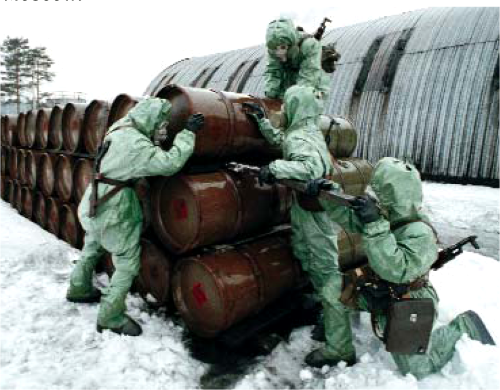
1993: Russian soldiers in protective suits check a store of chemical agents at a military base east of Moscow.
The administration preferred that the revised program be adopted by resolution to avoid lengthy debates outside the newly established intera-gency commission. But it is hard to predict whether the public will accept controversial changes of plan—especially in the affected regions. In most regions, opinion is divided on the question of allowing or banning transportation of chemical weapons. The governor of the Samara oblast has stipulated that any decision must be taken by popular referendum. In any case, transportation would have to be improved to ensure safety. The Ministry of Railway Transport insists there would have to be expensive improvements and detours away from urban centers.
There is little doubt that a more energetic administration is attempting to kick-start the process by introducing new ideas, investing more funds, and assuming greater civilian control over management. This is firmly in line with Putin's imposition of stricter political control over the power agencies and the recent reshuffle which saw Sergei Ivanov appointed defense minister. These changes should reduce lobbying from within the military. But it should not obscure the fact that there are still substantial hurdles to overcome if the disposal program is to be successfully carried out.
Foreign assistance
Foreign donors have given about $260 million to Russia's chemical weapons disposal effort—about a tenth of what is required for a cost-effective program. The Shchuchye project alone was recently estimated at $1 billion. For the program to succeed, foreign donors will have to play a much larger, more active, and more imaginative part, something former President Mikhail Gorbachev, as president of Green Cross International, has been lobbying for.
The United States is by far the largest donor, disbursing about $192 million in assistance. This aid has focused on two major projects—the Central Analytical Laboratory and the destruction facility at Shchuchye.
Resumption of U.S. assistance at Shchuchye depends on a set of specific conditions: Russia must allocate at least $25 million annually for the project; it must be used to destroy four other stockpiles; Russia must agree to destroy former chemical weapon manufacturing facilities at Volgograd and Novocheboksarsk (for which the United States has provided some assistance); and the international community must commit to long-term support for the Shchuchye project, to name the most important.
In September 2000 Putin raised the issue of assistance with chemical weapons disposal during his meeting with President Clinton at the U.N. millennium summit. He committed Russia to improving its record and to meeting most of Congress's conditions, something which appears to be under way. At the end of last year, a bilateral protocol was signed to pave the way for a limited resumption of U.S. activity at Shchuchye, to be funded mostly by unspent Cooperative Threat Reduction money. But U.S. funds remain frozen.
Germany is the second largest donor—and the only other donor to focus on actual destruction. Since October 1993 it has contributed about $27 million. German support has concentrated on the Gornyi site, which, although it accounts for less than 3 percent of the stockpile, is the Russian government's top priority. As soon as the destruction technology at Gornyi proves effective and safe, it will probably be introduced at the Kambarka site, where much more lewisite is stored in bulk. The latest bilateral agreement provides $4.1 million for the year 2001. The money will be used to purchase German-made hardware (a thermal decontamination plant with sewage treatment, equipment for emergency operations, and other equipment), and the cost of labor and services by German contractors. Additional projects are likely to be funded in the future. Other donors include the European Union, Sweden, Norway, Finland, Italy, Britain, the Netherlands, Canada, and Switzerland.
Generally, non-U.S. assistance, which now totals around $68 million, has been poorly handled by the Russian government. Interagency wrangling and a lack of government allocations to match foreign contributions have delayed and confused the planning and implementation stages. Differences in legal and accounting approaches in Russia and donor countries became serious obstacles to cooperation. Russia's own legal system needed improvement to accommodate other countries' specific demands. Most donors have assisted projects at the various sites individually, without coordinating their programs and without taking into account Russia's priorities. With U.S. assistance still frozen, the administration has done a good job rallying other donor countries in support of the Shchuchye project. In June, the Munitions Agency arranged a ceremony of raising flags of all foreign donors at Shchuchye to demonstrate international support for the project. Jose Bustani, director of the treaty organization, has suggested establishing an international coordinating committee, a plan Russia supports. But so far nothing concrete has come from the suggestion.
Such an informal group could make chemdemil assistance less vulnerable to extraneous political considerations in one donor country. The group would play a useful role in developing common standards for competitive tenders, hiring of Russian subcontractors, and accounting procedures. It might be instrumental in getting the European Bank of Reconstruction and Development and other financial institutions involved in building and/or modernizing transportation routes if Russia moves its program back to regional destruction facilities.
Although foreign donors now appear to be consulting with the Munitions Agency more closely, it is clear that even under the most optimistic expectations, international assistance will fall short. A Russian request to have some of its debts written off in exchange for increasing its own disposal budget has some support, but there are doubts whether it would work. International financial institutions would face difficulties in tracing the money flows and verifying their end use. This suggestion has not been taken up. Bustani, in what appears to be a firm signal to Moscow, is reported as having stated that Russia must bear the costs of its own disposal program. One reason for the apparent lack of sympathy may be that the treaty organization is experiencing financial difficulties because several countries, including Russia, have not been paying their dues.
Pluses and minuses
The reduction of the military's role is a welcome development and should have a perceptible impact on Russia's disposal efforts. But not too much should be expected. The Munitions Agency lacks manpower (discussions with officials suggest that personnel dealing with chemical weapons disposal should be doubled). And its ability to coordinate the program with other agencies may be limited by bureaucratic wrangling over privileges and authority. At a higher level, there are many other urgent tasks in the sphere of arms control and non-proliferation facing the government and the Security Council. The intera-gency Commission for Chemical Disarmament includes the necessary actors, but similar commissions have failed to produce anything more effective than broad policy outlines. There is also concern that the program may still lack transparency; Green Cross Russia has called for a permanent public body to maintain open discussion and national awareness of the issues involved.
While the Russian government would like to save costs, any saving at the expense of safety—which will be of great concern if chemical weapons are transported—will be vigorously resisted by the public. Russian officials and experts continue to publicly maintain that if no large-scale financial assistance is forthcoming, Russia will carry out the program itself. But private interviews suggest they are counting on aid.
Key to all this, as to so many other issues in the sphere of disarmament and nonproliferation, is Bush administration policy, not least because increased European funding probably depends on continuing U.S. support. Whether Bush chooses to reinvigo-rate the Russian chemical disposal program or considers it to be of marginal importance to U.S. security interests remains to be seen.
There are several factors to consider. Former President Bush committed his administration to making the Chemical Weapons Convention possible, and that could have some residual influence on an ultimate decision in favor of assistance to Russia (without which the cwc would be seriously weakened). On the other hand, a number of senior figures in the current administration are skeptical of multilateral arms control agreements. The Chemical Weapons Convention is not held in high esteem in Washington. The U.S.-Russia relationship in general has deteriorated under the combined weight of discord over U.S. missile defense plans and alleged Russian assistance to the Iranian nuclear weapons and missile programs. A January 2001 Defense Department report classified Russia as a country contributing to the proliferation of weapons of mass destruction and included allegations that Moscow may still be harboring residual chemical and bioweapon production capacities and a limited stockpile of a new generation of binary chemical agents. The United States would be reluctant to resume assistance in destroying old chemical stockpiles—now generally regarded as of little military use—if it believed that Russia was not complying fully with the treaty, which outlaws the development and production of any chemical compound destined for use as a warfare agent. The results of the review process regarding Russian programs undertaken by the Bush administration will soon be known, but under the best case scenario it is likely to take another year before any meaningful resumption of chemdemil assistance occurs.
The next year or two will be critical in terms of implementing the cwc. If Russia is able to put its administrative house in order and the promised level of federal funding is maintained, the international community—including the United States—may put aside narrow political differences and scale up current commitments. There are signs that European countries are prepared to do so.
If, however, in the absence of major international assistance the disposal program continues to proceed at the same slow pace, Russia could face massive leakage from its chemical weapon stockpiles and an environmental disaster of serious proportions. Concerns are already surfacing among officials and independent experts. Can the world community afford to wait for such an eventuality, the response to which may be very costly in both human and environmental terms?