




Abstract

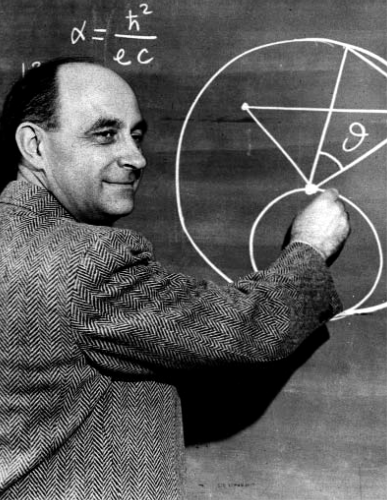
September 29 will mark the centennial of the birth of enrico Fermi. Venerated by physicists as a master of both experiment and theory, and perhaps the greatest practitioner of the art of the “back-of-the-envelope” calculation, Fermi won the Nobel Prize in 1938 for his leadership in the development of the field of neutron physics. Between 1939 and his death in 1954, he played a major role in the development first of plutonium-production reactors and then of thermonuclear weapons.
Fermi also had a role as a U.S. government adviser in two controversial decisions, which might be described as the “original nuclear sins.” They concerned:
•the use of nuclear weapons against Japan at the end of World War II, and
•the launch of a crash program to develop the hydrogen bomb.
In hindsight these decisions—like the decision to launch the development of nuclear weapons during “World War II because of the fear of a German nuclear-weapon program—seem almost inevitable. At the time, however, they were the subjects of hot, if secret, debates among physicists working in the U.S. nuclear program. The first debate is best described in Alice Kimball Smith's book, A Peril and a Hope, and the second in Herbert York's book, The Advisors: Oppenheimer, Teller, and the Superbomb. 1 Both debates are also described well in Richard Rhodes's popular books on the making of the atomic and hydrogen bombs. 2
Enrico Fermi.
The decision to use the bomb on Japan
In May and June 1945, Fermi served, along with the directors of the major U.S. nuclear laboratories—Arthur H. Compton from Chicago, Ernest O. Lawrence from Berkeley, and J. Robert Oppenheimer from Los Alamos—on the Science Advisory Panel to the government's “Interim Committee.” That committee, chaired by Secretary of “War Henry Stimson, and including President Harry Truman's choice for Secretary of State, James F. Byrnes, was charged with developing advice for President Truman on nuclear policy, including how the new atomic bombs were to be used.
The Science Advisory Panel was well aware that some of the scientists working in the wartime Manhattan Project held strong views on these questions. In particular, a group in Compton's Metallurgical Lab in Chicago (the “Met Lab”) had been discussing and analyzing them for a year. The final expression of their thinking before the dropping of the bomb was the “Franck report,” which Compton delivered to Stimson's office before the final meeting of the Science Advisory Panel.
James Franck, a Nobel Prize winner and a senior physicist in the Met Lab, had become sensitized to the social responsibility of scientists after participating in Germany's World War I chemical weapons program. 3 When Compton recruited him to the nuclear bomb project in 1942, he extracted the promise that, if the time came for a decision on the use of the bomb, he would have an opportunity to present his views to someone at the highest policy-making level. On June 4, 1945, Compton appointed Franck chairman of a committee on “social and political implications.” 4
The authors of the Franck report opposed the use of nuclear weapons without warning. Their primary argument was not humanitarian. The scientists were well aware that such considerations would not carry much weight. Three months earlier, on March 9-10, 1945, a single raid by 334 U.S. B-29 bombers had killed and injured 100,000 people and made one million homeless in Tokyo using only 2,000 tons of incendiaries. The U.S. government intended to destroy all of Japan's cities in this way as rapidly as possible. 5
The Chicago group's argument for restraint focused instead on the impact of U.S. nuclear use on the postwar international situation:
“If we consider international agreement on total prevention of nuclear warfare as the paramount objective, and believe that it can be achieved, this kind of introduction of atomic weapons to the world may easily destroy all our chances of success. Russia, and even allied countries which bear less mistrust of our ways and intentions, as well as neutral countries may be deeply shocked. It may be difficult to persuade the world that a nation which is capable of secretly preparing and suddenly releasing a weapon as indiscriminate as the rocket bomb and a million times more destructive, is to be trusted in its proclaimed desire of having such weapons abolished by international agreement…. From this point of view, a demonstration of this new weapon might best be made, before the eyes of representatives of all the United Nations on the desert or a barren island. The best possible atmosphere for the achievement of an international agreement could be achieved if America could say to the world, ‘You see what sort of a weapon we had but did not use. We are ready to renounce its use in the future if other nations join us in this renunciation and agree to the establishment of an efficient international control.’” 6
After being exposed to the decision-making environment in Washington, however, Fermi, Compton, Lawrence, and Oppenheimer came to a different conclusion from their Chicago colleagues. They explained the choice as follows:
“The opinions of our scientific colleagues on the initial use of these weapons …range from the proposal of a purely technical demonstration to that of the military application best designed to induce surrender. Those who advocate a purely technical demonstration would wish to outlaw the use of atomic weapons and have feared that if we use the weapons now our position in future negotiations will be prejudiced. Others emphasize the opportunity of saving American lives by immediate military use, and believe that such use will improve the international prospects, in that they are more concerned with the prevention of war than the elimination of this special weapon. We find ourselves closer to these latter views; we can propose no technical demonstration likely to bring an end to the war; we can see no alternative to direct military use.” 7
Thus, the relative priority of the importance of abolishing nuclear weapons and using them to deter war were being debated before the rest of the world even knew of the existence of the bomb.
Oppenheimer told his secretary that it took him all night to convince Fermi to go along with this conclusion. Fermi was against both a demonstration and military use. He wanted to keep the bomb secret and out of circulation as long as possible. 8
Today, the leaders of the U.S. nuclear weapons labs argue that the horror of what happened to Hiroshima and Nagasaki prevented the Cold War from turning into “World War III. Certainly, based on what we now know about the characters of Joseph Stalin and the leader of his secret police, Lavrenti Beria, it seems unlikely that it would have been possible to dissuade the Soviet Union from launching its own nuclear weapons development program.
Fermi scarcely participated in the postwar public debate over the use of the bomb or of its control. As his wife wrote in 1954, he was skeptical of the activists:
Don't make this mistake
After Canadian Peter Dant died in June at the age of 90, it was revealed that his will was rife with errors. It seems that Dant, who was “deeply disappointed with the decline in written and spoken English,” had decided to make the correction of his will a contest. An expensive piece of jewelry would be the prize for the lucky winner who could correct 12 errors found in each of 12 excerpts to be published in Canada's National Post over a 12-day period (Chemical & Engineering News, July 16).
Admiring as we are of Mr. Dant's ingenuity, we'd rather you just remembered the Bulletin in your will.
“Enrico did not think that in 1945 mankind was ripe for world government. For these reasons he did not join the Association of Los Alamos Scientists [one of the precursors of the Federation of American Scientists].” 9
However, Fermi was sucked into the official policy debate once again after the first Soviet nuclear test on August 29, 1949.
The decision to develop the H-bomb
Although many U.S. nuclear scientists had predicted that the interval between the first U.S. and Soviet bombs would be only a few years, the end of the U.S. nuclear monopoly came as an enormous shock to both the government and the public. The following decade saw the most desperate period of the arms race.
In 1941, Fermi suggested to Edward Teller that a fission bomb might be used to heat a mass of deuterium (heavy hydrogen) to fusion temperatures to create a nuclear explosion whose size would be limited only by the amount of fuel. 10 Achieving this became Teller's great obsession. His fear was that the Soviet Union would find a way to develop a hydrogen bomb before the United States did.
The area of death and destruction in Hiroshima had extended to a radius of more than a mile, but the radius of total destruction by blast and fire of a weapon with a thousand times the yield would be more than 10 times greater and its area of destruction more than a hundred times greater.
The government was not seized by Teller's nightmare until after Russia demonstrated that it could produce a fission weapon, the essential trigger for the “super.” At the time, Fermi, Oppenheimer, and Isador Rabi, a Nobel Prize-winning physicist from Columbia University, served on the General Advisory Committee to the Atomic Energy Commission (aec), the successor to the wartime Manhattan Project. Within months, the aec asked the committee to advise the government on whether a crash program should be launched to develop an H-bomb.
The scientists were skeptical. A convincing way to overcome the problem of igniting fusion fuel had not yet been devised. 11 In addition, committee members had moral qualms about increasing the power of nuclear weapons to such a degree:
“It is clear that the use of this weapon would bring about the destruction of innumerable human lives; it is not a weapon which can be used exclusively for destruction of material installations of military or semi-military purposes. Its use therefore carries much further than the atomic bomb itself the policy of exterminating civilian populations…. We all hope that, by one means or another, the development of these weapons can be avoided. We are all reluctant to see the United States take the initiative in precipitating this development…. The majority feel that this should be an unqualified commitment. Others feel that it should be made conditional on the response of the Soviet government.” 12
Fermi and Rabi, in a passionate separate opinion, added:
“The fact that no limits exist to the destructiveness of this weapon makes its very existence and the knowledge of its construction a danger to humanity as a whole. It is necessarily an evil thing considered in any light.
“For these reasons we believe it important for the president of the United States to tell the American public, and the world, that we think it wrong on fundamental ethical principles to initiate a program of development of such a weapon. At the same time it would be appropriate to invite the nations of the world to join us in a solemn pledge not to proceed in the development or construction of weapons of this category. If such a pledge were accepted even without control machinery, it appears highly probable that an advanced stage of development leading to a test by another power could be detected by available physical means. Furthermore, we have in our possession, in our stockpile of atomic bombs, the means for adequate ‘military’ retaliation for the production or use of a ‘super.’”
The atmosphere of hysteria following the detection of the Russian nuclear explosion, however, allowed H-bomb advocates to override the committee's advice. In January 1950, President Truman ordered a crash program. The revelation that Klaus Fuchs had provided the Soviet Union with early U.S. ideas about H-bomb design, as well as the North Korean attack on South Korea in June 1950, increased the sense of urgency. The Korean attack was widely seen as the beginning of World War III. That summer Fermi returned to Los Alamos to lay out the calculations required to see whether a hydrogen bomb was possible.
The breakthroughs came surprisingly quickly and the first U.S. test of a thermonuclear “device” (not a bomb), in which the X-ray radiation from a fission explosive “primary” imploded and ignited a thermonuclear “secondary,” took place in the South Pacific on Eniwetak Atoll in 1952. The yield was about 10 megatons (10,000 kilotons), 500 times larger than the weapon that destroyed Nagasaki. The United States tested several deliverable H-bombs in 1954, the year Fermi died of stomach cancer at the age of 53. The first Soviet test of a modern H-bomb occurred a year later.
Multi-megaton bombs and missile warheads were quickly deployed by both countries by the thousands. The last ones were not retired until the 1990s. After the advent of spy satellites in 1961, however, the Soviet Union and the United States quickly became open books to each other's targeteers. Both countries developed very accurate ballistic and cruise missiles, and the militaries phased in larger numbers of lighter, lower-yield nuclear weapons. Today the publicly quoted yields of U.S. and Russian strategic nuclear warheads are mostly in the hundreds of kilotons. These yields are still about 10 times larger than the Hiroshima and Nagasaki bombs, however, and the deployed strategic arsenals still contain four of these warheads for each of the approximately 3,000 cities of the world with populations greater than 100,000.
The continuing debate
Fermi advised against restraint in the decision to use fission bombs and for restraint in the decision to develop H-bombs. In both cases, the government opted against restraint. After the Cuban Missile Crisis in 1962, the futility and dangers of the nuclear arms race became more apparent, however, and the advocates for restraint began to win some debates. The Partial Nuclear Test Ban Treaty was signed in 1963, the Treaty on the Limitation of Anti-Ballistic Missile systems in 1972, and the Treaty on the Elimination of Intermediate-Range and Shorter-Range Missiles in 1987.
“I know there's something bothering you, Herschel. It's written all over your chart.”
Today, we are once again debating the choice between cooperation and unilateralism: arms control versus missile defense and new nuclear weapons. The times seem less dangerous now than during Fermi's last decade, but that perception is deceptive. The survival of civilization still depends on the restraint of governments.
The governments of the nuclear weapon states have to be reminded regularly by their concerned citizens of their awesome responsibility. In the United States, the last citizen uprising, the Nuclear Weapons Freeze movement, occurred in the early 1980s and helped lay the basis for the arms-control breakthroughs of the end of that decade. Today another uprising is sorely needed.
Footnotes
1.
Alice Kimball Smith, A Peril and a Hope: The Scientists' Movement in America, 1945-47 (Cambridge, Mass.: MIT Press, 1965); Herbert F. York, The Advisors: Oppenheimer, Teller, and the Superbomb (Stanford: Stanford University Press, 1976).
2.
Richard Rhodes, The Making of the Atomic Bomb (New York: Simon & Schuster, 1986), and Dark Sun: The Making of the Hydrogen Bomb (New York: Simon & Schuster, 1995).
3.
Franck was my grandfather.
4.
The other members of the committee were Donald Hughes, J. J. Nickson, Eugene Rabinowitch (founding editor of the Bulletin), Glenn Seaborg (subsequently chairman of the Atomic Energy Commission), Joyce Steams, and Leo Szilard (who separately met with James Byrnes and organized a similar petition to the president).
5.
Rhodes, The Making of the Atomic Bomb, p. 599.
6.
“Rocket bomb” is presumably a reference to the V-2 rocket with which Germany bombarded London beginning in June 1944. The Franck report is reprinted in A Peril and a Hope.
7.
Smith, A Peril and a Hope, p. 50.
8.
Peter Wyden, Day One: Before Hiroshima and After (New York: Simon & Schuster, 1984), p. 171.
9.
Laura Fermi, Atoms in the Family: My Life with Enrico Fermi (Chicago: University of Chicago Press, 1954), p. 246.
10.
Rhodes, The Making of the Atomic Bomb, p. 374.
11.
Ibid. Fermi and Teller's original idea that it would be possible to ignite a detonation front in deuterium at ordinary densities turned out to be infeasible. Much higher densities were required. Stanislaw Ulam and Teller in the United States and Andrei Sakharov and Yakov Zel-dovich in the Soviet Union discovered how to achieve these densities by using the intense radiation field created by a compact fission “primary” explosive to implode a thermonuclear “secondary.”
12.
For this report, including the separate Fermi-Rabi opinion, see York, The Advisors, pp. 153-62.