




Abstract

BURDEN OF PROOF
On October 30, 2000, the United States enacted a complex law providing health care and compensation for nuclear weapons workers, the “Energy Employees Occupational Illness Compensation Act,” and became the first country to compensate its workers for injuries incurred while producing nuclear bombs. No other nuclear weapon state has even acknowledged that its nuclear workers—as a group— were put at risk.
The United States built nuclear warheads at a feverish pace during the Cold War—about 10 a day at the height of the nuclear frenzy in the late 1950s, and about 70,000 in all. During that time, the government steadfastly denied that nuclear weapons workers—there were some 600,000 altogether—had been put at risk by exposure to radiation. When workers complained of illnesses, they were generally ignored. When they sought compensation, the government and its contractors fought them in administrative proceedings. When they went to court, the government spent millions trying to defeat them. Nuclear weapons contractors signed agreements that completely shielded them from any liability, even in cases of gross negligence. The meager resources of workers were no match for the combined strength of the corporations and the national security bureaucracy of the United States.
Energy enters guilty plea … again
After a slow but steady series of revelations in the early to mid-1980s, and a rush of scandals after that, the government made a historic admission. In April 2000, after more than five decades of denial, then-Energy Secretary Bill Richardson acknowledged that nuclear weapons workers as a group had been put at risk by exposure to radiation and other toxic substances. From then on, the Clinton administration supported a compensation program for workers with certain illnesses, and the October legislation was the result.
Richardson's admission came near the end of President Bill Clinton's second term in office, but it was reminiscent of another Energy admission made near the beginning of Clinton's first term. In November 1993, the Albuquerque Tribune published a series of articles by investigative reporter Eileen Welsome about ordinary people who had been secretly injected with plutonium as part of a program of human experimentation undertaken during the early years of the Cold War. The revelation shocked then-Energy Secretary Hazel O'Leary into saying: “Who were these people [conducting experiments] and why did this happen? The only thing I could think of was Nazi Germany.” It was a stunning statement on the part of the head of the agency that oversaw the country's nuclear arsenal. The revelations greatly intensified public skepticism of the government's “science-based” nuclear policies, many of which had already been put in doubt by earlier revelations.
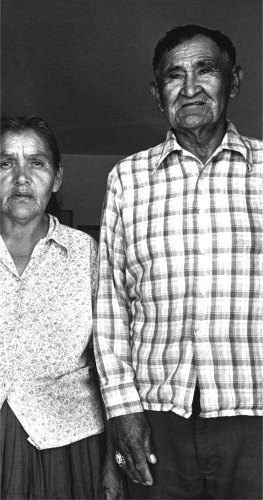
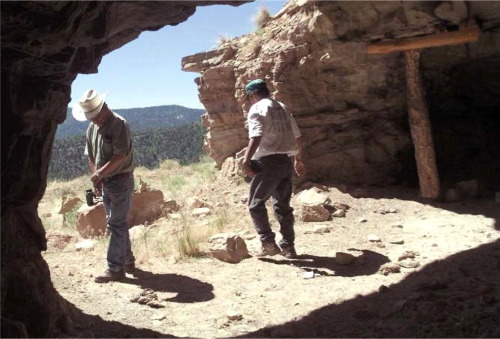
This former uranium mine near Cove, Arizona, is one of hundreds that ran at least two shifts a day for nearly 40 years. Previous page: Jeanette and Bernard Benally, August 18, 1982, at the Red Rock Navajo Reservation, Arizona. Bernard Benally, a lung cancer patient, worked as a uranium miner in the 1950s until he became too sick to work.
The first large crack in the government's defense of its nuclear activities appeared with the atomic veterans, who were exposed to fallout as a result of their participation in the atmospheric testing program. The first tests, called Operation Crossroads and conducted in 1946 at Bikini atoll, were accompanied by a large public relations extravaganza. It was the coming-out party for nuclear weapons. Forty-two thousand sailors and soldiers, and legions of dignitaries and journalists, were on hand to watch the Pacific Fleet conduct the Bikini tests.
The second test in the series was an underwater test using a plutonium bomb that had been positioned under a barge in Bikini lagoon. The explosion threw a million tons of intensely radioactive spray into the air, leaving plutonium hot spots over a wide area. But the radiological teams monitoring the tests did not have the ability to make accurate measurements in the field. “Every contaminated place … may be in fact the residence of many lethal doses of this alpha emitter [plutonium],” wrote Stafford L. Warren, then the Chief of Radiological Safety for the operation. Food was washed with contaminated water; radioactive materials were deposited in ships' evaporator pipes that provided water for drinking, cooking, and bathing; and surfaces like wooden decks absorbed the radioactivity and became “dangerously hot.” Nearly every ship in the Pacific Fleet was contaminated.
As late as 1982, a Defense Nuclear Agency “Fact Sheet” assured armed forces personnel who observed the tests that their internal exposures were “essentially insignificant.” During a House Veterans' Affairs Committee hearing in 1983, it was revealed that the government came to that conclusion without ever examining the documents in the archives of the Chief of Radiological Safety. The revelation and intense organizing by the veterans were major factors leading to the first nuclear-related compensation law.
The 1983 hearing was followed by a General Accounting Office investigation that further highlighted flaws in the government's actions. In 1984, Congress passed the Veterans Dioxin and Radiation Exposure Act, which provided the Veteran's Administration with guidelines to prevent arbitrary and summary rejection of claims by atomic veterans.
In 1990, the first law acknowledging possible radiation-related harm to two entire categories of people was passed. Called the Radiation Exposure Compensation Act (reca), the law provided health care and compensation for people who had lived downwind from the Nevada Test Site and for uranium miners—the first nuclear workers to be compensated by Congress. During the 1950s, uranium miners were treated as “guinea pigs”—the exact phrase used by a 1980 congressional committee to describe the government's treatment of these workers. The Atomic Energy Commission (aec)—the predecessor to the Energy Department—was aware that high levels of radon gas, as well as toxic dust suspended in poorly ventilated uranium mines, would cause lung cancer and other diseases. Instead of improving conditions in the mines, the government simply chose to monitor the miners (many of whom were Navajos).
As these and other revelations began to surface in the early 1990s, it became increasingly clear that similar patterns of abuse had been prevalent throughout the nuclear weapons complex. The 1990 legislation created for the first time a list of cancers for which atomic veterans might seek compensation—various types of leukemia, multiple myeloma, non-Hodgkin's lymphoma, and primary cancer of the breast (in women), esophagus, stomach, small intestine, pancreas, stomach, bile duct, gall bladder, and liver. Although the process for receiving compensation and treatment under reca is not simple—amendments have been necessary, for instance, to make it possible for many Navajo miners to collect compensation—the law pointed the government and legislators in the right direction.
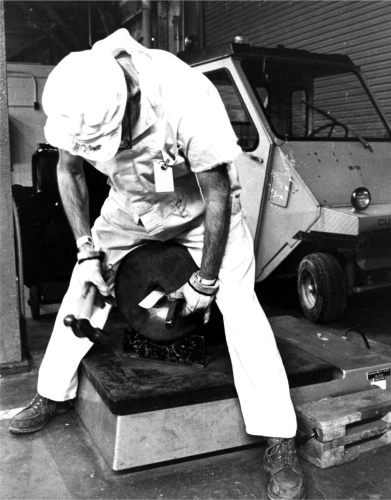
As this worker stamps a uranium ingot with a serial number, the radiation dose received between his legs would likely be greater than that recorded by his film badge, which hangs from the front of his coveralls.
The Fernald precedent
For those suffering from radiation-related illnesses, efforts to get redress in the courts generally met with failure until the late 1980s. When courts recognized the technical merits of a case, as sometimes happened, the government claimed “sovereign immunity.” The judiciary then deferred to the government's claim that because the acts were for national security it was exempt from liability.
But the courts eventually became a principal venue for exposing government and contractor negligence, and lawsuits stimulated congressional hearings and press coverage. In 1985, Lisa Crawford, a neighbor of a government-owned uranium processing plant near Cincinnati, Ohio, filed a class-action lawsuit against the plant's contractor, National Lead of Ohio. Some neighbors thought that the Feed Materials Production Center—commonly known as the Fernald plant—was in the pet food business, partly because of its name and partly because its water tower had a familiar checkerboard pattern. Then Crawford discovered that a 1981 test by National Lead had determined that the water in her well—the same water she used to make infant formula for her son—was contaminated with uranium. But National Lead and the government had never bothered to tell her.
My organization, the Institute for Energy and Environmental Research (ieer), was retained by Crawford's lawyers to evaluate emissions from the plant. Ieer's studies found that uranium emissions in the air were probably twice as high as official estimates—and possibly higher. The government's estimates, we concluded, were based on poor science, partly fabricated data, a deceptive calculation procedure, and in some cases, data gathered from instruments that had not been calibrated for decades. The government settled the suit for $78 million in 1989.
Fernald workers subsequently filed a class-action lawsuit against the contractor. (Ieer also did expert work in that lawsuit.) The most serious problems caused by uranium— which emits alpha radiation that can't pierce skin—occur when it is inhaled, ingested, or incorporated through open wounds. Working conditions at the plant—especially in the 1950s and early 1960s—were horrendous. Employees and work stations were often coated with radioactive dust. In the worst single instance, uranium dust in the plant's air was measured at 97,000 times the maximum allowable limit.
Despite these measurements, and without ever actually calculating internal doses from urine data and lung counts, the government and National Lead denied that workers had been overexposed.
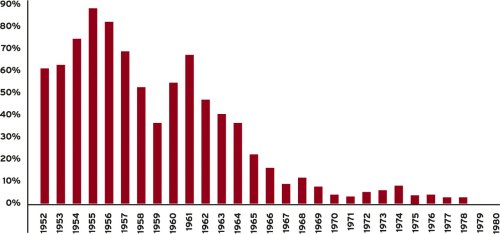
Ieer's calculations of doses to groups of workers showed that more than half had been internally exposed to higher-than-allowable amounts of radiation every year except one from 1952 through 1961. During the worst year, 1955, about 90 percent of the workers were overexposed (see chart below). In 1994, the government settled the Fernald worker lawsuit and gave workers health monitoring, a small monetary compensation, and a promise not to fight their worker compensation claims in court.
In 1994, the House Subcommittee on Oversight and Investigations held a hearing on worker dose records. In a document submitted to the subcommittee, the Energy Department admitted that external exposure records for workers were often incomplete, unreliable, and misleading. Records of internal exposures were also not reliable.
In testimony before the subcommittee, Jim Wells of the General Accounting Office said that in some instances zero doses had been recorded when dosimeters were not returned. Similarly, during the Fernald neighbor's lawsuit, it was revealed that in some cases zeros had been entered in the records of uranium releases into the environment when in fact no measurements had actually been made. How widespread this type of fabrication was in the weapons complex remains unclear.
According to ieer research, worker dose records were far more incomplete than was indicated at the 1994 hearing. We found that internal doses had never been calculated and entered into worker dose records. And there was little reason to believe that internal doses were ever calculated at any other weapons plant.
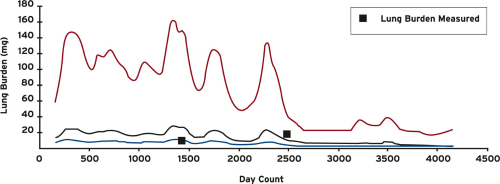
In 1997, after three more years of pressure and lawsuits, the Energy Department finally admitted that it had not calculated internal doses at any site until 1989. As a result, it will be impossible to calculate an individual's cumulative internal radiation dose until information from whole body counts and urine samples is evaluated. But because the available data are inadequate, any effort to make these calculations will be exceedingly difficult. The chart on the following page shows the results ieer obtained for one Fernald worker. The uncertainties are so large that at the lower end one would conclude that doses were well below the allowable limit. The opposite conclusion would be reached at the upper confidence bound. More reliable conclusions could be reached by pooling data and making estimates for groups of workers.
Percent of workers at the Fernald plant in Ohio whose annual internal exposure to radiation exceeded allowable limits. Source: Institute for Energy and Environmental Research (IEER).
This chart shows the probable daily dose of a single Fernald worker. Because the worker received only two “lung burden” measurements during a 12-year period, it is impossible to determine his actual dose (the annual allowable dose is 15 rems, corresponding to a lung burden of 12.93 milligrams of uranium). Based on available data, IEER was able to establish the worker's probable dose range: There is a 95 percent chance that the person received a dose less than that shown by the red line, and a 95 percent chance that he received a dose at or above the amount shown by the blue line. The black line represents the best estimate. Source: IEER.
Making matters worse, the available urine data indicate only the presence of alpha radiation, without differentiating between the possible sources of this radiation—which include uranium, plutonium, and thorium. Because the main radioactive material was uranium, it would be reasonable to conclude that it was the source of most of the radiation. However, calculating group exposures in this way would cause thorium exposures to be severely underestimated. Research done last year by ieer for usa Today showed that even a small amount of thorium processing could result in doses comparable to those obtained by processing vast amounts of uranium.
When the Washington Post revealed in 1999 that uranium processed at the Paducah enrichment plant in Kentucky was contaminated with plutonium, the government had little option but to accept that it had put workers at risk. The presence of plutonium—even in trace amounts— increases considerably the dangers posed to workers. Plutonium is about 100,000 times more radioactive than natural uranium.
Officially, plutonium contamination in uranium was supposed to be maintained below 10 parts per billion. But that limit was often exceeded at Paducah. Investigations of the other uranium enrichment plants at Oak Ridge, Tennessee, and Portsmouth, Ohio, showed they had similar problems.
These uranium enrichment plant workers did not have any of the protections provided to plutonium workers, who use gloveboxes when processing the material. At uranium enrichment facilities, radioactive dust is carried off by ventilation systems installed in hoods (not unlike the hood on a natural gas stove). This difference is the technical basis for the special place carved out in the new compensation law for those who worked at the three uranium enrichment sites—the so-called “Special Exposure Cohort.” (Many other places also processed recycled uranium laced with plutonium—including the Fernald plant.)
More to come
Enacting legislation to compensate these workers was a historic step, but there is much left to be done. Workers at the three enrichment plants and at the Amchitka test site in Alaska will be given the benefit of the doubt—those with cancer will be compensated without having to show they were exposed. The plutonium exposures at the enrichment plants and the apparent loss of exposure data at Amchitka were used to justify including workers from these four sites in the cohort. (The fact that all four sites are in states represented by powerful senators on Capitol Hill also didn't hurt.)
But the bar for workers at other sites will be far higher. They will have to prove that their exposures were large enough that their cancers were “at least as likely as not” caused by their exposure to radiation. By its very design, this requirement will leave out many people whose cancers were caused by workplace exposures. And the problems only start there. A principal difficulty for a large number of workers— perhaps most of them—is that radiation records are so poor and incomplete that it will be impossible to calculate radiation doses with any reasonable amount of confidence.
Workers will be given some benefit of the doubt, however, because of the way cancer risk calculations are determined in the legislation. If there is a greater than 1 percent chance that a worker was “as likely as not” to get cancer from his/her calculated dose, the worker will be compensated. The epidemiological tables that will be used to make these risk calculations are currently being reviewed by the Centers for Disease Control and Prevention (cdc). Also, the National Institute of Occupational Safety and Health is tasked with using the available records to adapt and modify the tables if necessary.
The telltale cloud from a nuclear test explosion as seen from Las Vegas about 1950.

If the extant dose records were more reliable, it would be possible to fill in some of the gaps in individual records and possibly produce more or less sound estimates. But for the most part, the records are far from reliable. Solving the problems created by systemic problems in the data— such as fabricated zeros and insufficient urine records—will be extremely difficult.
The legislation establishes a committee to advise the president on the procedures required to judge individual claims. If a dose cannot be calculated with reasonable confidence, the burden of proof will fall on the government.
While this approach seems reasonable on paper, it is impractical and will likely result in widespread injustices. It will take a long time to set up procedures for calculating individual doses, validate models, and extract and validate data. The expense will be great and the results controversial and highly uncertain. At the end of this lengthy process, the government—despite a good faith effort and huge expenditures—may find itself less trusted and embroiled in more litigation than before.
The most urgent order of business for the advisory committee should be to determine whether the state of the records is such that doses can be estimated with reasonable confidence for most workers. If not, all nuclear weapons workers should be made a part of the Special Exposure Cohort.
There is also a possibility that more groups of victims will be added to the legislation in the future. These could include the families of workers, who may have been exposed to radioactivity brought home in cars or on clothes, and those living near weapons plants whose environment was often contaminated with radiation and other toxic substances. A cdc study of the Fernald plant, for example, estimated that the upper limit risk of contracting lung cancer for those who received the highest off-site radiation doses was about equal to that of a smoker.
Many people were exposed to iodine 131 when it was emitted into the environment by some nuclear weapons plants—notably Hanford and Oak Ridge—during the 1940s. But millions more were exposed to the radioactive element during atmospheric testing in the 1950s and early 1960s when they drank contaminated milk. Children were the most exposed because they drank the most milk and had growing thyroids. The fresher the milk they drank, the higher the dose. The most exposed children—those who lived on farms and consumed goat's milk in “hot spot” areas in Idaho and Montana—had thyroid exposures of up to 2,000 rads, roughly the same as the most affected children living near Chernobyl. It is ironic that the U.S. government is doing follow-up studies of the Chernobyl children, but has not made any effort to find—much less inform—the most exposed American children.
The fallout tragedy was made worse by the fact that many down-winders were lulled by government assurances of safety into watching spectacular nuclear weapons tests, even as fallout rained down on their communities. Although fallout had been predicted, military commanders thought the public had a “hysterical or alarmist complex” about radiation. One commander said the public needed to be cured of its hysteria through “re-education over a long period of time.”
With the worker compensation legislation, the sweeping scope of the human cost of the Cold War has become more apparent. Although the relief proposed by the law is far greater than anything offered before, the road to compensation is long and complicated. Tragically, many of the victims can't wait.