




Abstract

For decades, japan's nuclear energy policy has been based on the idea that it would eventually use plutonium. Now, as plutonium stocks pile up, it is clear that Japan has no way to use it all.
Nothing has gone right for Japan's plutonium advocates. Accidents, cover-ups, cost overruns, and serious delays have squelched ambitions for widespread plutonium use. While the use of plutonium in Japan is still relatively minimal, the amount of separated Japanese plutonium stockpiled in Japan, Britain, and France has ballooned from 10 tons in 1990 to more than 35 ton last year. Japan's electric utilities have been told by the government that this plutonium must be used in reactors as mixed-oxide (mox) fuel. Increasingly, the utilities would rather not.
While the existing supply of plutonium is overwhelming, a new source is rapidly being constructed, the Rokkashomura reprocessing plant. The largest single industrial project in Japan, the plant will produce more plutonium in a country already awash in the stuff. At the same time, a combination of public unease, opposition from regional governments, and money problems at both national and utility levels, could lead to the demise of a program that was never what it claimed to be.
Domestic reprocessing
Japan's nuclear policy is clearly detached from commercial reality. Even after the 1997 criticality accident at Tokaimura, the construction at Rokkasho has continued apace. One of Japan's largest ever industrial projects, the facility will be capable of reprocessing 800 tons of spent fuel each year from Japan's 10 nuclear electric utilities. Operation was planned to begin in the mid-1990s, but by 1994 the date had slipped to 2001. Between 1992, when a construction permit was issued, and 1997, when the official operational date was moved to 2003, only 15 percent of the plant was built.
During the same period, Japan's plutonium surplus grew from less than two to more than 25 metric tons, a result of spent fuel reprocessing by British Nuclear Fuels Limited (bnfl) in Sellafield, in Britain, and by Coge-ma in La Hague, France. Following an accident at Monju—a prototype fast-breeder reactor, where leaking sodium coolant caused a fire that has closed the plant for more than five years—as well as the cancellation of a second fast breeder, the “Demonstration Advanced Thermal Reactor,” the need for plutoni-um for a commercial fast reactor program evaporated.
The cost of Rokkasho has rocketed. The design is based on Cogema's UP3 plant, which the French government reports cost 37 billion francs ($5 billion). During the 1990s cost estimates ranged from the 840 billion yen (more than $8 billion) proposed by Japan Nuclear Fuels Limited (jnfl), to two trillion yen ($20 billion) quoted in a report from MIT's Center for International Studies.
By late 1997 there were sufficient doubts within the utilities, which have to pay construction, operational, and eventual decommissioning costs, that a halt to construction was believed possible. Large numbers of construction workers were laid off and meetings were held between jnfl, the electrical utilities, key contractors, and government officials. Politics and the need for spent fuel storage, however, as well as penalty clauses for contract cancellation, led to the decision to complete construction.
By mid-1998, Rokkasho employed more than 5,000 workers. In 1999 the company revised the total construction cost upwards to more than $20 billion. At the end of March the plant was due to be 60 percent complete, with actual operations scheduled after July 2005.
In November 2000, jnfl, operator of the Rokkasho site, and Federation of Electric Power companies announced that a mox plant, also based on a Co-gema design, would be built adjacent to the reprocessing facility at a cost of $1 billion. The plant will be constructed between 2003 and 2005, with operation scheduled for 2007.
Rokkasho's future is still uncertain. The managers of Japan's utilities understand that it makes no economic sense. Meanwhile, the government's failing “no plutonium stockpile” commitment (which it violated before the ink was dry) is under review and risks being exposed on a monumental scale. Even with limited throughput, any plutonium produced at Rokkasho will be surplus as long as Japanese plutonium remains stockpiled in Europe.
The reprocessing plant will also absorb up to 20 percent of the International Atomic Energy Agency's (iaea) annual nuclear safeguards budget. Given the proximity of China and the Korean peninsula, the plant's operation could become a regional nonproliferation concern. In response the United States and the iaea have devised an enhanced safeguard system that will be the first of its kind in a non-nuclear weapon state.
To reduce the threat of proliferation, the plant is designed to produce mixed oxides of uranium and plutonium rather than separated materials. This mixture would become the base feed for the mox plant. However, questions remain about the practicality of using reprocessed uranium in fresh mox. In recent weeks, further doubts have emerged, and Japan's Nuclear Safety Commission now wants to look at using plutonium oxide as feed material for the mox plant. This implies that Rokkasho may produce separated plutonium as a final product, raising further the proliferation stakes.
The government is also considering shipping plutonium oxide rather than mox back from Europe. Whatever the outcome, even with safeguards, if Rokkasho becomes operational, it will raise serious East Asian and international proliferation concerns. The United States—with its contradictory policies of endorsing massive plutonium use in a country just a hop away from the Korean peninsula, where it has sought to block plutonium acquisition—bears considerable responsibility for this quagmire.
The Rokkashomura nuclear reprocessing complex, operated by Japan Nuclear Fuels Limited, is the largest single industrial project in Japan.
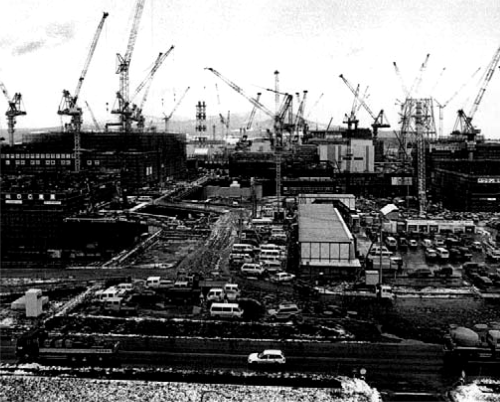
One further option for the utilities is to use Rokkasho as a training facility with minimal throughput. The utilities are considering this as a way to reduce proliferation concerns. The fact remains, however, that the plant could be ramped up to full production were circumstances to change.
Overseas reprocessing
In 1997 the Japan Atomic Industrial Forum surveyed the country's utilities, nuclear equipment, and construction companies and revealed a significant trend: The cost of nuclear fuel was becoming a more important factor in the utilities' annual costs than ever before, with nuclear fuel costs for the first time exceeding construction costs. The cost increase of 140 percent over the previous year was due to advance payment for Rokkasho and charges from overseas processing. The continued decline of the yen in recent years has only exacerbated the high costs of overseas reprocessing. With more than half of Japan's spent fuel still waiting to be reprocessed at bnfl, the pain of overseas processing will be felt for at least a few more years. At the end of 2000, around 30 tons of plutonium remained in Britain and France.
Questions have been raised about a possible new contract with Coge-ma. It was widely believed in Japan that such a contract would never materialize given the costs, the planned opening of Rokkasho, and the storage of spent fuel in Aomori. The 1999 decision to approve interim storage sites for spent fuel in Japan further eroded the argument for overseas processing, as did the approximately six tons of separated plutonium already accumulated domestically.
Japan's nuclear relationship with Europe is not over, however. Starting up Rokkasho will require trained technicians. But the honeymoon with Cogema seems to have ended—the French have agreed to train 70 Japanese technicians on the UP3 reactor only on the condition that “they bring their own spent fuel.” As of publication, a contract had not been finalized, reportedly due to disagreement over price.
Falsified data
With a growing stock of plutonium in Europe, Japan planned for most of its Mox to be manufactured in Britain and France, then shipped back to reactors in Japan. But how much mox can its reactors reasonably burn?
The use of mox in Japan's conventional light-water reactors was first suggested in the mid-1980s. By 1991, the Japanese Atomic Energy Commission's (aec) Nuclear Fuel Recycling Committee recommended that mox fuel be used in two light-water reactors by the mid-1990s, in four by 2000, and in 12 by 2010. A combination of events including delays, the oversupply of plutonium, and cancellation of the Demonstration Advanced Thermal Reactor led the government to revise the schedule to the use of mox in 10 light-water reactors by 2000 and 16-18 reactors by 2010.
After years of delay, the first mox shipments, one from the Cogema/Belgonucleaire mox group and another from BNFL, began arriving in Japan in September 1999. The shipment was equal to 1 percent of the approximately 45 tons of Japanese plutonium that will be separated overseas by around 2005. Before the boat pulled into Japanese waters, however, British media revealed that bnfl had falsified quality control data for a second batch of mox fuel still in production. Officials in Britain and Japan issued assurances that data on the the first shipment of mox fuel had not been falsified. But data that bnfl was forced to release publicly in Japan told a different story, and after three months of denial and a court challenge from citizen groups, bnfl was forced to concede that it had falsified data on the batch of mox fuel delivered to Japan.
The coincidence of the 1999 criti-cality accident at Tokai only fueled public discontent over Japanese nuclear power. The backlash against the nuclear establishment following that incident—including the demand for compensation and an embarrassing and reluctant commitment by the British government to take back the mox fuel—left a damaging legacy. The falsification scandal raised broader issues about the quality and safety of mox fuel, including that from France.
Although the mox fuel delivered to the Fukushima power plant was due to be loaded in early 2000, political, legal, and public opposition has led instead to its storage in the reactor's cooling ponds. A second shipment of mox fuel that arrived in March, also tainted with suspicions of falsified quality-control information, will now go into storage rather than reactors. Thus, all three shipments of plutonium (either in oxide or MOX form) remain stockpiled, and mox use now seems unlikely again this year.
Of the 10 utility companies that have reprocessing contracts with bnfl and Cogema, Kansai Electric Power Company (Kepco) and Tokyo Electric Power Company (Tepco) are the most important. Combined they own nearly 60 percent of all Japan's plutonium. As the largest utilities they receive the largest direct subsidies and follow government policy more closely than their smaller counterparts.
Other utilities, especially the smaller ones, are in no hurry to follow along with the government's mox plans. Even before the quality-control scandal it was clear that not all the utilities were going to blindly accept mox fuel, as they had the original reprocessing contracts. Even the larger utilities have committed only to relatively small mox contracts. Only after they are assured reliable transport from Europe and after successful demonstration of the fuel's performance will they consider signing follow-on contracts. Growing political opposition at the prefectural level suggests that even small-scale use of mox will be difficult in coming years.
Fast breeders
The accident with Japan's prototype fast breeder reactor at Monju ended all prospects for building a second one—and in November 2000 the aec indefinitely postponed fast breeder reactor commercialization. But Monju's days may not be over. The plant's operator, the Japan Nuclear Cycle Development Institute, intends to restart the reactor in 2003 or 2004 pending a safety review license from Fukui prefecture. The French and British are assisting the restart, specifically with research into sodium leak prevention, plutonium “burning,” and actinide partitioning. A civil and administrative lawsuit filed against Monju in 1983, currently under appeal, stands in the way.
MOX fuel is unloaded in Japan.
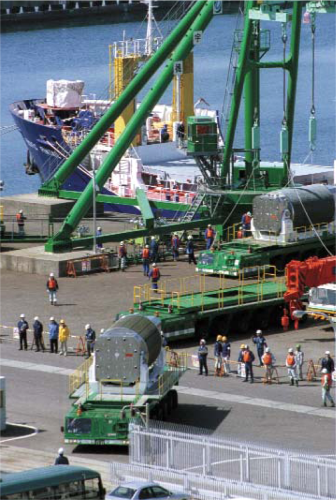
The restart of the Monju program in part explains the construction of a fast breeder reprocessing facility at the Institute's Tokaimura site. Construction of this plant began in 1995, before the Monju accident, and despite the widespread belief in Japan that it has been halted, the government has now spent more than $700 million on the facility, which is expected to cost $1.2 billion. According to a 1994 Greenpeace report, the plant will incorporate sensitive nuclear technology transferred illegally from U.S. facilities, including the Savannah River Site and Oak Ridge National Laboratory [see “Greenpeace Gets the Goods,” November/December 1994 Bulletin]. Details on the plant are difficult to obtain and the completion date remains uncertain. But if it is completed, it will be used to reprocess the 17.5 tons of breeder blanket fuel in Monju, as well as spent core fuel.
The significance of Japan acquiring tens if not hundreds of kilograms of supergrade breeder plutonium is not lost on policy-makers in East Asia. Fast reactor development in Korea and China continues, with a small test reactor scheduled for operation at Taejon in 2010, and in Beijing in 2005. Combined with the construction and operation of the plant at Rokkasho, Japan's growing surplus of weapons-usable plutonium opens the door to further proliferation of plutonium in this region.
The “Long Term Program”
Japan's nuclear power policy has been independent of its general energy policy. Unlike the Japanese aec's first program, formulated in 1956, there is a sense in Japan that the latest “Long Term Program for the Research and Development of Nuclear Power” has abdicated its influence on the nuclear budget. The new program states that its primary role is to serve as a “message” to the nation's citizens, society, and international community: “The civil sector that has a will to move the program forward will take its own initiative to act upon it.” In other words, the plan's role is not to instruct but to “guide” and “expect.”
The program avoids old-style binding targets and gives the civilian sector the right to make decisions for commercial programs belonging to the nuclear industry. When the draft of the Long Term Program was published in September 2000, and later finalized with only minor changes, Tepco adviser Sho Nasu said, “In today's world changes occur from year to year. It's no longer necessary to formulate five budget-year's worth of policy. [The new Long Term Program] has been able to indicate the direction of our thinking, and therefore I am satisfied.”
The latest program was criticized in many quarters. The language was vague and noncommittal, and local authorities involved in the government's nuclear fuel cycle complained it was pulling the carpet from under them. At the same time nuclear critics charged that planners were out of touch with public opinion after the Tokai accident. They charged that the program was drafted by “true believers,” including industry and fast breeder diehards. The media reported “almost no public input reflected in the program,” and public opinion solicited by the aec, at the end of the deliberations, was opposed to Monju's restart nine to one. After the Monju accident, a quarter of Fukui's population signed a petition opposing the reactor restart.
Waste management or Plutonium policy?
As vague and impotent as it is, the new Long Term Program presents to the Japanese public and international community an apparently solid front supporting the nuclear fuel cycle.
The current plutonium program has bought time. In a September 1998 statement, Kepco offered this candid remark: “Japanese nuclear power has been able to operate smoothly thanks to overseas reprocessing contracts.” Japan would have had a nuclear waste crisis long before now had it not shipped more than 5,500 tons of spent nuclear fuel (a total of 7,095 tons if gas-cooled reactor spent fuel is included) to Britain and France.
Just as one of the last shipments of spent nuclear fuel left for Europe in mid-1999, the Denki Shinbun ran headlines heralding an impending domestic nuclear waste crisis. As the Diet worked to further delay the crisis and Tepco shipped its first full load of spent nuclear fuel from its Fukushima nuclear power plant to Rokkasho, the program began to unravel. Tepco announced a moratorium on all new power plant construction, and Fukushima governor Eisaku Sato announced that the mox program was included in the moratorium. Immediately after, Aomori governor Morio Kimura responded by stating that if Fukushima were not going forward with MOX it should desist from shipping spent fuel to Rokkasho.
In the meantime, the ability to deal with the huge quantities of spent fuel being generated in nuclear power plants in Fukushima and Niigata (Tepco) and Fukui (Kepco) remain uncertain. In May 2000, Japan enacted legislation for a final repository solution for high-level waste. Although vague and unrealistic, it paves the way for negotiations with local authorities for interim storage sites. However, a recent public opinion poll showed that 90 percent of the Japanese public does not want a final repository site in their area, which effectively neutralizes the legislation.
Mayors and local legislatures have responded by passing resolutions and ordinances against siting interim storage sites in their areas, which has also stymied the search. But the economic recession is making the offer attractive to some local authorities. Mutsu in Aomori could become the first interim site.
Deregulating Japan's electricity
Until March 2000, Japan's 10 electric utilities had a monopoly on electricity. This is no longer the case. In the face of Japan's fragile economic situation, slashing high energy prices by opening up competition is essential. Deregulation will undoubtedly slow nuclear power plant construction and affect the plutonium program. According to a February article in Nikkei, Tepco is in a perilous financial state, with nearly $100 billion in interest-bearing liabilities. Tepco president Nobuya Minami said the company “is facing a business environment we have never experienced before.” With competitive bidding, newly formed independent power producers are stealing contracts away from the big monopolies, as Diamond Power did last August when it underbid Tepco by 4 percent for a contract to supply power for the Ministry of Economy, Trade and Industry (METl).
Other utilities, including Kepco, face a similar problem. For the national government to expect utilities to promote nuclear energy when they no longer buy their electricity from these utilities is a sign that the relationship between the government and the utilities is breaking down. Many local governments have large debts and are under pressure to reduce spending. On February 18, Osaka announced it would purchase its power from an independent power producer at a price 5.5 percent less than Kepco offered. The next day, Kumamoto announced that it would continue to purchase electricity from Kyushu Electric, but only after the big utility lowered its bid almost 12 percent from the previous year.
Utilities admit that fabricating mox fuel is several times more expensive than producing uranium fuel, and this estimate does not include the cost of reprocessing. The more liberalized Japan's electricity market becomes, the more its utilities will be reluctant to continue business as usual with nuclear power and their plans for mox.
Looking beyond MOX
Finally, the balance may be tipping toward a more practical approach. Tatsuo Hatta, a member of a meti committee on energy policy, said, “Japan failed to develop an economical [fast breeder reactor]. Pluthermal will cost too much and therefore is a waste. When competition enters into full force, it will become clear that it doesn't make financial sense. Since it doesn't pay financially now to reprocess, construction of the [Rokkasho] plant should be suspended.”
In December last year more than 2,500 citizens gathered at a memorial hall in central Tokyo to pay their last respects to longtime nuclear critic Dr. Jinzaburo Takagi. Reflecting on developments in recent years, it genuinely seemed possible to many in attendance that Japan could ultimately abandon its plutonium program. As the financial squeeze mounts, utilities will look past mox as the only option for dealing with their vast plutonium stocks.
All this will take time, but it could happen Japanese-style: While appearing to continue with its current plutonium program, Japan will move away from the nuclear twilight zone it has created. To continue with mox benefits only the European plutonium industry, which knows that its traditional commercial business is slowly but surely coming to an end.