




Abstract

At the door to courtroom iii, a u.n. guard hands me a translation headset after asking my language preference and setting the receiver to the appropriate channel. There are a half dozen other visitors already seated in the public gallery watching the court proceedings, but the room is completely silent. There's a soundproof glass wall sealing us off from the front of the courtroom, and without the headsets you can't hear a thing.
Beyond the glass, the accused sit against one wall under armed guard. They look a bit blank, weary perhaps after a year on trial and more than two in custody, listening dispassionately to the proceedings. Sitting here in their drab suits they look like dozing delegates at some numbingly dull conference. They are all charged with crimes against humanity.
Remember that haunting television footage from Bosnia back at the end of the summer of 1992, the images of bruised, emaciated prisoners standing behind barbed wire fences at a Bosnian Serb-run concentration camp, the one that looked an awful lot like Auschwitz? Well, that footage was taken at Trnopolje, one of three detention camps clustered around Prijedor in northwestern Bosnia. The skeletal prisoners came from Omarska, a defunct mining complex where the worst atrocities took place. Only lucky prisoners were transferred to Trnopolje, where they were less likely to be killed during routine torture.
The men behind the glass ran Omarska. Miroslav Kvocka, a tired-looking defendant in a gray suit, was a commander and deputy commander at the camp. The older man next to him, 64-year-old Dragoljub Prcac, also served as a deputy commander, and two of the other defendants were shift commanders. According to prosecutors, the final defendant in this case, retired taxi driver Zoran Zigic, simply enjoyed dropping by the camps to beat, torture, and kill prisoners.
Survivor accounts from Omarska are at least as horrid as you can imagine, an orgy of sadism and cruelty. Credible testimony described the organized gang-rape of female prisoners; nightly torture of inmates, including an incident where one prisoner was forced to castrate another; and the murder of at least several hundred Muslims whose bodies were dumped in an abandoned mine shaft.
Those in charge of the camp face trial only because of the existence of the U.N. International Criminal Tribunal for Yugoslavia, and the tenacity of its prosecutors. But this international tribunal—and its counterpart for Rwanda—is a temporary body, an aberration on the largely lawless international stage.
In much of the world, those Responsible for the murder of hundreds or hundreds of thousands of people are far less likely to be held accountable than those who murder one or two. The worst criminals—from Joseph Stalin and Mao Zedong to Guatemala's Rios Montt and Liberia's Charles Taylor—tend to oversee their nation's courts, not the other way around. Mass murderers who become heads of state expect investors, not indictments.
In our supposedly anarchic world of competing nation states, that was just fine. Just six years ago, professors at the University of Chicago taught me and my fellow international relations students that morality had no place on the international stage; it's a jungle out there, and only the strong survive. They probably deliver the same message today, but recent events must make their “realist” theories harder to sell: former Chilean dictator Augusto Pinochet's detention in London, Slobodan Milosevic's indictment by the Yugoslav crimes tribunal, the U.S. military intervention to prevent genocide in Kosovo, and the signing of the treaty creating a permanent global criminal court. All the while, European states are voluntarily blending their sovereignty, eroding the importance of the nation state.
Hobbes and Machiavelli must be rolling in their graves.
Bringing the rule of law to the fn-ternational stage is in most countries' interests. With an increasingly globalized economy, what happens in one country often has an immediate and palpable effect on others. Corporations want their patents and copyrights to be recognized everywhere. There's increasing pressure to create common standards for labor, environment, and accounting practices, to close down offshore banks and manufacturers of pirate software. All that can be very hard to accomplish if genocide and mass murder are acceptable political and business strategies.
Even so, the United States, the driving force behind the Nuremberg trials and the foundation of the Yugoslav tribunal, has become the principal opponent of the International Criminal Court. One hundred and thirty-eight countries, including the United States, signed the treaty. But congressional ratification looks uncertain. A bill proposed by North Carolina Republican Sen. Jesse Helms would declare the United States exempt from the court's jurisdiction altogether. The bill's proponents fear that U.S. soldiers and officials might be indicted by a politically motivated tribunal, taking them outside U.S. jurisdiction.
Helms vowed to overturn the U.S. signing of the treaty to protect “America's fighting men and women from the jurisdiction of this international kangaroo court” and “ensure once and for all that no American is ever tried by this golden star chamber.”
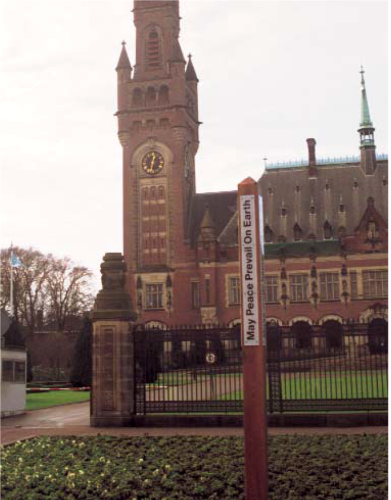
Some past attempts at international justice have been worthy of derision. After World War I, trials of Turkish and German war criminals in Istanbul and Leipzig were conducted by local judges and descended into farce. Before the war, Andrew Carnegie built the sumptuous Peace Palace in The Hague for use by an international court that he expected to prevent war; hostilities broke out the year after it was completed. Today the ornate palace is home to the International Court of Justice, whose judgments on disputes between states are often ignored when governments find them inconvenient.
On the other hand, the experience of the Yugoslav war crimes tribunal has been largely positive. The tribunal, which meets in a former insurance company building a mile north of the Peace Palace, is the first war crimes court since Nuremberg. Its proceedings are often slow and cumbersome, but they are clearly undertaken in a fair and professional manner.
The judges have convicted 18 Serbs, Muslims, and Croats of war crimes and crimes against humanity. Two have been acquitted on all charges. An additional 39 accused are in detention, including Bosnian Serb leaders Momcilo Krajisnik (plucked from his home by French troops) and Biljana Plavsic (who turned herself in). At this writing, there are 97 additional outstanding public indictments, including one against Slobodan Milosevic.
The International Court of Justice in The Hague. The Yugoslav war crimes tribunal meets in a converted insurance building nearby.
“Cynics say that the tribunals are a big fig leaf behind which the West can hide from the fact that they didn't do enough on the ground in Bosnia and Rwanda,” says Yugoslav tribunal spokesman Jonathan Landale. “But they have really gotten the ball rolling. People are realizing much more now that leaders can be held accountable for mass crimes against civilians.”
The tribunal has repeatedly demonstrated its independence, announcing its indictment of Milosevic at a time when U.S. and other nato leaders would have preferred that it keep quiet. Prosecutors carried out a preliminary investigation of Serb claims that nato forces had committed war crimes during the Kosovo bombing—a move that ruffled feathers in “Washington—but dropped the investigation when it became clear there was insufficient evidence to establish that crimes had taken place. By maintaining its independence from “the victors” of the Kosovo campaign, the tribunal has shown a commitment to the legal process rather than the political one.
“No action has been taken by this institution that should give cause for any concern in terms of acting irresponsibly or exposing citizens of any particular country to unfair prosecution,” says Deputy Prosecutor Graham Blewitt, a former Nazi war crimes investigator from Australia. “If one assumes that a future international [criminal] court is going to be doing their job fairly and honestly and without political interference, then I don't think it is an institution to be feared at all.”
The court will have jurisdiction over future crimes against humanity and war crimes only, so Henry Kissinger needn't worry about being indicted for his role in the bombing of Cambodia or the coup that put Pinochet in power in Chile. And it will only assume jurisdiction over cases that the relevant national governments are unwilling or unable to try, so U.S. courts will stay in business.
But by not participating in the International Criminal Court early on, the United States could help create a kangaroo court. Staffing appointments will be crucial to ensuring that the court has independence and credibility. The Yugoslav tribunal's integrity is the result of the appointment of highly qualified professionals who are committed to following law, not politics. “If you instead make political appointments of people who don't have these qualifications then you run the risk that something crazy might happen,” says Blewitt.
Patricia Wald, a former chief judge of the U.S. Court of Appeals in Washington, is one of three judges presiding over the Omarska case. She says international justice will always be difficult to implement, but that there will continue to be cases where national courts will be unable to act and only an international court will be able to mete out some sort of justice. Indeed it's hard to imagine Iraqi prosecutors charging Saddam Hussein with so much as a traffic ticket any time soon.
The International Criminal Court will begin operating whenever 60 signatories ratify it. When that happens, “International law and international norms are going to take an enormous step forward,” says Wald. “And we simply won't be a part of it.”