




Abstract
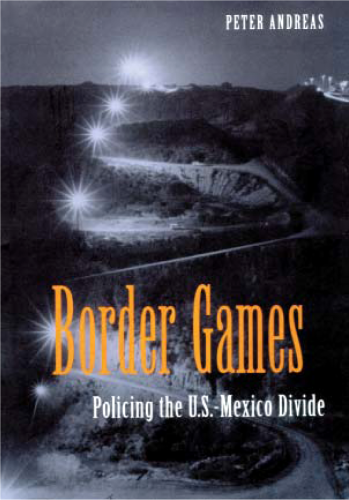
Border Games: Policing the U.S.-Mexico Divide
By Peter Andreas
University Press, 2000
158 pages; $26.00
On May 20,1997, 18-year-old Ese-quiel Hernandez was shepherding his family's goat herd near the small Texas border town of Redford. The family had recently lost several goats to feral dogs, and Hernandez, a U.S.-born high school student, was carrying a .22 rifle in case they should attack again. Not an unusual scene in south Texas.
Then things went terribly wrong. A camouflaged four-man marine unit on a drug surveillance mission happened to be hiding in the scrub nearby. The marines report that the boy, perhaps detecting movement in the brush where they were concealed, fired two shots at them. The marines did not respond but remained concealed and shadowed Hernandez for 20 minutes as he made his way back to town. At the edge of Redford, Hernandez allegedly turned and raised his rifle as if to shoot. The team commander opened fired with his M-16, killing the boy.
As a dividing line between the wealthy, industrialized north and the impoverished, developing south, the U.S.-Mexico border–like similar global faultlines elsewhere–has long been a hotbed of violence and clandestine activity. But with the denouement of the Cold War, new security concerns–international drug trafficking and transboundary migration by refugees and misplaced workers, for instance–have supplanted old ones. These new concerns are reflected in the U.S. approach to securing its territorial boundaries. Today, the U.S.-Mexico border is more heavily controlled than at any other time in its history. Es-equiel Hernandez had the misfortune to be shepherding goats in the middle of what increasingly resembles a war zone.
Border Games, by Peter Andreas, a professor of political science at Reed College, is a compelling account of the policy decisions and economic and political realities that have led to the current state of U.S. Mexico cross-border affairs. The author, a former post-doctoral fellow at Harvard University and research fellow at the Brookings Institution, fixes his account of U.S. security strategies within the broader context of free-trade politics and globalization.
Andreas describes how traditional border control equipment–fencing, stadium lights, and ground patrols–are increasingly high tech. The U.S. Border Patrol, which has seen its budget grow 148 percent since 1992, now employs infrared night-vision scopes, low-light remote TV cameras, and ground-motion sensors to monitor border activity.
Additionally, writes Andreas, “technologies and equipment originally developed for military use have increasingly been adapted for border enforcement purposes.” Magnetic footfall detectors and infrared body sensors originally used in Vietnam are now deployed on the border. The patrol also uses an electronic fingerprinting system, adapted from the navy's Deployable Mass Population Identification and Tracking System, to track previously apprehended border crossers.
In 1995, the Border Research and Technology Center was established in San Diego to facilitate the conversion of defense technologies to border-policing uses. Experimental devices tested at the center include an electronic current that stops a fleeing car, a camera that can see into vehicles to find hidden passengers, and a computer that checks commuters by voiceprint.
As the Hernandez incident indicates, the security buildup has also led to a growing fusion of law enforcement and national security agencies and missions. Marine patrols were halted after the Hernandez shooting, but the military continues to play a key role in support and surveillance activities.
“These developments,” Andreas muses, “defy the conventional wisdom that borders have become increasingly irrelevant in the so-called age of globalization.”
The central question of Border Games is why this unprecedented tightening of border controls is occurring at the same time that free-trade agreements are opening up borders and supplanting state control of commerce. In answering this question, Andreas demonstrates how U.S. security policies can be shaped by unrelated political concerns.
In case study after case study–with facts, statistics, and comments from officials to back him up–Andreas argues that intensified anti-narcotics and anti-immigrant controls have been promoted by policymakers less to deter the influx of undesirable commodities than for purely political reasons. For example, he says, the dramatic buildup of antidrug forces on the southwest border under the Bush and Clinton administrations helped ease passage of the North American Free Trade Agreement (nafta) in Congress. “Projecting an impression of cross-border commitment and progress in the anti-drug campaign has ultimately proved to be more politically consequential for U.S. and Mexican leaders than whether or not the drug supply has actually been reduced,” Andreas writes. “The escalation of enforcement efforts has helped to fend off political attacks and kept the drug issue from derailing the broader process of economic integration. In other words, a policy that has largely failed in its stated goal has nevertheless helped to realize other key political objectives–most notably the creation and maintenance of nafta.”
At first blush, it's hard to accept the author's premise that the massive U.S. border buildup is more about spin than control. But under An-dreas's scrutiny, the official policy line–that somehow the United States can stop migrants and drugs from coming north by simply strengthening its borders–begins to crumble.
The U.S. demand for drugs and cheap, tractable migrant labor continues to grow. Yet U.S. policy-makers nearly ignore the politically sensitive issue of demand-side enforcement. According to Andreas, the Immigration and Naturalization Service allots a mere 2 percent of its budget for enforcing sanctions on companies and individuals who hire migrants without work documents. Unchecked demand results in huge profits for those trafficking in drugs and humans. The Mexican government estimates that in 1994, gross revenues of Mexican drug-smuggling rings reached $30 billion; the previous year, Mexico's most important legal export, oil, generated $7.4 billion.
According to Andreas, smuggling organizations have successfully responded to stronger border controls by employing new and more sophisticated strategies. In the United States, cocaine and other illicit drugs are just as available–and just as affordable–as they were 10 years ago. Andreas cites a 1994 Rand study which found that $34 million spent on treatment would reduce domestic cocaine use to the same degree that $366 million spent on border interdiction or $783 million spent on eradication does.
In the end, Andreas concludes, it's simply easier–and politically expedient–to blame U.S. drug and immigration woes on a poorly protected border. “Border policing, from this perspective,” writes Andreas, “is not only a means to an end but an end in itself.” And once policing is stepped up, he adds, policy-makers and officials “find it difficult to change course because of the political embarrassment of seeming to backtrack on previous commitments.”
Some readers will come away from Border Games convinced that stronger border controls are still the best answer to international drug and migrant flows, but the book will have forced them to think through that assessment. Those opposed to current U.S. policy will find that while Andreas avoids a lot of prescriptive analysis, he does weigh in with an insightful recommendation or two.
Missing from the analysis is the human side of the equation, which has provoked criticism about the book from human rights advocates in the border region. The Border Patrol's blockade strategy has forced border crossers away from traditional crossing points to new areas, where they face a combination of rough terrain, severe weather conditions, and angry landowners. Migrants are dying in record numbers from exposure, accidents, and violence. Nearly 500 migrants died in 2000, and there is a direct relation between that grim fact and U.S. policy–yet Andreas refers to this only a few times, and with little detail when he does.
But this omission actually strengthens the book: The author measures U.S. border policy by its effectiveness vis-á-vis its stated goals, not by its moral shortcomings. By identifying serious policy problems rather than making emotional appeals, An-dreas's analysis has greater impact.
While the focus of Border Games is current U.S. border policy and the role of domestic politics in shaping that policy, the book has a much larger underlying theme. In a nutshell: In an age of unprecedented global change, what is the most appropriate, logical, and far-sighted way to deal with the byproducts of that change (massive migration and the specialization by poor countries in the production and export of illegal commodities)?
Andreas offers few answers, but he leads the reader to the question. And it's a question one wrestles with long after having turned the book's last page.