




Abstract
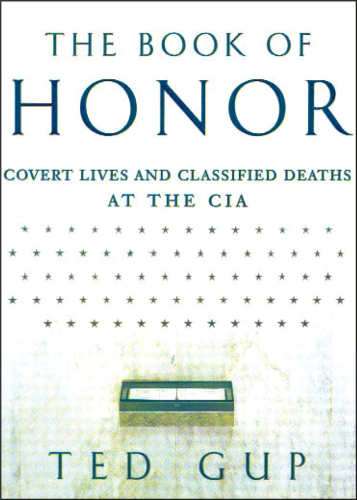
The Book of Honor: Covert Lives and Classified Deaths at the CIA
By Ted Gup
Doubleday, 2000
390 pages; $25.95
There were many heroes before Achilles, an ancient author once wrote, but they had no Homer to tell their tales and so their names were forgotten.
In this engaging volume, investigative reporter Ted Gup uses his storytelling talents to rescue dozens of deceased heroes and heroines of the Central Intelligence Agency from the anonymity to which they had been consigned for security reasons.
Gup's account begins with a visit to the lobby of cia headquarters in Langley, Virginia, where he was intrigued by the five rows of stars engraved in the marble wall above a sealed case containing the Book of Honor–a memorial to cia employees who have died in the line of duty (a total of 77 as of last year). Some of them are named in the Book, but the majority are not.
“How, I wondered, could a memorial purport to remember those who are unknown to all but a few?” Gup writes. “And what sort of person would be willing to make the ultimate sacrifice–the loss not only of life but of identity as well?”
Propelled by these questions, the author set out to discover as much as he could about cia officers who died undercover during the past 50 years. In a triumph of investigative journalism–and without the cooperation of the spy agency–he succeeded to a remarkable degree.
Gup presents affecting portraits of many of these individuals, drawing upon the memories of colleagues and family members. He traces the paths that brought them to the cia and describes, as far as could be determined, the circumstances of their deaths.
There is the heart-rending story of Hugh Redmond, captured in China in 1951 while on an intelligence mission. According to Gup, Redmond, who eventually died in a Chinese prison, might have been released if he had been willing to confess his CIA affiliation, or if the U.S. government had been willing to acknowledge it. The Chinese government indicated, as Janet Reno would say of Wen Ho Lee, that Redmond “held the keys to his own release.” But no such confession or acknowledgment was forthcoming and Redmond spent 19 years in squalid Chinese prisons–during which time he studied Chinese, Russian, and several other languages–until his death in 1970.
Larry Freedman, a college dropout who was fascinated with war, mastered a range of martial disciplines and was known by friends as “super-jew.” As a soldier in Vietnam, he acquired a chestful of combat decorations and went on to become a member of the counterterrorist Delta Force. A colorful if dangerous character, Freedman was killed by a land mine in Somalia in 1992 during a cia operation securing airports before U.S. military forces arrived. His death was described to the press as that of “a civilian employee of the Department of Defense.”
Gup highlights the ironies involved in many CIA operations. He recounts, for example, the stories of Mike Deuel and Mike Maloney, who posed as refugee aid workers for the Agency for International Development (aid) in Laos in 1965. In actuality, the two cia officers were busily recruiting Laotian farmers into anti-communist paramilitary groups. (The two died when their helicopter crashed while making payroll stops at the villages of cooperative tribesmen.) The officers' “real mission,” writes Gup, “was adding to the refugee problem and creating an ever-greater need for aid's assistance. As the cia succeeded in attracting more and more indigenous tribesmen into the ranks of its anti-communist units, there were fewer and fewer men left home to plant and harvest rice and other food crops…. There might well have been widespread famine had it not been for the intervention of genuine AID missions in the region.”
It is unlikely that any future work on intelligence history will be able to supersede Gup's achievement–partly because he did such a thorough job, but also because he has covered his tracks and completely obscured his sources, making it difficult or impossible for other researchers to confirm, refute, or further develop his work. While it is understandable that many of his interviews were conducted on a not-for-attribution basis, there is not a single footnote to indicate his documentary sources, or to point interested readers to additional sources of information. The book seems to have been written for those who, as an advertising slogan might put it, “are only going to read one book on intelligence.”
It is often impossible to distinguish between the results of Gup's own prodigious reporting and the unat-tributed work of others. Thus, for example, a reader might conclude that Gup uncovered a remarkable cia campaign to discredit an Indonesian official by distributing defective condoms with the official's name printed on them. But this little-known dirty trick was disclosed by Joseph B. Smith in his 1976 memoir Portrait of a Cold Warrior.
Although Gup succeeds in fleshing out the names behind the stars in the cia's Book of Honor, his book inevitably raises questions that he hardly begins to address. For example, in what sense is the cia officer who died along with 258 others in the 1988 explosion of Pan Am 103 a hero? Does he have a higher claim on our memory than any of his fellow passengers?
And what is heroism anyway? Judging by these stories, it is a matter of physical bravery and endurance. As instruments of the U.S. intelligence bureaucracy, these cia officers had little scope for independent moral judgment and self-determined action, and so their lives hold limited instruction even for sympathetic readers.
Nor does Gup spend much time examining whether the actions of these individuals and their cia bosses did more to promote American values or to undermine them. Final answers to these questions will have to await a full accounting of the role and impact of U.S. intelligence operations during the Cold War.