




Abstract
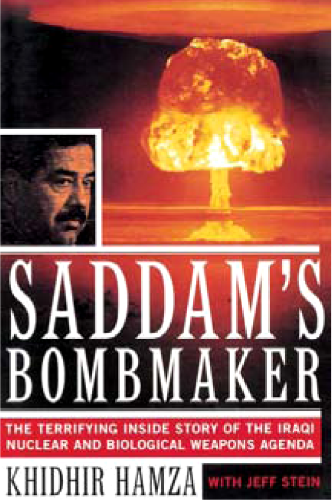
Saddam's Bombmaker: The Terrifying Inside Story of the Iraqi Nuclear and Biological Weapons Agenda
By Khidhir Hamza with Jeff Stein
Scribner, 2000
352 pages; $26.00
Last November, the Bulletin's elec-tronic BulletinWire ran a short news item about Khidhir Hamza's book, Saddam's Bombmaker. The news update, which was based on various newspaper accounts, said that Hamza claimed Iraq has a small nuclear bomb and the means to manufacture more. Soon after the item was posted, Hamza responded, writing: “Nowhere in my book do I [claim Saddam Hussein has a nuclear bomb].” Regrettably not having read (or even seen) the book, BulletinWire admitted culpability and quickly posted another update to set the matter straight. The next day, a copy of Saddam's Bombmaker arrived in the Bulletin's mailbox. The first sentence: “I've been wanting to write this story since the day I fled Iraq to warn the West about Saddam Hussein's nuclear bomb.”
But having nuclear weapons is not a matter of splitting hairs–you've got them or you don't. As it turns out, Saddam doesn't have the necessary fissile material (among other things). That lead sentence can be chalked up to authorly dramatics, probably designed to draw the kind of attention that the media gave it in the first place.
But it is an effective hook, and it draws the reader into an artfully told autobiographical account of Hamza's time serving as a top scientist in Saddam's regime, revealing along the way what Saddam did have in the way of secret weapons.
In the 1960s, Iraq bankrolled Hamza's master's degree in nuclear physics at MIT and doctorate at Florida State University. Shortly after Hamza finished his education and settled into life as a math teacher at a small Georgia college, Saddam demanded his return–and repayment in the form of government work. It was the early 1970s, and soon Hamza was chairing the Iraqi Atomic Energy Commission's physics department, happily pursuing peaceful uses of nuclear energy. But the honeymoon didn't last long. Hamza was soon told to draft a blueprint for an atomic bomb program. Realizing the moral implications of collaboration, but feeling more immediately the dangers of his situation (“If I said the wrong thing, [they] could have me killed right now, out back”), Hamza agreed.
And so began Hamza's involvement in Saddam's secret nuclear weapons program, a program that to this day is not fully understood. For 20 years Hamza labored under the pressures of a regime that frequently hauled its scientists off to torture chambers. He finally orches-trated his escape (no thanks to an initially inept cia) in 1994, fleeing first to Libya and then to the United States.
Hamza's recollection of these years will be of interest to the scientific community as well as to others. Tales like that of a bloodied, delirious Saddam with a throat-slit woman dead in his bathtub are an appropriately frightening backdrop to the inside story of Iraq's secret weapons programs. Hamza's tale is light on specifics but heavy on drama.
Most readers will be familiar with the International Atomic Energy Agency's trouble penetrating the secrecy of Iraq's nuclear weapons program a decade ago, which Hamza recounts with an insider's perspective. But it is in passages about Iraq's chemical and biological weapons programs that he makes more eye-opening assertions. For example: “Saddam's use of chemical weapons on humans began with Iraq's own Shiites, not, as is commonly believed, the Kurds.” As the Iran-Iraq war got under way, Saddam saw Shiite citizens as potential turncoats to Iran and began putting combat-aged Shiite men behind bars. And thus, according to Hamza, a new subject pool for chemical and biological weapons experimentation was formed.
In 1984 and 1985, hundreds of Shiite prisoners were fatally subjected to chemical and biological agents, resulting in the need for mass burial grounds, Hamza writes. Prisoners were allegedly taken to Iraqi Kurdistan (a location where the anti-Kurdish Saddam didn't care about environmental contamination), placed in trenches, and subjected to aerial dumps of canisters full of chemical agents.
And in 1987, Hamza writes, Saddam instigated more biological and chemical attacks on Kurdish villagers than is widely known. In the most well known incident, made famous by the wire photos of dead women and children, thousand of Kurds in Halabjah were killed with sarin, tabun, soman, and mustard gases. Encouraged by the “success” of these attacks, Saddam used chemical weapons against the encroaching Iranians–and prevailed after almost a decade of fighting, ending the Iran-Iraq war.
Chemical and biological weapons programs also played an unrecognized role in the Gulf War, according to Hamza. Aware of the imminent approach of Allied forces, Saddam ordered chemical and biological weapons stockpiles buried in caches to resemble normal ammunitions depots from the air, in the probable paths of oncoming troops. When the approaching Allied soldiers blew up the bunkers, they not only destroyed secret biochem weapons before they could be discovered, but also exposed unknowing soldiers to an array of harmful agents. This exposure, theorizes Hamza, is the source of the mysterious Gulf War syndrome. Why, then, have we never heard such allegations before? Because it's in the best interests of both Saddam and the Pentagon to keep quiet, Hamza thinks.
The problem with these claims, and others, is the lack of sources. Like the story of the dead woman in the bathtub, most are anecdotal and un-attributed, or use unnamed sources.
Although Saddam still lacks enough fissile material for a bomb, Hamza is certain that Iraq is working toward a nuclear goal, as well as continuing work on chemical and biological weapons. The best way to stop Iraq's progress, Hamza proposes, is to stop Russian scientists from entering the country, and to help Iraqi scientists escape Saddam's regime. “It is,” Hamza concludes, “the civilized world's urgent duty to help.”