




Abstract

Eight years ago, Shimon Peres, then foreign minister, declared “a farewell to chemical arms” as Israel became one of the first countries to sign the Chemical Weapons Convention (cwc), the treaty that prohibits the development, production, stockpiling, and use of poisonous gases and chemical agents as weapons.
Instead of saying no to another international regime, Israel seemed to show unprecedented acceptance–at least in principle–of the heavy burdens of inspection and verification called for in the treaty. On the other hand, the government planned to hold off when it came to ratifying the treaty.
At the time, a decision to sign but delay ratification was seen as the best policy option (also strongly urged by the United States). After all, Israel is surrounded by neighbors with large stockpiles of chemical weapons, some of whom have used poison gas in recent wars. Then, too, Israel is widely believed to have a powerful chemical-weapon capability of its own, built years ago as a “midway deterrent” between conventional and nuclear options.
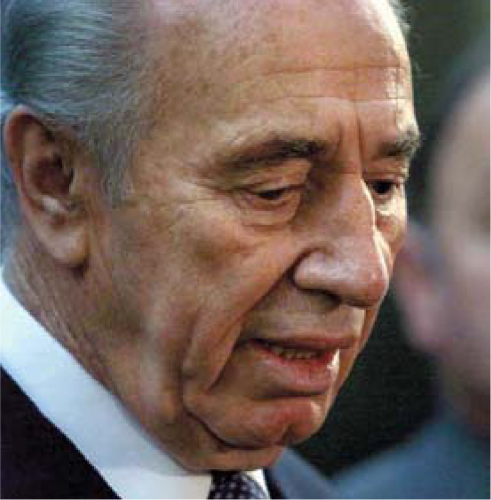
Shimon Peres signed the Chemical Weapons Convention in 1983.
“We believe that chemical weapons should be taken off arsenals all over the world,” one senior defense official in Tel Aviv told me last December. “But as long as this is far from reality, we have to contend with the threats surrounding us. These weapons do have some deterrent value, and we see a certain advantage in it.” The best course for Israel, said the official, is to maintain “constructive ambiguity” concerning chemical weapons. But “we don't hint anything, nor threaten anybody,” he added.
Still, the question of ratification cannot be set aside until eternal peace comes to the Middle East. Israel must make a choice. If it ratifies, it will have to open certain facilities for international inspections, something unheard of in security- and secrecy-oriented Israel. The defense establishment would prefer constructive ambiguity. Even if “it costs us $100-200 million a year, it might be worth it,” said the defense official.
The deadline for a ratification decision is approaching. As early as spring, controls on international trade in “Schedule III” restricted dual-use chemicals will take effect. After that, trading in those items will be monitored and permitted only between full members of the convention.
Israeli industries import about 5,000 tons of Schedule III chemicals every year, mostly from treaty parties–Germany, Switzerland, the United States, and China. These imported chemicals are used as raw materials in the manufacture of medicines, detergents, and electronic components. Without them, industries will have to shut down assembly lines–or transfer their production facilities and R&D labs abroad. (Because Israel represents only a tiny fraction of the global chemical trade, there is little chance that foreign producers would be willing to circumvent the treaty to supply their Israeli clients with forbidden merchandise.)
So far, the treaty's export requirements have caused little damage. Last year, when the trade embargo on “Schedule II” chemicals took effect, the list included only one relevant product, used by a single chemical plant in Israel, and the company somehow found a way around the problem. This time, with Schedule III just around the corner, the economic implications are substantial.
The foreign ministry, wary of trouble ahead, raised the issue last September and called for a government-wide review of the decision to avoid ratification, taken by the Netanyahu government in 1997 when the convention entered into force.
The Israeli defense establishment is united in its resistance. “As long as our neighbors see their chemical weapons as their deterrent against us, there is no point in talking about us joining the cwc,” said one defense official. “If they would sincerely enter the process of dismantling their chemical weapons and opening up for verification and inspection, we would overcome our other reservations.”
Those “other reservations” run deep. Because the treaty calls for full disclosure of past activities, if Israel did indeed develop and produce chemical weapons, it would have to submit a full declaration and open its facilities for inspection. That could involve painful admissions and open up more than one Pandora's box. Members of the defense establishment also believe that Arab countries would try to abuse the treaty, demanding challenge inspections at Israel's “holiest security sanctum,” the Dimona nuclear reactor, by claiming that its grounds are used to store chemical weapons, an allegation Israeli officials deny.
But possible embarrassment is only part of the problem. Israeli officials say the treaty's required transparency would put Israel at a disadvantage: “We cannot and will not tell lies,” they say. But “Iran entered the cwc and lies outright, and Syria, which owns the largest chemical stockpile in the region, is not even thinking about signing.”
To emphasize their point, Israelis frequently cite Egypt's use of poison gases in Yemen in the 1960s and Saddam Hussein's chemical attacks on Iranian soldiers and on his own Kurdish citizens during the prolonged Iraq-Iran war of the 1980s.
From day one, the chemical treaty has been used as a tool in regional power plays. Egypt, which calls for the dismantling of Israel's nuclear deterrent, decided it would not sign the cwc unless Israel joined the Nuclear Non-Proliferation Treaty first, and called on other Arab countries to follow suit. It was joined by Syria, which poses the main chemical threat to Israel, with its sarin and vx stockpiles, chemical-capable Scud missiles, and relatively short distances to Israeli population centers. Iraq and Libya, both producers of chemical weapons, also remain outside the convention. Moderate Arab countries like Jordan, Tunisia, and Morocco (which lack nerve gases anyway) broke ranks and signed the treaty.
Iran presents a particular problem. From the beginning, the Iranians have been very active in the Organization for the Prohibition of Chemical Weapons (opcw), which was created to implement the chemical convention. After ratifying the treaty, they admitted they had made an effort to develop chemical weapons during their war with Iraq, and they invited inspectors to visit.
Despite this seeming openness, Israeli and American intelligence assessments suggest that Iran has been far from honest, and that it has a chemical-weapons effort that is going full-speed ahead. According to a cia report to Congress last August, Iran is continuing “to seek production technology, training, expertise, and chemicals that could be used as precursor agents in its chemical warfare program.” Tehran denies the charge.
Israel is not currently under international pressure to accede to the treaty, nor does it anticipate any serious pressure ahead, although the opcw director, Jose Bustani, called on Israel to rethink its position in a U.N. address last October:
“By virtue of signing the convention, Israel has already entered into an obligation, inter alia, not to ‘develop, produce or stockpile’ chemical weapons. What, then, is preventing it from ratifying the convention and codifying its political commitment in legal terms?”
In the past, the national security establishment's objections would have been enough to prevent any serious discussion of ratification. Now, times have changed, and a strong industrial-diplomatic lobby is facing off with the Defense Ministry. Ratification proponents want to avoid trouble for the civilian chemical industry, and there is now a greater desire to accept global norms of behavior to avoid isolation.
Justice Minister Yossi Beilin is the main advocate for breaking traditional taboos and joining the international community. He recently lobbied successfully against the military for the signing of the International Criminal Court convention. Beilin now calls for ratifying the cwc: “We must not become a pariah state, and also pay a heavy price in denying necessary materials and data for our industries,” he says. “We can't be stuck in the mud forever, only because of things that were or were not done in the past.” While they echo the same feelings privately, Foreign Ministry officials are hesitant to argue with the defense lobby in public.
Israeli Justice Minister Yossi Beilin favors ratification.

The Ministry of Industry and Trade (i&t), with its industrial constituency, has no such hesitations. The ministry's leaders have asked repeatedly for the treaty to be ratified so they can prepare the legal and administrative framework for its eventual implementation. The ministry has begun issuing end-user certificates, requested by treaty members, for the civilian industries that import controlled chemicals. But this, of course, is insufficient for full treaty compliance.
Defense officials are not impressed by industry's concerns, and they believe that eventually some way out will be found. In response, their counterparts at i&T complain about the defense establishment's inflexibility and ignorance. “These people have never seen a chemical plant from the inside, and their ideas for solving the problem are impractical,” an i&T official told me.
Up until now, and not unexpectedly, national security considerations have prevailed. And political leaders will, as usual, delay their intervention to the last possible moment. Industry, with some help from its friends in the foreign ministry, hopes to plead its case more successfully when decision time comes.
But with the revival of the old security mentality and fears of war in Israel brought about by the renewed Intifada late last year, it is doubtful that policy will change. In all likelihood, Israel will stick to its ambiguous chemical option and remain outside the treaty until international pressure forces a change.