




Abstract
The idea of using a nuclear powered submarine to haul cargo under the ice-covered Arctic is as old as the nuclear submarine itself. Back in 1958, as the uss Nautilus was crossing the Arctic to become the first ship to reach the North Pole, a feasibility study by its builder, the Electric Boat Co., concluded that a double-hulled submarine tanker displacing 50,000 tons submerged could be built to carry 30,000 tons of oil. But it wouldn't be economical.
In the 1970s, oil-price shocks, coupled with the discovery of oil in Alaska, prompted a second look. Instead of building a pipeline across Alaska, would it be worthwhile to haul the oil to California under the ice? Nope–still too expensive.
Now the idea has reemerged, but with a twist. What if the submarines were free? And what if they had been designed and built to be able to surface through thick pack ice?
In 1997, Vladimir Potanin, one of the youngest and most astute of Russia's new ^s tycoons, bought rao Norilsk Nickel, the world's biggest producer of nickel and palladium. Built in the 1930s with prison labor–and a cost of thousands of lives–the spraw-ling mining-and-smelter kombinat is today one of Russia's most profitable enterprises, with 1999 sales of $2.9 billion and profits of $1.3 billion–and sales for 2000 estimated at $5.4 billion. Most of the company's 103,000 employees work in the city of Norilsk, 700 miles north of Russia's highway network, where they produce 22 percent of the world's nickel, along with 60 percent of its palladium, 40 percent of its platinum, and significant amounts of copper and cobalt.
Getting these valuable metals to markets, mostly in Western Europe, is no easy task. They are loaded onto ships in Dudinka, a bleak port on the vast Yenisei River, and hauled 350 miles north to the Kara Sea, where the ships turn west for an 1,100-mile coastal voyage to Murmansk, Arctic Russia's main ice-free port. There, the icebreaker turns back and the cargo ships continue to their destination, usually Rotterdam. Only during the summer can the ships travel without icebreakers.
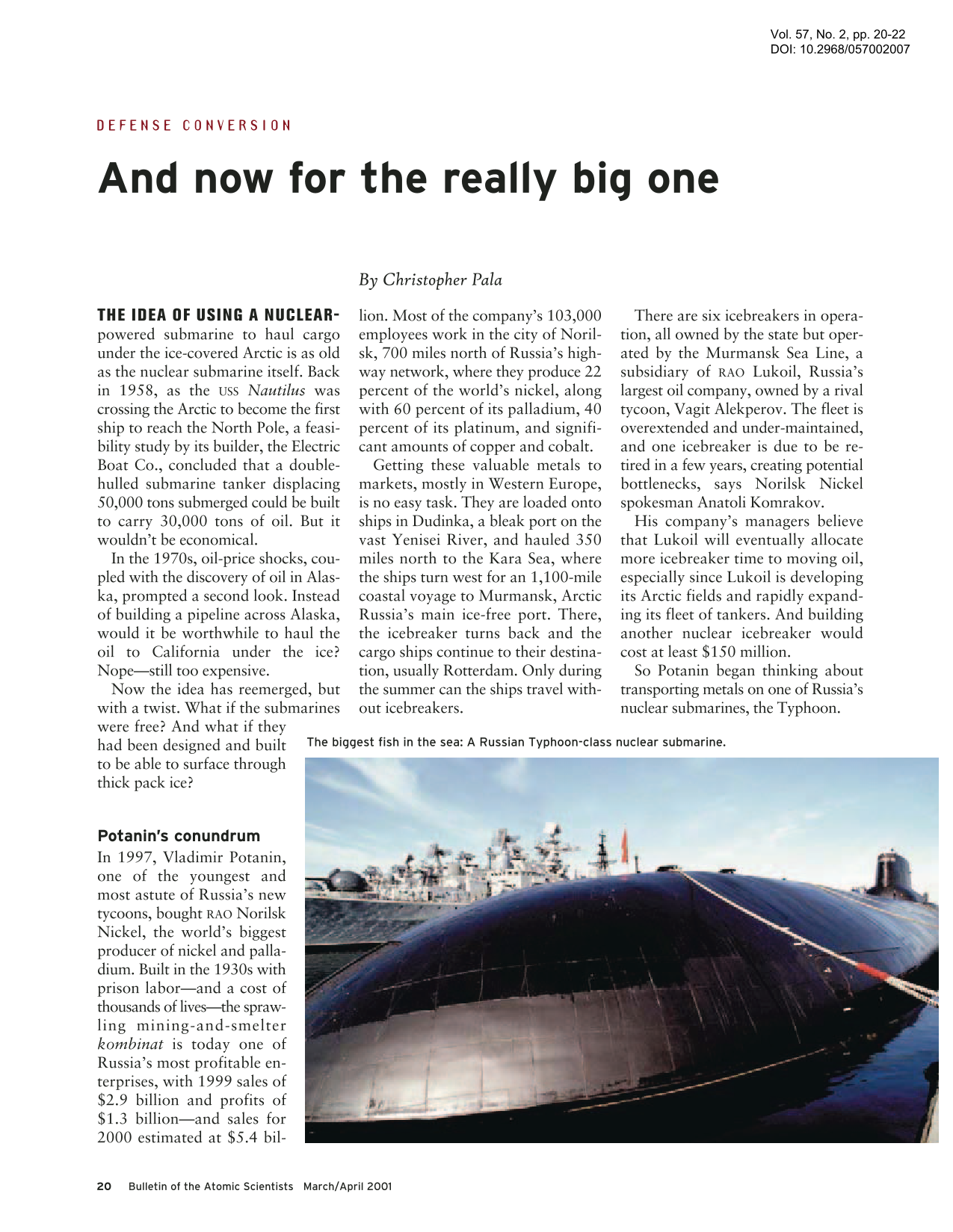
The biggest fish in the sea: A Russian Typhoon-class nuclear submarine
There are six icebreakers in operation, all owned by the state but operated by the Murmansk Sea Line, a subsidiary of RAO Lukoil, Russia's largest oil company, owned by a rival tycoon, Vagit Alekperov. The fleet is overextended and under-maintained, and one icebreaker is due to be retired in a few years, creating potential bottlenecks, says Norilsk Nickel spokesman Anatoli Komrakov.
His company's managers believe that Lukoil will eventually allocate more icebreaker time to moving oil, especially since Lukoil is developing its Arctic fields and rapidly expanding its fleet of tankers. And building another nuclear icebreaker would cost at least $150 million.
So Potanin began thinking about transporting metals on one of Russia's nuclear submarines, the Typhoon.
The Typhoon is arguably the most lethal weapon ever built. Armed with 20 SS-N-20 Sturgeon missiles (the world's largest), each with 10 100-kiloton warheads, it carries more firepower than the combined power of all the bombs dropped in World War II. Displacing 36,000 tons submerged, it is nearly twice as large as its closest rival, the 19,000-ton U.S. O^fo-class boomer. Its colossal bulk gives it an estimated 30 to 45 percent reserve buoyancy, enough not only to break through the 10 feet of ice that covers most of the Arctic Ocean, but also to ride high enough in the water to clear the ice from its missile hatches. Its two propellers are partly protected against the ice, and its sail is reinforced. Its diving planes, mounted on the bow, are retractable–a novelty.
The United States first heard about the Typhoon during a Vladivostok summit meeting in 1974, when Soviet leader Leonid Brezhnev told President Gerald Ford that, in response to the Ohio, the Soviet Union would launch a giant strategic sub called the Typhoon. Nato code-named the Russian sub the Typhoon class.
Unaware that the Soviets had already named it Akula (“shark” in Russian), in 1984 nato assigned the code name Akula to a completely different class, a 10,000-ton attack submarine. Mercifully, Norilsk Nickel refers to the object of its desire as the Typhoon, minimizing confusion.
The Typhoon fleet embodied a shift in Soviet strategy. The comparatively noisy Soviet strategic subs could be shadowed with relative ease in the Atlantic and Pacific by quieter U.S. attack subs, so the Typhoon was designed to retreat to the safest bastion of all: the Arctic Ocean, where the Typhoons' Kola Peninsula base is located.
U.S. submarines can cross the Arctic, but they are unable to surface in an emergency unless they find a rare patch of thin ice or open water. In a nuclear exchange, with its 4,500-nautical-mile range and increased-accuracy missiles, the Typhoon could wait out an attack, sitting silently under the pack, ready to resurface to deliver a counterstrike. Making only a weak and unsuccessful attempt to modify Los Angeles-class attack subs to tag Soviet boomers in the Arctic, the United States never did find a way to neutralize the Soviet boat, which has inspired two best-selling thrillers, Typhoon and The Hunt for Red October.
The first Typhoon was launched in 1981 and the sixth and last in 1989. Today, only three are more or less operational.
In 1999, the other three were awaiting demolition under a U.S.-funded, $250-million program to help the impoverished Russian Navy pay for the dismantling of ballistic missile launchers called for in arms-reduction treaties.
So Norilsk Nickel commissioned the St. Petersburg's Rubin Design Bureau to study the feasibility of turning the Typhoons–minus their missile and torpedo launchers–into cargo ships.
The company's general director, Alexander Khloponin, headed for the Sevmash shipyard in Severodvinsk, near Arkhangelsk, where the Typhoons were built and where missile launchers were being removed from the first of them. He had no trouble convincing the navy brass to delay cutting up the hull while the study was under way. They loved his plan, just as they hated losing the gem of their strategic submarine fleet. Adm. Vladimir Kuroyedov, commander of the Russian Navy, told a television interviewer that the project “is the best way to use surplus submarines.”
The sub's designers delivered their conclusion a year ago: For $80 million, a Typhoon could be adapted to carry 10,000 to 15,000 tons of cargo safely and reliably. Its length would be stretched from 171 to 176 meters, and its underwater displacement would be increased to a whopping 48,000 tons, just 2,000 short of the submarine tanker dreamed up by Electric Boat in 1958.
Norilsk Nickel envisions retrofitting three Typhoons. As the company sees it, a Typhoon loaded with nickel and other metals would plow through the surface ice while descending the shallow Yenisei River, using its buoyancy to push the ice apart–unlike an icebreaker, which uses its powerful nuclear engines to climb onto the ice and its weight to crush it. “Breaking through the ice is easier from below than from above,” says company spokesman Komrakov.
The sub would travel on the surface during the first, shallow section of the Kara Sea. Off the Ob estuary, it would slide below the ice and, at a speed of 25 knots–three times faster than an icebreaker-led convoy–pass south of Novaya Zemlya to reach Murmansk, where its load would be transferred to surface vessels. The entire operation would take place in or near Russian waters.
With three all-weather Typhoons plying the Dudinka-Murmansk route, Norilsk Nickel wouldn't need Lukoil's icebreakers any more. Company chairman Yuri Kotlyar is downright enthusiastic. “I think this project is absolutely realistic,” he told a wire service early last year. “I am certain we will have our first sea trials next year.”
Meanwhile, the company has ordered a second study to assess the cost of modifying the company's docks and of operating the subs. Results are due in the spring.
If the project is deemed economical, a political decision will be made later this year. Komrakov said his company favors creating a joint venture with the navy. The submarine crews would work as civilians–and presumably be paid more than the paltry $50 a month a junior officer now receives.
The ultimate swords-to-plowshares deal has plenty of skeptics.
“It's a crazy idea,” says Thomas Nilsen, a researcher at Norway's Bel-lona Foundation, which monitors environmental threats posed by Russia's Northern Fleet. “Navigating the Kara Sea is very tricky because it's so shallow.”
U.S. submarine expert and author Norman Polmar disagrees. “It's a great idea: These are marvelous ships, they're exceedingly well designed,” he said. “I know the designers at Rubin very well, and if they say it can be done, I believe them. But I doubt it would be economical, because these things are horribly expensive to run.”
“It's economically unrealistic,” agrees metals analyst Mikhail Selesnev of Moscow's United Financial Group. “They should use their healthy cash flow to build ice-breakers.”
Meanwhile, defense analyst Robert Norris of the Natural Resources Defense Council in Washington, D.C., says the United States “should support commercial conversion,” and Amb. Thomas Graham, a former head of the Arms Control & Disarmament Agency, points out that U.S. Russian treaties require the destruction of missile launchers only. Russia “can dispose of the ship as it wishes.”
So it is possible that one day a Typhoon may carry metals from Norilsk to Murmansk. On the other hand, if Norilsk Nickel executives ever had hopes that the Typhoons might range farther afield, perhaps delivering directly to their clients in Rotterdam, those were sunk last summer along with the Kursk. “No European country is going to want a Russian nuclear submarine in its waters now,” says Princeton University submarine researcher Joshua Handler.