




Abstract
Even as the Cerro Grande fire smoldered and burned, Los Alamos, the birthplace of nuclear weapons, was reeling from a series of traumatic blows.
The sun glows orange through the smoke of last May's wildfires.
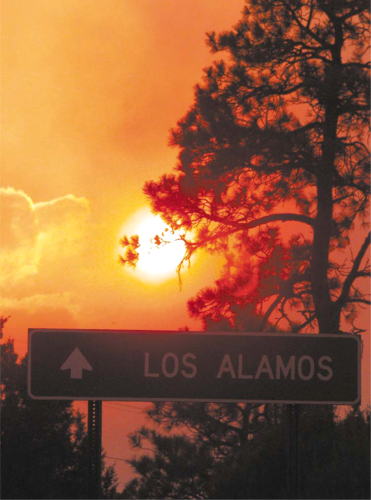
Last May a “controlled burn” by the National Park Service in Bandelier National Monument in northern New Mexico got out of control. In a matter of days, the Cerro Grande fire burned a 43,000-acre swath in and around the Energy Department's Los Alamos National Laboratory.
It was easy to see the fire as a metaphor for Los Alamos's long season of discontent. Even as the fire smoldered and burned, the birthplace of nuclear weapons was already reeling from a series of traumatic blows.
If J. Robert Oppenheimer, the lab's first director, had not suffered from childhood asthma, Los Alamos might have been just another tourist stop. But he was sent from his home in New York to a boy's ranch at Los Alamos to breathe the fresh air of the Parajito Plateau, nestled in the junipers of the Jemez mountains.
Years later, Oppenheimer proposed it as an ideal location where scientists could work in secrecy on the atom bomb. After the war, Los Alamos became one the premiere technical institutions of the Cold War era. The lab now occupies 43 square miles, has more than 2,000 structures, and employs more than 11,000 people.
With the end of the Cold War, everything changed for Los Alamos. For decades its identity had been tightly bound to the nuclear arms race. But the golden age of nuclear buildups is long gone. “The [weapons] labs are falling apart,” says Jon Medalia of the Congressional Research Service. Indeed, the aging and deteriorating nuclear weapons industrial base in the United States and Russia is collapsing as the messy process of partial nuclear disarmament unfolds.
Los Alamos National Laboratory–the designer, developer, producer, and tester of the majority of weapons amassed in America's nuclear arsenal–is facing its greatest crisis.
In an effort to shore up the nuclear weapons laboratories–Los Alamos and Sandia in New Mexico and Lawrence Livermore in California–the Clinton administration established the “Stockpile Stewardship and Management Program” after the end of the Cold War.
The program is meant to ensure the safety and reliability of the stockpile in the absence of fission-yield tests. But it is also designed to present scientific and technical challenges intriguing enough that the labs can keep–and recruit–scientific talent.
The program involves the construction of several new and expensive research and testing facilities, including construction of the world's largest and fastest computer at Los Alamos. The tab for the lab's “high priority” projects over the next several years adds up to some $4.4 billion.
A lot of money, yes. But it may not be enough to bring smiles to the lab. Sigfried Hecker, a former lab director, told me recently, “With all the things being written about this laboratory, anybody who has a choice has to think twice about coming to Los Alamos. A lot of damage has been done.”
Hecker was speaking of the laboratory's security “scandals.” The arrest and imprisonment in 1999 of Los Alamos scientist Wen Ho Lee–and the collapse of the government's case against him last September for computer security violations–has caused significant resentment at the lab.
And, of course, there was the case of the disappearing disks. During the Cerro Grande fire, computer disks containing weapons design data for use by Energy's emergency response team vanished for nearly a month and half, leading to howls of outrage in Congress. The disks later resurfaced behind a copy machine.
Lab personnel were widely pilloried in the press, on talk shows, and in Congress as incompetent and possibly untrustworthy. But they “are very loyal to this country,” Lab Director John Browne said last summer before a congressional panel. “They thought that their loyalty was being questioned.”
Others at the lab have been less diplomatic. “Quite frankly, it's a witch-hunt,” Merri M. Wood, a member of the top-secret X-division, said last August.
Because of congressional concerns over lax security, travel budgets for staff members at the lab were cut and a moratorium on visitors from sensitive countries was imposed. (The lab's discretionary research budget was also cut by $30 million, but for reasons unrelated to security concerns.)
And now, as we enter a new year, more than 2,000 lab employees face mandatory lie detector tests because of a congressional requirement in the fiscal 2001 Defense bill.
“People don't want to take lie detector tests; they don't want to come to a place that has already been beaten down. And Los Alamos has been beaten down,” weapons scientist Patrick S. McCormick told the Washington Post in August. “Why am I still here? Good question.”
Staff anger is not directed exclusively at the Energy Department and Congress. Lab managers are also targets, as evidenced by comments on the lab's electronic bulletin board. Consider this jeremiad posted last July by William S. Varnum, a weapons designer in X-division:
“It should be clear by now that the lab is in a major crisis with morale at a very low point. Many people are considering leaving…. Management is making no visible effort to support the employees. In government and business activities throughout the world, when this happens, the people at the top offer their resignations as a means of helping to resolve these crises. I think it's time for laboratory upper management to consider doing the same.”
Retirement and attrition are also taking a toll as the majority of the laboratory's technical cadre involved in the design and testing of the existing nuclear arsenal approach retirement. The annual attrition rate among scientists has jumped from 4 percent to double-digit percentages. Many are this month–January 2001–taking advantage of financial bonuses and other incentives offered by an early retirement program. Ironically, the lab's generous benefits are further undermining its ability to retain key personnel.
Concerns are growing among remaining staff members that retirees are not being replaced fast enough by fresh science graduates. That's no surprise, say many staff members. After all, who would want to work in a repressive, secrecy-obsessed environment when there are so many challenging and high-paying jobs in the private sector?
The opportunity to do basic research used to be an important draw for science graduates–“the entry to get people into the system,” as Deputy Director Bill Press puts it. But funding for basic research has been declining and today represents only 7.4 percent of the lab's budget.
The Advanced Computing Laboratory, a key element of the Energy's Stockpile Stewardship and Management Program, has taken the hardest hit. As of January, 40 percent of the staff will have left.
Asians and Asian-Americans, who claim more than one-fourth of all doctorates awarded in science and engineering at U.S. universities, increasingly shun the laboratory. “There is no question in my mind that the Asian-Americans are consciously avoiding work at Los Alamos and other labs like the plague,” L. Ling-chi Wang, director of the Asian-American studies program at the University of California-Berkeley, said last September.
The number of Asian-Americans accepting jobs at Los Alamos fell from 21 in 1998 to three last year. (Asians and Asian-Americans applying for jobs at Los Alamos plummeted from 12 percent of all applicants in 1998 to 4 percent in 2000.)
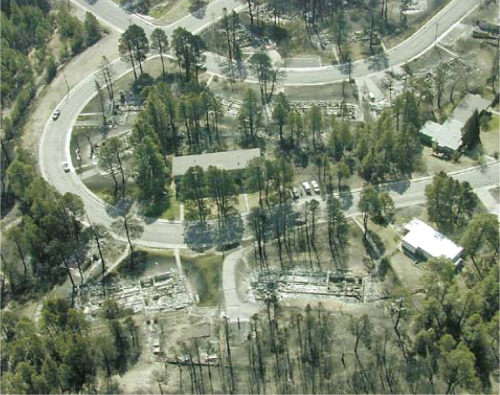
The Cerro Grande fire left more than 400 Los Alamos residents homeless, destroying or damaging hundreds of structures in Los Alamos township and on the lab's grounds. It spread over hundreds of contaminated areas and disrupted the operation of the entire site.
Vegetation in the mountains slows runoff from rain and melting snow. Once that vegetation is gone, flash floods become possible, even probable. At a nuclear weapons laboratory, that is a major problem.
Recently the Energy Department concluded that flash flood risks, mud slides, and high runoff would persist at the laboratory for as long as five years. Despite measures taken by the Corps of Engineers (including building a 70-foot-high debris dam), several test facilities, a fissile material storage vault, and a defunct nuclear reactor are vulnerable to flash floods.
There is also the possibility that surface runoff, short of flooding, could expose buried wastes and carry greater loads of contaminated sediments into water supplies. Similarly, faster seepage of water into the ground because of the loss of protective layers of soil and vegetation might also hasten the migration of subsurface contaminants into aquifers.
Security signs hang on a Los Alamos entrance gate.
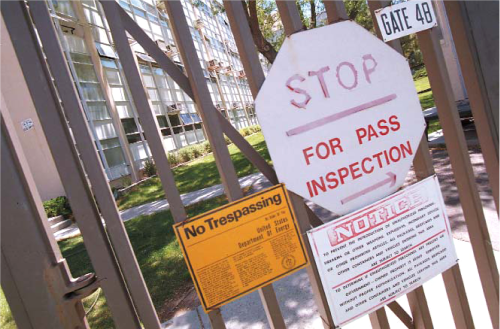
And make no mistake about it–Los Alamos National Laboratory has a formidable burden of contaminants. Last October, the Energy Department concluded that the amount of buried transuranic waste at Los Alamos was about 10 times greater than previous estimates. There are many disposal pits, burial grounds, underground tanks, and hundreds of shafts filled with radioactive or toxic wastes. Over the decades, test facilities released large amounts of radioactive materials into the environment, creating severe contamination.
In Technical Area 49, for instance, some 40 kilograms of plutonium lie at the bottom of several shallow holes, the residue of hydronuclear testing in the late 1950s and early 1960s. All told there are more than 2,120 potential “release” sites at Los Alamos.
Several canyons on the Parajito Plateau received decades of radioactive and hazardous discharges. The site's extensive canyon drainage system has steep slopes that accelerate the flow of water, sediment, and debris into the Rio Grande. The fire has made the problem more urgent.
According to Steve Reneau, the lab's soil expert, as much as 300,000 cubic meters of contaminated sediment could wash into New Mexico's largest fresh water artery during a heavy monsoon season. That is the rough equivalent of a 300-foot high mound the size of a football field.
Despite a modest monsoon season last year, radioactive contaminant levels ranging from five to 20 times higher than average reached the river.
For more than a decade, the Energy Department has been downsizing its operations, which has led to more than 46,000 layoffs around the country. Some 2,000 layoffs were at Los Alamos.
According to a study by the School of Public Health at Boston University released last October, Los Alamos workers appeared to suffer more emotional distress from job cuts than did workers at four other Energy Department nuclear weapons sites. (The others: the Nevada Test Site, the Idaho National Engineering and Environmental Laboratory, the Pantex Weapons Disassembly Plant in Texas, and the Y-12 Weapons Plant at Oak Ridge, Tennessee.)
About 6,000 Energy Department lab employees were surveyed; even though Los Alamos experienced fewer layoffs in percentage terms, there were more angry confrontations and serious psychological problems on the plateau than elsewhere. In particular, Los Alamos employees reported that bosses who had moved up from the ranks of scientists were often poor managers.
The laboratory and its subcontractors play a dominant economic role in northern New Mexico, a desperately poor area. “We are grateful for the work,” Ben Ortiz, a former employee, said last March. Hispanics constitute a major portion of the construction, maintenance, custodial, security, and waste disposal workforce.
Bitter resentment among hourly employees erupted in 1995 after 173 jobs were eliminated. Most of the laid-off employees were Hispanic. A class-action lawsuit alleging racial discrimination was filed.
In 1996, the court ruled against the laid-off Hispanic employees. But after a sustained political outcry, the lab agreed to rehire many of the workers. Nevertheless, anger among the Hispanic workers has not abated. “If the lab really cares, where is the justice? Where is the fairness? Where is the respect?” Grace Gutierrez, a former lab employee, said last spring.
Last March an unprecedented outpouring of pent-up anger and resentment occurred in Española, where many of the lab's hourly employees live. At a town meeting sponsored by the Energy Department, more than 50 workers and family members spoke of being discriminated against, of being exposed to hazardous substances, of getting sick and then having to battle against the laboratory, which seemed to spare no expense to block claims.
“In the 19 years that I worked at the lab, not once do I recall safety meetings on the hazards of chemicals. …I was never required to use protective equipment or clothing,” said Ortiz, who lost a bitter and prolonged battle against the lab to obtain compensation for respiratory and neurological disorders.
Georgia Salazar Martinez spoke about her father, Jose, who died shortly before the town meeting. Her father, who had worked in maintenance at the laboratory, had battled cancer and other diseases for several years.
“Who knows exactly what type of contamination this man was exposed to during his lifetime at work,” his daughter said. “We would wash his clothes …we would hug him as soon as he got in, so we were also exposed.”
Environmental contamination in areas beyond the lab's boundaries is a continuing problem. It results mostly from existing inactive waste sites on the lab property that were eventually transferred to Los Alamos County and private owners.
An especially bizarre example: During the 1980s, a laboratory employee operated a uranium chemistry laboratory in his suburban home in White Rock, near Los Alamos. He also had a uranium processing operation at another property he owned in Pecos, about 40 miles south of Los Alamos, where he received uranium shipments from other Energy Department sites.
The state of New Mexico granted him a license to operate the Pecos facility, but he lacked a license to operate a lab in his home. In 1994, he left the area and abandoned about two tons of depleted uranium waste in Pecos. The Energy Department was left with the task of cleaning it up. Apparently, the department took no action to force the man to pay for the cleanup.
In the late 1980s and early 1990s, the laboratory identified some 110 inactive waste sites located on property previously owned by the Energy Department. About 300 people owned homes, condos, and businesses on or near these sites. In 1991, Energy found that the lab did not have a program “to ensure continued protection of public health and the environment at inactive waste sites.” The lab seems to have regarded the contamination as trivial and it did not undertake remedial action.
Is that really asking so much?
“WANTED: Gifted, energetic scientists trained at top universities, international reputation desirable. Knowledge of physics, chemistry, mathematics and computer science reguired. Willing to work long hours. Must be extremely flexible to adjust to rapid changes of policy and detailed direction by government agencies. Psychologically capable of withstanding ridicule by congressmen and media. Should have independent means as housing is very costly in isolated area and pension uncertain. Salary increases possible in years of budget surplus. Association with top university possible but not guaranteed. Able to obtain high-level security clearance. Willing to abide by stringent security regulations, with solitary confinement possible for mishandling of classified data. Occasional lie-detector tests and FBI interrogation. Active volunteer ski club maintains slopes but no snow in recent years. Should not enjoy tennis, as courts not maintained. Help with biking trails through novel Black Forest. Fight forest fires and support flood control projects in free hours. Should be willing to disarm nuclear weapons in emergencies, including weekends. Free Red Cross lunches available. Apply to Box 1663, Santa Fe, NM 87545.”
From the help-wanted section of the Los Alamos Monitor, the lab's community newspaper, June 25,2000.
A decade later, excessive radiological contamination was found in a public area known as Acid Canyon in the township of Los Alamos. The canyon, which is open to hiking, was released to Los Alamos County for unrestricted use in 1967. During the lab's “dirtiest” period from the 1940s to the early 1960s, radioactive and hazardous liquid waste had been discharged in it. The contamination is near several homes and a public skateboard park.
Last September, after pressure from the state of New Mexico, the laboratory published recent sampling results of contaminated sediments in the canyon. Concentrations of plutonium approaching 8,000 picocuries per gram were found, readings normally associated with restricted zones in nuclear weapons plants, where workers are required to wear protective clothing.
The lab agreed to remove the contamination. For the third time in more than 30 years, Acid Canyon will undergo remediation.
Despite its various setbacks and discontents, the lab is not about to give up its long-held vision of the importance of nuclear weapons. Last June in a paper prepared for the Defense Department, “Nuclear Weapons in the Twenty-first Century,” chief Los Alamos weaponeer Stephen M. Younger advocated the development of mininukes for use against an array of targets that might be vulnerable to small, simple but high-precision nuclear weapons.
According to Younger, “We could use a gun-assembled [design similar to the first bomb dropped on Hiroshima in 1945, which did not require previous testing] or other simple, rugged designs that might be maintained with high confidence without nuclear testing.” He added:
“Such designs would require a significantly smaller industrial plant for their maintenance than other current forces. Finally, simpler weapons might be maintained with higher confidence for longer periods by a weapons staff that has little or no direct experience with nuclear testing.”
Wildfires in Los Alamos left 400 families homeless.
Younger's paper is eerily reminiscent of proposals for small precision tactical nuclear weapons made by Oppenheimer and others in the early 1950s. It also echoes the lab's push for mininukes in the early 1990s. Congress then imposed a ban on new low-yield weapons designs, which was lifted last year.
Victor Mikhailov, former head of Russia's Ministry of Atomic Energy, echoed Younger in an article published in Russia last August, called “The Twenty-first Century and Russian Nuclear Weapons.” He said: “Of great importance [to Russia] will be [the future] development of a new generation of super-precise nuclear weapons of super-small yield and with a small impact on the environment.”
Frank von Hippel, a nuclear weapons and arms control expert at Princeton, is dismayed. “They believe they have to make more ‘usable’ nuclear weapons–a quest that has driven the arms race for many years. Now that the Cold War is over, Younger and Mikhailov think that maybe there is still a niche market. But if these things can't be done with conventional weapons, it is not worth breaking the nuclear taboo.”
Even as the Youngers and the Mikhailovs dream of mininukes, the U.S. and Russian nuclear weapons industrial infrastructures are collapsing and the costs to shore them up are enormous. Even in an age of bilateral nuclear arms reduction agreements, the expense of maintaining thousands of nuclear weapons and paying for their environmental and nuclear material legacies is staggering.
Huge amounts of unstable materials contained in deteriorating U.S. and Russian facilities are a growing menace. Russia is unable to meet START I warhead levels because it cannot afford to build the facilities needed for nuclear material and waste storage. In the United States, large amounts of nuclear explosives are still stored in decades-old wooden buildings.
Yet the enormous expense of maintaining nuclear weapons is compelling Russia to unilaterally slash its nuclear arsenal to pay for more urgent conventional force requirements. The United States, even with its great wealth, can no longer afford to maintain its large nuclear weapons production complex, which is expected to shrink to 10 percent of its Cold War capacity.
Given these circumstances, decisions regarding the U.S. and Russian nuclear weapons postures will be increasingly influenced by the large legacy costs associated with the nuclear weapons industrial facilities.
Despite the end of the nuclear arms race, the United States is spending $5 billion on the Energy Department's nuclear weapons program–its highest level ever. Los Alamos's nuclear weapons spending takes up half of that amount–or about 15 percent of the Energy Department's total budget for all of its missions. Much of the money is going into the building of new facilities required for the stockpile stewardship and management program–and to repair the damage created by the Cerro Grande fire.
Money, however, is not the answer to the “brain drain” problem. It certainly has not quelled growing resentment among Hispanics and Asian-Americans, who play prominent if disparate roles at Los Alamos. Nor has it reduced growing anxieties about the risks posed by the lab's environmental legacy in nearby communities and to the Rio Grande. As New Mexico's primary water supply, the Rio Grande is regarded by residents of New Mexico as far more important than the laboratory.
The strong support of Los Alamos by Republican Sen. Pete Domenici of New Mexico, chairman of the Senate Budget Committee, has a lot to do with the laboratory's large budgets. In response to the Cerro Grande fire, Domenici was able to direct more than $500 million in additional funds to compensate homeowners for loss of property and to deal with the post-fire risks of flooding and runoff.
“Despite the federal largesse the stockpile stewardship program at Los Alamos enjoys, it has a very narrow and vulnerable congressional support base,” says Keith East-house, a former reporter for the Santa Fe New Mexican, who covered the lab for years. “The lab's ability to command funds is primarily in the hands of one person, Pete Domenici, who is now in his 70s. “What will happen when he leaves is anybody's guess.”
Former Los Alamos director Sig-fried Hecker is concerned. The lab has a dim future, he says, “unless we can turn around the way people view the lab, and unless we can attract people with exciting research to help solve national problems.”