




Abstract

Brig. Gen. Amos Gilad is a brisk, assertive Israeli intelligence officer who made his career following the actions of Middle Eastern dictators such as Saddam Hussein and the late Hafez Assad. Since 1996, as head of the military intelligence division of research and analysis, General Gilad has warned against what he sees as the gravest threat to Israel's security: the Iranian effort to acquire nuclear weapons and long-range ballistic missiles, assisted by a flow of technology and expertise from Russia. He and his colleagues in intelligence regard this issue as a top national priority. Prime Minister Ehud Barak appears to believe it is less important.
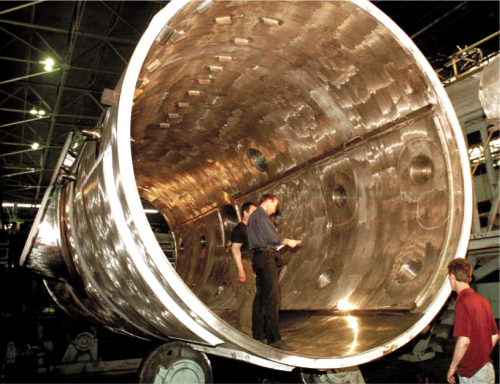
Russian workers inspect a steam separator casing for Iran's Bushehr nuclear power plant.
In the wake of the Gulf War that weakened Iraq, Israel identified Iran–with its hardline Islamic ideology, opposition to the peace process, and support for Hizbollah guerrillas and Palestinian Islamic terrorist groups–as its main regional adversary. An Iranian bomb would break Israel's nuclear monopoly in the region and alter the balance of power in the Md-dle East. According to Israeli intelligence, Iran will achieve “initial operational capability” for its nuclear force as early as 2005, and perhaps sooner, if Iran obtains enough fissile material through the black market.
The Iranian missile program is more developed than its nuclear counterpart. Last July, Iran successfully launched the 1,300-kilometer Shihab 3, capable of targeting all of Israel, and the program is now headed toward deployment with the assistance of Russia, which provides help with the guidance systems for the missiles.
Recently, however, Israeli concern has shifted from missiles to bombs. Even though the Shihab program is much further along than Iran's nuclear program, which still faces crucial stages of development, the possibility of Iran obtaining the bomb poses a much larger threat. Israel is also concerned that Russian assistance has accelerated Iran's nuclear program.
According to Israeli officials, Iran intends to create an infrastructure for producing plutonium and highly enriched uranium. From Russia come necessary parts and knowledge–but not fissile material. Nuclear technology leaks from Russia to Iran through two main channels, according to Israeli intelligence. One way is through clandestine deals and phony companies. A more transparent way, however, is through nuclear power arrangements, including the 1,000-megawatt nuclear power plant under construction outside Bushehr, for which Russia has an $800 million construction contract. A $1 billion contract for a second reactor at Bushehr is pending. Although the plant will operate under International Atomic Energy Agency safeguards, Israel remains suspicious.
“Why would Iran, one of the world's largest oil producers, need a nuclear power station?” asks a senior Israeli defense official. “The Bushehr project enables the training of Iranians in Russia, employing Russian experts in Iran, and procuring equipment for so-called legitimate civilian purposes.”
General Gilad believes that Moscow is trying to regain a foothold in the Middle East, a sort of counterbalance to U.S. deployments in the Persian Gulf. Israeli intelligence identifies Yevgeni Adamov, head of the Russian Ministry of Atomic Energy (Minatom), as the mastermind behind the technology transfer to Tehran. They describe him as an old-style ideologue, resentful of his country's decline into a second-rate power. Adamov needs to find work for his under-employed scientists and engineers as well as hard currency from export deals. Yet Israeli officials say that policy directives originate from higher-ups at the Kremlin.
U.S. intelligence depicts a similar picture. An August 2000 cia report reads, “Despite some examples of restraint, Russian businesses continue to be major suppliers of wmd [weapons of mass destruction] equipment, materials, and technology to Iran. Specifically, Russia continues to provide Iran with nuclear technology that could be applied to Iran's weapons program.” U.S. intelligence, however, falls short of accusing the Russians of helping Iran create weapons.
Robert Einhorn, assistant secretary of state for nonproliferation, told a Senate hearing in October: “We don't doubt the Russians when they say their interests would be harmed at least as much as ours by Iran's acquisitions of these capabilities. But if the Russians believe that the nuclear and missile cooperation now under way will not actually contribute materially to, and accelerate Iran's acquisition of such a capability, they are engaging in wishful or short-sighted thinking.” Einhorn added, “We are convinced that if Russia's leaders gave the matter sufficient priority, Iran's nuclear and missile procurement efforts in Russia could be stopped.”
Why is it that Iran, one of the world's largest oil producers, needs to have a nuclear power station?
Unable to deter Iran's programs by military force or to negotiate with a hostile regime, Israel turned to preemptive diplomacy. As early as 1997, former Israeli Prime Minister Ben-yamin Netanyahu tried to pressure Moscow into plugging the Russian leaks using U.S. political clout. Uzi Arad, Netanyahu's diplomatic adviser, used two main strategies to do this: maintaining close consultations with two U.S. case officers on a “leakage committee,” and maximizing the influence of Capitol Hill sympathizers.
The Netanyahu government willingly took on the Russia-Iran issue. Isolated internationally for its hardline policies toward the Palestinians and its reluctance to move the peace process forward, it desperately needed other talking points. In September 1997, Secretary of State Madeleine Albright arrived for her first visit to Israel. The focus was the Palestinian issue, but Netanyahu raised the Iran-Russia issue to the top of his agenda. According to an Israeli source who attended the meeting, Albright balked.
Netanyahu refused to accept this response, and Arad began pulling strings to move the United States toward pressuring Moscow–with mixed results. By the end of 1997, Clinton, Gore, and Albright added the Iran proliferation issue as a permanent agenda item in their talks with Russian leaders. But the administration remained unenthusiastic. In January 1998 Netanyahu visited “Washington and met Gore, who asked him to discontinue the congressional pressure initiated by Israel. The requests became periodic. The Israelis knew they had no choice but to rely on Washington.
In early 1998 the U.S. government announced sanctions against several Russian scientific institutions and companies involved in technology transfers to Iran. The list was expanded in 1999; since then two names have been removed. Moscow followed suit and announced an investigation into other companies suspected of passing missile technology to Iran. The investigation led to three convictions, but there were no similar actions regarding the nuclear program. Russia strengthened its export control laws, but Israeli officials remain unimpressed. “It's all lies,” they say.
“When Ehud Barak succeeded Netanyahu in July 1999, he made close coordination with Washington the cornerstone of his foreign policy. On his first visit with President Clinton he was asked, and promptly agreed, to leave the Russia-Iran issue in the administration's hands.
Barak has an entirely different view of Iran than his predecessors. He thinks that Iran and Israel share a basic geopolitical interest and he believes that moderate forces within Iran will prevail. Under Barak's direction, Israel cooled down its rhetoric against Tehran. When Barak met Yeltsin in August 1999, he acknowledged Iranian security concerns. “Iran is not striving for nuclear weapons merely because of us. When the Iranians look eastward, they see a string of nuclear powers from their border to the Pacific,” he told Yeltsin. Barak promised that the leakage issue would not block Israeli-Russian relations.
In March 2000 President Clinton reluctantly signed a slightly less restrictive sanctions bill. The new law, a lighter version of a 1998 bill vetoed by Clinton, demanded periodic reports to Congress and limited U.S. assistance to the Russian-partnered International Space Station.
The election of Vladimir Putin as Russia's president prompted Israel to try a new approach. Before the July 2000 G-8 summit in Okinawa, a team of Israeli intelligence officers and diplomats traveled to Berlin, London, and Paris to brief their counterparts on the Russian-Iranian link and to ask European leaders to raise the issue with Putin. After the summit, which coincided with the Camp David peace conference between Barak and Yasir Arafat, the Europeans reported to Jerusalem that they discussed the proliferation issue with Putin, but to no avail. The new Russian leader stuck to the same denials as his predecessor.
According to Einhorn's testimony at the G-8 summit, Putin assured Clinton “that he would take personal responsibility for ensuring that Russia's laws and commitments with respect to these nonproliferation issues are carried out faithfully.” Putin's first test came when the United States provided information about a planned sale of uranium enrichment technology to Iran by Russia's Yuframov Institute. The Russian authorities “suspended the transaction pending a thorough investigation of its implications,” said Einhorn. But the Israelis were unimpressed. This was “a secondary effort, with only a supportive role in the Iranian rush towards fissile materials,” said one senior official. “They might as well renew the deal after the American election.”
The U.S.-Israeli leakage committee met again after the G-8 summit, but the Israelis felt that the effort was running out of steam in view of the U.S. presidential campaign. When Clinton met Putin in New York on September 6, he raised the issue again, but made little or no progress.
The Israeli officials involved, including General Gilad, are pessimistic about the future of Iranian missile and nuclear programs. Recurring trips of U.S. officials to Moscow, sanctions enacted by Congress, U.S.-Israeli power plays, and intelligence exchanges have been futile, say Israeli officials. At most, the Russians and the Iranians have been forced to work harder to conceal their movements. Nevertheless, Barak appears less worried than his subordinates. On September 7, he met Putin in New York–and avoided reading the proliferation line from his cue card. The prime minister chose instead to focus the entire meeting on the peace process, and left the unpleasant issues to Clinton.