




Abstract
Blowback is a worthy read for anyone concerned about the long-term future of the U.S. role in a changing world. Chalmers Johnson, president of the Japan Policy Research Institute, offers an unabashedly opinionated perspective on the emergence and current status of the American “global empire.”
Many inside the Washington belt-way will view the work as heretical. However, most of Johnsons diagnoses and prescriptions for the United States in the twenty-first century are simply a call for far-sighted approaches to contemporary problems.
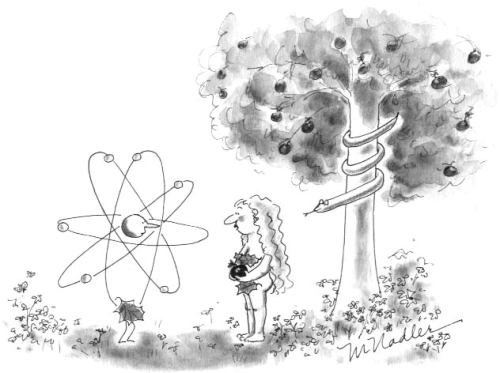
“Something seems a little funny about this, but here goes.”
That the United States has, in fact, created an empire, writes Johnson, is “almost too obvious to state—and so it is almost never said.” The American empire is unique: “informal,” “unacknowledged,” even “accidental.” It is neither a Marxist “imperialism” nor a British or Roman territorial do-minium. “The more modern empires I have in mind,” he writes, “normally lie concealed beneath some ideological or juridical concept … that disguises the actual relationships among its members.”
According to Johnson, the U.S. empire most resembles that of the Soviet Union. He acknowledges that few Americans are ready to recognize the parallel, because it implies moral equivalency. He agrees that “America's values and institutions are vastly more humane than those of Stalin's Russia.” But this does not alter the fact that the two countries experienced similar paths of military and economic devel-opment—and, as a result, reached similar international positions.
Johnson's central concern is the consequence to the United States of neglecting its imperial position. He adopts the CIA term “blowback” to describe the unintended consequences of U.S. “imperial” policies, which are often implemented without the knowledge of the American people. Over time, these policies build up a “balance sheet” that eventually must be reconciled, almost always to the detriment of U.S. interests—and sometimes at the cost of American lives. Eventually, he writes, reconciliation will take the form of crisis and collapse. “History indicates that, sooner or later, empires do reach such moments, and it seems reasonable to assume that we will not miraculously escape that fate.”
The substantive chapters of Blowback detail this argument against the backdrop of U.S. policy in East Asia since World War II. An opening chapter describes the local reaction on Okinawa to the September 1995 rape of a twelve-year-old Okinawan girl by two U.S. marines, which demonstrated the deep social impact of the U.S. military presence on the island— now essentially a Pentagon colony where U.S. forces “can do things they would not dare do in the United States.”
The book's discussion of South Korea details U.S. involvement in the military coups d'état of 1961 and 1979, and especially U.S. complicity in the suppression of popular protests in Kwangju in May 1980. Johnson acknowledges that North Korea's nuclear and missile programs may be serious problems—but he says the weapons programs of the United States and Japan are also destabilizing. “We finally have a chance to help promote a peaceful reunification of the Korean peninsula. Instead, the Pentagon is promoting a ballistic missile defense system. Surely no better illustration exists of our continued imperial ambitions and delusions.”
In two chapters on China, Johnson discusses that country's economic modernization program and aspirations to enter the world economy; human rights in the post-Tiananmen era; and China's evolving relations with Taiwan and the United States. He condemns U.S. support for theater missile defense in Taiwan, terming it an “unwelcome provocation” that is not “even slightly necessary.” Instead, he says, “The United States needs to bring its own security apparatus under control and stop exaggerating the Chinese military threat.” Johnson does not favor open economic engagement of China or admitting China into the World Trade Organization on its own terms, because “its mercantilism will ultimately do serious damage to the American economy, not to speak of the WTO system.” Instead, he favors a “managed trade” relation between the two countries.
Subsequent chapters on Japan and the Asian financial crisis extend Johnson's analysis of U.S. economic activities in East Asia. Globalization, he argues, opens up more opportunities for the United States to exercise its economic muscle, which will inevitably come back to haunt the U.S. economy. To stem these effects, he proposes the creation of “something comparable to the Bretton Woods agreement of 1944 to 1971, with fixed exchange rates and controls over the movement of capital.”
Blowback depicts the American empire as being on a precipice and embraces Paul Kennedy's concept of “imperial overstretch.” Again, Johnson argues, the Soviet experience is telling— its collapse may not just be a model of what awaits the United States, but a presaging of it. “In the long run, it may turn out that, like two scorpions in a bottle, [the United States and the Soviet Union] succeeded in stinging each other to death.” Johnson concludes: “World politics in the twenty-first century will in all likelihood be driven primarily by blowback from the second half of the twentieth century—that is, from the unintended consequences of the Cold War and the crucial American decision to maintain a Cold War posture in a post-Cold War world.”
In an age in which U.S. ascendance seems unimpeded, the weight placed on Kennedy's thesis may seem outdated, and the prediction of an impending collapse of American leadership is unlikely to find many receptive ears. Indeed, the use of the term “empire” gives Blowback a retrospective feel, which is enhanced by the book's under-emphasis on important new features of international politics: the connectedness of local and global experience that makes globalization much more than economic interdependence, and the transformative effects of the emerging “information economy.”
However, underlying Johnson's analysis is an essential insight: An overwhelming power inevitably generates opposition, regardless of the values that power promotes. No analyst of U.S. international policy should overlook this basic realist postulate. Madeleine Albright's “indispensable country” is also becoming the world's only undeterrable country—a fact that U.S. global interventions from Iraq to Kosovo have amply demonstrated. Meanwhile, economic, informational, and cultural globalization provides a less dramatic but more pervasive instrument of expanding U.S. influence. The appeal of American values will not mitigate the loss of self-determination— and the resentment resulting from this loss— that U.S. global dominance generates.
In many ways, the American “empire” is contrary to American values. The logic is simple: Wherever U.S. power breeds resentment it also inhibits the appeal of American values on their own terms. This result is also contrary to U.S. interests insofar as the innate appeal of American values is one of the country's most valuable and enduring assets.
Here, U.S. Cold War experiences are instructive. Underlying the U.S. Cold War posture in a post-Cold War world is the implicit judgment that this posture “won the Cold War.” And if it ain't broke, don't fix it.
But this lesson may be wrong. George Kennan, whose famous cable from Moscow originated the concept of “containment” that became the basis of U.S. Cold War foreign policy, saw the U.S. ability to “measure up to its own best traditions” as the linchpin to containment's success. Instead, from 1950 onward, containment became a more strident and belligerent militarism. Kennan himself concluded in 1991 that this more aggressive approach tended to strengthen comparable hard-line views in the Kremlin, producing a “braking effect on all liberalizing tendencies in the regime,” and perhaps even delayed the Soviet Union's collapse.
The prospect that the United States may have flexed too much muscle during the Cold War underscores Blow-back's main post-Cold War counsel: Be concerned for, not confident in, current U.S. global preeminence. Johnson's principal argument is that the greatest current challenge to the United States is to live up to its own best principles, rather than its residual imperial ambitions. This argument is all the more powerful when one recognizes that this is not a new challenge—it is the central challenge the United States has faced since it first emerged as a world power more than a century ago. The difference is that today the United States has the unprecedented opportunity for world leadership, and so the stakes of its choices have never been higher. Whether the United States continues to emphasize Cold War-style military strength, or instead renews its leadership through the power of its own example, will likely set the course of world affairs for a century to come.