



Abstract

Throughout World War II and the Cold War, American scientists and policymakers compromised the ideals of openness of both science and democracy for the sake of national security, creating vast enterprises based on “black” or secret science. ¶ Nowhere was that more apparent than in nuclear science. The Manhattan Project of World War II spawned a host of nuclear research labs, including large laboratories at the University of Chicago, Los Alamos in New Mexico, and Oak Ridge in Tennessee. Meanwhile, it turned the existing Radiation Laboratory at the University of California-Berkeley into a high-security war plant.

After the war, the University of Chicago site was shut down but nuclear research continued near Chicago at a Manhattan Project facility that became Argonne National Laboratory in 1946. The Manhattan Project and its civilian-run successor, the Atomic Energy Commission (aec)—created in 1946—decided to sustain Los Alamos and Oak Ridge and established a new national laboratory at Brookhaven in New York.
Security at the labs involved the physical protection of lab facilities and materials; classification of the information produced; and investigations of the loyalty of lab scientists. As the AEC reported to Congress in 1949, the lab system solved “the problem of how to get the men and the machines together in places where atomic energy work can be done in security” 1
Historians have long examined the effects of spy scares, McCarthyism, the Oppenheimer case, and other loyalty investigations. But they have paid less attention to the impact of classification and “compartmentalization”— the latter a security strategy championed by Gen. Leslie R. Groves, director of the Manhattan Project, who tried to keep working groups in the dark about what other groups were doing.
Classification of archival material still hinders historical research into the subject of secrecy. But enough material has come to light to suggest how nuclear scientists and AEC administrators adapted during the Cold War to the requirements of national security and secrecy while reproducing some of the trappings of openness.
Compartmentalized
After publication of nuclear fission experiments in January 1939, physicists in America, many of them émigrés— most notably, the Hungarian-born Leo Szilard—imposed self-censorship on further work in nucleonics, so as not to give unintended help to the Nazis.
Their self-censorship did not prevent some of them—most vociferously, Szilard—from later protesting when General Groves and the Manhattan Project institutionalized censorship and compartmentalized information.
Compartmentalization kept scientists from knowing what was going on at other sites or even in other programs within the same lab. In a few cases, that delayed the overall advance of the project—for instance, by hampering the coordination of different fast-neutron cross-section studies obtained by far-flung experimental groups.
In 1943, the consequences of compartmentalization led to the creation of Los Alamos on an isolated mesa in New Mexico. In the fall of 1942, J. Robert Oppenheimer, head of fast-neutron research for the project, urged that the design of the fission weapon be worked out at a new centralized lab. Such an isolated lab might help overcome the lack of communication and coordination in the program, which was then scattered from Columbia University in New York to Berkeley in California, with the principal node at the University of Chicago.
Groves established Los Alamos and named Oppenheimer director, but continued to regulate communication between the labs, except for a handful of top scientists, such as Arthur Holly Compton and Enrico Fermi, at Chicago, and Oppenheimer.
Born classified
At the end of the war the Manhattan Project began to relax security restrictions. On August 12, 1945, before the Japanese surrender, it released Atomic Energy for Military Purposes, a report on the project written by physicist Henry DeWolf Smyth. The “Smyth report” publicized much material that had been top secret just a week earlier, but it was also intended to set a limit on what material would be released.
The lodge at Los Alamos. Below left, Gen. Leslie Groves; at right, J. Robert Oppenheimer.

The report outlined the workings of the Manhattan Project, the basics of nuclear physics, and even some of the technologies employed in producing highly enriched uranium and plutonium. It did not, however, reveal key details needed to build a bomb.
Despite the candor of the Smyth report, the Manhattan Project and then the AEC retained the policy that all nuclear research was born classified and had to be reviewed by senior scientists before release. That ensured that only a trickle of information saw the light of day. By the end of 1946, reviewers had declassified 500 documents, a small fraction of the total produced by the Manhattan Project.
Philip Morse, the director of Brook-haven, and Ernest Lawrence at Berkeley believed that the “born classified” system would stifle scientific research. They urged the AEC to declare that certain non-weapon research topics would be open, so that research in those areas would not have to await review before publication.


Their idea was modest. Morse explicitly recommended in 1948 that lab directors set their sights low: “If we try to get all of the fields opened that everybody would like to have declared open now, we will have a long battle on our hands…. [It is] easier, safer, and better strategically to get a few areas which are obviously unclassifiable declared so at present.” 2
The proposal went nowhere. De-classification would proceed on a document-by-document basis, ensuring a continuing backlog. Eighty-two percent of the reports produced in the labs between November 1947 and November 1948 were un-publishable, according to reviewers. Los Alamos, the key weapons facility, apparently did not even attempt to report on much of its work. Only Brookhaven, which had not yet built its nuclear reactor, could publish most of its research.
At the end of the war, hundreds of scientists and technicians left the labs. The continuing security apparatus contributed to the exodus and it hampered recruitment of permanent staff.
The AEC required all lab employees and administrators with access to classified data or facilities to have a “q” clearance. Prospective employees had to undergo a full FBI investigation, which AEC security staff evaluated. The backlog of cases brought delays of two months or more in the clearance of new employees—quick by todays standards, but in the tight labor market of the post-war years, it led to the loss of valuable recruits to academe or private industry.
The big chill
Following the war, many former Manhattan Project scientists fought for the international control of nuclear energy and argued that continued secrecy in science was antithetical to the spirit of science and to the principles of democracy, in which openness and accountability were fundamental values. The Bulletin of the Atomic Scientists became their forum; the Federation of American Scientists their political arm.
These protests and alarums were snowed under by the Soviet Unions rejection of the American plan for the international control of atomic energy, the incorporation of Eastern Europe into the Soviet sphere, and the onset of the Cold War.
In February 1946, Joseph Stalin declared that war with the capitalist West was “inevitable.” Less than a month later, Winston Churchill thundered that an iron curtain had de scended across Europe “from Stettin in the Baltic to Trieste in the Adriatic.”
From Our Files
Editor Eugene Rabinowitch wrote: “In the days of the Manhattan District, a scientist was summoned to Washington and reprimanded for having mentioned in public a physical constant which was still secret. The accused fingered through the [unclassified] Smyth Report and pointed to a number there. ‘Yes,’ said the security officer, ‘but that is in pounds per square inch, while you gave the figure in kilograms per square centimeter. Why make it easier for the Russians?’”
—June 1950
Growing anti-communism in the United States led to congressional criticism of the AECs security procedures by the summer of 1947, mainly by congressmen who sought a return of military control of atomic energy.
The AEC responded by tightening security. In 1948, for instance, the AEC withdrew the clearances of 12 previously cleared employees at Brook-haven, suspended two Oak Ridge researchers, and investigated six others. The charges against one man included, “You are reported to be intolerant of security regulations.” 3
In this climate, scientists and administrators chose to tolerate security regulations. The trustees of Brook-haven “recognize[d] the extreme difficulty under which the [aec] is laboring in the matter of security clearances and that the Laboratory … is not the place in which to make an issue of personal liberties out of security clearance procedures.”
These procedures included hearings before a review board for individuals with “questionable” backgrounds, but they did not include the right to confront accusers. Nevertheless, a Brookhaven trustee called the hearings “a genuine and, on the whole, successful attempt to protect the rights of the individual.” 4
Although most of Brookhaven's research was declassifiable, the lab agreed to seek Q clearances for all its staff. In Berkeley, Ernest Lawrence abandoned his proposal to declassify parts of his laboratory.
Political pressure on the labs increased with the rise of domestic anti-communism, fueled by a series of events in 1949 and 1950 that produced a sense of national crisis: The first Soviet atomic bomb test in August 1949; President Truman's decision to pursue a thermonuclear bomb in January 1950; the confession of Soviet spy Klaus Fuchs and the arrest of Julius and Ethel Rosenberg; and the outbreak of the Korean War in June 1950.
The supercharged atmosphere of the early 1950s fostered Mc-Carthyism and a continued preoccupation with secrecy. But it also contributed to an emphasis on results at the labs, with less regard for the niceties of process.
In its first seven years the AEC investigated half a million people for security clearances, at a cost of more than $10 million a year. In 1953, in the midst of Mc-Carthyism, the House Appropriations Committee expressed “the belief that there is a very large waste of public funds” in the AEC's security program. 5
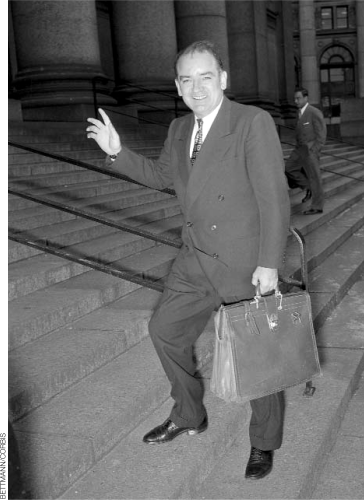
Joe McCarthy in 1947. His briefcase soon bulged with the names of “known communists.”
There were less tangible costs. After the Soviet bomb, lab scientists pointed out that the AEC could assume the Soviets knew the so-called secret of the bomb and that continuing across-the-board secrecy only handicapped American scientists. The AEC agreed and its director of classification called for less emphasis on secrecy, to help American scientists win the race with the Soviet Union. But the backlog of personnel cases awaiting clearance persisted and continuing security clampdowns hurt morale at the labs.
Meanwhile, security standards within the AEC and with other agencies were inconsistent. Los Alamos might classify certain work “Secret” while Oak Ridge considered parts of the same subject “Top Secret.” Work left unclassified at Berkeley was classified at Los Alamos. Further, the military established its own standards, which did not necessarily coincide with the AEC's. Only 10 percent of top officers at Strategic Air Command headquarters had AEC Q-clearances.
A classified community
The limits to communication imposed by classification and compartmental-ization had two contradictory effects. Questionable research programs could escape peer review, such as the human radiation experiments that subjected patients to injection with radioactive materials. On the other hand, promising programs could suffer for lack of the stimulating interchange of new ideas among researchers.
Early in the program for controlled thermonuclear fusion (Project Sherwood), Cornell physicist Robert Wilson developed important insights in isolation from related research in the national labs. The AEC then insisted that his work be kept compartmentalized. Similarly, Nicholas Christofilos at Brookhaven, who had already filed a secret patent on a fusion reactor, could not work in the field because he lacked clearance.
From Our Files
From News in Brief: “Senator Joseph McCarthy, in a statement published in the Congressional Record on October 20, charged that the scientific profession was the victim of communist infiltration. ‘This real threat to the nation's security is a matter which has either been ignored by the Atomic Energy Commission or treated far too lightly by this vital administrative agency of the government.’
“McCarthy claimed that at least 500 [of] the 50,000 scientists whose biographies appear in American Men of Science have been ‘openly affiliated with the communist movement through its deceitful and seditious front organizations.’ He asserted that the Federation of American Scientists was ‘heavily infiltrated with communist fellow-travellers’ and that ‘the largest scientific body in the world, the American Association for the Advancement of Science, was being dominated by a clique of fellow-travellers.’”
—November 1950
In the case of Project Sherwood, AEC staff downplayed the negative effects of secrecy, including the lack of peer review and the failure to disseminate new work. They believed they had already compensated for these drawbacks by creating a classified community, an often-invoked but ill-defined entity that in this case comprised a system of secret conferences, publications, and interlocking advisory committees.
Classified communities, a key Cold War invention, provided a kind of ersatz scientific openness. In June 1946, scientists from scattered Manhattan Project sites gathered in Chicago to swap information about their research. Two months later Los Alamos convened a conference on nuclear physics attended by 57 scientists from the various labs. All of them had clearances.
The success of the Los Alamos meeting inspired the lab directors to suggest that the newly created AEC sponsor “information meetings” to promote intellectual interchange among the sites. The AEC agreed and sponsored classified conferences in the spring and fall of each year. The labs took turns hosting the meetings.
The first conferences included sessions on physics, chemistry, biology and reactors; later, they included metallurgy, health physics, radioisotopes, and solid-state physics. From time to time, there were additional conferences on particular topics. An information meeting on biomedicine at Oak Ridge in March 1948 drew close to 300 scientists for the first day, for which the program was classified. Attendance dropped to 200 for the second and third days, for which the programs were unclassified.
The AEC intended the information meetings to “parallel public professional society meetings.” The sessions allowed the discussion of classified data and analyses by scientists from the various labs and they also provided scientists with a kind of peer review as well as with peer recognition of their work.
As Norris E. Bradbury, the first postwar director of Los Alamos, put it: “These meetings are large enough … so that one feels very much a part of a large technical, scientific group, where one can make a contribution which can be talked about and whose impact on other laboratories considered.” 6
The AEC also tried to simulate the publication apparatus of the open scientific community. For reports that reviewers did not declassify, the AEC issued multiple classified copies and sent them directly to its laboratories. To alert scientists who might not have received or noticed a relevant report, the AEC twice a month issued “Abstracts of Classified Research and Development Reports,” which covered all classified work of the AEC except for certain highly secret programs. The AEC also published a kind of “textbook,” the National Nuclear Energy Series. Of its 110 volumes, about 60 were classified.
The combination of classified conferences and publications fostered a free flow of information among the national labs. Because most lab scientists held clearances and hence could plug into this network, there was little chance of missing relevant research or review.
The national labs developed another mechanism to promote the flow of information, a network of advisory committees with overlapping memberships similar to the interlocking directorates of top-level American corporations.
Brookhaven was the pioneer. In 1947, its trustees set up scientific advisory committees for the physical, engineering, and life sciences. All committee members held security clearances.
Two years later, the lab expanded the arrangement and established five-man “visiting committees” for each department; their mission was to report once a year on the program of that department. It explicitly encouraged the inclusion of representatives of other national labs on its committees.
By 1957, Oak Ridge and Argonne had also formed review committees with representatives from other national labs. Only Berkeley, Livermore, and Los Alamos resisted the creation of committees, which possibly reflected the degree of informal coordination they had already achieved.
The visiting committees provided peer review and helped the diffusion of information about the programs at each lab, including classified research. Almost all of the members of visiting committees through the 1950s held security clearances. The committees also included members from industrial corporations and universities. In Washington, the publication network embraced other government agencies, including a system to share reports with the military services.
Edward U. Condon

From Our Files
At a dinner for Edward U. Condon in May 1948, Robert M. Hutchins, chancellor of the University of Chicago, tried to be amusing about the House Un-American Committee's attacks on Condon:
“If Ed Condon, whose Americanism sticks out all over him and all over his record, could be linked to a spy ring, nobody was safe. We might wake up and find that none of the great American landmarks, from the Washington Monument to Lydia Pinkham, was above suspicion. As a matter of fact, Lydia Pinkham's name is suspicious.”
∗ ∗ ∗ ∗
“I am not even interested in scientists or science, for whom and for which I have been forced by the faculty of the University of Chicago to express my reverence many times. I am interested in the future of the intellectual life of America, or perhaps I should say, that I am interested in the future of American life.”
∗ ∗ ∗ ∗
(On guilt by association) “Nobody is safe. Any one of us, or the wife of any one of us, may chance to know a Pole, or a Czech. At this moment the President of Czechoslovakia and the Polish ambassador to the United States are both professors on leave from the University of Chicago. Where does that leave me?”
—June 1948
The AEC s own advisory committees often included several scientists with ties to the labs: for instance, the first General Advisory Committee (Gac) included Manhattan Project stalwarts I. I. Rabi from Brookhaven and Glenn Seaborg from Berkeley. Oppenheimer, the former Los Alamos director (and then director of Princeton's Institute for Advanced Studies), was chairman.
Many of these same elite scientists found themselves on advisory committees for other government agencies. Oppenheimer joined advisory panels for the Departments of Defense and State while he still chaired the GAC. John von Neumann, a Los Alamos consultant who served on the GAC from 1952 to 1954 before joining the AEC, chaired an important committee advising the air force on missiles in 1953. Herbert York from Livermore and Darol Froman from Los Alamos would join von Neumann s committee the following year.
Classified communities could have a dramatic effect on lab research programs. The possibility of using nuclear energy for rocket propulsion had first circulated soon after the war, but then the notion sat on a back burner for several years. In 1954 scientists at Livermore kicked the idea around with some air force scientists, who passed it on to the Pentagon.
Meanwhile, Los Alamos scientists, inspired by Froman's membership on von Neumann's committee, had also taken up the idea and discussed it with scientists at the Applied Physics Laboratory, a Defense Department-sponsored facility at Johns Hopkins University in Baltimore.
As a result of the growing interest, the air force convened a committee chaired by Mark Mills of Livermore that also included von Neumann. The recommendations of the Mills committee led to large programs on nuclear rocket propulsion at Livermore and Los Alamos.
In short, the nuclear rocket program—which cost billions of dollars but eventually came to naught—owed its origins to informal conversations and committee connections between air force staff and scientists at AEC and Defense Department labs, and to a formal recommendation offered by another air force committee chaired by a scientist from Livermore.
The program thereafter developed the means to exchange information between the AEC labs working on nuclear reactors and military contractors working on non-nuclear rocket components. At first even the existence of the program at Los Alamos was classified, but the program does not appear to have suffered from lack of communication.
Information perhaps flowed too easily for the comfort of Los Alamos scientists, who were wont to guard their territory from the encroachments of the upstart Livermore lab. The Los Alamos crew was surprised to hear Livermore scientists propose a design for a nuclear rocket motor remarkably similar to one described in a classified technical report Los Alamos had sent to Livermore.
Science in the shadows
By the mid-1950s scientists in the national labs had developed ways to satisfy security requirements while maintaining communication among themselves and with other classified institutions.
The classified community provided scientists with a reasonable approximation of open research. Nonetheless, the separation of classified from unclassified research had harmful effects. Loyalty investigations disrupted personal careers and lives and they cost the AEC and the national labs the services of some top scientists, most notably Oppenheimer, whose security clearance was revoked in 1954. Further, because the classified community was a national network, scientists within it were cut off from colleagues in secret programs abroad.
REVOLUTIONARY SECRETS?
Secrecy in science predated the discovery of nuclear fission in three forms: personal secrecy to ensure priority of discovery; industrial secrecy to secure proprietary rights; and secrecy for national security, such as the secret weapons lab of Antoine-Laurent Lavoisier and other chemists during the French Revolution.
In the last case, the French chemists tried to develop potassium chlorate as a substitute for potassium nitrate (saltpeter) in the production of a new and more powerful form of gunpowder. They also investigated incendiary ammunition for naval warfare and explosive shells to replace iron cannonballs.
In 1822, Georges Cuvier, in his eulogy of Claude-Louis Berthollet, one of the instigating scientists, observed that “science has been able to count on the support of government only since it became one of the essential elements of the art of war. But … the means of destruction furnished by science, in rendering combat more decisive, have made wars less frequent and less murderous.” ∗
Secrecy is not always forced on scientists by national governments. The excusable ignorance of military and political leaders regarding details of the latest scientific and technical developments, combined with the technological conservatism of the military, has often impelled scientists to assume the initiative in developing new technologies for national security—as was the case during the French Revolution.
It was Albert Einstein's letter in 1939 to President Roosevelt, drafted with the help of Hungarian émigrés Leo Szilard, Eugene Wigner, and Edward Teller, that helped get the atom bomb project under way.
—P. J. W.
∗Cited by Charles Coulston Gillispie, in “Science and Secret Weapons Development in Revolutionary France, 1792-1804: A Documentary History,” Historical Studies in the Physical Sciences, 1992, pp. 35-36.
The secrecy that prevailed in nuclear science in the United States also violated democratic ideals. Classification prevented public debate and scrutiny of major programs, particularly the nature and the role of nuclear weapons. Further, the AEC would invoke “national security” to limit discussion of radioactive fallout and other issues it deemed sensitive for public relations reasons or because of concerns over legal liability.
Why did American scientists agree to work under conditions that compromised their ideals? They suggested secrecy themselves as they first explored the implications of nuclear fission; then they saw their self-censorship extended and institutionalized in the race to develop the atomic bomb in World War II. The patriotic mobilization of scientists continued in the Cold War, especially in the national emergency of the early 1950s.
But scientists did not passively acquiesce to all the restrictions that accompanied national security work. While accepting the need for secrecy, lab scientists and managers also sought to ensure scientific and technological progress, which they achieved in part with the creation of the classified community.
This extensive community continues to conduct its business in the shadows of secrecy, except when scientific successes or security slip-ups bring scientists, blinking, into the light.
Footnotes
1.
Atomic Energy Commission, “Fifth Semiannual Report to Congress,” January 1949, p. 67.
2.
P. M. Morse to F. H. Spedding, March 12, 1948, Director's Office files, Brookhaven National Laboratory.
3.
Stephen White, “Report on Oak Ridge Hearings” and “The Charges Presented in Oak Ridge Cases,” Bulletin of the Atomic Scientists, July 1948, p. 196.
4.
Associated Universities Inc., Executive Committee minutes, December 19, 1947, and C.F. Dunbar to E.C. Shoup, Oct. 13, 1948, Director's Office Files, Brookhaven National Laboratory.
5.
U.S. Senate, 83:1 Congress, “Second Independent Offices Appropriations for 1954,” p. 11.
6.
Atomic Energy Commission, “Seventh Semiannual Report to Congress,” January 1950, p. 185; Norris E. Bradbury in Joint Committee on Atomic Energy, 81:1 Congress, “Investigation into the United States Atomic Energy Project,” p. 821.