




Abstract

Contested borders tend to be pretty nasty up close—barbed wire, mine fields, guys wandering around with assault rifles and aggressive German shepherds. The Koreas add giant electrified fences and forward-deployed armor; the Turkish Army likes to surround the overnight Sofia-Istanbul passenger train with intimidating soldiers, just to let you know they're there. In Albania the entire country looks like a border zone, with a million dome-shaped bunkers guarding every road, field, and street corner—an expansive memorial to the late Enver Hoxha's fear of just about everyone.
On the Belize-Guatemala border: three children watch visitors come and go.
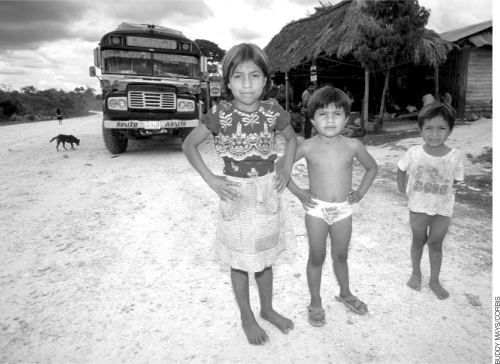
But here I was at the main border crossing between Belize and Guatemala, ground zero for one of Central America's most intense border disputes, and it just wasn't living up to the part.
I arrived by car from San Ignacio, Belize, on a newly resurfaced highway that passed through a chain of sleepy, Spanish-speaking villages. Pigs and chickens wandered on and beside the road, slowing traffic. We stopped behind an aging yellow school bus filled with Belizean shoppers and Guatemalan farm laborers to wait for a hen and her chicks to clear the road.
The border posts were, by comparison, a hive of activity. Taxis were coming and going to San Ignacio, collecting fares from a crowded parking lot. Moneychangers haggled with English and American backpackers in assorted clumps as cargo-laden trucks trundled by. An entire family of Mayan peasants had started the two-mile walk to Benque Viejo, the nearest Belizean village. An estimated 20,000 Guatemalans work in Belize, and virtually all of them cross here.
In the no-man's land between the border posts there were no minefields or machine-gun-toting soldiers. Instead, there were throngs of Belizeans hanging in and around several bars selling cheap Guatemalan beer. Would-be tour guides offered to take me to nearby Mayan ruins. An unarmed customs official stamped my passport without so much as a glance, and waved me out a door and into Guatemala.
I experienced more tension the last time I crossed from Maine to New Brunswick, where diligent customs officers quizzed me on the finer points of freelance journalism and seized my girlfriend's pepper spray, a “concealed weapon” under Canadian law.
But things in Benque Viejo aren't as relaxed as they seem. This year the sleepy, jungle-covered border is once again at the center of one of the most bitter, longstanding territorial disputes in the region. There have been fatal shootings and cross-border military incursions, renewed territorial claims, and increased military activity, heating up a conflict most people here thought had been put to rest.
Guatemala, which is in the midst of a difficult peace process after 36 years of civil war, announced in February that it was seeking “the return” of 4,739 square miles of Belize, more than half the tiny nation's territory. The newly elected Guatemalan government said it would bring the case before the International Court of Justice in The Hague if the matter wasn't resolved quickly.
Officials of both countries flew to Miami a few weeks later, but a planned meeting never took place. Belizean officials walked out when they learned that Guatemalan troops had just captured a four-man Belizean military patrol somewhere in the jungle-covered border area and charged them with carrying illegal firearms. Belize maintains the incident took place well inside Belize; Guatemala says they were 4 kilometers over the line.
“They were having trouble reading their GPS,” Carlos Avila, charge d'affaires of the Guatemalan embassy in Belize City, told me. But he insisted that the patrol couldn't possibly have been in Belize because his country doesn't accept that the border exists.
“Guatemala stretches from sea to sea, so we couldn't charge [the Be-lizean patrol] with entering Guatemala illegally. We charged them with carrying weapons,” he said. “This kind of incident shows the need to resolve where Guatemala ends and Belize begins.”
Since then tensions have continued to escalate. Security was tightened at the Guatemalan embassy in Belize City after a bomb was thrown at the building. The Guatemalan Army strengthened its garrisons along the 135-mile border, including facilities near each of the two border crossings.
Belize has asked Britain for increased military assistance in the form of light arms and basic equipment for its tiny defense force of 1,000. When Guatemala threatened to invade the then-British colony in the 1970s, British Harrier jets based in Belize intimidated Guatemalan troops by hovering above border positions. But today the British force has dwindled to around 80 soldiers on tropical training missions. They are often seen driving around in large trucks on the rugged back roads in the mountainous Cayo district, of which Benque Viejo is a part. Locals say their presence intimidates small bands of would-be looters around the remote ancient Mayan city of Caracol, but neither they nor the Belize Defense Force have enough sabers to rattle the Guatemalan Army.
“The borders have been decided and they're not going to be changed,” says Oliver del Cid, an employee of Belize's foreign ministry, which occupies one of the dreary concrete buildings in the nearly deserted capital, Belmopan. International law and opinion were on his nation's side, he said, and they would work for a peaceful solution to the building crisis.
Guatemala's territorial claims are based on a 1493 papal decree that gave Spain sovereignty over much of the New World—the same document that prompted Argentina and Chile to claim swaths of Antarctica. In the sixteenth and seventeenth centuries, present day Belize was part of New Spain on paper, but the Spanish never occupied or properly explored the area.
Instead the area was settled in the seventeenth century by English woodcutters who brought large numbers of African slaves to cut huge mahogany trees in the dense, insect-plagued jungles. Spain recognized their right to continue logging in a number of treaties from that time period, but repeatedly sent ships and soldiers to the area to assert sovereignty and suppress English buccaneers operating out of the mangrove-covered islands along the coast.
In the eighteenth century things got complicated. New Spain collapsed in revolution, and Mexico and Guatemala both claimed sovereignty over Belize. But so did Britain, which argued that the Spanish successor states had no right to territory that Spain had never occupied. Eventually the English-speaking enclave became the colony of British Honduras, with the boundaries of present day Belize.
Mexico dropped its claim in 1897, and Guatemala and Belize resolved their differences in an 1859 treaty. The issue would have been put to rest then and there, but the British failed to live up to one of the treaty stipulations— that it help build a cart road from Belize City to Guatemala City. Guatemala later argued, persuasively, that the treaty was therefore invalid. Nothing ever took its place.
Belize became independent in 1981, but wasn't recognized by Guatemala until a decade later. Guatemala did not recognize the border, but with the end of the Cold War and the advent of peace in Guatemala, the border issue was largely forgotten. The last thing Guatemala's leaders needed was a crisis with its neighbor. They had plenty to focus on at home.
“It's curious that the issue has sprung up now, after being so quiet for so many years,” says W. George Lovell, a Guatemala expert at Queen's University in Kingston, Ontario, and author of A Beauty that Hurts: Life and Death in Guatemala. “It's a great way to distract people from the fact that things aren't quite working out in Guatemala.”
A 1996 peace accord ended Guatemala's 30-year civil war in which an estimated 200,000 people were killed. But progress on implementing key elements of the accord has been painfully slow, including measures to end the exclusion of the Mayan Indian majority from political, economic, and social life. Mayans make up 60 percent of the population, but most are impoverished and between 80 and 90 percent are illiterate, the U.N. Verification Mission in Guatemala estimates. Meanwhile, the richest 2 percent of the population owns an estimated two-thirds of all the arable land and resists efforts at land, tax, and social reform.
“If you look at the actual progress on [implementing] the peace accord, it's really pathetic,” Lovell says. “There's an inability to confront what I think is the central challenge, which is to come to a meaningful redistribution of basic resources.”
Meanwhile there has been an explosive increase in violent crime. Kidnappings are common, and many wealthy parents hire bodyguards for their children. Guatemala City convenience stores are guarded by men with pump-action shotguns.
A key element of the accords was to remove the army from politics and law enforcement, as that U.S.-backed force was responsible for more than 90 percent of wartime atrocities, according to the official report of Guatemala's Truth Commission. But military leaders have used the crime wave as an excuse to continue security patrols and reopen rural bases.
The Belize border issue was revived shortly after Alfonso Portillo's Republican Front won last November's presidential election. The party was founded by Gen. Efrain Rios Montt, who ruled Guatemala from March 1982 to August 1983, one of the bloodiest periods of the civil war. He is now president of the Congress. The revived “Belize threat” may provide a new reason for the army to strengthen its numbers and reoccupy garrisons closed after the peace accords.
Until recently the “highway” linking Flores, Guatemala, with Belize was little better than the cart path called for in the 1859 treaty. Until the 1960s there were no roads at all linking Belize or Flores to Guatemala City. Guatemala's first post-war civilian government began paving this dirt path only a few years ago.
But the smooth, well-drained highway ends abruptly 10 miles short of the border, at the site of an enormous Guatemalan Army barracks. Our vehicle bounced along over potholes and past curious Guatemalan soldiers playing soccer on a makeshift parade ground.
“The new government stopped work on the road as soon as they came into office,” my Guatemalan driver explained. “It's the only good thing they've ever done for people out there and now they're not even going to finish it.”
The highway runs past tiny farms and villages whose residents have no electricity, running water, automobiles, or access to health care. New utility poles line one side of the highway, but telephone and electricity lines were never strung. Children seem to be the main local beneficiaries of the aborted project. After a heavy downpour they gather in droves to play and bathe in the flooded concrete culverts beside the pavement. “Out here,” the driver continued, “you're really on your own.”
As the peace process stagnates, more and more Guatemalans are crossing into Belize in search of a living. Most come to work in the country's fruit plantations, where they will accept half the pay a Belizean would demand and have a reputation for obedience and hard work. Carlos Avila points outs that the estimated 20,000 Guatemalans working in Belize equals about one for every 10 Belizeans.
The criminal element is coming as well, and the crime wave in Guatemala has recently spilled into Belize's border regions.
In June three men believed to have been Guatemalans hijacked a ferry in the middle of a crossing from Puerto Barrio, Guatemala, to Punta Gorda, Belize. The men turned machine guns on the crew and passengers, killing six. Three survived—including an American crewman—by jumping overboard and treading water for 17 hours before being rescued. The ferry was found abandoned in a mangrove swamp but the hijackers remain at large.
In August tiny Benque Viejo was the site of two separate murders, a rape, and a jewelry store robbery, all believed to have been committed by a gang of four Guatemalans thought to have committed another four armed robberies just across the border in Melchor. In one incident a Guatemalan guest worker was found shot to death in a local river. Days later robbers killed one guard and wounded another at the local Texaco station. Two weeks later a 23-year-old woman was abducted in broad daylight and raped in front of her children. Local police have advised travelers to the area to exercise special caution.
“What worries me,” a man from San Ignacio told me, “is that there's just too many people over there with nothing to lose.”