




Abstract

It is no secret that India wants to become an important regional power. Attaining nuclear weapons and developing military technological capabilities are important elements in reaching that objective. Indian policymakers also believe that India must assert itself at sea.
India's naval plans are troubling to long-time adversary, Pakistan. And the assertion of naval power by India is likely to be challenged by China, which is trying to make inroads into the Indian Ocean by establishing ties with Myanmar [Burma], where Chinese naval bases are being built.
A member of the Indian Navy keeps watch on the deck of the Delhi docked in Bombay.
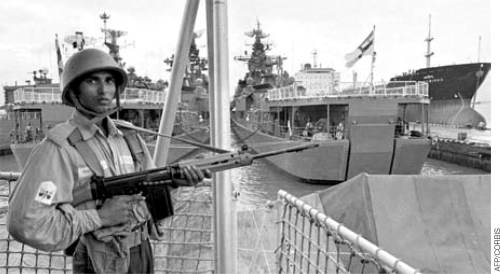
Although China's military activities are not specifically aimed at India, New Delhi is apprehensive about China's growing military power. Then there is Beijing's continuing relationship with Pakistan. Because of the strategic linkage between China and Pakistan, India also views Islamabad's military power as part of the Chinese military-strategic equation. In making calculations about deterrence, Indian planners tend to combine the strength of its two traditional rivals.
The Indian Navy has one aircraft carrier, 26 surface combat ships, and 40 patrol and coastal craft to counter Pakistan's eight surface combat ships, nine submarines, and 10 patrol and surface vessels. But China's naval force includes 50 surface warships and 52 submarines, including a nuclear-powered submarine and a variety of fast attack craft. Then, too, Chinese naval capability seems even more threatening when viewed from the standpoint of China's aspiration to attain global naval status by the first half of the twenty-first century.
Upgrading naval capabilities and acquiring a nuclear arm are likely to appeal to Indian policy-makers. Major projects include the development of sea-launched cruise and ballistic missiles and the construction of indigenous nuclear-powered submarines. According to Indian analysts, some missile projects are at a fairly advanced stage.
Various news reports indicate that three different sea-launched missiles— the Sagarika, Dhanush, and Prithvi III—are nearly identical, except for range. According to these reports, “Prithvi III” and “Sagarika” are just two names for the same missile (which has a range of 200 to 250 kilometers).
Many analysts believe, however, that there is some difference between the Sagarika and Dhanush. The latter is believed to have a greater range than the Sagarika, and to be built with more indigenous components. U.S. intelligence officials have reportedly linked India's sea-launched missile capability to aid from Russia. The Prithvi III or Sagarika was tested from a naval ship in 1998. This missile, propelled by a solid-fueled rocket with longer-range potential, could improve India's ability to strike deep into the territories of both its adversaries.
Other analysts, however, report that the Dhanush, a surface-to-surface missile fitted with a 500-kilogram warhead, is the same as the Prithvi III. The Dhanush, these reports indicate, will later be converted to carry nuclear warheads. A Dhanush missile was test-fired in April from the Sub-hadar, a modified offshore patrol vessel. Deploying a ballistic missile on a surface vessel is not likely to impress international analysts; in their view the deployment would present a risky option.
Pakistan's Gen. Pervez Musharraf inspects the naval base at Ormara with Chief Adm. Abdul Aziz Mirza (right).
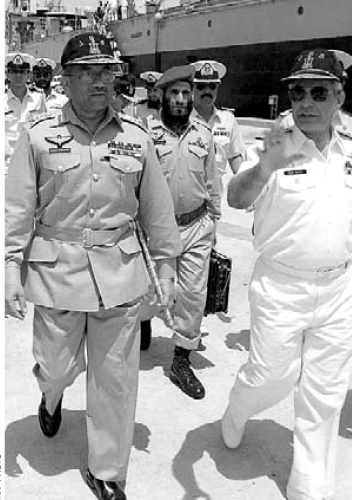
Some Indian analysts say that work on naval missile development has been retarded because of the slow pace of work on the nuclear submarine project and the dearth of procurement funding. Although Jane's Defence Weekly has reported India's intention to deploy a nuclear-powered submarine by 2007, analysts indicate that India is having problems developing the sub's nuclear reactor.
A surface ship is not the best platform for deploying a missile carrying a nuclear warhead, but given the submarine delay, the Indian Navy seems to be pushing that option in its hurry to join the domestic nuclear club currently dominated by the army and the air force.
The two naval projects appear to have been pursued independently, which means that the navy might opt for deploying cruise missiles on surface ships. In addition to providing the Indian Navy with a nuclear capability at an earlier date, that option would also boost the navy's image in the Indian Ocean littoral. Then, too, the early development of a sea-launched cruise missile might persuade policy-makers to devote more resources to the nuclear submarine project.
A nuclear-capable navy would be an asset in fulfilling New Delhi's ambition to discourage superior forces from asserting power in the Indian Ocean. Indian policy-makers still remember with some bitterness that U.S. arm-twisting in 1971, when the Enterprise visited the Bay of Bengal at the height of the India-Pakistan war, affected the course of the conflict. Although current Indian rhetoric is aimed at China, New Delhi may eventually try to control the ocean from any foreign influence. This may not necessarily be achieved by a confrontational stance against the United States, but it might be accomplished through some bilateral arrangement.
Pakistan sees such developments as highly threatening. Islamabad, which makes no claim to being a regional power, is alarmed by New Delhi's technological acquisitions. Pakistani analysts believe that, with its growing naval power and blue-water capability, India would be able to throttle its smaller adversary, if war came. Ninety-seven percent of Pakistan's trade is by sea. Remembering the blockade of the single seaport at Karachi during the 1971 war, naval planners continue to push the government for funds to enhance the service's capabilities.
Given the country's lack of resources and the orientation of military-strategic planning toward land war, Pakistan's naval leaders are considering adopting the poor man's option, adapting surface ships to launch Shaheen and Ghauri missiles, which were primarily developed for the army. Such an approach clearly indicates that Pakistan lags behind India technologically. Nevertheless, the navy was “assigned a nuclear role” in May 1999, an action taken to give the impression that Islamabad was thinking of developing a nuclear triad.
After the nuclear tests in 1998, Pakistani policy-makers felt pressured to appear capable of managing nuclear deterrence. Pakistan's lack of strategic depth makes nuclear deterrence important vis-à-vis India, but the government has not yet initiated any work on developing a sea-launched missile capability or procuring a platform capable of handling nuclear weapons.
A strategic directorate at naval headquarters was established to control fixed and mobile missiles that would be based on the shore. The Shaheen I, Shaheen II, and Ghauri I missiles have ranges and payloads of 750 kilometers/1,000 kilograms, 2,300 kilometers/1,000 kilograms, and 1,500 kilometers/700 kilograms respectively.
Shaheen missiles can be fired from mobile launchers, which could be placed on shore or aboard surface vessels. But so far there have been no reports of any naval vessel being modified to carry these missiles. Islamabad plans to put weapons on the southern coast, if the need arises.
During my discussions with Pakistani naval officers, they indicated that the service would like to modify Harpoon missiles to carry nuclear warheads. But the Harpoon carries a warhead with an approximate weight of only 220 kilograms, so considerable technological expertise would have to be devoted to developing miniature nuclear warheads.
A number of analysts doubt if Pakistan has such capabilities. Miniaturizing nuclear warheads to fit the Harpoon would require expertise that even China, a main source of nuclear material and technological acquisitions for Pakistan, may not have. In addition, Pakistan's current nuclear program is purely army-oriented. The navy is seen as a much less significant element in the country's military strategy, so it is unlikely that military planners would want to spend resources in developing a miniaturized warhead for what is seen as a lesser role.
But Pakistan's future development of a naval nuclear capability cannot be ruled out. If the Indian naval program appears to be making progress, Islamabad will be tempted to develop a sea-based, second-strike capability. Pakistani Foreign Service officials claim that any further testing in South Asia will aim at developing a sea-based nuclear capability.
Unlike India's thinking, Pakistan's nuclear deterrence calculations remain basic. The idea is to ensure that in case of hostilities, Islamabad can manage to deliver two to three nuclear weapons to the adversary's territory. For the time being, this would be achieved with land-based missiles.
The army, which dominates the nuclear program, is unlikely to encourage allocation of funds for the development of a sea-based, second-strike capability. However, the navy is being prepared to attack Indian nuclear-weapon-carrying surface ships if these vessels should ever threaten Pakistani land targets.

Such a scenario would certainly threaten peace and stability in South Asia. But, in any case, the cold war between India and Pakistan has great potential for interfering with sea traffic in the Indian Ocean. A potential confrontation at sea—in which India tried to blockade its adversary's seaports (Pakistan is building another port and naval base at Gawadar, northeast of Karachi)—would be a threatening development for all sea trade passing through the Indian Ocean.
An encounter at sea is more than a fantasy. Indian sources claim that in the summer of 1999, New Delhi gave the order, and the navy was prepared, to blockade Karachi during the Kargil crisis—had Islamabad not withdrawn its forces from the area of tension. The Kargil skirmishes thus wiped out any benefits of a series of peace initiatives that had been undertaken between the two navies between 1997 and 1999.
If the two neighbors do not alter their perceptions of each other, or discuss options for cooperation, it is likely that Islamabad will view New Delhi's naval weapons development and acquisitions as highly confrontational. The borders between the two are not demarcated at sea, and there is a dispute over the division of Sir Creek, a marshy land that falls between the two countries. Cooperation at sea, especially multinational cooperation, should be considered as a way to bring some safety and stability to the Indian Ocean.