




Abstract
The NPT Conference was a success— at least in diplomatic terms. Will it make a difference in the real world?
On May 20, at the close of the sixth review conference of the Tr eaty on the Non-Proliferation of Nuclear Weapons (npt), the nuclear weapon states pledged an “unequivocal undertaking to accomplish the total elimination of their nuclear arsenals” and agreed to consider a number of practical steps toward that goal.
U.N. Secretary General Kofi Annan hailed the agreement as “a significant step,” even as U.S. government officials moved swiftly to assert that the agreement did not indicate a significant shift in American policy.
Confounding the many predictions of disaster, the npt conference was a success, at least in diplomatic terms. But will this diplomatic agreement mean more than earlier pledges have when it comes to national security calculations in the real world?
Do they mean it?
Many problems were simply ignored. Concerns about U.S. missile defense plans and the impasse in negotiations on a fissile material cut-off in the Geneva Conference on Disarmament were swept under the carpet in deals among the nuclear powers. Behind the scenes agreements between Cairo and Washington, squared with Tel Aviv, worked out careful language on Israel, whose nuclear weapons program, developed outside the NPT, is a major problem for NPT members in the Middle East. India's and Pakistan's nuclear tests were deplored, even as France and Russia raced to sign nuclear-power supply contracts with India.
When the United States insisted on “balancing” calls for Israel to adhere to the treaty with criticisms of Iraq's non-compliance with Security Council Resolution 687, it almost wrecked the conference. But after the clock was stopped to allow another 24 hours of negotiations, a compromise was found.
None of the weapon states—faced with some hard pressure from non-nuclear weapon countries—wanted to be blamed for blocking agreement. Clearly the NPT is important enough for them to make tough diplomatic compromises. But has nonproliferation now become important enough that they mean what they say about eliminating their nuclear arsenals?
In addition to firming up the Article VI obligation on nuclear disarmament, the conference's final document underlined the importance of the START process and the Comprehensive Test Ban Treaty (CTBT). It also called on India and Pakistan to implement U.N. Security Council Resolution 1172, urging them to join the CTBT and NPT and not to weaponize their nuclear capabilities.
The weapon states agreed to further unilateral efforts to reduce their nuclear arsenals, including their non-strategic nuclear weapons still deployed in Europe. And despite China's traditional dislike of transparency, Beijing at the last minute accepted a commitment to provide more information about its “nuclear capabilities and the implementation of agreements.” China's ambassador to Geneva, Hu Xiaodi, however, reiterated that without unconditional pledges on no-first-use and the ending of nuclear sharing arrangements and the deployment of nuclear weapons outside the territory of the nuclear weapon states, transparency and other confidence-building measures would remain “empty talk.”
Other paragraphs—watered-down versions of calls by many of the non-nuclear weapon states for nuclear weapons to be taken off alert and for all the nuclear powers to pledge not to be the first to use nuclear weapons— emphasized the need to reduce the operational status of nuclear weapon systems and diminish the role of nuclear weapons in security policies.
Mindful that fissile material and components from dismantled warheads can be recycled to make new weapons, they stressed the importance of applying the principle of irre-versibility in arms control. Finally, Britain, France, and China were called on to join Russia and the United States and engage “as soon as appropriate” in negotiations on nuclear disarmament.
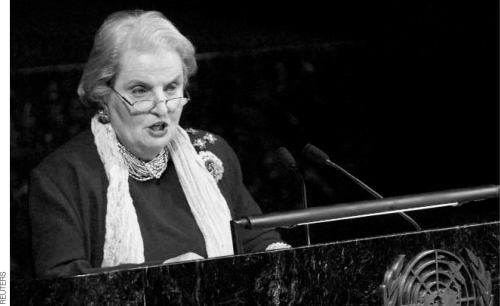
Bringing in the big guns: U.S. Secretary of State Madeleine Albright speaking on opening day, April 24.
Most of these steps are familiar. Arms control and disarmament groups have been talking about them for a long time, and some have found their way into the government statements and policy positions of a range of non-nuclear countries.
Most significantly, the dual-track approach of requiring an unequivocal commitment from the weapon states and identifying practical, doable interim steps, came directly out of a resolution put forward in the U.N. General Assembly in 1998 and again in 1999 by seven medium powers that have become known as the New Agenda Coalition—Brazil, Egypt, Ireland, Mexico, New Zealand, South Africa, and Sweden.
The New Agenda was launched in June 1998 with a joint statement by the foreign ministers of these seven countries and Slovenia. Later in the year, they sponsored a resolution to the U.N. General Assembly highlighting the need for renewed commitment and new initiatives on nuclear disarmament. Heavy pressure from the United States forced Slovenia to drop out, but the resolution garnered 114 votes in favor, with 18 against. In 1998 and again in 1999, four of the nuclear powers—Britain, France, Russia, and the United States—opposed the New Agenda resolutions. Despite hard lobbying by the weapon states to vote against, Japan and most of the NATO states abstained, although none summoned the political will to defy the “loyalty” edict and vote in favor. Canada, Germany, Japan, and the Netherlands had come under pressure from parliamentarians and NGOs at home to support the moderately worded New Agenda resolution in 1999, and they were determined to show the NPT Conference that they too had constructive ideas for addressing nuclear disarmament.
Many of these allies were therefore chagrined when the weapon states passed over them and negotiated directly with the New Agenda states. What happened to make the major powers do business with the New Agenda Coalition?
Predictions of disaster
Forecasts before the conference were overwhelmingly pessimistic. There was a widely shared view that since 1995 nuclear nonproliferation has been moving in the wrong direction—with India's and Pakistan's nuclear tests in May 1998, the rejection of the CTBT by the U.S. Senate in October 1999, the long deadlock in the START process and at the Conference on Disarmament (CD) in Geneva, and growing concerns about the impact on nuclear arms control of U.S. plans for national missile defense.
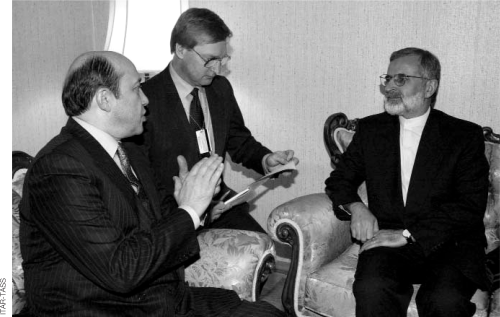
But the Russian Duma's ratification of the CTBT and START II just before the review conference changed the dynamic. Igor Ivanov, Russia's foreign minister, was warmly applauded by NPT parties when he presented his “National Report on the Compliance by the Russian Federation with the Non-Proliferation Treaty.” There was widespread support for his proposal to reduce U.S. and Russian strategic arsenals to 1,500, a “historic chance” that he said would be missed if the United States destroyed the ABM Treaty. Ivanov went on to put forward Russia's proposal for addressing missile threats and missile proliferation through a “Global Missile and Missile Technologies Non-Proliferation Control System.”
Russia's late moves on the CTBT and widespread international criticism of U.S. national missile defense (NMD) forced the United States on the defensive, making it necessary to field a higher-level delegation than originally intended. Secretary of State Madeleine Albright gave the opening address, welcoming Russia's recent steps. She defended the Clinton administration from accusations of “sabotaging the ABM Tr eaty and strategic arms control” and told the conference, “We share the frustration many feel about the pace of progress toward a world free of nuclear weapons.” Nevertheless, she warned, “If countries demand unrealistic and premature measures, they will harm the NPT.”
As countries lined up to criticize U.S. missile defense plans, it looked as if NMD would be the issue on which the conference would founder. Describing the United States as “a superpower which rampantly intervenes in other countries' internal affairs,” China's head of arms control and disarmament, Sha Zukang, said a U.S. missile defense would “trigger off a new round of the arms race in new areas.” Referring to the impasse in the CD, he added that “the prevention of the weaponization of outer space is a task even more urgent than the FMCT [Fissile Material Cut-Off Treaty].”
The five-power statement
The conference was surprised a week later when China and Russia signed on to a five-power statement that referred to “preserving and strengthening the ABM Treaty as a cornerstone of strategic stability and as a basis for further reductions of strategic offensive weapons.”
This careful language covered a multitude of interpretations, but it was clear that the nuclear powers had collectively agreed to keep the NMD issue out of the NPT. The commitment to preserving the ABM Treaty was interpreted as meaning that the United States would not abrogate the treaty, but U.S. diplomats immediately made clear that “strengthening” the treaty would not rule out certain modifications permitting a limited NMD deployment. Apart from these two key issues, the rest of the five-power statement covered the standard bases, with one positive new pledge that “None of our nuclear weapons are targeted at any state.”
At the meetings of the NPT preparatory committee (PrepCom) in 1997 and 1998, France had been successful in coordinating a five-power statement. In 1999, at the height of the NATO air strikes against Yugoslavia, during which the Chinese embassy in Belgrade had been bombed, no joint statement was possible. This year— although the stakes were higher and negotiations began months before the conference opened—it had appeared that the combination of U.S. missile defense plans and China's linking of the FMCT negotiations to NMD and outer space issues would defeat France's hopes.
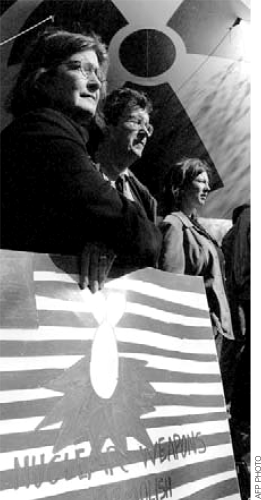
An anti-nuclear rally outside the United Nations on April 25, the second day of the conference.
Reaction to the statement was ambivalent. Some welcomed it as a sign that deep divisions among the weapon states would not deadlock the review conference. But others saw it as a cynical attempt by the weapon states to maintain the privileges of the nuclear club in the face of sustained pressure from the non-nuclear countries. By lifting the pressure accumulating on missile defense, the five-power statement appeared to be to the advantage of the United States. So why did the other nuclear weapon states back it?
France and Britain had pushed for a five-power statement in the hope that it would contribute constructively to the conference outcome. Despite their own misgivings about missile defense, neither wanted the issue to derail the NPT. Russia had its eye on talks in Washington between Ivanov and the U.S. State Department and on the June summit meeting of Presidents Clinton and Putin.
China agreed to the statement in return for a weak, conditional paragraph on FMCT, thereby staving off strong pressure from a number of Western non-nuclear weapon countries who had been determined to make the cutoff treaty the main focus of their program of action for 2000 to 2005. China's stated reason for going along with the five-power statement was Beijing's desire for a successful conference, but two political factors may have been uppermost: the China trade bill, which was facing a tough ride in the U.S. Congress; and relations with France, which put its prestige behind achieving five-power agreement.
Whatever the reasons, the five-power statement ensured that neither NMD nor the cut-off treaty would be a make-or-break issue. Some of the non-nuclear countries were furious, but they recognized that if they wanted a final document, they would have to reproduce the nuclear weapon states' language on these two key issues.
The “New Agenda”
After three weeks of debate in the committees on nuclear disarmament, safeguards, and nuclear energy, all the positions had been rehearsed but few had been resolved. Attention focused on discussions in two “subsidiary bodies”—formal working groups that were open to all NPT members. One was on nuclear disarmament and the other on regional issues, including the Middle East.
The Acronym Institute had first suggested using the 1995 provisions to have a body separate from the main committees to address practical disarmament steps as a way of putting teeth into the third part of the 1995 program of action on disarmament, which called for “systematic and progressive efforts to reduce nuclear weapons globally.” Taken up by South Africa at the 1998 PrepCom, the idea gathered support from the New Agenda and non-aligned states.
In the run-up to this year's conference, the weapon states rejected the idea of these subsidiary bodies, but the non-aligned countries were prepared for a fight on the issue at the beginning of the meeting and they threatened to force a vote. Wanting to avoid a head-on clash early in the conference, the president of the conference, Algeria's Abdallah Baali, persuaded the weapon states to let the subsidiary bodies be convened.
Chaired by New Zealander Clive Pearson, the nuclear disarmament subsidiary body looked first at the “unfinished agenda,” including START, the CTBT, and the “fissban,” and then turned to new or further steps. That left the review and assessment of progress since 1995 to Committee I, where delegations disagreed vehemently over the significance of dismantlements and numbers of weapons remaining in the arsenals, nuclear testing, stockpile reinforcement and nuclear weapons modernization, the 1996 advisory opinion of the International Court of Justice, and so on.
Pearson piloted the disarmament discussions through several drafts. The nuclear states considered one early draft too close to New Agenda positions. Then (to the surprise of many) various NATO countries led the charge against the next version, which they criticized for veering too far the other way and being too weak—although parts of it were still unacceptable to some of the weapon states.
Then the unexpected happened. When it looked as if the discussions were at an impasse, the United States initiated private negotiations between the nuclear weapon states and the New Agenda countries.
The private negotiations started tentatively with a Saturday morning meeting before the final week. By Wednesday, a draft paper based on Pearson's last working paper—but with substantial compromises agreed to by the New Agenda states—was circulated among a larger group of about 50 countries, chaired by Baali.
Britain and the United States said they were willing to agree. France still had problems with making an “unequivocal undertaking” to eliminate its nuclear arsenal. Russia opposed several provisions, including the “unequivocal undertaking” and the paragraph dealing with tactical nuclear weapons. Russia, in particular, wanted the practical disarmament steps to be conditioned on “strategic stability.”
Some had believed the United States was counting on failure.
The weapon states might have gone along with that, but the New Agenda states refused, arguing that “strategic stability” could be used as an excuse to maintain the nuclear status quo. China, for its part, balked at the paragraph on transparency.
Discussions among the nuclear powers and the New Agenda countries broke up in the early hours of Thursday morning, May 18, apparently deadlocked.
There was astonishment and applause, therefore, when the Russian ambassador, Yuri Kapralov, came back the next morning and said that Russia was ready to accept the negotiated package, even though he felt that the conference had neither sufficiently acknowledged nor understood Russian security concerns. Still stressing that without strategic stability Moscow could not take risks in arms control and disarmament, Kapralov said that Russia would “in the spirit of compromise” give up its insistence and accept the paper as it stood.
Russia's agreement put France and China in the spotlight. France quickly acquiesced, despite its belated realization that instead of nuclear disarmament being characterized as the “ultimate goal” as it was in 1995, the “ultimate objective” was now described as general and complete disarmament.
China took another day, lobbying first for deleting references to transparency, and then linking its acceptance to the reintroduction of a paragraph committing the nuclear powers to no-first-use of nuclear weapons. On what was meant to be the last day, however, China gave in, accepting the reference to providing information relating to “nuclear weapons capabilities and the implementation of agreements pursuant to Article VI and as a voluntary confidence-building measure to support further progress on nuclear disarmament.”
Down to the wire
With this agreement, the conference took on a new relevance. Baali asked the weapon states to work with the New Agenda Coalition and others on the contested nuclear disarmament review language coming out of Committee I. The prospect of a substantive program of forward-looking steps gave added incentive to most delegations to find ways to agree to the remaining text without selling their positions too short. Pressure redoubled to resolve outstanding issues, particularly the question of Iraq's non-compliance with the 1991 U.N. Security Council Resolution 687. The United States insisted on noting this as the price for agreeing to the Arab states' demand that Israel be singled out as the only state in the Middle East which has not adhered to the NPT. Iraq objected, saying that Resolution 687 was not relevant to the NPT and went beyond the safeguards inspections required by Article III of the treaty. The chair of the subsidiary body on regional issues, Christopher Westdal of Canada, had managed to convince Iraq's ambassador, Saeed Hassan, to accept mention of Resolution 687 and a paragraph based on the June 24 statement by the International Atomic Energy Agency (IAEA) director-general, which noted that the IAEA was unable to verify Iraqi compliance. The remaining disagreement between the United States and Iraq was therefore only over which parts of the IAEA statement to note and whether and how to refer to Resolution 687.
April 25: A meeting between Russian Foreign Minister Igor Ivanov (left) and Kamal Kharrazi, of Iran (right).
As Westdal shuttled back and forth between separate huddles of Iraqis and Americans, trying to get agreement on the wording, time was running out. Baali stopped the clock at ten to midnight to enable discussions to continue. By 2:00 a.m. on Saturday, both sides appeared ready to throw in the towel. But other delegations, particularly the New Agenda, non-aligned, and some NATO states, did not want to give up and lose the significant agreements already worked out on disarmament. Most delegations thought the 2000 conference needed to make some reference to the necessity for Iraq to comply fully with its NPT obligations and IAEA safeguards agreements. But once Hassan had agreed to this in principle, few could understand why the United States appeared so willing to give Iraq the publicity and power to block the whole conference.
Speculation mounted during the final night that the United States had been planning on a conference failure, with the hope that Russia, China, or Iraq would take the blame for lack of agreement on disarmament or the Middle East. It was thought, however, that the United States did not want to be perceived as the obstacle. In an uncoordinated but concerted action, therefore, various non-nuclear states, non-governmental representatives, and even Westdal and Baali let the American negotiators know that the U.S. and Iraqi positions were no longer far enough apart to justify the conference's failure. Most important, they showed they would consider the United States as well as Iraq to be responsible.
The meeting broke up shortly after 5:00 a.m. for delegates to get a few hours of sleep. Some hours after it reconvened, Iraq and the United States finalized their agreement. The paragraph would reaffirm the importance of Iraq's “full, continuous cooperation with the IAEA and compliance with its obligations” and note that while the IAEA could not provide assurance that Iraq had complied with Resolution 687, the agency had carried out a safeguards inspection in January 2000.
The agreement on Iraq enabled the section on regional issues to be finalized. This in turn resulted in a flurry of activity to resolve the outstanding issues from Committee II, which concerned export controls, safeguards, and a Belarus proposal for a Central and Eastern European Nuclear Weapon Free Space (opposed by 15 other states in the region).
By this time, few had the stomach to argue, so a number of disputed paragraphs were simply scrapped. Some of the deleted sections addressed aspects of safeguards and export controls that the Western states considered important. But they gave in on the basis that the 2000 document would reaffirm the 1995 “Principles and Objectives” on these issues, which therefore still stood as a baseline. Baali also managed to push through a short paper intended to improve the effectiveness of the strengthened review process.
Entangled in their own web?
There are two main schools of thought on what happened at the 2000 NPT Conference. According to one view, the nuclear powers came to the conference wanting to make it a success, both to reaffirm the 1995 decisions and to boost the nuclear nonproliferation regime. The five were willing to engage on all aspects, including nuclear disarmament, and they compromised on some difficult issues in order to facilitate agreement. (They also published reports—even glossy brochures—outlining what each had done to comply with their obligations, especially Article VI.)
Just days before the conference opened, the new government of Vladimir Putin at last provided the leadership to push the Russian Duma to ratify the CTBT and START II.
Britain issued a summary report on a study conducted by the Atomic Weapons Establishment at Aldermaston on verifying the reduction and elimination of nuclear weapons. Indeed, Britain's whole approach at the conference was constructive. Its role as a bridge-builder towards the New Agenda Coalition in particular was widely appreciated.
France wanted a joint statement from the five nuclear powers and refused to give up in the face of China's difficulties. The United States had sought to work out a position with Egypt in advance to ensure that the problem of the Middle East would not derail the review conference. And when conference negotiations on practical disarmament steps in Pearson's subsidiary body appeared to reach an impasse, it was the United States that approached the New Agenda countries to suggest meeting to hammer out their differences.
Finally, when the heat was turned up, the nuclear powers compromised for the sake of agreement. By this scenario, the nuclear powers are viewed as constructive and engaged. But does this mean they consider the review conference commitments as serious and binding? Or was agreement easier because the conference document is only regarded as a document?
An alternative analysis of the meetings casts a machiavellian United States in the lead, and suggests that the major nuclear powers became entangled in a web of their own strategies, particularly in relation to each other. None wanted to be blamed for a failed conference, but the United States, Russia, and China sought also to gain tactical advantage over the others, using the conference as the backdrop for larger political objectives. This theory has the United States— among others—assuming that agreement on a final document would be impossible, making it easier to give concessions on its parts.
The Clinton administration appeared determined that after the CTBT ratification debacle, the United States must not be blamed as the main cause of NPT failure, as happened at the 1998 PrepCom. The delegation, led by Norman Wulf, therefore sought as many ways as possible to be accommodating and constructive, especially on the traditionally difficult areas of the Middle East and disarmament.
Russia's ratification of the CTBT and START II raised the stakes and increased the pressure on the United States, as Moscow had intended. In initiating talks with the New Agenda coalition, the United States may have sought to corner Russia and China, calculating that they would be unable to accept the paragraphs on tactical nuclear weapons and transparency, respectively. As Russia, China, and France fought to water down or take out commitments they disliked, many commented on how unusually conciliatory the United States was being. Observers also confirm that the American and Chinese delegations “practically fell off their chairs” when Kapralov accepted the disarmament paper on the penultimate day.
Suddenly, the conference looked close to success. And at that point, the disputed paragraph on Iraq moved to center stage and threatened to destroy the outcome.
To prevent this happening, conference president Baali and a number of delegations, including Britain, Russia, Japan, Poland, the Netherlands, Portugal on behalf of the European Union, Indonesia on behalf of the non-aligned states, and Mexico on behalf of the New Agenda Coalition, underlined the responsibility of both countries and publicly called on the United States and Iraq to reach agreement. The message to the United States was clear, and resulted in high-level intervention from Washington. Only then did the United States accept a compromise paragraph close to what Iraq had said it would accept many hours earlier.
What went on in the nuclear weapon states' delegations in those last few days? The truth probably lies somewhere between these two scenarios. Clearly the weapon states felt pressed to make stronger commitments than they had at previous conferences, whether to reinforce a nonproliferation regime shaken by the South Asian nuclear tests, or to reassure and appease the non-nuclear states. The successful outcome undoubtedly vindicates the 1995 decisions and sends a strong signal that India and Pakistan are likely to find unwelcome.
Halfway through the conference, India's Foreign Minister Jaswant Singh made a statement to the parliament in New Delhi, once again declaring that India is a responsible nuclear weapon state and arguing that any statements issued at the conference about India rolling back its nuclear program are “mere diversions to prevent focused attention on the basic goals of the NPT.”
It would have been convenient for India and Pakistan if the review conference had collapsed in acrimony. Instead, the final document reflects how much attention was focused on the basic goals not only of nonproliferation, but also on nuclear disarmament. Moreover, the NPT parties deplored the South Asian nuclear tests and underscored that “such actions do not in any way confer a nuclear weapon state status or any special status whatsoever.”
Behind all the sound and fury, however, what have the weapon states actually agreed to? The unequivocal undertaking reflects the advisory opinion of the International Court of Justice on the legal obligation to eliminate nuclear arsenals, delinked from general and complete disarmament. That is important. After considerable watering down, however, the practical steps are couched as aspirations and principles, with no specifics. There are no target dates or timetables for accomplishing any of the objectives.
Diplomacy can set the standards and expectations, but it will take concerted political will to translate the words adopted at the review conference into concrete actions towards the total elimination of nuclear arsenals. So far, only Britain looks as if it might genuinely want to find that political will, but it lacks the independence to go it alone.