




Abstract
How far will Mexican authorities go to avoid facing the problems at the Laguna Ve rde nuclear power plant?
Located on a narrow swath of land between the verdant coastal mountains of northern Veracruz and the Gulf of Mexico, the hulking structures that make up the La-guna Verde nuclear power plant seem out of place. Except for an occasional tropical storm, little happens in this drowsy, underdeveloped region of Mexico. But since it came on line in 1990, a series of controversies at the plant have provided those living nearby with a steady source of conversation.
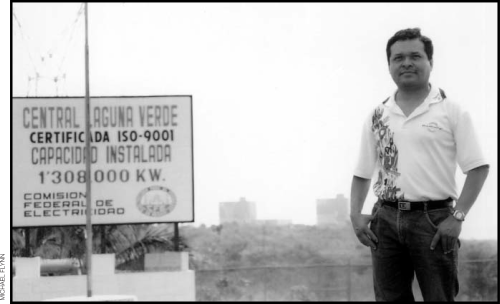
Although the local population has apparently grown accustomed to the plant—and demonstrations by fisherman and farmers worried about radioactive fish and contaminated sugarcane ceased years ago—distrust of plant officials runs high in the surrounding areas.
The Laguna Verde nuclear power plant.
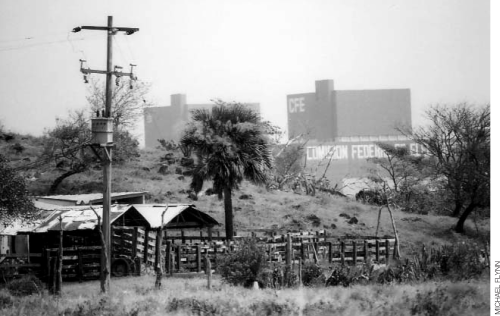
When I asked a fisherman in the nearby village of Palma Sola whether he thought the plant would come to the community's aid in an emergency, he responded, “Hell no. Of course, they'll clear out the trunk [the plant], but the rest of us will be abandoned.”
According to Bernardo Salas Mar, a former radiation engineer at the plant, the community's suspicions are not unwarranted. He points to an incident in March 1993 as an indication of plant management's dangerously lax approach to security.
On March 9, monitors in the plant's main steam pipe detected trace amounts of radiation seeping from the reactor, indicating a possible core meltdown. Plant officials immediately shut down the reactor and placed the plant on a state of alert. Remarkably, officials failed to tell employees the reason for the shutdown and made no effort to prepare for an evacuation.
Although the leak was later determined to be a false alarm, for Salas, management's failure to institute the plant's internal emergency plan was inexcusable. “At the very least,” he says, “authorities should have followed plant regulations and directed everyone to their meeting places to await further instructions. If the situation deteriorated, everyone would then be in a position to be evacuated. Instead, they left us all in a defenseless position.”
Salas compares this 1993 incident to the accident at Three Mile Island in 1979. At least at Three Mile Island, he says, authorities followed internal emergency procedures and evacuated workers when a meltdown was detected. “If there had been a meltdown at Laguna Verde that day, Three Mile Island would no longer be considered the worst nuclear accident in the Western hemisphere. Plant workers and thousands of people living near Laguna Verde could have been contaminated without even having known about it.”
According to Salas, the person responsible for failing to institute the emergency plan was plant superintendent José Francisco To rres. But instead of being reprimanded for his negligence, says Salas, Torres was given a promotion several months after the incident.
An unlikely activist
In May 1996, after working more than 14 years at Laguna Verde, Bernardo Salas was fired for allegedly violating plant regulations. His supervisors accused him of having clocked in at an improper location and posting unauthorized reports of problems at the plant on bulletin boards. Salas says the real reasons for his dismissal were that he refused to ignore corrupt practices among plant higher-ups and insisted on bringing irregularities to the attention of his supervisors.
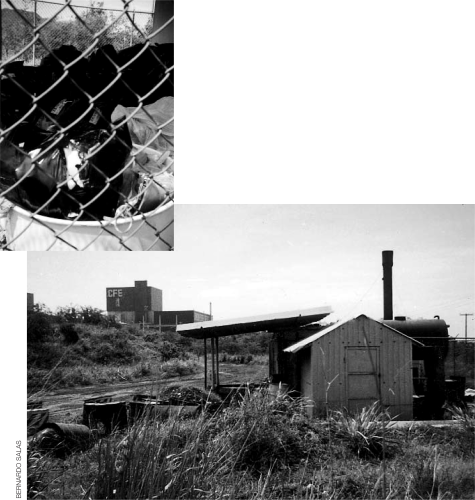
Since his dismissal, Salas has been one of the most outspoken critics of the state-owned plant and the government agency charged with overseeing it, the Federal Electricity Commission (CFE). His accusations, which have been widely publicized in the Mexican press, range from the burning of radioactive waste in the open air to the purchase of faulty radiation monitoring equipment and a disregard for safety regulations on the part of plant officials.
Not surprisingly, his case has become a cause célèbre among Mexican anti-nuclear activists. But to their dismay, Salas refuses to sign on to a campaign to shut down the plant. An unrepentant nuclear power enthusiast, Salas argues that the only thing Laguna Verde needs is new management. “I believe in nuclear power, and I think Laguna Verde could be a fine plant,” Salas told me during a conversation in Mexico City in March. “But incompetent and corrupt officials are destroying Mexico's nuclear industry.”
Plant officials have been largely successful in fending off Salas's criticism. Government agencies have apparently done little to investigate his charges, and since winning an arbitration case brought by Salas, CFE officials have generally ignored his periodic statements to the press.
In mid-March, however, Salas's allegations were revived when an anonymous group of engineers at the plant leaked a highly critical report about plant operations to Greenpeace Mexico. The report, which is a collection of observations made by representatives of the World Association of Nuclear Operators (WANO), criticizes the plant's security procedures, radiation monitoring techniques, engineering practices, and safety culture. It also describes several recent accidents and reproaches the plant for using substandard equipment (see “Trouble at the Green Lagoon,” May/June Bulletin).
Although the report does not directly substantiate any of Salas's allegations, its numerous criticisms regarding the plant's safety procedures lend credence to his charges.
Marco Martínez Negrete, a physicist at the Autonomous National University of Mexico, told me, “The WANO report describes serious deficiencies in the plant's security, which is something Salas has been telling us for years. The report's conclusion that the plant's safety culture is seriously inadequate corresponds with Salas's claims regarding the improper disposal of low-level waste and the management's blatant disregard of radiation monitoring procedures. Those running the plant apparently don't think it is necessary to adequately train their workers.”
[On June 6, as the Bulletin was going to press, CFE announced that it would allow a congressional energy committee and Greenpeace Mexico to designate independent experts to undertake an audit of Laguna Verde.]
Forced out
On October 22, 1991, during a routine check to measure employee exposure, a Russian technician working temporarily at the plant caused an enormous spike to register on the plant's whole-body counter, which indicated that he was emitting radiation. Salas, who was operating the monitor, initially thought the technician, Anatoly Koulitchenkou, had to be carrying a cesium source in one of his pockets. Koulitchenkou insisted that he wasn't. Inquiring further, Salas learned that the technician had been exposed to extremely high levels of radiation while working at Chernobyl.
Fake dosimeter components (the six with white centers) used at Laguna Verde and the CFE purchase order for them.
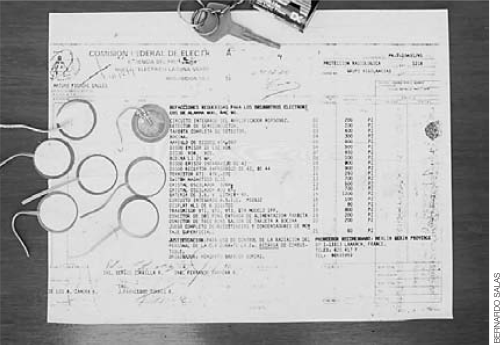
To the dismay of Mexican anti-nuclear activists, Salas remains a nuclear power enthusiast.
Inexplicably, though, the printout produced by the counter's computer did not show the Russian to be contaminated. Alarmed, Salas immediately filed a report with his supervisor, Sergio Zorrilla Romero. However, Zorrilla did not respond to the report and no investigation was made to determine the cause of the faulty printout. (Salas later discovered that the counter, which the plant had been using for 10 years, had never been tested and was improperly calibrated.) Several days after Salas filed the report, colleagues told him that Zorrilla had instructed them not to let him use the whole-body counter.
According to Salas, this was the first of a series of similar incidents that eventually led to his dismissal. During the next four years, each time Salas uncovered an irregularity, he would report it to ever higher levels of authority in the hope that corrections would be made. Instead, plant management responded by demoting him, reducing his responsibilities, cutting his financial incentives, and ultimately relieving him of his position and isolating him from his coworkers.
When Salas arrived at work on January 16, 1995, a letter from supervisor Zorrilla was waiting on his desk. It instructed him to report to Roberto Klee García, who managed the plant's temporary waste storage facility. Salas was then told to go to a small abandoned building next to a radioactive waste depository and await further instructions. He spent the final 18 months of his job isolated in the building's single bare room— which he jokingly refers to as “my cell”— without an assignment, a dosimeter, or any means of communication.
Top, a yellow bag used to discard radioactive waste can be seen through a tear in the black garbage bag covering it. Below, the facility where Salas discovered workers burning the bags.
Undeterred by his isolation, Salas pressed ahead with his efforts to document irregularities. He diligently made records of each problem he had uncovered, collected evidence to support his claims, and made copies of the numerous reports he had given to his supervisors. Ironically, Salas discovered documents that supported some of his claims stashed in boxes in his “cell.”
He then sent letters explaining his situation to several national and international agencies, including the Federal Electricity Commission, the National Nuclear Safety and Protection Commission, the Mexican Electrical Workers Union, and the International Labor Organization. No one responded.
Salas also gave plant superintendent José Francisco Torres copies of the documentation he had collected. Several days later, during a plant-wide meeting, Torres denounced Salas as a “bad element.”
In a last desperate attempt to inform his colleagues of the irregularities he had uncovered, Salas posted an open letter on bulletin boards around the plant in which he repeated his allegations and invited co-workers to review the evidence he had collected. He was fired soon afterward.
“We fired him because he is lazy”
In June 1996, Salas filed a complaint with the attorney general's office and the labor arbitration board. He claimed that he had been improperly dismissed, and made a series of accusations about inappropriate practices at the plant, most of which he backed up with documentary evidence.
His charges included: failure to implement the plant's internal emergency plan during the 1993 incident; incorrect calibration of radiation counters; the burning of low-level radioactive waste on beaches next to the plant; inappropriate placement of radiation monitors; purchase of defective radiation detectors that had been recalled by the manufacturer; and the use of bogus components in dosimeters.
Salas also claimed the computer program that recorded each employee's cumulative exposure produced inaccurate records and often decreased workers' individual doses. He used the record of Miguel Angel Velazquez Mejía, a plant mechanic, to support his claim. In his January-March 1992 record, Velazquez had a cumulative dose of 3.169 rem. But in the following trimester, his cumulative dose decreased to 0.879 rem and remained at that level for several years. Salas, who claimed that there were about 5,000 employee records with similar errors, said that the faulty program made it impossible to determine whether an employee had exceeded his permitted exposure level and prevented the plant from adequately protecting workers.
He contended that the faulty computer program might have indirectly contributed to the deaths of two coworkers, Felix Rafael Ortega Domínguez, who died of kidney cancer, and José Luis Lopez Islas, who died of pulmonary fibrosis. Both had been designated as “Personnel Occupationally Exposed to Radiation” because they had worked in areas of the plant where the likelihood of exposure was exceptionally high.
(During a class-action lawsuit brought against the plant in 1997 by former employees, Lopez's widow alleged that just before her husband died, the plant's personnel director, Laura Gisela Sánchez Saucedo, threatened him, telling him “not to speak to anyone about your condition because it will only bring harm to you and your family.”)
In response to Salas's complaint, CFE and plant officials accused him of fabricating the charges and introduced new reasons for having fired him. In their legal brief denying his allegations, plant officials claimed Salas was dismissed because he had “demonstrated a lack of integrity and honesty.” Rafael Fernandez de la Garza, the plant manager at the time, told a Mexican reporter, “We fired him because he is lazy. He is pouring out his bitterness attacking us.” And Leonardo Alcaine, head of SUTERM, the government-aligned electrical workers union, told the Mexican daily La Jornada, “Unfortunately, our companion Bernardo Salas is sick and crazy; he has psychological problems.”
After a drawn-out legal battle at the labor arbitration board in Veracruz, the judge ruled in favor of the plant. Salas told me that he expected to lose. “The plant has never lost a labor dispute at the arbitration board in Veracruz.”
Several months after Salas filed his complaint, 200 former plant workers brought a class-action lawsuit against CFE for illegally breaking their contracts and dismissing them without compensation. To avoid having the case heard in Veracruz, the workers filed their suit with the federal arbitration board in Mexico City.
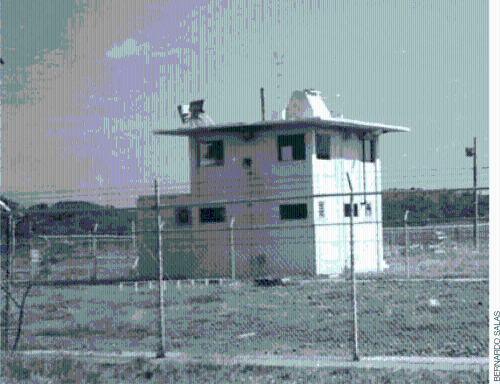
Salas spent the final 18 months of his job in this abandoned building without an assignment, a dosimeter, or a telephone. Ironically, it also housed documents that supported some of his claims.
“Bernardo knows too much … I told him to always be looking over his shoulder because there could be an attempt on his life.”
Apparently alarmed by this move, cfe lobbied the arbitration board to transfer the case to Veracruz. When the board refused, cfe proposed an out-of-court settlement. Although most of the workers accepted the offer, 70 opted to press forward with the lawsuit. Early last year, the arbitration board ruled in favor of the workers. Cfe has appealed the ruling.
The politics of fear
During my investigation into Salas's case, I discovered that many former Laguna Verde employees refused to speak about their experiences at the plant. Those who did usually asked to remain anonymous.
Most were concerned that by speaking out they would jeopardize their jobs. But others, like “José,” one of the former workers involved in the class-action suit, claimed that the price of speaking out could be much higher. As for Salas, José told me, “Bernardo knows too much, which makes him a threat to CFE. Most of us choose to stay quiet and we try to leave our experience at the plant behind us—but not Bernardo. I told him to always be looking over his shoulder because there could be an attempt on his life.”
Las Madres
In Mexico, conversations about the Laguna Verde nuclear power plant often turn to a small group of women based in Xalapa, the capital of Veracruz. Called Las Madres Veracruzanas—the Mothers of Veracruz— this tenacious group of housewives, academics, business owners, and doctors has led opposition to the plant for more than a decade.
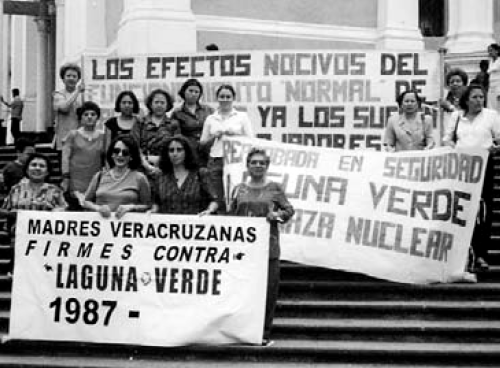
According to Claudia Gutierrez, one of the founding members and a psychology professor at the University of Xalapa, the group was formed in response to the accident at Chernobyl. “When the government first began construction at Laguna Verde in the early 1970s, no one was concerned about it. We were all led to believe that nuclear power was the cleanest source of energy. The accident at Chernobyl caused us to realize just how dangerous the plant was.”
Since 1987, the group has gathered every Saturday in the plaza directly across from the governor's offices in Xalapa to demonstrate against the plant and repeat its calls for an independent audit. The women claim they have not missed a single Saturday vigil in 13 years.
In the late 1980s, the women forged a powerful coalition of concerned citizens, fishermen, unionists, farmers, politicians, and activists who lobbied the government not to open the plant. By 1988, Las Madres had generated so much publicity that during the run-up to the presidential election, several opposition candidates met with them in an attempt to secure their support.
Just before the plant came on line in 1990, the women undertook a series of high-profile public protests. They broke through police lines and blocked the main highway to the plant, sneaked into press conferences, demonstrated at various public events, and repeatedly marched through the streets of Xalapa.
In 1990, then-President Carlos Salinas met with Las Madres and promised to order an independent audit of the plant. But according to the group, Salinas never followed through with his promise. Instead, he turned responsibility for the audit over to a secretary, who ignored the group's repeated requests for a meeting.
In recent years, the group has seen its membership dwindle from several dozen to about 15. And the broad coalition of citizen groups that coalesced in the late 1980s has all but evaporated. “Government officials don't pay attention to us anymore,” says Gutierrez. “We no longer pose a threat to their plant.”
The movement's decline, however, has not dampened the women's resolve. In early May, they filed a legal complaint arguing that the plant's off-site emergency plan is seriously inadequate and does not meet standards set in federal law.
Their tenacity and devotion to the cause, already widely recognized in Mexico, are beginning to receive attention abroad. Velma Garcia, a political scientist at Smith College, published a book last year about them titled Mothers and the Mexican Antinuclear Movement.
Garcia, who received a Ford Foundation grant to study the group, says that she was drawn to Las Madres by their remarkable persistence. “Most social groups give up their campaigns when their issues begin losing steam. But Las Madres have remained steadfastly loyal to their ideals and have refused to make any compromises. They are very much invested in the idea that they are above politics and are only trying to protect their children and society.”
“We won't ever give up our work,” Gutierrez says. “We don't want the threat of catastrophe always hanging over our families. Nuclear power is not necessary in Mexico. We are rich in so many other sources of energy. Instead of keeping Laguna Verde open, the government should be investing in sustainable sources of energy, like solar power.”
—M. F.
In 1987, Miguel Angel Valdovinos Terán, a physicist, was helping to design Laguna Verde's environmental impact lab when he discovered a series of safety problems at the plant. Together with a group of plant engineers, Valdovinos drafted a highly critical report detailing deficiencies in the plant's administration and problems with its security procedures. Plant officials, who were then busy preparing to start up the plant, tried to bury the report and fired one of the engineers.
A year or so later, Guillermo Guerrero, the director of CFE, invited Valdovinos to discuss the report with him in person. Instead of addressing problems at the plant, however, Guerrero informed Valdovinos that he was fired and told him to drop his allegations.
Valdovinos claims that as he was leaving the meeting, four men threw him into a van and took him to a secluded building. For three nightmarish days, he says, his captors tortured him by applying electric shock to his genitals and repeatedly dunking his head in water. He was then threatened with further reprisals if he disobeyed plant officials.
Shortly after being released, Valdovinos moved with his family to Mexico City. “My wife and I decided to forget about Laguna Verde,” he told me. “The most important thing was to keep our family safe.”
In 1996, however, Valdovinos agreed to be an expert witness at Salas's arbitration hearing. “I decided that it was the right thing to do. I didn't receive support from anyone during my quarrel with the plant, and I knew Bernardo could use some help.”
Valdovinos, who now directs a series of environmental impact studies at the Autonomous National University of Mexico, told me that his report caused such a strong reaction partly because it was viewed as politically threatening by officials of the governing PRI party, which at that time was in the middle of a fiercely contested presidential campaign.
Although Valdovinos was willing to tell me his personal story, he was reluctant to give his opinion about the plant. “Let's talk again after this year's elections are over,” he said. Just as in 1988, he observed, “the PRI is concerned that it might lose the elections. And I don't want to have any more run-ins with them.”
An unflagging optimist
Life since Laguna Verde has not been easy for Salas. Unable to find work in Veracruz, Salas has spent the last few years bouncing from one temporary job to another in Mexico City. In the meantime, his wife and two children remain in Cardel, a small town not far from Laguna Verde. Because the cost of living in Mexico City is so high, Salas told me, he can't afford to move his family.
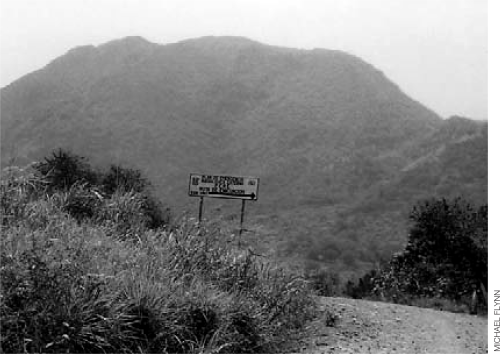
The sign, part of the plant's “external radiological emergency plan,” marks this nearby dirt road as an evacuation route.
I asked Salas why he chose to continue with his campaign against plant management, given all the trouble it has caused him. “In Mexico,” he told me, “we have the tendency to think that we are incapable of getting things right, that corruption will always dominate, and that there is nothing we can do about it. But I don't accept that. As a matter of personal ethics, I need to continue working to bring about change at the plant. I also need to prove that what I was saying was true. At some point things will change, and I want to be a part of that.”