




Abstract
A report from Colombia—the front line in Washington's war on drugs.
In the glare of the midday sun, the banks of the broad Putumayo River in Colombia are an unbroken wall of green. The jungle is so dense that from midstream it's hard to pick out the mouth of a narrow tributary—until three naval patrol boats burst roaring from between the trees.
Colombian marines patrol the Putumayo River.
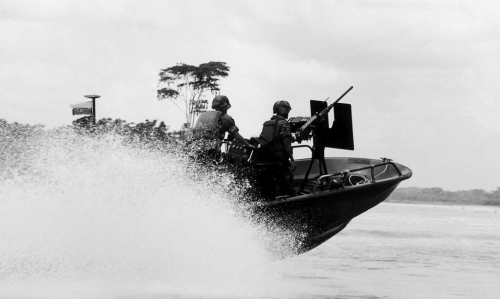
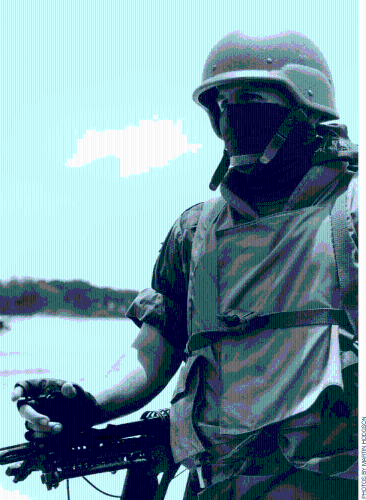
On the foredeck of the lead vessel, a Colombian marine ratchets the magazine of his heavy machine gun, and as the boats skim past their target, the troops unleash a barrage of automatic fire. They shoot blindly, pounding the undergrowth with .50 caliber rounds— then a sudden calm falls as the speedboats head back to base.
Unnoticed by the marines, a dugout canoe detaches itself from the shelter of the riverbank and noses steadily up river. The patrol boats are almost out of sight as the peasant woman on board paddles silently past the target zone.
Colombia and its allies in the United States are pushing for a massive injection of American cash, which they say will rescue this war-torn country from anarchy. But in their haste for a final victory in the war on drugs, the policymakers seem to have forgotten the Colombian people.
Today's operation on the Putumayo, which at this point separates Colombia and Peru, was just a training exercise, but the marines cannot afford to drop their guard. The jungles of southern Colombia are a lawless region.
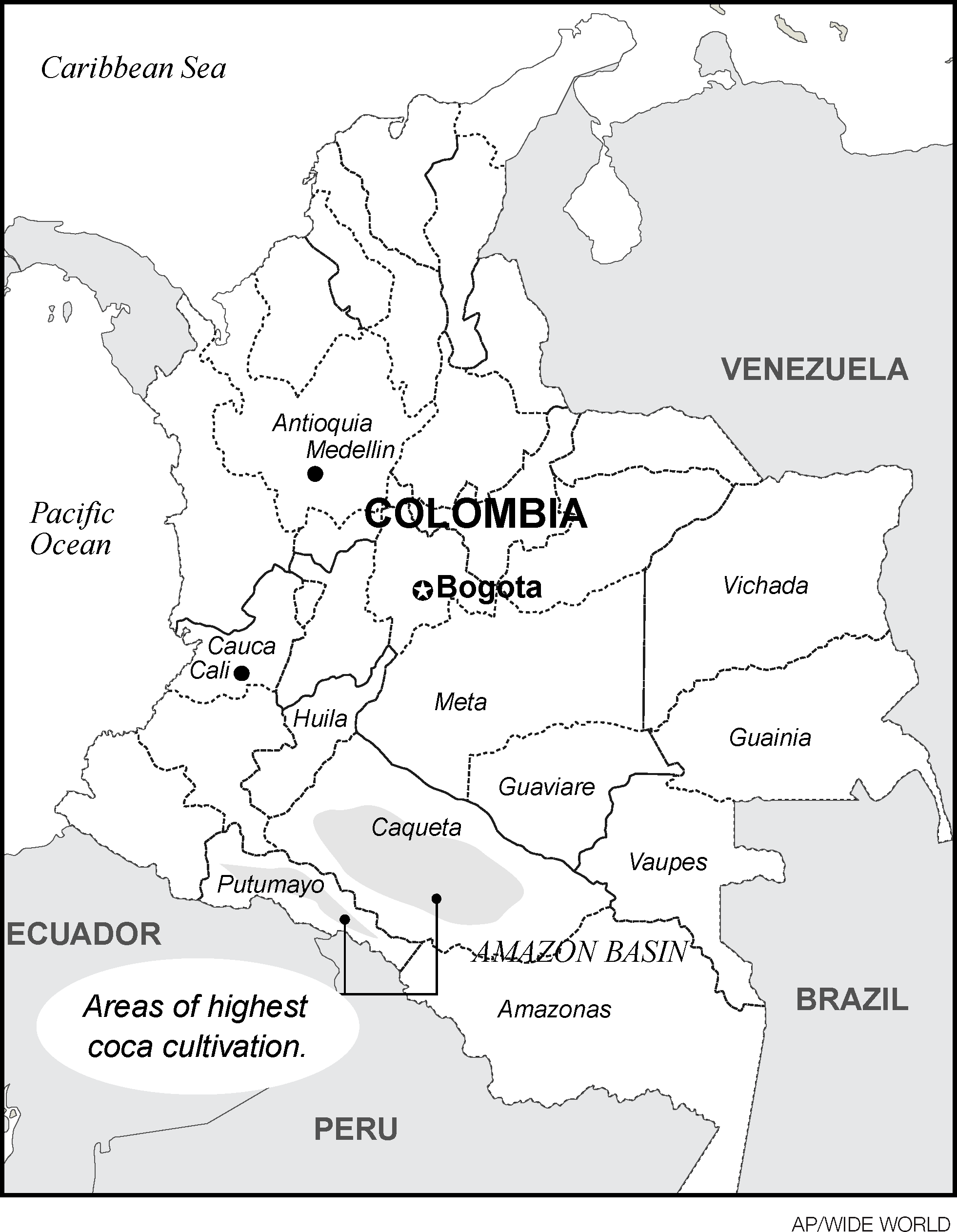
On the eastern flanks of the Andes, the remote states of Caqueta and Pu-tumayo are home to thousands of leftist guerrillas who guard illegal coca plantations, secret landing strips, and clandestine laboratories that churn out more than 70 percent of Colombia's cocaine. The naval base in nearby Puerto Leguizamo, on the Peruvian border, has never been attacked, but for as long as anyone can remember, it's been on red alert.
This is the front line in Washington's war on drugs.
“Plan Colombia”
According to army figures, last year the 90th Riverine Battalion destroyed 68 cocaine-processing labs and the marines seized 201 kilograms of cocaine base and 77,700 kilograms of coca leaves. (Although people involved in the drug war are fond of attaching staggering dollar values to such seizures, it would be impossible to put a realistic sum on these seizures if the fully processed cocaine had reached the streets of New York, Chicago, or Los Angeles.)
The 90th was among the first Colombian military units to receive U.S. anti-drug training and equipment. Now the battalion is hoping to benefit once more from the extra $1.7 billion in emergency aid currently under debate in the U.S. Senate.
If approved, the money will go toward an ambitious two-year plan that the Colombian government says will stamp out the country's illegal drug trade, revive its ailing economy, and end 36 years of bloody civil conflict.
Administration officials in Colombia and the United States say the money will bring peace by rooting out the social conditions that breed violence. Cynics argue that what little humanitarian aid is included in the plan is a fig leaf that scarcely conceals the package's real goal: military victory over Latin America's longest-surviving left-wing insurgency.
U.S. aid to Colombia has grown tenfold since 1995, making it the third-ranking recipient of U.S. military aid after Israel and Egypt. Last year alone Colombia received about $300 million in equipment and training, reflecting a growing U.S. concern that this Andean country is heading toward a major crisis.
Nevertheless, despite two decades of aggressive narcotics interdiction, the drug business is booming. The U.S. government estimates that Colombia produced some 520 metric tons of cocaine and up to eight tons of heroin last year.
January 2000, at a camp at Los Pozos in southern Colombia: A comrade helps “Gira,” a 19-year-old FARC guerrilla, comb her hair.
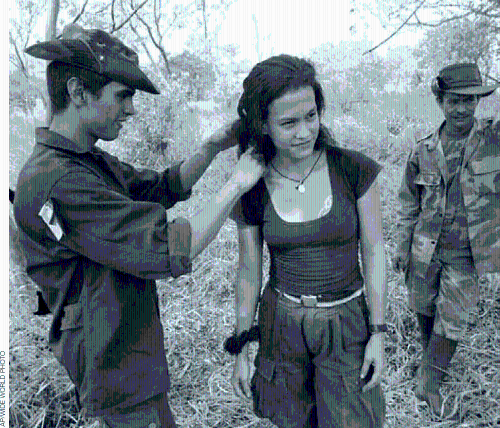
Drug money has bred corruption, undermined the country's legal economy, and fueled an increasingly savage internal conflict that pits left-wing guerrillas against government forces and far-right paramilitaries. In the past 15 years nearly 1.9 million Colombians have been forced from their homes by violence—including some 12,000 who fled last year into neighboring Panama, Venezuela, and Ecuador.
An attack by FARC guerrillas last December destroyed the police station in Curillo.
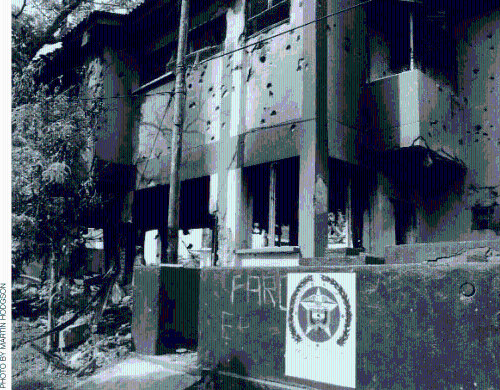
Further, warring factions regularly cross the country's borders to carry out kidnappings and secure supply routes, and some U.S. officials warn that the conflict—which already spills over Colombia's frontiers—now threatens to destabilize the entire region.
As Barry McCaffrey, the White House's anti-drug chief, said during a visit to Bogotá last year: “Clearly we have a democratic regime in trouble. The money, corruption, and violence brought by drugs are the heart and soul of its problems.”
McCaffrey—an outspoken advocate of the proposed aid package—stresses that “Plan Colombia” is not just a military strategy; it also includes money for judicial reform, human rights protection, and economic development.
The total two-year cost of Plan Colombia is $7.5 billion. According to Colombian officials, the remainder of the cash—destined for social and economic recovery schemes—will be raised from the Colombian government budget and donations from European countries, the International Monetary Fund, and the World Bank.
But the U.S. contribution will be overwhelmingly military, with around $1 billion earmarked for strengthening the Colombian army and police with weapons upgrades, intelligence infrastructure, and training. (Curiously, non-American diplomats say the original draft of Plan Colombia was written in English, not Spanish, and while the military portion was ready in late 1999, the Colombian government has yet to present a coherent social investment program.)
Until the plan is presented, few governments will be willing to climb aboard what is widely perceived as an American project to clean up its backyard. “Nobody wants to be seen at the tag end of a U.S plan,” said one European diplomat.
An unfortunate comparison
U.S. personnel are already involved in many of Colombia's anti-narcotics programs, although they are banned by law from joining in military operations against drug traffickers or rebel groups. At any time, between 200 and 300 U.S. soldiers—mostly special forces trainers, intelligence officers, and radar technicians—are stationed in the country.
Last year, U.S. trainers helped prepare a new thousand-person specialized anti-narcotics battalion. Two more elite anti-narcotics units will be trained in 2000. In Puerto Leguizamo, for instance, U.S. Special Forces commandos taught four river combat courses.
“U.S. training is useful here because they gained so much experience on the rivers in Vietnam. They lost a lot of men, but they learned plenty,” says Lt. German Arenas, a Colombian marine who was trained by the Green Berets.
That is the sort of comparison that makes U.S. politicians squirm.
America's interest in Colombia is clear: 80 percent of the world's co-caine—and most of the heroin sold in the United States—comes from Colombia. But in Washington, some lawmakers fear that increased military aid may eventually drag the United States into another complex and unwinnable jungle war.
The single most expensive element of the American aid package will be the loan and maintenance of 63 combat helicopters, costing around $400 million.
These helicopters will support the new anti-narcotics troops as they push deeper into southern Colombia's rain forests, clearing the way for crop-duster planes to spray drug plantations with herbicides.
Inevitably, this will bring the military into direct conflict with the guerrillas of las Fuerzas Armadas Revolucionar-ias de Colombia—the Revolutionary Armed Forces of Colombia, or FARC— who dominate the remote south and rake off millions of dollars in drug kickbacks and protection fees.
Formed in 1964 from an alliance between landless peasants and the Colombian Communist Party, the FARC has grown steadily stronger in recent decades. Although the guerrillas have little support in urban centers, they control about 40 percent of rural Colombia, especially in the grasslands of the Orinoco basin and the jungles of the Amazon south.
Fifteen years ago, the FARC had barely 3,000 persons under arms; now it fields a force of nearly 16,000. Ironically, the money that paid for this quantum leap came from the United States. Like Colombia's construction companies, antique dealers, and luxury car importers—in fact, like most of the country's legitimate economic sectors—the rebels rode the flood tides of the drug bonanza, filling their coffers with “war taxes” on drug operations in their zones of influence.
“At every step of the drug industry, from planting the seeds to extracting cocaine itself, the guerrillas make a profit,” says Gen. Ismael Trujillo, head of Colombia's anti-narcotics police.
Of course, the rebels are not alone in profiting from the drug trade. Their right-wing paramilitary enemies participate directly in the trade as well, funding about 6,000 combatants with the proceeds of narcotics deals.
Originally set up by drug dealers and landowners tired of guerrilla extortion, these militias are a growing military force, battling the rebels for control of strategic regions such as Pu-tumayo, where the jungle frontiers of Colombia, Ecuador, and Peru are open corridors for weapons, drugs, and the chemicals needed to process the drugs.
President Andres Pastrana and his military high command have promised to crack down on members of the military linked to the paramilitaries, but human rights monitors say that many officers still tolerate or even collaborate with the militias.
U.S. officials calculate that between them, the rebels and the paramilitaries may earn as much as $600 million a year from drugs. The chaos and anarchy of near-civil war in parts of Colombia provide ideal conditions for the narcotics industry to continue.
Since January 1999, the FARC has participated in slow-moving peace negotiations with President Pastrana. But the rebels say that a cease-fire is out of the question until the talks start to bear fruit—and that could take years. The leaders of FARC say they want much more than favorable terms for a cease-fire:
“Many people think that the peace process just means that the guerrillas give up their weapons, but it means significant changes in all areas of Colombian life,” says Maria Teresa Bernal of Redepaz, a Colombian foundation that promotes local peace initiatives.
Last May, the two sides agreed on a 12-point agenda including wide-ranging political and social reforms and an overhaul of Colombia's military. But since then there has been no real progress, and the fighting continues.
Cover operation?
Farc commanders repeatedly accuse the United States of using the war on drugs as a cover for a military campaign aimed at destroying once and for all the hemisphere's oldest rebel army. “Plan Colombia, as we understand it, is no more than a way for hawks in the United States to become more deeply involved in our internal affairs. It's a declaration of war by the United States,” said chief farc negotiator Raúl Reyes in February.
Other critics of the plan question why the strategy focuses on the south of the country—long a traditional rebel stronghold—rather than on those mainly northern regions where paramilitaries control the drug trade.
Anti-narcotics operations have become increasingly militarized as interdiction missions run up against heavily armed farc fighters. Rebels often shoot at fumigation planes, which are escorted by helicopter gunships. At least five helicopters and one crop-duster have been shot down in recent years while on fumigation sorties. (Since 1981 more than 3,000 anti-narcotics police have died on anti-drug missions.) The rebels are rumored to have obtained ground-to-air missiles, although intelligence officials say that this has yet to be confirmed with hard evidence.
Military analysts say that greater air power has already boosted the army's operational capacity, helping the troops retake the initiative after a string of guerrilla victories. The 63 additional U.S. helicopters, which would be provided by the aid bill now before the Senate, could be enough to tip the balance in their favor, they add.
Although U.S. officials insist that they have no interest in straying more deeply into Colombia's labyrinthine internal conflict, in the jungles of Putumayo that distinction is hard to maintain.
“We don't differentiate between counterinsurgency and counter-narcotics operations—they're the same thing,” Lt. Col. Jose Leonidas Muñoz, commander of the 90th Battalion, told me in March.
Despite their record of success, the marines operate under huge handicaps. Without air support, they use an aging fleet of 1950s gunboats and U.S.made speedboats (known locally as “piranhas”) to patrol the more than 3,000 kilometers (1,800 miles) of rivers that lace the jungle.
Longer missions can last several months, with groups of up to a hundred marines traveling upriver on armored tugboats, hitting one drug laboratory after another as they go. Following tips from local informers, the marines slog for hours down rough jungle trails to reach the drug installations.
Typically by the time they arrive, the peasants who run the crude processing units have already fled. Open combat with rebels or paramilitaries is uncommon, but the marines regularly come under fire from unseen snipers.
“Around here we're in constant danger. The enemy is all around, but if they see a strong unit they hide among the trees—or they disguise themselves as peasants,” says Lieutenant Arenas.
“But we're totally on the offensive,” he adds.
Caught in the crossfire
As the newest U.S.-backed offensive gathers momentum, human rights groups fear that once again the civilian population will be caught in the cross-fire.
Some 350 miles northwest of Puerto Leguizamo, locals in the town of Cur-illo are convinced that more U.S. aid will further fuel the flames of war.
“We're expecting the most atrocious violence. They say this aid package is to bring peace, but it will be the peace of the tomb,” says one villager, Emilio Vivero.
Curillo, deep in the southern savanna, is a typical town in the remote backlands now dominated by the FARC. A few miles down the road, rebels in uniform are stationed at a checkpoint. Crowning the hill above the town center is the burnt-out shell of the police station, abandoned after a FARC attack in December.
Three officers died in the assault and eight others were captured. Three months later, nobody dares to remove the painted portrait of the FARC's septuagenarian commander-in-chief, Manuel Marulanda, which the rebels left hanging in front of the mayor's office.
Bodies for bullets
In its World Report 2000, Human Rights Watch describes the relationship between the Colombian Army's Medellín-based Fourth Brigade and a paramilitary group headed by Carlos Castaño, the most feared paramilitary leader in Colombia. In a process called legalización, Castano's men turned over civilian corpses to the army in exchange for weapons. The army then dressed the corpses in uniforms and claimed they were guerrillas who had been killed in combat.
As the United States prepares to give more than $1 billion in military aid to Colombia to fight the country's narcotics trade, allegations about the military's involvement in human rights abuses loom large, particularly concerns about such relationships between the army and paramilitary outfits. The U.S. State Department, in its 1999 Country Reports on Human Rights Practices, concludes that “security forces actively collaborated with members of paramilitary groups by passing them through roadblocks, sharing intelligence, and providing them with ammunition.”
In their efforts to “cleanse” the countryside of guerrillas, paramilitaries have massacred, tortured, and otherwise terrorized anyone suspected of guerrilla sympathies. According to Human Rights Watch, during one week last year, “authorities registered over one hundred killings attributed to paramilitaries, who mutilated some of their victims and dumped their bodies into rivers to destroy evidence.”
To win over critics of the U.S. aid package, U.S. and Colombian officials claim that the military has taken steps to stamp out abusive practices. Evidence of this, they say, is a newly revised military penal code, which includes a number of judicial reforms regarding the prosecution of military personnel, and the dismissal of four army generals last year who either ignored or were complicit in violations.
But according to the State Department, little has changed. Its report states, “Government forces continued to commit numerous, serious abuses, including extrajudicial killings, at a level that was roughly similar to that of 1998.”
Independent human rights groups say that many of the reforms lack teeth. In particular, they argue that the much-touted military penal code fails to adequately establish how human rights cases involving military officers will be prosecuted. Human Rights Watch alleges that although human rights cases fall under civilian jurisdiction, “the military continued to dispute and often win jurisdiction.” As a result, very few soldiers have faced prosecution.
The rights group concludes that the U.S. decision to focus its aid package on the Colombian military “threatens to turn some American officials into apologists for the army's human rights record.”
—Michael Flynn
For years the FARC's rule was rarely challenged in Curillo and, according to one U.N. official, the rebels eventually took control of the local drug trade.
The guerrillas' involvement with narcotics has grown steadily since the 1993 death of Medellín kingpin Pablo Escobar and the mid-1990s collapse of the Cali cartel, says Klaus Nyholm, coordinator of the Bogotá office of the U.N. Drug Control Program.
With the disappearance of those vertically integrated cartels, the Colombian drug business fragmented into a network of small and medium-sized drug traffickers. In Curillo a new set of middlemen appeared—and with them came the paramilitaries.
“The FARC didn't like it. Some of these people were allied to the paramilitaries, and others underpaid the campesinos for their coca leafs. So in some areas, the FARC took over the local trade,” explains Nyholm.
The rebels impose their own form of justice in the region, punishing thieves and drug addicts, and forcing drug intermediaries to pay the standard fee of 2 million pesos (just over $1,000) per kilo of coca base—plus another 800,000 pesos in “tax.”
Sitting on a shady porch above the Caqueta river, Lucas Caquimbo, who heads an association of former coca growers, says bitterly: “The government doesn't care if the guerrillas are here or not—it's got nothing to lose. The only state presence in this town is when they collect taxes or fumigate the crops.”
As if on cue, two OV-10 military planes used for fumigation and reconnaissance buzz low across the chocolate-colored waters.
“We've grown used to that sound,” says Caquimbo.
A growth industry
Last year government planes sprayed around 42,000 hectares (104,000 acres) with herbicides in the relentless campaign against illegal crops. Despite the spraying, U.S. and Colombian data show that coca production in Colombia has more than doubled since 1995.
Officials claim that without the spraying the figure would be even larger, but the evidence suggests otherwise. “Fumigation kills the coca, but the peasant moves further into the for-est—and they plant much more than they need just to be sure that some of it survives,” says the U.N.'s Nyholm.
In Caqueta and Putumayo, the two states targeted by Plan Colombia, recent history seems to confirm this analysis. Putumayo—which now produces two-thirds of Colombia's cocaine—saw an explosion of coca cultivation after a major fumigation campaign in 1997 and 1998 wiped out production in eastern Guaviare state, Colombia's previous cocaine capital.
Caqueta also saw an increase in production, but its proximity to anti-narcotics bases left it open to a more aggressive fumigation campaign. Local government officials describe the effects of that campaign as catastrophic.
“There has been indiscriminate fumigation of legal and illegal crops. Fumigation causes displacement and damage to the environment,” says Hever Gomez, a local state ombudsman.
Aerial eradication is carried out by private U.S contractors and Colombian police pilots who spray drug crops with glyphosate, a water-soluble herbicide produced in the United States by Monsanto and marketed as a garden weed killer.
The U.S. Department of Agriculture describes glyphosate as harmless to humans, but environmental activists say that exposure to the chemical can produce respiratory problems, diarrhea, and eye problems—and that aerial fumigation is impossible to accurately control.
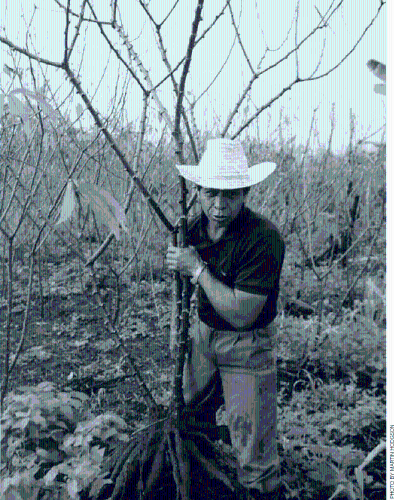
Fifteen minutes upstream from Curillo, farmer Jaime Cabrera surveys a five-hectare swathe of scorched and twisted vegetation, the result of a January fumigation run.
“This was all yucca. I had a good little crop—until the planes came over. All my work has been lost,” he says, his voice cracking with sadness and anger.
Pointing to the few surviving plants, he shows how their leaves are twisted and deformed. When the edible tubers are pulled from the black soil they are withered and sick-looking.
Cabrera says that with six children in school and $4,000 in debts, he has no choice but to try again.
“The fumigation planes fly over all the time, but I'm planting seeds again. We'll see which runs out first—their poison or my determination.”
Colombia's top anti-narcotics cop, General Trujillo, says he's heard it all before. “We know the routine—that we fumigated breadfruit, maize, plantain, or that we damaged the forest, or some animals died or people were hurt or killed by fumigation. It's not true. It can't be true. Fumigation isn't improvised; it's scientific and organized.”
Farmer Cabrera among his yucca plants destroyed by planes spraying herbicides.
Don't forget to change the oil
The Clinton administration insists that Colombia needs more coca-hunting Bell and Sikorsky helicopters, and U.S. helicopter builders always want new customers. So Colombia will be getting some free helicopters— 30 new Sikorsky UH-60 Blackhawks, at a cost of $10 million each and $1,500 an hour to fly, as well as 33 improved Vietnam-era UH-1 Hueys, at $1 million each and $500 an hour to fly.
The last time the United States sent helicopters to Colombia, however, things didn't go so well. When Colombia received 12 “previously owned” U.S. Hueys in 1997, each could be flown less than 10 hours before requiring an overhaul, and only two were flying two months later (Time, March 6, 2000).
—Bret Lortie
According to Trujillo, crops are sprayed only if they have been identified from French- or U.S-supplied satellite images and aerial photos. But he admits that mistakes can be made:
“In some instances there may be a margin of error—there are no absolutes in anything, but fumigation is controlled by technology.”
A living wage
Technology has so far proved ineffective against the many large-scale plantations that operate safely outside the range of the crop-dusters in the far eastern regions of Guainia, Vaupes, and Vichada, say some Colombian drug experts.
Meanwhile, in Curillo, small coca producers say they themselves would destroy their illegal crops—if only they had a financially viable alternative.
Farmer Caquimbo tore up his plot of coca in 1993 after a six-month jail sentence. With the support of a United Nations scheme, he planted sugar cane and maize. “We showed that you could switch to legal crops without fumigation—and without violence. To eradicate you must start with the conscience of the campesino,” he says.
But change is not easy: Peasants in the southern reaches of Colombia live hundreds of miles from the nearest markets, and agricultural prices have been deeply undercut by cheap imports. It's nearly impossible for them to survive on legal crops.
Despite the high cost of fertilizers and processing chemicals, those growing coca can make a living wage. “People are tired of coca. People want to change, but they don't want to end up with empty bellies,” says ombudsman Gomez.
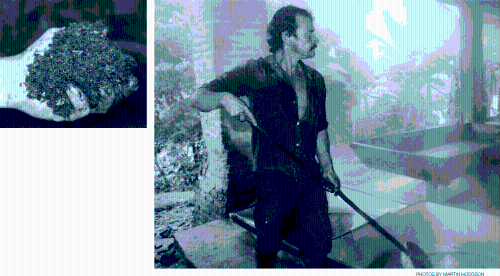
Coca farmers deliver their crop to a “kitchen,” where the leaves are ground, cooked, then mixed with cement, gasoline, and acid. The leaves, stripped of their cocaine alkaloids, are discarded. The remaining liquid is further processed into a dry cocaine base.
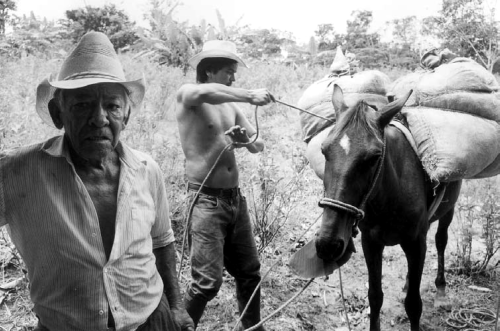
Outside a makeshift coca “kitchen” a few miles outside Curillo, Abelardo, a 33-year-old coca farmer, says he has little choice other than to grow coca.
“What's the point of planting yucca if nobody will buy it? At least with coca I make just enough to feed the family,” he says, as he unloads bales of coca leaf from the back of a scrawny horse.
Under the rickety tin roof, Abelardo empties the leaves in the corner before shredding them with a lawn trimmer. Later he'll mix the leaves with construction cement which acts as a catalyst when the mixture is left to soak overnight in a drum of gasoline. In the morning Abelardo drains off the gasoline, now rich with cocaine alkaloid. The brown mulch of leaves is discarded on the foul-smelling heap behind the kitchen—just a few yards from the stream which brings water to a nearby farmhouse.
Next, Abelardo adds sulfuric acid to the gasoline solution and stirs it until an alkaloid-bearing “water” forms. After separating the liquid, he adds caustic soda to neutralize the acid, then filters the “water” through potassium permanganate, before leaving the residue to dry in the sun. It forms a yellowish powder—cocaine base.
Cartel buyers and middlemen travel for hundreds of miles to purchase this crude form of cocaine, which is then refined for export in high-tech “crystallizing” labs.
“If you've worked in a kitchen, you'd never take cocaine. Not after seeing all the things that go into it,” jokes Caquimbo.
Although he makes an occasional profit, the gasoline fumes, acid spills, police raids, and fumigation planes mean that Abelardo's job is invariably unpleasant and stressful.
“I would have left this all a long time ago, if there was anyone who'd help me,” says Abelardo.
Limited choices
The United Nations and the Colombian government have both explored alternative agricultural products, experimenting with tropical fruits, dairy farming, and fish breeding. But the thin alluvial soils of southern Colombia are ill-suited to large-scale agriculture—and nobody has yet found a crop as profitable as coca leaf. When the market was at its height in Curillo in the mid-1990s, 100 grams of cocaine base fetched the same price as a ton of maize.
The Bulletin blew it again
In another example of the Bulletin's failure to get on the gravy train, the editors of this magazine were as surprised as everyone else when investigator Daniel Forbes reported in Salon (March 30) that six magazines have been the beneficiaries of particularly sweet advertising deals cut with the Office of National Drug Control Policy. They are: U.S. News & World Report ($652,000), Family Circle ($1.425 million), Seventeen ($144,000), Sporting News ($414,000), Parade ($1.85 million), and USA Weekend ($418,000).
These magazines signed contracts with the drug policy office in which they agreed to run one free anti-drug ad for every ad the office paid for. There was a way to avoid running those free ads, though—the magazines could publish certain stories that met the guidelines the office had laid down for editorial content.
According to reporter Forbes, the drug policy office sent the magazines formal instructions called “Strategy Platforms,” which outlined not only the sorts of articles the magazines were expected to run, but in which months. In the case of a story for Sporting News, the office even designated which writer the magazine should hire.
Had we only known …
—Linda Rothstein
As fumigation continues, the rural poor will face fewer and fewer options for survival, says Gabriel Peña, age 27. He counts himself as lucky. When his family's coca plot was eradicated, they had enough money to buy a small grocery store. Other youngsters face a starker choice:
“They join the army, they join the guerrillas, or they join the paramilitaries. In Curillo there are 300 unemployed men, but who'll give them work? At least in the guerrillas they give you food and clothes,” Peña said.
The U.S. aid package includes $145 million dollars earmarked for social development projects, and temporary aid for as many as 10,000 people forced from their homes. But in private, some U.S. officials say the plan may displace 10 times that many.
The newly homeless may continue the cycle of displacement and colonization by heading deeper into the virgin jungle. Or they may join the thousands of other war refugees who have fled to the slum neighborhoods that ring Bo-gotá and other major cities.
They probably won't find much support from Plan Colombia, said Marco Romero, head of political sciences at the National University in Bogotá.
“The military element and the social element of Plan Colombia are not at all coordinated. So far the only certainty is the U.S. military aid, but nobody is willing to invest in social reconstruction,” he said.
Carlos Salinas of the human rights organization Amnesty International likens Colombia to a house in flames, and he describes the pending aid package as a gruesome farce. “There's one guy with a bucket of water, three guys with flame-throwers, and then somebody shows up with a packet of seeds for the garden,” he says.
“Unfortunately the flame-throwers are going to win the day and the house is going to burn to the ground.”