




Abstract

DEAR SENATOR LUGAR:
Although I respect your legislative record, I am disappointed by the rationale for your vote. I share your advocacy for effective and verifiable arms control agreements. However, what does “effective and verifiable” mean? When you pass laws on civil and criminal matters, you do not ask whether all evasions will be foreclosed. You do not propose that murder should be legal because all murderers are not caught. What you ask is whether—on balance—passage of a law benefits the national welfare, taking the anticipated level of compliance into account.
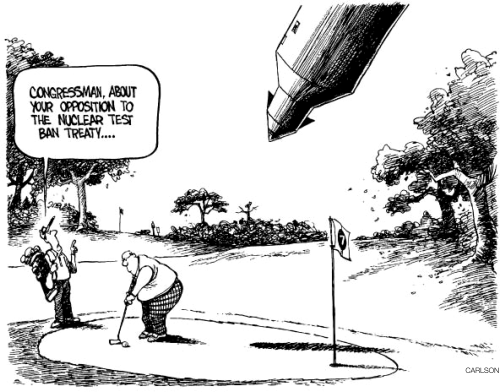
Similarly, the test for a treaty should be whether national and international security are served better with the treaty than without it, taking the anticipated level of compliance into account. By that standard the case for ratification of the Comprehensive Test Ban Treaty (ctbt) is exceedingly strong.
You cite the constitutional responsibility of the Senate in advising and consenting on ratification of a treaty signed by the executive branch. You remark that this requires that the Senate “examine the treaties in close detail.” True, but how can this observation be reconciled with the fact that the treaty was withheld for two years from any hearings in the Foreign Relations Committee but then was placed on the Senate agenda with an extremely short deadline and with only a few witnesses giving testimony? In contrast to this summary process, hearings on the Chemical Weapons Convention (CWC) were carried out over a period of time many times longer than those dedicated to the CTBT.
Also, how do you explain the fact that the Senate leadership did not permit discussion of conditions or reservations that could be annexed to the Senate advice on ratification of the CTBT? Instead, the leadership required a simple up or down vote. It is for these procedural reasons that most of the debate on the CTBT is taking place after the Senate vote rather than in preparation for it.
How much is enough?
You deal with the maintenance of the U.S. nuclear deterrent as the only test of the merits of the treaty. You doubt whether such a deterrent can be maintained without nuclear tests. In fact, you propose a debate—an “honest dis-cussion”—that seems designed to lead to the conclusion that only “limited testing,” starting now, would assure the safety and reliability of the stockpile.
This assertion is absurd. The United States has a nuclear stockpile of about 12,000 nuclear weapons spread over nine distinct weapons systems. Each of these weapons, on average, is 20 to 30 times more powerful than the weapons that killed about 250,000 people in Hiroshima and Nagasaki.
How much deterrence is enough now that the Cold War has ended? Given the enormous U.S. stockpile of nuclear weapons and the multiplicity of weapon designs and delivery systems, how could any adversary conclude that the whole U.S. arsenal would have become nonfunctional after even an extensive period without nuclear tests? The assertion that the U.S. nuclear deterrent will decline significantly in effectiveness under the CTBT is unsupportable.
Every one of the nine nuclear weapons systems has been fully tested and certified. Each has a “design margin” so large that significant changes in the yield of the primary will not affect the yield of the thermonuclear secondary.
The safety and reliability of the stockpile is to be certified annually by the secretaries of State and Defense, the chairman of the Joint Chiefs, and the directors of the nuclear weapons laboratories. In the event that those parties are unable to do so, then the president has explicitly stated that the unilateral withdrawal provision of the treaty would be invoked.
The argument that ensuring the safety and reliability of existing weapons requires nuclear tests is incorrect, based on the clear record of past nuclear tests. Contrary to common assumptions, the United States rarely conducted fission-yield tests for reliability and safety.
In fact, nuclear tests have not significantly added to maintaining the reliability of nuclear weapons. A 1996 tally by the Energy Department showed that of some 830 defects detected between 1958 and 1993 in stockpiled weapons, less than one percent was uncovered through nuclear tests.
You state that over the last 40 years, a large percentage of the weapon designs in our stockpile have required post-deployment tests to resolve problems. But this statistic is heavily distorted by the fact that it includes weapons that were introduced into the stockpile in 1958-61, during President Eisenhower's nuclear testing moratorium. These weapons had been placed in the stockpile without adequate development or tests. Therefore “stockpile validation testing” was indicated once the moratorium ended. In any event, those weapons have long been retired.
The United States has conducted 1,030 nuclear tests. The vast majority were carried out to examine new designs or modifications—not to test the safety and reliability of old designs.
The U.S. stockpile would indeed deteriorate if no remedial action were taken. I realize that in their CTBT testimony, some present and past U.S. laboratory directors expressed “growing concern” about the future reliability of the stockpile. However, all the non-nuclear components—ranging from firing and fuzing, the geometry of the detonation of the conventional explosive, and all other weaponization items—can and will be tested under the CTBT. In fact, we have been doing such testing for years, and therefore have a wealth of experience. Must we actually involve the nuclear explosives in this testing process? Must we do an annual test, throwing a lighted match into a can of gasoline to prove that it ignites?
In fact, aging of the stockpile will proceed with or without the CTBT. For example, the alpha particle decay of the plutonium in nuclear weapons will, over time, produce helium atoms and recoil fragments that tend to dislocate plutonium atoms and thus affect the physical structure of the material. Similarly, tritium, the “boost” gas, decays and will have to be replaced to maintain a conservative “performance margin” between primary and secondary yields.
Stewardship
The Science Based Stockpile Stewardship Program is designed to counteract these and other aging effects. You say that the program is just beginning, that the “jury is still out” as to its effectiveness. However, stockpile stewardship, under a variety of labels, has been going on for a long time, with ever increasing sophistication. Further, it is not a limited-term project. It is a process that is expected to continue until such time that the United States no longer needs to maintain a nuclear deterrent.
Today's stewardship program has two essential components. The first— the “core” program—focuses on the existing stockpile. It includes detailed inspection and performance tests on non-nuclear components; the remanufacture and replacement of such items as required; and tests using radiography of the non-nuclear components of the weapons under actual deployment conditions. Eleven weapons of each type in the stockpile are withdrawn annually and tested by such methods. One is “destructively” tested; the others are reassembled and returned to the stockpile.
Computational capacity, which is already extraordinary, will grow, making it easier to predict performance in the presence of aging components. Although construction of some new and marginally better testing equipment will take several years, the core program functions well today.
The second part of the stewardship program is more difficult to evaluate. Its purpose is to maintain a cadre of capable and highly distinguished scientists and engineers of all ages at the national weapons labs who will maintain interest and expertise in nuclear weapons.
Toward that end the stewardship program includes items—such as the National Ignition Facility—that have little direct linkage to questions regarding the safety and reliability of the stockpile. This technology is, however, relevant to nuclear weapons research as well as to other kinds of research, and it is expected to capture the interest of scientists and engineers.
The long-range success of this part of the stewardship program is hard to predict. It depends largely on factors other than continued nuclear tests— such as opportunities for weapons scientists to maintain contacts with the open international scientific community and to advance their careers.
Over the decades, the weapons labs have compiled a remarkable record. Tests of new designs, even those incorporating very complex and sophisticated new concepts, have had an exceedingly high success rate. U.S. weapons designers have been excellent in going from “paper” design to functioning weapons: What they designed has worked as intended an overwhelming fraction of the time.
In fact, a system of nuclear deterrence involves three crucial links: performance of the nuclear weapons; performance of the delivery systems; and the performance and reliability of the humans involved in the awesome chain of delivery of nuclear weapons.
I believe the record is clear. Under the stewardship program, the reliability of nuclear weapons in the U.S. arsenal has been—and will continue to be—higher than that of their delivery systems, mainly missiles. And I would not even dare to comment on the reliability of fallible human beings enmeshed in this deterrence chain.
Verification
You criticize the verification provisions of the CTBT and demand that verification be “effective.” But your statement provides no standard for effectiveness. Complex as the situation may be, it is inexcusable to designate the CTBT as “unverifiable.” Never in the history of arms control have verification provisions been more detailed and stringent.
An International Monitoring Sys-tem—with more than 300 facilities in at least 90 countries—is well under way. It uses physical phenomena (earth movement, acoustic and hydro-acoustic surveillance, and nuclide collection) to reveal evidence of nuclear explosions.
In addition, national technical means will be used by the United States to initiate an investigatory and inspection process of suspect occurrences. This process, like any other, leaves room for doubt in its ability to detect, identify, and locate very small nuclear explosive events. A classified Presidential Directive has determined the acceptable thresholds of detection of the international and national systems. These standards are expected to be met. Tests above a few kilotons—even if conducted under conditions of concealment—will be detected.
Much debate has focused on the utility of very small nuclear explosive tests whose detection would have to rely more on collecting intelligence than on physical measurement. After numerous studies as to whether the CTBT should in fact become a “threshold” treaty— that is, permit tests below a certain magnitude—the U.S. executive branch decided to go for a true zero-yield treaty that forbids any nuclear yield in an explosion.
The reason for that decision: very small nuclear tests were not needed by the United States. Such tests would not significantly benefit the U.S. quest for reliability and safety of its weapons, because the modification of a stockpile weapon required to produce such low yields would in fact make the test unrepresentative of the real thing.
To be sure, very small tests could be of some utility to proliferant nations who could use “mini-tests” to examine new design principles. But under the CTBT, even the smallest tests would increase the risk that a clandestine program would be detected through intelligence collection or leaks of information. Given that, the United States opted for a true zero-threshold treaty. That serves the U.S. national interest better than a threshold test ban treaty would.
The Russians are on board
The CTBT permits all tests, whether related to nuclear weapons or not, which produce no nuclear chain reaction. Within that framework, the United States—as well as Russia and probably China—conduct “subcritical” tests. These are experiments in which fissile materials (such as plutonium) are subjected to very high temperatures and pressures without producing a nuclear reaction.
These tests are useful in determining the physical properties of fissile materials without testing new weapons designs. Both Russia and the United States have carried out sub-critical tests at their test sites in Nevada and Novaya Zemlya. These tests have been conducted in secret, however, without foreign observers; not surprisingly, both countries have been accused of conducting low-yield nuclear weapons tests in the guise of subcritical experiments.
Your release states that Russia has not accepted the CTBT's zero threshold. That is incorrect. On the official level the Russians have accepted it. To be sure, without increased transparency by all parties at the nuclear test sites, suspicions will linger. Nevertheless, I know of no persuasive evidence that either the Soviets (and now, the Russians), the Americans, or the Chinese have cheated by abusing the conduct of permitted subcritical experiments.
As already noted, the utility of very small nuclear explosive tests is marginal and the party conducting such tests could never be sure that the evasion was undetectable. I should add that compliance by the Russians with earlier treaties limiting nuclear testing, such as the Partial Test Ban Treaty of 1963 and the Threshold Test Ban Treaty of 1984, has been exemplary.
You remark on the decision-making process that would initiate inspections or even more severe action in case a violation was suspected. Such a response to a suspected violation will always be to a large extent an international political decision, depending on the strength of the evidence. You also make a comparison with the Chemical Weapons Convention that is profoundly misleading. In the CWC, inspections are the only verification mechanism. Under the CTBT, a worldwide network of physical observations, together with national technical means, constitute the verification system that can trigger an inspection. The ultimate recourse is a referral to the U.N. Security Council.
We must succeed
The overriding goal of the United States in the CTBT—as in the earlier Nuclear Non-Proliferation Treaty (NPT), the Anti-Ballistic Missile Treaty, the Intermediate-range Nuclear Forces Tr eaty, and the Strategic Arms Limitation and the Strategic Arms Reduction treaties—is to decrease the nuclear weapons risk to the United States and to the world.
U.S. national security is affected by the proliferation of nuclear weapons and by improvements in weapons in countries such as Russia and China. In your statement you fail to identify the nonproliferation regime, of which the CTBT is an integral part. You only state, without giving a reason, that its usefulness to the goal of nonproliferation is “highly questionable.”
But nuclear nonproliferation and stopping the evolution of more “advanced” weapons is what the CTBT is about. The CTBT complements the much earlier Nuclear Non-Proliferation Treaty. That treaty represents a remarkable and inseparable bargain, one that prohibits non-nuclear weapon states from acquiring the wherewithal for nuclear weapons. Meanwhile, the nuclear weapon states are forbidden from furnishing nuclear weapons information or hardware to non-nuclear weapon states. In this respect the NPT is discriminatory because it divides the world into nuclear “haves” and “have nots.”
To blunt the discriminatory character of the NPT, the nuclear weapon states are obligated to furnish assistance in non-military nuclear applications, such as nuclear power plants, provided they are carried out under International Atomic Energy Agency safeguards. It also obligates the nuclear weapon states to work in good faith in the field of nuclear arms control and to decrease their reliance on nuclear weapons in international affairs.
Finally, to achieve the indefinite extension of the NPT in 1995, the nuclear weapon states, led by the United States, committed themselves to conclude a Comprehensive Test Ban Treaty as soon as possible.
The CTBT—if obeyed or even if only partially obeyed—would limit many forms of nuclear proliferation. It prevents the nuclear weapon states from developing and then deploying new physics packages for their nuclear arsenals, a policy formally adopted in the United States by President Bush.
The treaty would also prevent non-nuclear weapon states from stockpiling nuclear weapons of all but the simplest designs. Further, it makes it impossible for nations that have acquired advanced nuclear weapons design information through espionage to convert that knowledge into actual weapons. Thus the CTBT is an essential element of the total nonproliferation bargain.
The proliferation of nuclear weapons represents at least as large a risk to the security of the United States as does the possible—but highly improbable—deliberate use of nuclear weapons among the parties that already have them. A world with widespread deployment of nuclear weapons would be unmanageable. Nuclear weapons are the great equalizer between militarily strong and weak nations in the same way in which firearms put the physically weak and the physically strong on a relatively equal footing.
The United States, as the strongest nation in terms of economic power and advanced conventional forces, has the most to lose should nuclear weapons proliferate. In the words of one Indian general: “Never face the United States without nuclear weapons.”
The CTBT is an essential—but partial—step in the nation's effort to stop nuclear weapons from proliferating across the globe. The rejection of ratification compromises that effort, although under international law the United States is prohibited from carrying out activities in contravention of the purposes of the CTBT until a president certifies that the United States no longer wishes to pursue ratification—a step the president refuses to take.
Over the course of human history, the proliferation of new technology to worldwide military use has never been prevented. But in the case of nuclear weapons, we must succeed in preventing proliferation, lest following generations face a very dangerous future.
The CTBT has been—and is—an integral part of that effort. When President Eisenhower left office he stated that his failure to attain a CTBT during his tenure was a deep disappointment to him. Forty years later the Senate action has deepened that failure.