




Abstract

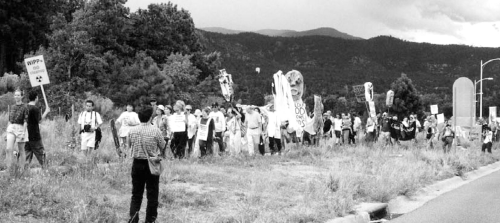
August 9, 1999: Protesters march on Los Alamos.
The summer of 1999 may go down as the worst in history for Los Alamos, home to the laboratory that created the bomb and continues to watch over it.
A small town with the densest concentration of Ph.D.s and one of the highest median incomes in the country, Los Alamos has always had an air of isolated privilege, sitting high atop a mesa above the poorer surrounding communities of New Mexico.
This summer that bubble of isolation burst as the laboratory found itself at the center of a feeding frenzy over allegations that a spy at Los Alamos had given China the design for the most advanced warhead in the U.S. arsenal while incompetent lab officials turned a blind eye. Next, the public in this small company town suddenly turned on its main employer and, for the first time ever, forced the cancellation of a weapons experiment. Finally, the laboratory endured the largest protest in its history as activists from all over the world converged on this insular community for the anniversary of the bombing of Nagasaki.
“A culture of arrogance”
The long hot summer began in late May when the Cox committee released a report alleging that China had stolen the design for the sophisticated W88 warhead. Media coverage of the Cox report linked the theft to a Taiwanese-born scientist, Wen Ho Lee, who had transferred top secret computer codes used to simulate nuclear tests to Los Alamos's unclassified computer network. He had been allowed to stay in his position in Los Alamos's weapons design division long after counterintelligence officials discovered his transgression.
Meanwhile a second committee report (this one by the President's Foreign Intelligence Advisory Board chaired by former Sen. Warren Rudman) concluded that a “culture of arrogance” at the weapons labs had “conspired to create an espionage scandal waiting to happen” and that lab managers were “still resisting reforms.” A third report, this one by the General Accounting Office, said the Los Alamos and Livermore laboratories had ignored warnings about their lax security for years.
The allegations of spying brought Los Alamos media attention the like of which it had not seen since the original bomb project was revealed at the end of World War II. Journalists converged from all over the country on this town of 18,000, clogging Wen Ho Lee's neighborhood with TV crews and satellite trucks, and giving Los Alamos a new round of fame as the place that not only invented the bomb but had now given it to China as well. Close behind the media were the FBI, whose heavy-handed surveillance of the neighborhood eventually provoked an altercation between FBI agents and Wen Ho Lee's neighbors, bringing the chief of police rushing over to intervene. The neighbors, one of whom began snapping pictures of undercover agents and demanding to see their identification, complained about headlights shining in their homes at all hours and FBI agents casing the area like common burglars.
Next came the politicians. Los Alamos scientists, accustomed to laboring in tranquil isolation in the high desert, watched with horrified fascination as a procession of senators came to see their “culture of arrogance” for themselves and denounce it with the kind of indignation Republican congressmen usually reserve for welfare mothers and drug dealers rather than tax-paying, god-fearing weapons scientists. (Los Alamos has more churches per capita than any other community in the United States).
Surely the least favorite politician in Los Alamos this summer was Energy Secretary Bill Richardson, the district's former congressman. If Los Alamos had hoped to be defended by “Secretary Blutarsky” (as one lab public relations official calls the corpulent Richardson, comparing him with the John Belushi character in Animal House), they were mistaken. Nearly every scientist I spoke to at Los Alamos was convinced that Wen Ho Lee was not guilty of espionage and that both he and the laboratory were victims of a congressional ambush followed by a media lynching.
But Richardson insisted that Lee be fired and recommended that disciplinary measures be taken against three senior officials at the lab–including former director Sig Hecker–for negligence during the Wen Ho Lee episode. This was widely perceived as scapegoating rather than punishing officials who deserved to be held accountable. Nor were scientists impressed by Richardson's gaffe at a press conference early in the scandal when he said that, of course, weapons scientists had to take secret documents home to work on them–a quote many gleefully affixed to the safes in their offices.
The new security measures introduced by Richardson, perceived as more of an inconvenience than a security improvement, have been particularly unpopular. In June Richardson ordered a two-day stand-down at the labs so employees could, in the words of one weapons designer, be sent to “re-education camp.” This was followed by the introduction of new security rules which one weapons designer estimated had reduced his productivity by “at least 30 percent.” (For example, because the bottom page might fall off a secret document, weapons scientists must now make sure that not only the last but also the second-to-last page of all classified papers in their safes are stamped “top secret” at the top and bottom. Inspectors are doing spot checks to make sure that scientists have gone through every one of the hundreds of papers in their safes with stamp in hand. The laboratory is also deactivating floppy disk drives, even on scientists' unclassified computers, to make it harder to transfer data on diskettes. This also means that scientists cannot put unclassified memos on diskettes to give them to their secretaries, or take them home in the evening to work on them.)
Most unpopular of all, however, was Richardson's announcement that many weapons scientists would be expected to submit to polygraph tests. Most Los Alamos scientists perceive polygraph tests (which are not admissible as evidence in court) to be about as scientific as medieval witch-detection techniques. They point out that the notorious spy Aldrich Ames passed his polygraph test and that estimates place the tests' false positive rate at anywhere from 2 to 40 percent. Using the conservative estimate of 2 percent would mean that, out of the 5,000 scientists Bill Richardson wants to test, a hundred might be falsely branded as security risks. What protections would such people have, Los Alamos scientists ask, and why would new Ph.D.s want to come and work at a laboratory that subjected its employees to such indignities?
“Any luck, Diogenes?”
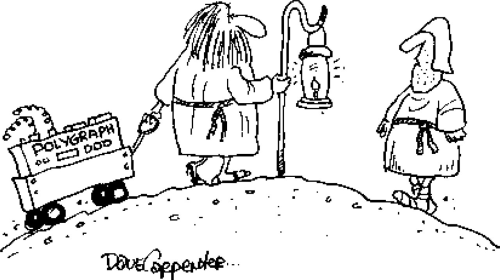
Shortly after Richardson announced the new polygraph policy, a meeting was held in Los Alamos to discuss, for the first time, the formation of a union. The main grievance raised at the meeting, which was well attended, concerned the proposed lie-detector tests. At the same time, of the 220 scientists who work in Los Alamos's X Division (the weapons design division) who were asked, 165 signed a petition sent to Richardson to “express our dismay” and “ask you to reconsider your … decision to begin extensive polygraphing.”
When Richardson visited Los Alamos on June 21 to discuss the new security measures in person, he did not get a warm welcome. He tried to talk about his concern for ethnic diversity at the lab–and to elicit sympathy for his suffering at the inquisitorial hands of congressional committees–but employees in the auditorium repeatedly complained about polygraphs and about new restrictions on hiring foreign nationals, even for unclassified work. One scientist, saying that “because you've decided to do it does not make it right,” told Richardson that “a number of people in the weapons science community really resent the notion that polygraph testing should be imposed … as a tool for sniffing out spies. This is a tool that's known to be unreliable.” Another scientist, her voice trembling with anger, responded to Richardson's statement that he “might” himself be willing to take a polygraph by saying, “I want to know as an employee of the lab for 25 years, when I'm asked to take a polygraph test and I reply, ‘I might,’ will it be greeted with laughter?”
At the end of the summer, two editorials in the Los Alamos Monitor observed that the espionage scandal was demoralizing the town and creating an atmosphere of paranoia. On August 22, the former editor compared the humiliation of Wen Ho Lee with the earlier McCarthyite smear of the laboratory's first director, J. Robert Oppenheimer. On August 18, the new editor had written that “more and more people are whispering to us their concerns about ‘scapegoatism,’ ‘witch hunts,’ and ‘McCarthyism.’ … More and more older scientists are talking about retiring; more and more younger scientists are talking about getting out. … People in Washington are clearly feeding this frenzy. We can only guess at their motivations, but it seems to us that it's time to get on with the business of … the laboratories–before the labs are so seriously damaged that no one in his right mind would work at one of them.”
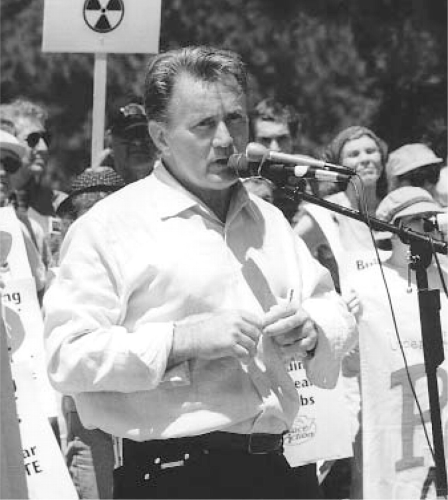
Martin Sheen spoke to the anti-nuclear group in downtown Los Alamos before they marched to the lab.
“Not in my backyard, not anymore”
Los Alamos has been developing a research program on biological weapons and has plans to open a facility for anthrax research in the future. Ironically the same local population that has ungrudgingly tolerated a plutonium facility and regular road closures when toxic and explosive materials need to be transported on the community's narrow roads is unhappy about this program.
In June Los Alamos officials announced that, for the purpose of calibrating experimental biowarfare detectors, they planned to release a simulant for anthrax, a “harmless” bacteria called Bacillus globigii, on the edge of the laboratory's property. Normally such an experiment would be conducted at the Dugway Proving Ground in Utah, but lab officials decided to conduct it locally to save time and money. Emphasizing the safety of the experiment, they pointed out that the same bacteria is found on potato skins, in the dirt in the ground, and in health foods, and that it is often used by hospitals to test their air purification systems.
Officials said the release could only be harmful to people with extremely compromised immune systems, such as cancer patients undergoing chemotherapy, who would be in hospital. At a public meeting called to discuss the proposed tests, one lab scientist said that the bacterium “is put on rice with soy sauce and eaten,” and a New Mexico public health department official assured the public that “a single human sneeze probably contains more pathogenic bacteria than these experiments.” The scientists' neighbors were not persuaded, however, and the experiment provoked unprecedented public criticism of the laboratory at a meeting in nearby White Rock so full that some had to listen to it on loudspeakers in the corridor of City Hall.
One lab retiree at the meeting said: “This is just too close. … You all have to really work to find a location at which you are not going to have a risk of a problem. … If anybody perceives that they have suffered from it, there is going to be a lawsuit.”
A woman who had lived in Los Alamos since 1965 and who had always “felt pretty secure in this town,” said: “This is the first meeting that I have attended on lab safety of any type. … Who knows how strong their immune system is? … I don't want to be your guinea pig. … Why can't this test be done at Dugway, which is set up in every possible way to deal with biological agents? One of the things mentioned in the newspaper was expense. When I saw that, I thought, my heavens, do you mean to say that all the tests that all my neighbors went to in Nevada and all the tests they went to in the Pacific didn't cost anything? But now you want to cut back on your budget so that you can test 2.5 miles from my house?”
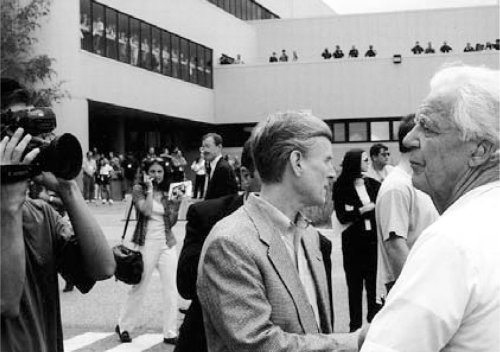
During the demonstration at the lab, local activist and retired lab employee Ed Grothus (right) was arrested as lab employees looked on from above.
Another local resident said: “It is arrogant to say, ‘we guarantee it is not going to escape’. … Is it fair to risk a whole community down here?”
A resident of the nearby Indian pueblo at San Ildefonso said: “You told me some years ago that uranium would not be of concern. … I got my kids growing up, my grandkids growing up now. I don't want this stuff going on. You have places that are designated for these things. … If it is going to cost you a million dollars to get over there three times a year, you do it. But not in my backyard, not anymore. I'm tired of it.”
A woman from Santa Fe, 30 miles away, asked: “If it is so safe, why don't you release it into the office of [Sen.] Pete Domenici?”
Although some speakers at the hearing defended the experiment, lab managers were eventually shrewd enough to heed the advice of one lab employee at the meeting who said, “I hope you realize that you do not go into this, and I pity you for that, with enormous trust from the community. You should really consider the PR consequences of what you want to do.”
The day after the hearing the laboratory announced it was cancelling the experiment.
“This place is about pure, unmitigated evil.”
Much more than its sister laboratory at Livermore, Los Alamos has always been touchy about Hiroshima and Nagasaki. Los Alamos prefers to celebrate the anniversary of the first ever nuclear test in July and let the Hiroshima and Nagasaki anniversaries in August slip quietly by. The Bradbury Science Museum at Los Alamos, which has tried to have activists arrested for handing out leaflets about Hiroshima on the sidewalk outside, shows a historical documentary that goes straight from the Trinity test to VJ Day in 1945 without even mentioning Hiroshima and Nagasaki.
Anti-nuclear activists, of course, feel the opposite way, and a certain number always show up on August 6 or 9. The most regular is Ed Grothus, a lab retiree turned anti-nuclear activist, who ignores occasional jeers and obscenities as he stands downtown with his American flag and banner, which reads the same every year, saying “We are sorry about Hiroshima and Nagasaki. We are the new abolitionists.” This year Grothus had a lot of company, thanks to a national planning campaign led by Peace Action that produced the largest protest in Los Alamos's history–an event anticipated with considerable apprehension by local residents.
So it was on August 9 that this small town, where the vandalizing of a marker on a hiking trail would normally make front-page news, braced for invasion by 300-400 activists from around the world, many of them pledged to commit civil disobedience at the lab. By 11 a.m. the activists had assembled downtown, signs and banners in hand, ready to hear a succession of speakers. Across the street, a small cluster of veterans staging a counter-demonstration eyed them frostily. Four youths in a pickup truck circled with a sign saying that the lab “protects your first amendment rights.”
The speakers at the rally included a Nagasaki survivor, who spoke of the despair that overwhelmed her in the years after the bombing of her city; Bruce Hall of Peace Action; Amy Goodman of Pacifica Radio; and Clayton Raymond of the Fellowship of Reconciliation, who condemned the scientists at Los Alamos as “middle-class people who go to temple or church and witness in their daily lives for violence and destruction.”
But these harsh words were just a warm-up for the main act. When Helen Caldicott, the Louis Farrakhan of the peace movement, took the stage, she pulled no punches. Using inflammatory language that offended both the people at Los Alamos and some of her fellow activists, she said, “This place reminds me of Schindler's List. People go shopping and do their everyday deeds as they are preparing the global gas oven. That's what this place is about. It's about pure, unmitigated evil. Let's not mince words. The people here have big left brains and very small right brains. They probably walk like this [leaning to one side]. We have to close this place down.”
Caldicott was followed by Hollywood actor Martin Sheen, who dedicated his protest to J. Robert Oppenheimer, of whom Sheen said, “I'm quite sure that, if he were alive today, he'd be leading this march.” With that, the marchers set off for the laboratory, followed by occasional jeers of “get a job” from the locals.(“Give up your jobs,” the protesters shouted back.) At the laboratory, Sheen knelt to say the Lord's Prayer, then told the head of security, “I'm all yours.”
Sheen and about 70 other protesters–including a blind retired professor who had traveled all the way from New Jersey for the event–were arrested by guards in flak jackets and latex gloves. Protesters continued to chant “close the labs” and “quit your jobs” as the arrestees were taken to yellow school buses parked nearby.
Meanwhile some of the lab employees (who, unlike their counterparts at Livermore, had never seen anything quite like this before) stood en masse on the balcony of the cafeteria, like colonial administrators on their verandas. Others lined the opposite side of the street, watching this strange ritual with tight-lipped fascination. When I slipped across the street from the noisy throng of protesters to the silent ranks of observing lab employees, I was reminded of Night of the Living Dead. My requests for a reaction to the protest were not even rebuffed, simply ignored with glassy-eyed, straight-ahead stares. Some of the employees eventually told me that they had been instructed, ever since the start of the Wen Ho Lee affair, to refer all questions about anything to Public Affairs. Some even believed they could lose their jobs for talking to the press. (Pretty ironic for the lab that “protects your first amendment rights.”)
Long after the chants had died down and the signs had been thrown away, this image stayed with me as somehow iconic of the lab's predicament at the end of its long, hot summer of incursions by journalists, senators, and protesters. The scientists Caldicott denounced as the masters of the new global gas ovens looked more like deer trapped in the headlights, gazing uncomprehendingly as something alien bore down on them.