




Abstract

Hua Di at Stanford, in better days.
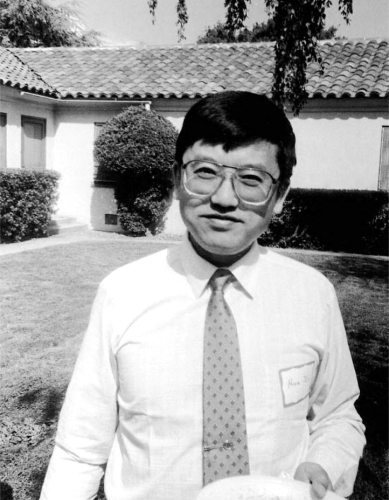
Hua Di is a research associate at Stanford University's Center for International Security and Arms Cooperation, commonly called CISAC. While reading his five-paragraph bio on the CISAC web site, it is easy to imagine that Hua leads the intellectually stimulating, globe-trotting, upper middle-class life of a distinguished scholar at one of America's premier universities.
That would be wrong.
Hua has been held virtually incommunicado by the Chinese government since January 5, 1998. As of October 8, when this issue of the Bulletin was sent to the printer, he had spent 636 days in custody.
Political prisoners are not a rarity in China. But the Hua Di case is particularly puzzling, starting with the question of whether he is actually a political prisoner. The Chinese government alleges that Hua has committed a crime–but the nature of that crime has not been specified nor has a trial date been set.
Hua Di seems an unlikely candidate for prison. He was born in Shanghai in 1936, the son of prominent revolutionaries. After the Communist victory, Hua's father headed the Forbidden City's Palace Museum for more than 30 years, a great honor.
At the age of nine, Hua joined the People's Liberation Army in 1945 and later fought in the civil war. In the mid-1950s, he was sent to Moscow to be trained as a rocket scientist. By 1978, he had received the State Prize for his contributions to China's icbm program. He was one of China's rising stars.
Hua first came to the United States in 1980 as a visiting scholar at the University of Washington, and he then traveled down the coast to Stanford, where he was named a CISAC fellow.
At Stanford, Hua began a close association with CISAC's John Lewis, a man who has spent much of his professional life attempting to put U.S. and Chinese thinkers and doers in touch with one another.
Shortly after returning home in 1981, Hua was permitted by the government to leave the missile program and transfer to the American Studies Institute, which had been recently formed by the Chinese Academy of Social Sciences. Hua returned to Stanford often during the 1980s, always with the blessings of the government.
Hua worked with Lewis's Project on Peace and Cooperation in the Asian-Pacific Region, and he helped Lewis write articles on the history of China's missile programs.
“Hua was one of three people authorized by China's Commission of Science, Technology, and Industry to give me materials on the history of strategic programs,” recalls Lewis. “The others were Gen. Wang Shouyun, a missile expert with the People's Liberation Army, and Li Yiangxiang, a nuclear weapons expert.”
The Chinese government was pleased, says Lewis. “Officers in the People's Liberation Army were very complimentary and saw it as helping China's position to be understood in the West.” The Chinese government thought so highly of Hua in the 1980s that it made him co-director of an international research institute under the auspices of the China International Trust and Investment Corporation.
But then came Tiananmen, the bloodletting in Beijing that reminded the world that despite its far-reaching attempts to build a market-based economy, China was still a Party-controlled police state in which political dissent was not easily tolerated.
Pro-democracy activism had grown steadily more vigorous in the early months of 1989, but the Chinese government did not begin to crack down hard on dissidents until May. Although Hua had not been a leading activist, he was sympathetic. On May 18, he and others signed a petition opposing the crackdown. An order for his arrest was issued but not carried out, probably because of the general chaos.
The night before the June 4 violence at Tiananmen Square, Hua left for a conference in Paris. During a stopover in Moscow, he called Lewis to arrange to travel to the United States. By July he had become the highest ranking person to flee China after Tiananmen. He was not, however, a defector. He retained his Chinese passport, which China renewed a few years ago.
Hua joined CISAC, where he wrote or co-authored articles and conference papers on space technology, statistics, nuclear strategy, international relations, arms control–and the Chinese missile program.
“All of his articles were based on materials widely circulating in U.S. university libraries,” recalls Lewis. “The data were not unique. But Hua Di's knowledge of them was.”
In October of 1997, Hua's family urged him to return to China to conduct memorial services for his mother, who had died in 1996, and for his brother-in-law, who died during a medical procedure gone wrong. As the eldest son, Hua felt a strong obligation to return. His CISAC colleagues suggested caution.
Hua flew to Hong Kong, no longer a British colony, and spent two days with mainland officials going over the possible charges against him. The Tiananmen charges were “basically dropped,” says Lewis. But Hua was now accused of having leaked state secrets regarding China's missile program. After more discussion, says Lewis, the mainland officials gave Hua a “clean bill of health on all of his legal problems.”
Lewis recalls that, according to Hua, the mainland officials even said that he–Hua–“would be welcomed back to China” and that he should prepare a briefing on U.S.-China relations for senior officials in Beijing. Hua returned to Stanford on October 28 and began work on the briefing.
Although Hua was excited, his CISAC colleagues again suggested caution. Hua, who held a green card, was due to receive his U.S. citizenship in July 1998; he should wait until then before returning. In any event, he should travel only with a Stanford delegation.
Hua disagreed, and he left for China on December 31, traveling alone. He was arrested in Beijing shortly before he was to attend a banquet in his honor put on by some of his former friends and colleagues in the missile program. A month later, he was charged with “leaking state secrets” (xielu Guojia mimi). He remains today in the Big Red Gate Detention Center in Beijing. No family members or friends have been permitted to visit.
Shortly after the arrest, Lewis sent a letter to President Jiang Zemin urging Hua's release and offering evidence that Hua had been authorized by the Chinese government to help with the Stanford history project. There was no answer.
Three months later, former Defense Secretary William Perry, who by then was one of Stanford's (and CISAC's) biggest guns, wrote a similar letter, which was entrusted to the U.S. embassy. The embassy delayed the letter for two months before delivery. Again, there was no answer.
Meanwhile, the State Department told Lewis that it would not intervene because Hua was not a U.S. citizen. “To my knowledge,” says Lewis, “no official effort has ever been made by the U.S. government to help free Hua.”
Between January and September 1998, Lewis made a half dozen quiet visits to Beijing on Hua's behalf. Experts on China's judicial system had advised Lewis that it would be best for Hua to keep the matter out of the public eye. Insofar as Lewis could tell, nothing happened.
But in September, Hua's family asked Lewis to help them prepare for his legal defense. And they also suggested that Lewis “bring public pressure” to try to force Hua's release on “medical parole,” so Hua could be treated for a rare form of breast cancer. (He had had two cancer operations in the United States before going to China.)
The CISAC crew brought together documents showing that Hua had been authorized to provide material on China's missile programs, and that the materials used in the CISAC studies could be found in many libraries in the United States and even Hong Kong. Meanwhile, news of Hua's arrest began to hit the press in October, first in Singapore and then in Taiwan, Hong Kong, and finally in the New York Times.
Over the following months, U.S. and Asian newspapers published a host of stories, some sketchy but accurate, others simply wrong–such as tales of how Hua had been secretly tried and found guilty, or that he was a U.S. agent (or a Chinese agent). Perhaps the most bizarre story was published last May by a Taiwanese newspaper, which alleged that Hua was the “walkin” named in the Cox report, who gave Chinese nuclear secrets to the CIA in Taipei.
Last March, says Lewis, Hua was taken to a closed-door court. Hua's lawyer later told the family that Hua pleaded innocent to the charge of leaking state secrets. Further, the lawyer said that Hua would not be prosecuted for any charges stemming from his work at Stanford–or anywhere else in the United States or China.
But, the lawyer said, Hua would be tried on charges related to unspecified actions that had allegedly taken place in a third country, which was not named.
Six-hundred and thirty-six days and counting, with no firm trial date in sight. As the Bulletin goes to press, nothing is certain, not even the charges. Kafka's Joseph K. would understand.