




Abstract
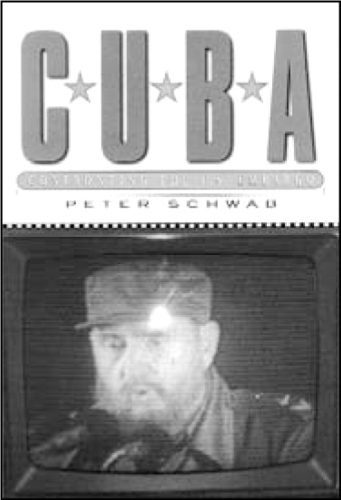
Cuba: Confronting the U.S. Embargo By Peter Schwab, St. Martin's Press, 1999, 224 pages; 29.95
Cuba: Confronting the U.S. Embargo is a perplexing book. Peter Schwab, a professor of political science at Purchase College (State University of New York), begins by saying that it is a labor of love. It obviously is–the reader senses early on his deep affection for Cuba and the Cuban people. Not surprisingly, he calls for a lifting of the U.S. embargo and for the normalization of relations with Cuba. But in the process, he overstates the embargo's effectiveness, thereby buttressing the arguments of embargo proponents who would like the U.S. public to believe that it has been an effective tool against Fidel Castro.
It is difficult to argue with the author's basic conclusions. He views U.S. efforts to rid itself of the Cuban Revolution as part of its long-standing determination to control the island. During the Cold War, the United States had legitimate security concerns resulting from the Cuban-Soviet alliance–concerns that came most visibly and dramatically into play during the 1962 Missile Crisis.
He argues, however, that with the end of the Cold War, and with the Pentagon saying the island no longer poses any conceivable threat to U.S. security, U.S. insistence on maintaining and tightening the embargo is mean-spirited and counterproductive. He points out that U.S. Cuba policy has been rejected by the rest of the world community–157 countries voted to condemn it during the U.N. General Assembly in November 1998, and only one country, Israel, voted with the United States. In effect, however, the United States stands alone. Israel is one of Cuba's most active trading partners and investors.
Schwab contends that the U.S. embargo has been largely successful in its attempt to cripple the Cuban economy. But the fact is, no unilateral embargo in history has ever worked. If an embargoed country can trade with all the countries in the world save one, the effects of the embargo must be limited–even if that one country happens to be the economically powerful United States.
This has clearly been the case with Cuba. During the years that Cuba enjoyed a preferential trading relationship with the Soviet Union, the effects of the U.S. embargo were minimal. The collapse of the Soviet Union sent the Cuban economy into free fall. Between 1991 and 1994, the economy retracted by an estimated 35-50 percent. The impact of the U.S. embargo was bound to increase.
But although the embargo was tightened by the Cuban Democracy Act in 1992, the Cuban economy began to recover as a result of a series of economic reforms carried out by the Castro government in 1993–including banking reforms, a self-employment law, dollarization, the opening of private markets for farmers and artisans, and the widening of parameters for foreign investment. By 1996, the economy was growing at a rate of 7.6 percent. It has continued to grow–though at a less impressive pace–in the years since, despite passage of the Helms-Burton Act in 1996.
Indeed, the strongest argument against the embargo is its limited effectiveness. Schwab fails to recognize this, and instead gives aid and comfort to the embargo's proponents when he writes, “The rotten state of Cuba's economy is predominately a result of the frightening, mean-spirited, and 40-year-long war against Cuba conducted through the U.S. embargo.” Proponents wish the embargo were working so well, and if someone convinces them that it is, they will likely stick with it.
The embargo, however, cannot possibly achieve its objective of getting rid of the Castro regime. It makes it difficult to get credits, forces Cubans to search for sources of supply and markets, and in general makes life more difficult–but it has not, will not, and cannot bring about anything even approaching economic collapse. It is not even the key cause of Cuba's economic hardships.
The “rotten state” of the Cuban economy is predominately the result of the collapse of the Soviet Union and Cuba's loss of the subsidy that resulted from its preferential trading relationship with its former ally. This is demonstrably the case since the economic crisis only began after these two events. Cuba must adjust to life without Soviet support. The U.S. embargo only makes that adjustment more difficult.
The case of foods and medicines is exemplary in this regard. Because of the potential savings in transportation costs, Cuba could purchase more food for the same amount of money if it could buy from the United States. Also, the country's inability to buy directly from the United States makes the purchase of a few specific medicines and items of medical equipment extremely difficult. Even so, the fact remains that Cuba can buy food from any other country in the world. And in one way or another it can get most of the medicines it needs.
This does not mean, however, that the United States should maintain its embargo on the sale of foods and medicines. To include those commodities in a trade embargo is a violation of international law. Denying the sale of foods and medicines to anyone is a position the United States should never be in.
Schwab also suggests that Castro's opening to religion is, in part, a consequence of the embargo. It is likely, he writes, “that there was a very strong interconnection between the embargo, the death of the Soviet Union, and the new opening to the Catholic Church.” This argument coincides with the views of Sen. Robert Torricelli, author of the Cuban Democracy Act and one of the embargo's most energetic supporters–strange company for Schwab to be in.
But neither the embargo nor the collapse of the Soviet Union had much if anything to do with the opening to the Church, which began in 1979, at a time when the Soviet economy and Soviet-Cuban economic ties were doing well. In that year, Castro traveled to Nicaragua and met a number of Third World priests involved in the Sandinista revolution. Upon his return to Cuba, he remarked that the differences between the Catholic Church and the Cuban Revolution were not as wide as he had imagined. A slow process of rapprochement followed.
One of the milestones was Castro's lengthy 1985 interview with Frei Betto, a Brazilian Dominican priest, which was published as a fascinating book titled Fidel and Religion. Anyone who thinks that the opening to the Church resulted from the collapse of the Soviet Union should read it.
Astonishingly, Schwab even seems to believe the Cuban Democracy Act and Helms-Burton helped bring about the release of a number of political prisoners. He writes, “The Cuban Democracy Act and the Helms-Burton Act, buttressed by appeals from the Vatican, may have led to the early release of some political prisoners.” This statement is not only completely off the mark, it also supports the positions of Sens. Jesse Helms and Torricelli. The appeal from the Vatican did bring about the release of some prisoners, but the Cuban Democracy Act and Helms-Burton had nothing to do with it. As one Cuban human rights activist put it just after the Pope's visit, “The Pope has accomplished more in three days with his message of openness and reconciliation than U.S. sanctions have accomplished in 40 years.”
One can sympathize with Schwab's anti-embargo sentiments. But one must be concerned that this book may actually encourage proponents to prolong it. Surely that was not Schwab's intention.
We want to hear from you
Send them to: Letters, The Bulletin, 6042 South Kimbark, Chicago, IL 60637, Or, 773 702-0725 fax
Be sure to include your mailing address and phone number.