




Abstract
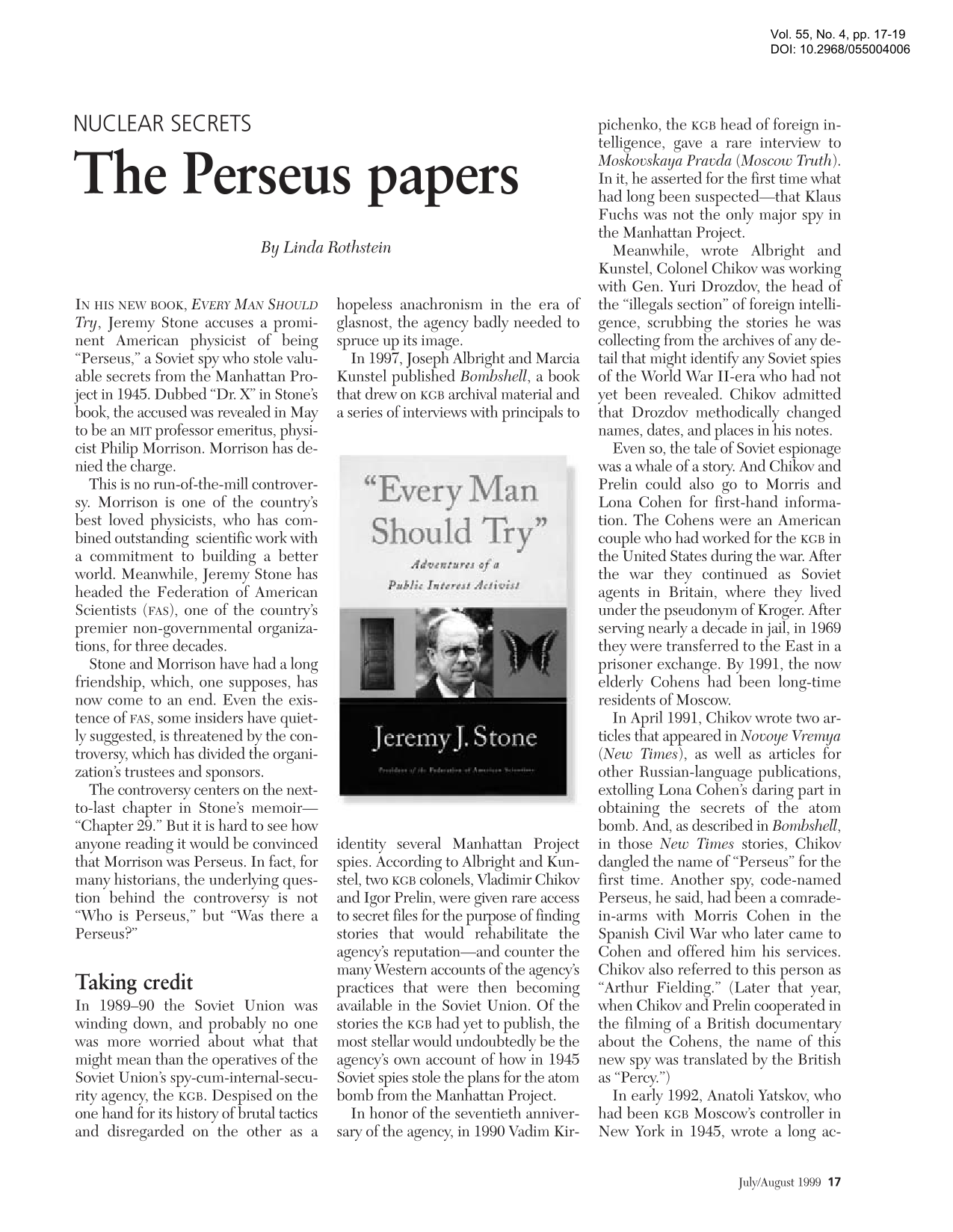
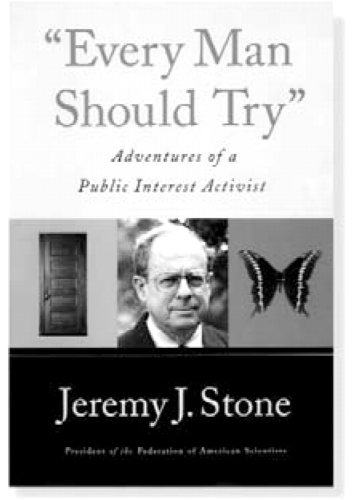
In his new book, Every Man Should Try, Jeremy Stone accuses a prominent American physicist of being “Perseus,” a Soviet spy who stole valuable secrets from the Manhattan Project in 1945. Dubbed “Dr. X” in Stone's book, the accused was revealed in May to be an mit professor emeritus, physicist Philip Morrison. Morrison has denied the charge.
This is no run-of-the-mill controversy. Morrison is one of the country's best loved physicists, who has combined outstanding scientific work with a commitment to building a better world. Meanwhile, Jeremy Stone has headed the Federation of American Scientists (fas), one of the country's premier non-governmental organizations, for three decades.
Stone and Morrison have had a long friendship, which, one supposes, has now come to an end. Even the existence of fas, some insiders have quietly suggested, is threatened by the controversy, which has divided the organization's trustees and sponsors.
The controversy centers on the next-to-last chapter in Stone's memoir–“Chapter 29.” But it is hard to see how anyone reading it would be convinced that Morrison was Perseus. In fact, for many historians, the underlying question behind the controversy is not “Who is Perseus,” but “Was there a Perseus?”
Taking credit
In 1989-90 the Soviet Union was winding down, and probably no one was more worried about what that might mean than the operatives of the Soviet Union's spy-cum-internal-secu-rity agency, the KGB. Despised on the one hand for its history of brutal tactics and disregarded on the other as a hopeless anachronism in the era of glasnost, the agency badly needed to spruce up its image.
In 1997, Joseph Albright and Marcia Kunstel published Bombshell, a book that drew on KGB archival material and a series of interviews with principals to identity several Manhattan Project spies. According to Albright and Kunstel, two KGB colonels, Vladimir Chikov and Igor Prelin, were given rare access to secret files for the purpose of finding stories that would rehabilitate the agency's reputation–and counter the many Western accounts of the agency's practices that were then becoming available in the Soviet Union. Of the stories the KGB had yet to publish, the most stellar would undoubtedly be the agency's own account of how in 1945 Soviet spies stole the plans for the atom bomb from the Manhattan Project.
In honor of the seventieth anniversary of the agency, in 1990 Vadim Kirpichenko, the KGB head of foreign intelligence, gave a rare interview to Moskovskaya Pravda (Moscow Truth). In it, he asserted for the first time what had long been suspected–that Klaus Fuchs was not the only major spy in the Manhattan Project.
Meanwhile, wrote Albright and Kunstel, Colonel Chikov was working with Gen. Yuri Drozdov, the head of the “illegals section” of foreign intelligence, scrubbing the stories he was collecting from the archives of any detail that might identify any Soviet spies of the World War II-era who had not yet been revealed. Chikov admitted that Drozdov methodically changed names, dates, and places in his notes.
Even so, the tale of Soviet espionage was a whale of a story. And Chikov and Prelin could also go to Morris and Lona Cohen for first-hand information. The Cohens were an American couple who had worked for the KGB in the United States during the war. After the war they continued as Soviet agents in Britain, where they lived under the pseudonym of Kroger. After serving nearly a decade in jail, in 1969 they were transferred to the East in a prisoner exchange. By 1991, the now elderly Cohens had been long-time residents of Moscow.
In April 1991, Chikov wrote two articles that appeared in Novoye Vremya (New Times), as well as articles for other Russian-language publications, extolling Lona Cohen's daring part in obtaining the secrets of the atom bomb. And, as described in Bombshell, in those New Times stories, Chikov dangled the name of “Perseus” for the first time. Another spy, code-named Perseus, he said, had been a comrade-in-arms with Morris Cohen in the Spanish Civil War who later came to Cohen and offered him his services. Chikov also referred to this person as “Arthur Fielding.” (Later that year, when Chikov and Prelin cooperated in the filming of a British documentary about the Cohens, the name of this new spy was translated by the British as “Percy.”)
In early 1992, Anatoli Yatskov, who had been KGB Moscow's controller in New York in 1945, wrote a long account of Soviet espionage at the Manhattan Project that was accepted for publication by Voprosy Istorii Yestestvoznaniya i Tekhniki (Questions of Natural History and Technology). After the journal was printed but not yet distributed, Soviet bomb physicists, led by Yuli Khariton, prevailed upon the publishers to withdraw it. Most but not all of the copies were destroyed.
The physicists argued that Yatskov's account contained secrets that still needed to be kept from would-be nuclear proliferators. But the Soviet physicists were at least equally appalled by what they saw as the KGB's attempt to take all the credit for the Soviet bomb. To get their own version of the story out, Yuli Khariton and Yuri Smirnov, two critically important members of the bomb team, brought their version of events to the Bulletin, which published their account in 1993. In a 1994 article in the Bulletin, Izvestia reporter Sergei Leskov described the KGB and the physicists as locked in a “struggle for a place on the Mount Olympus of history.”
Questions about Manhattan Project spies were catapulted into the headlines again in 1994 with the publication of Pavel Sudoplatov's book, Special Tasks. Along with his duties in arranging assassinations and running guerrilla warfare behind enemy lines, KGB General Sudoplatov had briefly–in 1945–headed “Department S,” which KGB head Lavrenti Beria set up solely to supervise atomic intelligence efforts.
In a single chapter on atomic spying, Sudoplatov discussed Klaus Fuchs, who was code-named “Charles” or “Charlz.” He also revealed two other code names, “Mlad,” and “Star.” But his claim that “Star” referred to both Robert Oppenheimer and Enrico Fermi, who, he said, had knowingly allowed their secrets to be copied, was much disputed and found wanting by Manhattan Project historians for a variety of reasons.
New articles, back issues, special collections, helpful links, cartoons, photos, book reviews, and coming attractions. … Our World Wide Web site is the perfect online tool for your international security and nuclear-related research.
As for “Perseus,” Sudoplatov was dismissive. He explained in a footnote that while Yatskov mentioned Perseus in an interview in 1992 as the code name of a major, still-living source, he himself remembered no such name. He suggested that “Yatskov or his colleagues” had created Perseus to cover the real names of their sources.
A slender thread
This is the point in the drama where Jeremy Stone enters the picture. In Chapter 29 he explains that while reading Sudoplatov's book, he remembered reading an article by Michael Dobbs that appeared in the Washington Post in 1992, describing Chikov's New Times pieces. Stone tracked down an English translation of the Chikov articles, and one part in particular caught his attention:
“On reading the article,” Stone writes, “I thought I realized who Perseus was because [of] a paragraph that Perseus had uttered, 50 years before, to his recruiting KGB officer. And, despite the fact that this paragraph had been translated into Russian and back into English and then modified at least slightly, there was a statement and a turn of phrase that seemed to me to identify the speaker like a thumbprint.”
This is it–Perseus declining an offer of money for his services: “Oh no, for God's sake. I'm willing to cooperate with them for a cause, not for money. I want to dedicate my life to averting the danger of a nuclear holocaust looming over mankind, because I have just realized how real the threat of such a holocaust is, and this prompted me to counter it in the ranks of the Soviet intelligence service.”
This “evidence” has struck several FAS board members as a slender thread on which to claim that a particular individual uttered those words–or something more or less like them–and, more than 50 years later, accuse that individual of having been a spy.
But Stone goes on: “Any original atomic scientist,” he writes, “who would say that he would ‘dedicate my life to averting the danger of nuclear holocaust’ would be among FAS's original members.” And if that person were still living, “he would be helping us still.”
Having decided who Perseus was, Stone was able to make other pieces of the Perseus mystery fall into line: When an expert told him that the information about Perseus was “either an ‘indiscretion’ or a piece of ‘disinformation,’” he concluded that it had to be an indiscretion.
But in Chikov's account of Perseus's recruiting interview, Stone finds disinformation. A reference to the Pentagon, made during the war, must be a code-word for Gen. Leslie Groves. Stone is certain, because, he says, the Pentagon was not built until after the war. But unlike the murkier corners of the past, this is the sort of thing that can be easily checked. As most historians of the era know, Groves was chosen to head the Manhattan Project in 1942 because he had already supervised the construction of the Pentagon; in fact, as described in Richard Rhodes's The Making of the Atomic Bomb, Groves received his first briefing on the bomb project assignment from Brig. Gen. Wilhelm Styer in Styer's office in that building.
Through the summer and into the fall of 1994, Stone considered using a variety of methods to flush out Dr. X as a Manhattan Project spy, including several visits with Morrison in Cambridge, during which, Stone claims, Morrison's body language showed that he was worried and upset–and therefore, was the spy that Stone believed him to be.
After several months of indirect attempts to convince Morrison to admit to being the person Stone wanted him to be, Stone left the matter pending. He made no public accusations, and in his book mentioned only a “Dr. X,” about whom, he said, he had decided “to reveal what I knew.” Although “Dr. X” was not identified, enough details were provided to persuade historians that Stone was writing about Morrison. Finally, in a May interview with the New York Times's Bill Broad, Stone said publicly that Morrison was Dr. X.
A “similar spy”
In pursuing his theory, Stone goes against what many historians regard as contrary evidence. This is nowhere more clearly seen than in the penultimate paragraph of Chapter 29, with its fleeting mention of Bombshell: “In any case, my speculation to X that the public would understand his position, were it described, was, I felt, borne out in the subsequent release in 1977 [sic] of the book Bombshell about a similar spy named Ted Hall.”
For Stone to characterize Hall as a “similar spy” is ironic. For in the five years since Sudoplatov first piqued Stone's interest, Ted Hall has been definitively revealed as “Mlad,” and his friend Saville Sax is now known to have been “Star.” We also know that it was Mlad who passed critically important documents to Lona Cohen–the material that confirmed the truth of the bomb secrets transmitted to the KGB by Klaus Fuchs. Stone describes Lona Cohen as Perseus's courier.
Remember Sudoplatov's statement that Yatskov or his colleagues had created Perseus in the early 1990s? Chikov admitted openly in 1996 that he and other KGB officers he worked with had combined Mlad and another spy code-named “Pers” into a single spy, Perseus. “The main goal was to make the story unclear, so when the intelligence of other countries began to analyze this, it would not reveal the forms and methods of the work of Soviet intelligence,” he told the authors of Bombshell. According to Chikov, in early 1991 he and General Drozdov changed dates and cables, and then Prelin got together with Yatskov to fake the story of how Perseus was recruited.
The fragmentary Venona transcripts of Soviet coded messages also mention Pers, an as-yet-unidentified spy known to have been based at “Camp 1”–Oak Ridge. Stone concludes at one point that Pers must be Perseus. But, as seems pretty well established, if Pers had been at Oak Ridge, he could not have been Perseus. Or alternately, if Perseus is Pers, then he could not have been at Los Alamos, where both Hall and Philip Morrison worked.
It is very difficult to prove a negative. But Morrison, in a statement issued on May 10, was able to demonstrate that he could not be the Perseus described by Chikov. Stone had omitted certain details from Chikov's account–that Perseus served in the Spanish Civil War, and that he also visited his parents in New York City. Morrison did not serve in the Spanish Civil War (he was a graduate student at the University of California at Berkeley at the time), and his family lived in Pittsburgh. (Hall's parents did, however, live in New York, and Hall did visit them.)
The next day, an apparently unapologetic Stone wrote to Morrison: “I welcomed the information you provided in your letter of May 10, 1999, concerning the ways in which you differ from the profile given by the KGB of the spy, Perseus, and in the light of these facts, which I certainly cannot contradict, I can only accept your denial that you are Perseus.”