




Abstract

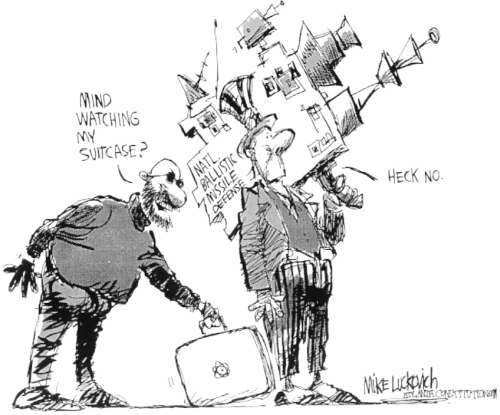
Senate and House votes to endorse national missile defense exploded like thunderclaps across the American national security landscape in mid-March. The prolonged Republican campaign for deployment–which had seemed like a fool's errand only days before–had suddenly come the closest to accomplishment since Ronald Reagan delivered his famous Star Wars speech in 1983.
The change in the tenor of the debate began on January 20, when Defense Secretary William Cohen announced that the administration would add $6.6 billion to the Pentagon's six-year budget for the deployment of a national missile defense, bringing missile-defense spending for the period to $10.5 billion. He also said that the administration would make a decision on deployment as early as June 2000, in the midst of the presidential campaign. The announcement of additional money was driven by a bureaucratic imperative: the need for the Pentagon to lay out its budget plans for the next six years.
Interpretations of Cohen's announcement differed widely. Some saw the president as finally donning the Republican's Star Wars armor after years of resistance. Others saw the decision as providing only the appearance of change, while in reality deferring a deployment decision into the indefinite future. Once more it appeared that the president, so expert at “triangulation,” had coopted a Republican position without endorsing it in its entirety. He had filched the issue just as he had welfare reform, deficit reduction, crime, and, most recently, military spending.
Despite Cohen's announcement, Republicans who had made missile defense a litmus test pressed on. In the Senate, Republican Thad Cochran of Mississippi introduced a measure mandating national missile defense deployment “as soon as technologically feasible.” He had tried twice last year to win Senate endorsement of an identical bill, only to be staved off by a 59-41 vote when 60 votes were needed to begin debate. That one-vote margin loomed increasingly large as the March showdown approached.
In 1998, only four Senate Democrats–Daniel Inouye and Daniel Akaka of Hawaii, Joseph Lieberman of Connecticut, and Ernest Hollings of South Carolina–joined with all 55 Republicans to support debate on the Cochran measure. With the same ratio of 55 Republicans and 45 Democrats in the 106th Congress, a single Democratic defection could change the dynamics of the debate.
Three Democrats–Michigan's Carl Levin, Delaware's Joseph Biden, and Minority Leader Tom Daschle–led this year's fight against the Cochran bill. They persuaded National Security Adviser Sandy Berger to write a strong letter in opposition. Berger argued on February 3 that the Cochran bill would decide deployment only on the basis of whether deployment was “technologically feasible,” without regard to the impact on nuclear arms reductions or the Anti-Ballistic Missile (abm) Treaty, or the total cost of the system and whether it could be truly effective.
The administration launched its campaign against the Cochran bill in early March. Robert Bell, the National Security Council's chief arms control expert, and Leon Fuerth of the vice president's staff made a number of visits to Capitol Hill to explain the administration's position and to assure wavering Democrats that the president would stand firm against the Republican bill.
Administration officials explained that congressional endorsement of missile deployment would hinder Russia's long-delayed approval of the start II nuclear reductions agreement and undermine hopes for cordial negotiations with Russia aimed at modifying the abm Treaty to permit limited defenses against the rogue-state missile threat.
Meanwhile, Levin, Biden, and Daschle worked to solidify the positions of Democratic waverers. Several moderate Democrats, including Mary Landrieu and John Breaux of Louisiana, Bob Graham of Florida, John Edwards of North Carolina, Blanche Lincoln of Arkansas, and Evan Bayh of Indiana, were undecided.
The strategy appeared to be working as late as March 11. Democrats had lined up 41 votes by early afternoon. But two hours later, when a key Democrat defected, the plan self-destructed. Nebraska Democrat Bob Kerrey's defection led directly to the overwhelming passage of the Cochran bill less than a week later.
Earlier in the year, Kerrey had staked out a position endorsing unilateral U.S. nuclear arms reductions down to the start III level (from about 7,000 long-range strategic weapons to about 2,500), without waiting for Russia to sign treaties formally reducing arsenals to that level. He argued that the United States does not need to retain such a large stockpile, no matter what Russia does. His move was designed to help break the long deadlock in U.S.-Russian nuclear reduction negotiations. No other member of Congress has been so bold.
But Kerrey will be up for re-election in 2000 in a conservative state. While endorsing unilateral cuts, he embraced national missile defense as a trade-off. In a March 16 speech, Kerrey explained to the Senate that he had had a change of heart, the result of the July 1998 report on the rogue-state missile threat by the commission headed by former Defense Secretary Donald Rumsfeld, as well as North Korea's three-stage missile test over Japan in late August.
After Kerrey backed away from his earlier commitment to vote against bringing up the Cochran bill, other moderate Democrats turned squishy. Levin, Biden, and Daschle were forced to abandon their tactic of blocking a full debate on the Cochran measure.
The Democrats' anti-missile defense position deteriorated rapidly. Administration officials began to doubt that they could count on 34 votes to uphold a presidential veto of the bill. Levin conceded to reporters that he could no longer be certain of the vote count. The administration then began backtracking and looking for face-saving measures to avoid outright defeat.
As the Senate began debate on March 15, Cochran offered an amendment to his own bill, stating that even if the Senate endorsed deployment, Congress would need to authorize and appropriate missile defense funds annually. Cochran took this step to demonstrate that his bill did not put national missile defense on auto-pilot without regard to cost. Eager Democrats embraced the provision as evidence that “affordability” would remain a crucial determinant. The amendment was adopted 99-0, notwithstanding the fact that the amendment merely reaffirmed the constitution.
Next, Landrieu offered an amendment stating that nuclear arms reductions would continue as a goal even while the United States pursued missile defense. The administration needed this provision so it could claim that arms control–and by extension the ABM Tr eaty–were still factors in a deployment decision. This amendment also passed 99-0.
Its cover complete, the White House sent word that it would endorse the Cochran bill and, by extension, missile defense deployment. After the vote, the president issued a statement on March 17: “I am pleased that the Senate, on a bipartisan basis, included in its national missile defense (NMD) legislation two amendments that significantly change the original bill, which I strongly opposed.”
While many Democrats were dismayed by the administration's flipflop, all but three–Vermont's Patrick Leahy, Minnesota's Paul Wellstone, and Illinois' Dick Durbin–voted for the Cochran bill. It passed 97-3.
In the House, the dynamics were different. Pennsylvania Republican Curt Weldon and South Carolina Democrat John Spratt offered a 15-word bill endorsing national missile defense, but with no timetable and no conditions. Republicans argued that passage would commit the House to deployment, but Spratt suggested that the measure was so vague that lawmakers could read into it whatever conditions they wanted.
Weldon and Spratt had introduced the same bill last year, but internal Republican party divisions prevented it from being brought up for a vote–conservative Republicans wanted a bill that most Democrats would oppose, to sharpen party differences before the November 1998 election.
This year, a more temperate Republican leadership was eager to push a measure that might embarrass the Clinton administration, even if many Democrats went along. In the end, House Democrats split down the middle on the Weldon-Spratt bill, while all but two Republicans supported it. The bill passed easily, 317-105, after a secret session in which the Rumsfeld commission briefed members about the roguenation threat.
But House Democrats demonstrated that they could have upheld a presidential veto. A motion by Maine Democrat Tom Allen encompassing the administration's earlier conditions on deployment–that a system should be operationally effective, not jeopardize Russian nuclear weapons reductions, and be affordable–lost 152-269. Only 141 votes would have been needed to sustain a veto. Both Democratic leaders, Richard Gephardt of Missouri and David Bonior of Michigan, supported Allen's motion and opposed the Weldon-Spratt bill.
Neither the Senate nor the House bill spends a dime on national missile defense deployment. Neither makes it any easier to “hit a bullet with a bullet,” shorthand for getting the hit-to-kill technology to work. However, the political upheaval in mid-March moves the United States many steps closer to deployment and increases the pressure on the administration to commit to deployment in June 2000.
Despite the administration's bobbing and weaving, most observers interpret the vote as did a March 19 New York Times editorial: “The Clinton administration this week capitulated to Republican pressure. … It was a political decision, designed to shield the White House.” It also was not clear whether the Russians would interpret the votes as anything but a commitment to deploy a missile defense. The Russian foreign ministry issued a statement suggesting that the votes “pose a serious threat to the whole process of nuclear arms control, as well as strategic stability.”