




Abstract
The work of the U.N. Special Commission (UNSCOM) charged with disarming Iraq of its chemical and biological weapons was disrupted last December. And in an exceptionally problematic way.
UNSCOM's downfall resulted not only from the use of its work to justify, without the support of the U.N. Security Council–and possibly to assist–the bombing of Iraq by the United States and Britain, but also because of the gradual blurring of organizational and operational boundaries that needed to be kept pristinely clear.
Saddam Hussein's campaign to conceal his biological and chemical weaponry was a major catalyst for UNSCOM's problems. Had Iraq fully declared its biological and chemical weapons programs under U.N. Security Council Resolutions 687 and 707, UNSCOM's role could have been restricted to confirming declarations and reporting to the U.N. Security Council.
Instead, the agency's tasks evolved from gathering information to countering an elaborate game of deception. In so doing, UNSCOM became a pawn in another game of deception being played by the United States. Details of UNSCOM's transformation have been exposed in recent months by the skillful investigative reporting of Barton Gellman and his colleagues at the Washington Post, as well as other journalists around the world.
UNSCOM's control over information was the first casualty of the blurring of boundaries. From its inception, UNSCOM relied on national information, particularly intelligence from the United States, to assess Iraq's chemical and biological warfare programs. It was understood–and even seen as “natural”–that the results of UNSCOM's analyses would flow back to those governments.
As Rolf Ekeus, UNSCOM's first chairman, told me in March, if governments provided intelligence, they expected feedback regarding the reliability of the information. That was “part of the game.” In theory, information was not allowed to flow to national governments without the approval of UNSCOM's chairman. In practice, it appears this safeguard was not consistently observed.
A second casualty of the blurring of organizational and operational boundaries was the means by which UNSCOM generated data. Thwarted by Iraqi concealment strategies that aimed to defeat inspections by keeping sensitive materials and equipment on the move, Ekeus initiated probes into the strategies themselves as early as 1994. An important information source was Israeli intelligence–itself problematic given the tense relations between Israel and Iraq. Following exposure of the biological weapons program in 1995 by a key defector, Hussein Kamel, Ekeus approved “special collection missions,” headed by the controversial and disquietingly single-minded Scott Ritter, who later resigned to protest U.S. interference with UNSCOM's work.
Certain inspectors on these missions carried commercial scanners and recording devices into facilities to secretly intercept and record Iraqi security telecommunications. The United States, Britain, and Israel were involved in decrypting the clandestinely collected Iraqi messages.
Given the sophistication of the Iraqi concealment program, these measures seemed defensible. In mid-1996, Ekeus briefed the Security Council in a general way about the probe into Iraqi concealment methods, and about the risk that tracking the concealment of weapons might also reveal the techniques used to conceal Saddam Hussein.
Apparently no one objected. Perhaps no one imagined the shape of UNSCOM's intelligence efforts to come. (Un-SCOM's future transformation may have been foreshadowed in a complaint issued by Ekeus in September 1996 to John Deutch, then director of U.S. Central Intelligence. Ekeus said that Washington had denied UNSCOM full access to the results of the special collection missions.)
Some time in the 1996-98 time frame, UN-SCOM's intelligence gathering took a major turn. If the Washington Post's sources are accurate, U.S. spies, working under cover as UNSCOM technicians, installed minute listening devices in innocuous-looking monitoring equipment that UNSCOM placed in Iraqi facilities. The information acquired was relayed to Baghdad and then to a CIA post in Bahrain that beamed it to National Security Agency headquarters at Fort Meade.
Britain and Israel were relieved of their decryption duties, and within UNSCOM, access to information produced by the listening devices was tightly controlled by Washington. If U.S. explanations given in March are accurate, Ekeus and his successor, Richard Butler, were not in the loop. The person with the fullest access to the information was said to be Charles Duelfer, the deputy to both directors and a former director of the U.S. State Department's Center for Defense Industry Trade, and a person undoubtedly equipped with a high-level security clearance. Washington's “help” had turned into virtual total control of the information collected by the listening devices.
A third casualty of the blurring of UNSCOM's boundaries was the substance of the information collected. Because the same elite Iraqi security forces that protect Saddam Hussein also protect his chemical and biological weapons, U.S. officials argue that information about the former was a mere “byproduct” of gathering information about the latter. The listening devices inevitably transmitted both types of information; therefore, say the officials, there was no choice but to receive both.
But such arguments falsely portray political choices as technical imperatives. They obscure the political nature of the decisions that allowed UNSCOM to be hijacked by the United States and used to clandestinely collect data about the nature and location of Iraq's security forces. Apparently no one who knew about it questioned Washington's infiltration of UNSCOM or its appropriation of data transmitted from Iraqi sites for its own geopolitical purposes.
According to a Washington Post story on March 2, “U.S. government officials considered the risk of discrediting an international arms control system by infiltrating it for their own eavesdropping. They said the stakes were so high in the conflict with Iraq, and the probability of discovery so low, that they deemed the risks worth running.” Thus, U.S. officials acting in secret determined that their own goals would supercede those of the Security Council.
If press reports are accurate, a final casualty of boundary-blurring may have been the use of the information generated under cover of UNSCOM to define targets for the December bombing raids during Operation Desert Fox.
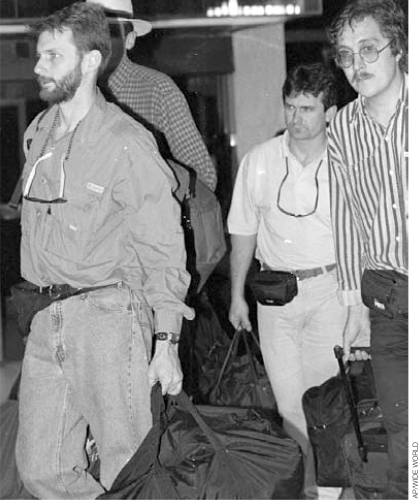
November 1998: Forbidden—once again—from carrying out inspections in Iraq, U.N. inspectors relocated to Bahrain.
It is not known if information was actually used in this way. But certainly the American and British bombing attacks did not respect any boundaries between the weapons sites claimed as the provocation for the attacks and sites associated with the regime itself. Moreover, the present uncertainty about whether or not the information was used in this way underscores the point that it certainly could have been.
Originally UNSCOM was designed as an impartial organization of experts pursuing an international effort to disarm Iraq under Security Council Resolution 687. But under strong U.S. influence, it underwent a political transformation into a cover for U.S. espionage. Whether the information collected turned out to be of any actual use to the United States is beside the point.
The crucial political problem underscored by UNSCOM's transformation is that there were no barriers to prevent either the collection of the information or its use by the United States for its own purposes, possibly including bombing raids aimed at undermining the Ba'ath regime.
There are no obvious solutions to addressing the problems posed by Saddam Hussein's regime, but surely the path chosen by the United States has produced one of the worst possible outcomes:
Today we have a discredited monitoring agency unable to reenter Iraq and resume its responsibilities; a low-intensity, undeclared war against Iraq that has not been approved by Congress or the Security Council; a weakened Security Council; and the continuance of sanctions that are killing an unknown number of Iraqi children each month through disease and malnutrition.
In February, the Security Council appointed two panels chaired by the Brazilian ambassador to the United Nations, Celso Amorim, to address the disarmament and humanitarian dimensions of U.N. policies toward Iraq. On March 29, the 20-member disarmament panel produced a report that expresses the mixed national interests represented on it–those of Britain and the United States, who wish to retain UNSCOM and an intrusive approach to verification, and those of France, Russia, and China, who want to phase out the verification phase of the Security Council's responsibilities.
While the report does not move to radically alter or disband UNSCOM, it perhaps offers possibilities for moving beyond the December 1998 deadlock. Clearly responding to the blurring of UNSCOM's organizational and operational boundaries, it proposes that UNSCOM's “substantive relationship with intelligence providers should be one way” and that the organization “should not be used for purposes other than the ones set forth” by the Security Council. Specific measures to reinforce these conditions are, however, not proposed.
In addition, the report proposes to “revitalize” UN-SCOM's role by broadening its composition to include members of the U.N. Secretariat and the Hague-based Organization for the Prohibition of Chemical Weapons in addition to representatives of national governments. This broader membership would “renovate” the inspectorate by appointing inspectors with a wider range of backgrounds and by ensuring that most inspectors were on the U.N. payroll rather than those of national governments–moves reportedly resisted by various Western representatives. Finally, the report proposes “ongoing monitoring and verification” that combines UNSCOM's disarmament function (actively ensuring that Iraq gives up its weapons of mass destruction) with the monitoring of sites previously declared to be free of weapons.
There is something for everyone in the disarmament panel's report. But at the time of this writing in late March, it remains to be seen how the Security Council will respond when it considers the report along with that of the second panel on sanctions. The United States could remedy some of the damage it has caused by giving full support to the disarmament panel's proposals for restructuring UNSCOM and its inspectorate. (Full support should include ensuring that American commissions and inspectors have an uncompromising commitment to the United Nations.)
The Security Council itself should seek to define a “third way” that would restructure the inspection and monitoring regime in a way that prevents Iraq from producing new nuclear, chemical, and biological weapons but maintains strong safeguards against the misuse of information by national governments. Continued monitoring of dual-purpose imports for their end-uses should play an important role. A new regime should also include an emergency program to rebuild critical civilian infrastructures, especially those for water purification, agricultural production, and medical care, and it should initiate conditional, phased steps towards lifting sanctions and normalizing trade.
But for now, it is unclear just how much the United States values the United Nations when it comes to Iraq. Mean-while–and surely with unintended irony–the compromising of UNSCOM by the United States has helped Saddam Hussein tighten his grip over the Iraqi people. And because he no longer has to worry about inspections, he has the opportunity to rebuild his nuclear, chemical, and biological arsenals.
More profoundly, hijacking a U.N. agency to pursue national geopolitical goals, including a low-intensity war, has undermined trust in all forms of international cooperation.
Will this prompt American policy-makers to rethink their assumption that the Security Council can be used when it suits American purposes and circumvented when it does not? The jury is out on that one.