




Abstract

Information about Soviet underground testing near Semipalatinsk and Novaya Zemlya has been well reported since the end of the Soviet Union. Accidents at nuclear power stations, the consequences of atomic weapons testing, problems with nuclear submarines, and lesser known nuclear subjects like “portable bombs” have also been discussed in the media.
Much less has been written, however, about the Soviet Union's “peaceful nuclear explosions” (PNEs)–explosions conducted for a variety of seismological, geological, and waste-disposal purposes from 1965 to 1988.
Unlike tests of nuclear weapons, which took place in remote areas, PNEs were sometimes carried out in densely populated regions–for instance, in the Ivanovo area, which is about 200 kilometers northeast of Moscow. Information about the program was strictly classified and only a small group of specialists was aware of the details. (In contrast, nearly all of the 27 U.S. PNEs were conducted at the Nevada Test Site.)
After the collapse of the Soviet Union, information about pne projects became “open.” But even then, the information was not available to independent researchers or investigators in Russia or abroad. Then, in December 1997, the Duma invited testimony from the top rank of experts for a clear statement about the history of and problems with underground PNEs and radioactive contamination. It was a remarkable event. The environmental committee heard from about 30 experts and researchers on PNEs, and these witnesses were questioned not only by about 10 members of the Duma, but by many members of an audience of about 100 people as well. It was the first time that many of those who were involved in the PNE program spoke out about it. After the hearings, the authors were able to arrange a number of private interviews with those who testified.
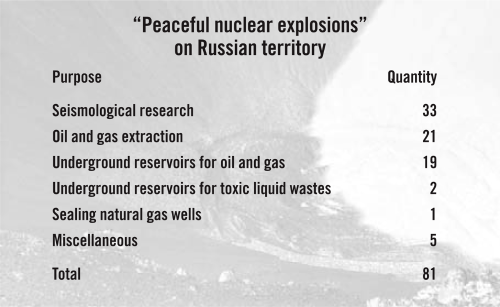
The data presented there, and gathered in our subsequent investigation, indicates the scale of the program: Over a period of 23 years, the Soviet Union carried out 124 PNEs–81 on Russian territory. In Russia, the explosions occurred as far south as the Astrakhan region on the Caspian Sea; as far north as the Murmansk region; as far west as Ivanovo; and as far east as Sacha-Yakutiya in north-central Siberia.
A “modern technology”
In the mid-1960s, the Soviet people believed it would be easy and inexpensive to obtain nuclear energy. Most were swayed by propaganda–not only political propaganda, but scientific propaganda as well. That belief was nurtured by government policy and strongly maintained by a “nuclear lobby” that included scientists, generals, and bosses of industry.
After the Cuban missile crisis was resolved, the superpowers experienced the first wave of détente. But it was impossible to stop the military machine, and so attempts were made to apply military technologies to non-military industry. The idea of the “peaceful atom” became popular.
Traditional blast technologies have long been used for deep seismological research, to enhance the extraction of oil and natural gas, and to extinguish fires in natural gas wells. Many extremely dangerous blast materials were used. In comparison to traditional blast materials, nuclear explosives weighed less and were more compact. Using atomic charges instead of traditional blast materials seemed like a good idea. Unfortunately, researchers did not take into consideration the problem of underground–or surface–contamination.
What “underground” could mean
Soviet PNEs can be divided into three types of “underground” nuclear explosions–those that were effectively on the surface, those that were sub-surface, and truly deep underground explosions. In an on-the-surface explosion, radioactive materials and contaminated soil quickly escaped and a crater filled with radioactively contaminated earth was created.
Such an explosion was, of course, the worst type from an environmental and public health standpoint, because radioactive materials and radioactive gases and nuclear contamination could be carried by the wind far from the point of the blast. Sub-surface explosions were not much better, because radioactive gases often broke through and vented into the atmosphere. Even in the case of deep underground explosions, radioactive pollution eventually appeared on the surface.
For a proposed channel between the Pechora and Kolva Rivers near Perm (not far from Sverdlovsk, now known as Ekaterinburg), three charges of 15 kilotons each were exploded at a depth of 130 meters. These charges were so powerful they produced several craters filled with contaminated soil and radioactive products. Gases escaped into the atmosphere. In another case, in Central Siberia, an explosion was set off at a depth of 100 meters, but with a force of only two kilotons; it was a subsurface explosion. The PNEs meant to produce a channel between the Pechora and Kolva Rivers occurred on the territory of the Russian Federation, but two similar on-surface PNEs were detonated in Kazakhstan, near the military test site at Semipalatinsk.
Most of the Soviet PNEs took place at depths of 500-2,000 meters. The power of the charges was usually between two and 20 kilotons. The most powerful underground explosion conducted for peaceful purposes was a 40-kiloton charge set off at a depth of 1,500 meters in Archangelsk, 65 kilometers from the town of Narya-Mar.
Profit and loss
Our investigation is based on the more or less official figures and opinions obtained from experts and other non-classified sources. It is difficult to make estimates with any degree of reliability from the existing data. But for greater accuracy, we have compared similar data from at least two different sources.
Forty percent of all Russian PNEs were conducted for seismological research. Russian specialists generally believe that these blasts opened a new page in Russia's knowledge of the deep structure of the Earth. The former Soviet Union conducted 39 PNEs–33 on Russian territory–for seismological purposes. The data made it easier to define more precisely the depth of the magma of continental platforms and to obtain new data about the size of sediments on those platforms. This is important, but theoretical, knowledge.
More interesting to the nuclear lobby–to illustrate the high degree of importance of underground explosions for peaceful purposes–was the practical information that might be obtained about deposits of natural resources–oil, gas, coal, and other mineral resources.
For example, nuclear explosions in Western Siberia opened up 20 new fields of natural gas, and to some extent, of oil. Experts from the Ministry of Geology said that the value of these applied PNEs was 160 million rubles (in 1984-year rubles, when the official exchange rate was 0.67 ruble/$1 U.S.) It is impossible to say whether this relatively modest figure is correct in any sense–and Soviet experts on nuclear affairs rarely took into account any future costs.
The next most common purpose for Russian PNEs (26 percent) was to increase the rate of extraction of oil and natural gas at pre-existing wells. Twenty-one atomic charges were used on six previously exploited fields. An economical result was reached in four cases. An average of 100,000 tons of additional fuel resulted from each explosion. Using the average international price, the total value of the additionally extracted fuel was about $20 million U.S. But if the cost of the nuclear charges–and the possible costs of environmental cleanup–were to be deducted, the cost/benefit calculus would turn negative.
“Peaceful nuclear explosions” on Russian territory
Creating underground reservoirs for natural gas was the purpose of another 25 percent of the explosions. The demand for new underground reservoirs appeared in the late 1960s, when the wide-scale development of huge new fields of oil and gas began. Reservoirs were needed near the sources of extraction, near pipelines, and near industrial areas.
Traditionally, reservoirs for the storage of natural gas under high pressure were created by non-explosive technologies–using underground spaces between solid levels of natural salt, searching out other underground spaces, or building above-ground steel reservoirs.
All these methods seemed too old-fashioned and expensive in comparison with the “modern,” and “cheap” nuclear explosive technology. (Traditional methods were also used, but the pressure of time was always a problem in Soviet industrial planning.)
From 1970 to 1985, 19 underground nuclear explosions were used to create new underground reservoirs–most of them in the Orenburg and Astrakhan gas fields in the south. Experts from the Ministry of Geology estimated that creating underground reservoirs with nuclear explosive technology was three times less expensive and took one-third to one-fifth the time that using traditional technologies required.
Even if accurate, these estimates did not take into consideration the cost of closing reservoirs or repairing local damage. In some cases, the sites were poorly chosen, some were at the wrong depth, and some filled with water. Of the 19 underground reservoirs created during the period, only 10 are in use today.
The Soviet Union used five PNEs to snuff out fires in gas wells. Only one of these was on Russian territory. The four other blasts, which took place in Uzbekistan, Turkmenistan, and Ukraine, were successful. In May 1981, at the natural gas field in Archangelsk (in Russia's European north), the most powerful of all PNEs–the already mentioned 40-kiloton explosion–was not successful; the second hole, drilled for the nuclear charge, did not intersect with the well because the direction of the original drilling was misidentified.
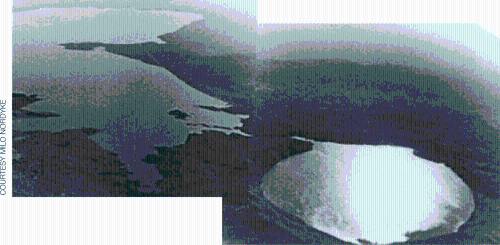
Composite of photos showing Chagan Lake as it was altered with a “peaceful nuclear explosion.” The round “Inner Reservoir” is the crater created by the blast.
The problem of the disposal and safe storage of chemical and nuclear liquid wastes has yet to be solved. But two decades ago, attempts were made to create underground reservoirs for the disposal of chemical wastes. In limestone, a nuclear charge does not produce a vitrified chamber; instead, it loosens or crumbles the surrounding material, increasing the amount of waste that could be pumped into the repository. This method was used in Russia to create reservoirs at two chemical plants, one near the town of Sterlitamak in 1976 and another near the town of Salavat in 1982.
Hazards
Every underground nuclear explosion produces radiological, geophysical, and geochemical processes that cannot be predicted in fine detail. An explosion has long-lasting effects on the hydro-logical system, the atmosphere, and the biosphere. Although mathematical models are used to predict the consequences of underground explosions, many effects are not predicted because our knowledge about multi-level natural changes is not extensive enough. There was little appropriate research regarding consequences before and during the PNE program. As a result, erroneous predictions were made. In fact, PNEs produced:
▪ widespread contamination in the depths and on the surface of the Earth (especially through the contamination of groundwater);
▪ air pollution;
▪ dangerous geological and geochemical processes (earthquakes, landslides, subsidences,); and
▪ disorders in the Earth's electromagnetic and geophysical fields.
In several cases, underground “peaceful nuclear explosions” spewed radioactive matter into the atmosphere and on the surface environment. In the worst case, in Central Siberia in 1978, workers received external doses that exceeded 8-15 rem (80-150 microSieverts), as well as equal internal doses of radioactivity. Efforts were made to decontaminate the topsoil, ground, and equipment. In the area of greatest contamination (an area of 0.45 square kilometers), the average external dose was equal to 30-50 micro-roentgens per hour.
Another accident, which took place in 1971, occurred 40 kilometers from the town of Kineshma–not far from Moscow. There, radioactive gases vented into the atmosphere. Today, the radiation near the crater is two to four times that of natural background.
Similar nuclear contamination occurred in 1971 during the blasts meant to create the channel between the Pechora and Kolva Rivers. For some time, the public was forbidden to approach the resulting trench, which was filled with contaminated earth.
In Perm, near the town of Osi, a project called “Grifon” was intended to increase the extraction from oil wells in older and less productive fields. Immediately after the explosion, the level of radioactivity seemed normal, but since 1976 the number of wells that produce radioactively contaminated fuel has increased. No experts have been able to explain the reasons for an unexpected and unpredictable distribution of radioactive contamination in the oil fields. Some have claimed that the workers in these fields suffer from more blood diseases and disorders of the immune system than similar workers elsewhere, but there is no way of knowing whether such a claim has any foundation.
Another kind of problem occurred in the condensed gas fields 35 kilometers north of Astrakhan. A series of PNEs were used to create 15 artificial underground reservoirs. There the contamination of groundwater appears to have led to the appearance of radioactively contaminated solvents on the surface. The radioactive background in many places is 30-40 micro-roentgens an hour. (Since the creation of the underground reservoirs, the ground under the gas processing plant has begun to shift.)
We can now say definitely that any underground nuclear explosion–regardless of its purpose–is potentially destructive. It disrupts the natural processes and threatens environmental sustainability. It will be many decades before the places where PNEs were conducted return to normal. Radioactively contaminated groundwater will remain a threat to sources of drinking water. Because geological processes are very lengthy and have long latent periods, it is extremely difficult to predict the future behavior of the regions where Soviet underground nuclear explosions took place.