




Abstract

The value of the Comprehensive Test Ban Treaty (CTBT) can best be measured by the opposition to it. For almost 40 years, nuclear weapon complexes have opposed a test ban with great intensity. A welcome and rare combination of factors finally led to the treaty's conclusion in 1996, but its implementation remains in doubt, held hostage to a uniquely pernicious entry-into-force requirement. Forty-four specified countries, including the United States, Russia, China, India, Pakistan, Israel, and North Korea, must deposit their instruments of ratification before the treaty can come into effect. Renewed efforts to implement the CTBT are needed–efforts that now hinge on an obscure treaty provision allowing for a special conference in the fall of this year.
Negotiating the treaty required unflagging commitment by two generations of anti-nuclear weapon activists. Only when the U.S. government followed their lead–in addition to the insistent efforts of non-nuclear weapon states–did the CTBT emerge from the relaxed negotiating rhythms of Geneva, where diplomats had been gathering to exercise their vocal chords on the subject of nuclear testing since October 1958.
At long last conditions became ripe for a treaty signing with the end of the Cold War and the advent of the Clinton administration. With the United States respecting a moratorium on nuclear testing, Britain was also precluded from carrying out nuclear detonations at the Nevada Test Site. Russia, beset by post-Cold War economic difficulties and the loss of its primary test site in Kazakhstan, was in no position to begin another test series.
Recognizing the prospect of a successful negotiation, the governments of France and China resumed nuclear tests, thereby creating even more momentum for the CTBT. French citizens discovered that continued testing in someone else's backyard was no longer politically sustainable. Beijing, caught in a bind between its own disarmament rhetoric and long-delayed strategic modernization plans, sharply curtailed its test program to conform to political imperatives. More momentum was provided by the Nuclear Non-Proliferation Treaty's (NPT) indefinite extension in 1995, when the five nuclear weapon states joined in a consensus commitment to conclude a CTBT within one year.
Nonetheless, the negotiating end-game at the Conference on Disarmament was brutally difficult. Caught in the same crucible as France and China but unable to pull the trigger on nuclear testing, India's political leaders reversed four decades of championing a test ban, suddenly conditioning Indian support for a treaty to commitments for a time-bound framework for nuclear disarmament. This gambit left India painfully isolated, but it also left the door ajar for a more risk-taking leadership in New Delhi to subsequently conduct nuclear tests.
Britain, Russia, and China adopted another indirect approach to dampen prospects for the CTBT's implementation: Unable to block a popular treaty, but unwilling to be bound formally by its provisions, they found refuge in a unique entry-into-force provision–the treaty could not take effect until all 44 states listed in a treaty annex deposited their instruments of ratification. The annex was drawn from states listed in the International Atomic Energy Agency's 1996 edition of Nuclear Power Reactors in the World as well as from the list of states participating in the CTBT negotiations. By this tortured device, all nuclear weapon states and most states of proliferation concern–but not Iraq and Libya–were to be captured.
No other treaty has required 44 specified countries to ratify before it entered into force. The widely heralded NPT, for instance, specified ratifications by only three named states–the United States, Great Britain, and the Soviet Union–along with 40 additional states. The Chemical Weapons Convention required ratification by 65 unspecified states.
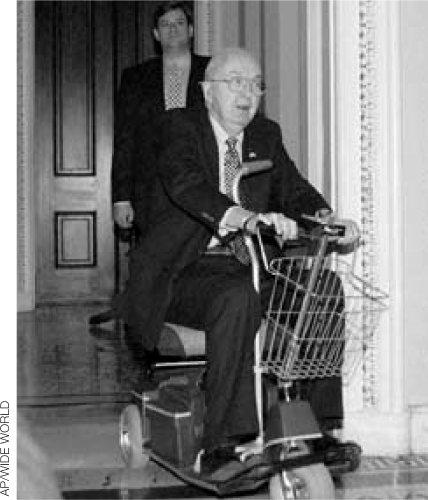
Jesse Helms, chairman of the Senate Foreign Relations Committee, may block the CTBT by insisting that the Senate should consider “all treaties”—including the September 1997 modifications to the ABM Treaty, and the environmental accord reached at Kyoto—at the same time.
The initiative to make the CTBT's entry-into-force provision 15 times more onerous than the NPT's began with Britain's Conservative government. Led by Prime Minister John Major, Britain insisted that the “threshold” nuclear states–then consisting of India, Pakistan, and Israel–be included in any treaty. This British initiative found immediate support from the two nuclear weapon states least ready to stop testing for all time–China and Russia. The Indian government immediately went on the warpath against this formula. To make the entry-into-force provision less “discriminatory,” the chairman of the test ban treaty negotiations, Amb. Jaap Ramaker of the Netherlands, broadened the formula, but to no avail: India remained a treaty holdout.
A too-long-delayed telephone call from President Bill Clinton to Prime Minister Major persuaded London to take a more flexible approach to entry into force. But by the time Clinton finally picked up the phone, time was running out to convince Russia and China, the two most reluctant–and most crucial–parties, to soften the entry-into-force provision. The text of the treaty, including its demanding requirement of 44 specified ratifications, was transmitted to the United Nations in time for approval by the U.N. General Assembly in the fall of 1996.
Before transmitting the text, however, Canada and other friends of the CTBT inserted another unique clause relating to entry into force. Under Article XIV of the treaty, a conference of ratifying states could be convened any time after September 1999. The purpose of that conference: to “consider and decide by consensus what measures consistent with international law may be undertaken to accelerate the ratification process in order to facilitate the early entry into force” of the CTBT. A simple majority of ratifying states is needed to convene the special conference.
The potential utility of a special conference to generate ratifications is evident. The powers of the special conference are intentionally vague but potentially far-reaching. All decisions require consensus, and each ratifying state has a veto over those decisions. If a state wishes to have a say in the outcome of the special conference, it must ratify the treaty to show up with voting and veto rights. Thus, the prospect of a special conference constitutes the nearest approximation to a CTBT ratification deadline for many key states.
As with the Chemical Weapons Convention, Washington and other capitals appear to need a ratification deadline in order to act. Indeed, President Clinton has made Senate ratification one of his “top priorities” for 1999. Meanwhile, the prime ministers of India and Pakistan have tied their ratifications to the prospect of a special conference; Israel, Russia, and China are also holding back, waiting to see what the U.S. Senate decides. In the case of the chemical weapons treaty, the Senate's positive action prompted ratifications by China and Russia in short order.
Champions of the CTBT must once again come to the aid of this essential treaty. States that have already ratified the treaty, including Japan, Germany, Great Britain, France, Brazil, and Sweden, now have the added responsibility of generating moments of decision in states that have fallen behind. They can begin to do so by declaring their intention to convene a special conference this fall.
Two venues are being considered for the special conference–Vienna and New York. Vienna is the home of the Comprehensive Test Ban Treaty Organization, the treaty's implementing body, which is awaiting its entry into force. Technical and administrative experts are already in place in Vienna, and they would naturally like to host the conference.
But the other option–New York–makes more sense. The history of the CTBT is interwoven with the U.N. General Assembly, which voted overwhelmingly in support of the CTBT's text and has monitored the treaty's halting evolution for four decades. Moreover, every CTBT signatory has a diplomatic mission in New York; the same cannot be said of Vienna. New York is also saturated by international media as well as non-governmental organizations. A special conference at the fall session of the U.N. General Assembly would become a meeting ground of political leaders; a conference held in Vienna could devolve to civil servants.
For the special conference to succeed in facilitating the CTBT's entry into force, it must be a large convocation of political leaders, NGOs, and the media. States that have already ratified the treaty must now lead the charge for a special conference to be held at the United Nations. Those who seek the CTBT's entry into force can then begin to plan on assembling in great numbers for the purpose of completing the unfinished business of Jawaharlal Nehru, Dwight D. Eisenhower, John F. Kennedy, and two generations of anti-nuclear activists.