




Abstract
Inside Terrorism By Bruce Hoffman, Victor Gollancz, 1998, 278 pages; $24.95
America's Achilles' Heel: Nuclear, Biological, and Chemical Terrorism and Covert Attack By Richard Falkenrath, Robert D. Newman, and Bradley A. Thayer, MIT Press, 1998, 350 pages; $22.50
The Bulletin clock has moved backwards a bit since the worst of the Cold War years, as the risks of nuclear armageddon have declined. But there is growing concern that the likelihood of the use of weapons of mass destruction may be increasing, especially if these weapons fall into the hands of non-state actors. How real are the risks? Are terrorists more interested in causing mass casualties than heretofore? If so, what can be done to reduce these risks?
Fiction has taken up these themes with gusto. Richard Preston's The Cobra Event and Tom Clancys Rainbow Six are two of the more successful novels that have helped fan the flames of concern. Preston's book can be credited with compelling the president and his cabinet to tackle the issue of biological terrorism head on. The non-fictional literature, however, has been sparse–until now. Although very different in style and focus, Inside Terrorism and America's Achilles' Heel offer a welcome dose of reality and clarity.
Hoffman's book provides a broad historical view of terrorism. Formerly at the Rand Corporation, and now a professor at St. Andrews University in Scotland, the author is a widely respected analyst of terrorist organizations, methods, and mindsets. His advice on countering terrorism is listened to by governments on both sides of the Atlantic. In this volume he has drawn together two decades of thinking about terrorism to illuminate key trends of continuing significance. The result is informative, insightful, and readable.
He begins with an historical review of the changing nature and function of terrorism. This is a reminder that terrorism did not start with the airliner skyjackings in the 1960s. He defines terrorism as “the deliberate creation and exploitation of fear through violence or the threat of violence in the pursuit of political change. … [It] is designed to create power where there is none and to consolidate power where there is very little.”
Hoffman then tracks the evolution of terrorism–its place in the anti-colonial movements of the post-World War II era, its internationalization in the 1960s, and its emergence on both the left and the right. He writes a particularly interesting chapter on the ability of terrorists to manipulate the media to shape public opinion and achieve political ends. He argues persuasively that terrorist tactics are shaped to a significant degree by organizational dynamics–the need to keep the group together and to survive. With an eye on public opinion and group coherence, terrorists have thus far largely refrained from killing enormous numbers of people because mass casualties could be counterproductive. In Brian Jenkins's famous quip, “Terrorists want a lot of people watching but not a lot of people dead,” so that the fear they generate can be reaped for political gain.

Especially alarming is the author's account of the dramatic rise in the number of terrorist organizations with a religious character. As he notes, these include not only well-known Islamic groups, but Jewish and Christian white supremacist groups, and cults such as Aum Shinrikyo. He argues that religious terrorists do not think about violence in the same way that groups motivated by more traditional political goals do. In the context of religious terror, “Violence is a sacramental act: a divine duty, commanded by religious text and communicated by clerical authorities.”
Apparently, many religious terrorists are ordered by their god or gods to accelerate the arrival of the apocalypse by generating mass casualties. Aum Shinrikyo and the Ramzi Yousef gang (bombers of the World Trade Center in New York) were both inspired by such a message. Of course, religiously inspired terrorists aren't the only ones with an interest in and the capacity to employ weapons of mass destruction. And many so-called “holy” terrorists may be uninterested in or dissuaded from killing innocents.
If there is anything dissatisfying in this treatise, it is the author's failure to explore where trends reach breakpoints and new factors emerge. Near the end of the book, he observes: “New adversaries, new motivations, and new rationales have emerged in recent years to challenge at least some of the conventional wisdom on both terrorists and terrorism. … In no area, perhaps, is [the] potential irrelevance of much [of the conventional wisdom] clearer, or the critical lacuna more apparent, than with regard to the potential use by terrorists of weapons of mass destruction.” Hoffman then takes a few pages to assess past terrorist interest in these weapons and concludes that we are on “a disquieting trajectory.” If the trajectory is new, then we need to clearly understand the breakpoints from past trends. If the conventional wisdom is suspect, what new wisdom should guide us?
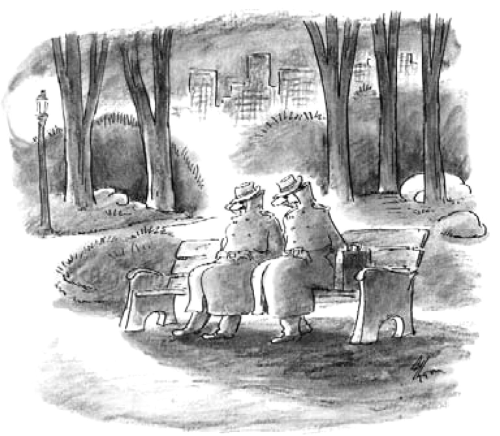
“I'm more of a scout than a spy.”
The volume by Falkenrath, Newman, and Thayer is an excellent complement to Hoffman's book. The authors are policy analysts at the Belfer Center for Science and International Affairs at Harvard University's Kennedy School of Government. They do not have Hoffman's decades-long experience in analyzing terrorism; instead, they are specialists on national security, with an eye on a new threat. As they helpfully remind us (and without a hint of irony), the view from Harvard does not always coincide with political reality in Washington. But as the lengthy list of acknowledgments indicates, they have drawn on the very latest thinking in both government and academe on terrorism with weapons of mass destruction.
One unfortunate result is that the book attempts to be too many things to too many different audiences. It is a compilation of all available thinking and writing on the subject and, accordingly, is loaded with footnotes and sidebars. But the authors have done remarkably well in writing a book that covers an enormous amount of terrain. The book is a primer on terrorism and asymmetric conflict; a comprehensive critique of all the salient arguments in the counter-terrorist policy debate; and an argument in its own right about societal vulnerabilities and about what is right and necessary to do to redress them.
Their view of terrorism has a harder edge than Hoffman's–they're more impressed by what has changed than by what hasn't. They make a good case that the old disincentives to terrorist use of weapons of mass destruction are diminishing at the same time that new incentives are emerging and capabilities to conduct attacks are improving. In fact, the authors see a multifaceted threat: They are concerned about separatist movements, the American militia, and religious extremists wanting to strike U.S. targets for purposes of righteous anger and revenge. They are also concerned about “amateur terrorists” (Hoffman's term) who are not connected to any particular organization but are empowered by technology and hatred to inflict mass casualties. And they are concerned about the covert use of weapons of mass destruction by individuals or groups sponsored by states with which the United States may find itself at war.
The threat is indeed as multifaceted as they suggest. But the decision to treat all its various aspects in a single line of argument adds greatly to the complexity of that argument.
The authors then tackle the policy question: What can the government do to counter the terrorist threat? Too often, it seems we are left with only two unpalatable options: bombing terrorists in their camps when we can find them, or managing the consequences of attack. They rightly argue that there is still much to be accomplished. They offer a 13-point agenda of recommendations that encompasses organizational changes to bring about better policy focus at the national level, and improved state and local competencies to cope with the consequences of attack. In their words: “It is not a tidy agenda. There are no simple, technical solutions to the national security threats posed by the potential for covert [nuclear, biological, or chemical] attack. … Reducing vulnerability to covert attack requires a very broad range of responses, as well as leadership and strategic coordination.”
The authors' most controversial recommendation relates to the military. They see the military as having been reluctant to defend the nation against terrorist threats, and ducking their responsibility by leaving counterterrorism in the hands of law enforcement officials. The military, however, has been less reluctant than uncertain about how best to contribute to what is obviously a mission that it alone cannot take on. Moreover, military leaders appear more concerned than the authors about the gut sense of most U.S. citizens that the military should keep its nose out of domestic matters. Whatever the context, the authors' specific recommendations are fairly innocuous: give the National Guard some responsibility in training and equipping local first-responders to help minimize casualties (a step already endorsed by the Defense Department).
Words of caution about the authors' policy agenda are, however, in order. First, as they note, their “recommendations omit not only unimportant policy areas, but also important ones that currently receive adequate attention from the U.S. government.” Their readers would have been well served by an overview of national strategy and the priorities that have already been assigned by policymakers. Without an overview, readers from outside the Beltway may not readily grasp the authors' sense of how to fine-tune the existing approach. Second, the recommendations are written at such a level of specificity that the passage of time inevitably deprives some of them of their currency. The federal government has spent a lot of time worrying about this problem over the last couple of years, and many details of arguments crafted in 1996 and 1997 have been overtaken by events. Still, their strategy is sound and it provides a valuable benchmark against which to measure the government's progress.
Any good Harvard policy study will set out a view of the problem and a set of recommendations. Count on Harvard scholars also to use descriptors like “vigorous, coherent, purposeful, balanced, and respectful of core American values” in setting out the requirements of effective policy. But this report stands apart from most studies by leavening its discussion of what to do with a discussion of how hard the government should try to do it.
Public policy is, after all, the art of applying constrained resources against a seemingly unconstrained problem set. Here the authors make a very good pitch–the United States should spend at least as much to prevent terrorist and covert delivery of weapons of mass destruction as it does to develop the means to prevent their delivery by ballistic missiles. Sage advice at a time of renewed debate about how best to keep the Bulletin's famed clock from moving closer to midnight.