




Abstract
There is no easy way to prevent small shipments of small arms.
A man, a child, and a gun: A settler from New Jericho takes time out from a visit to a museum in Tel Aviv.
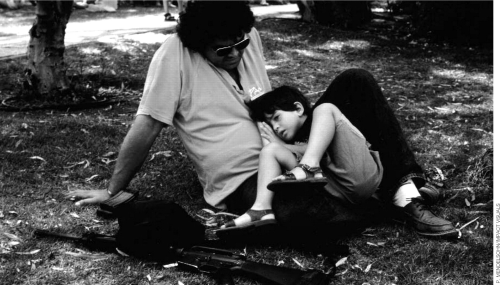
The year 1998 witnessed two events, modest in and of themselves, with little direct effect on global peace and security. Their importance, rather, lay in what they showed about the changing nature of the least conspicuous and most deadly aspect of the global arms trade.
First was the death on April 29 of Samuel Cummings, widely renowned as the most talented arms dealer of the second half of the twentieth century. For 50 years he had been the acknowledged master of the business of selling not just weapons but small arms in particular. With Cummings also died an era of business practices in which private firms traded large quantities of military equipment to whomever had the cash. Although Cummings was a private entrepreneur, his business served the interests of states. Almost all his biggest clients were governments. The other major clients were groups to which Western governments gave covert support.
Personally visible and accountable, Cummings apparently was scrupulously legal in his practices, as were virtually all successful arms dealers of his era; those who weren't ended up in jail. During his life, however, Cummings saw his role as an arms supplier marginalized as governments asserted progressively greater direct control over arms exports. Regulations and government sales practices designed to control and support sales of major weaponry eventually were extended to the trade in small arms. His niche was disappearing. In the end there was little left for legal, private dealers like Cummings to sell other than collectors' items to sportsmen.
The second modest event of 1998 was the 350th anniversary on October 24 of the Treaties of Westphalia. Those agreements ended Europe's Thirty Years' War, created the modern international system, and established the sovereign state–and by implication, the primacy of national interest.
Like Cummings's death, the anniversary of Westphalia also marks the end of an era, in this case the era of the sovereign state it formalized. While states obviously survive–we all live in one–they no longer dominate international politics as completely as they did for the past three centuries.
The trade in major conventional military equipment may remain essentially Westphalian. It is, after all, primarily a business between governments. But its salience has been replaced by the more unpredictable and dangerous trade in small arms–a trade that often views the state as an obstacle or adversary. In place of the legal sellers and official recipients that Cummings knew, we now have post-Cold War congeries of hustlers and partisans serving the demands of ethnic insurgencies, terrorists, and criminal conspiracies.
States do not often make war on one another these days; the riddle of postmodern arms control is how to arrest the growing strength of non-state threats to international security. While the orthodox state-to-state trade in major weaponry was fascinating in its complexity, it also is the image of straightforward simplicity compared to today's trade in small arms.
Old weapons, new buyers
The rise of ethnic insurgencies, terrorist organizations, and criminal conspiracies is not new. What has changed is their role in the international system. During the Cold War such groups could find large quantities of small arms only with the connivance of state sponsors. The rise of the Viet Minh in the 1950s and the Viet Cong in the 1960s would have been inconceivable without support from the Soviet Union and China channeled through North Vietnam.
Without the Reagan administration the Nicaraguan contras would not have existed. It was Libyan-supplied arms that enabled the Irish Republican Army to remain a fighting force in the 1980s, just as East Germany stocked the Red Army Faction. But with the end of the Cold War competition for global geopolitical advantage, there was nothing to be gained through such activities and they largely ceased.
The actors that took their place differed in being almost exclusively home grown and supported. Instead of relying on state sponsors, today's insurgents, terrorists, and criminals generate their own income and buy their own armaments. Unlike their predecessors they cannot be stopped by convincing a traditional sponsor to end their support.
Not only are today's most questionable arms buyers nongovernmental entities, but the strongest advocates of small arms control are nongovernmental organizations. NGOs have long contributed to arms control and disarmament, but their contributions were limited as long as states controlled the goals and the pace of the process and were guided exclusively by national interests.
As the grip of the state relaxes, as it has in recent years, other perspectives can gain consideration; today, NGOs can help shape the global agenda. NGOs, for instance, were responsible for the convention banning land mines, signed in 1997. In that case, more than a thousand groups joined the Landmines Campaign, led by Vietnam Veterans of America and Human Rights Watch, and they created enormous pressure within the disarmament community.
The convention emerged not because of the lobbying of any one government, but in reaction to NGO pressure. Turning the juggernaut of sentiment into a treaty required government action, of course, and the personal support of officials like Canadian Foreign Minister Lloyd Axworthy was instrumental. But with no major national interests at stake, most governments found it easiest to get out of the way and give the NGOs their treaty.
One of the most impressive aspects of the land mine campaign was the way national interests were submerged and practically ignored. When they were allowed to speak out, the armed forces of various nations often expressed serious reservations about the effects of the convention relative to their country's national interest.
Many authorities tried to reconcile the convention with national interests, but their efforts were not persuasive. They also were beside the point. The few governments to buck the international consensus were apologetic exceptions. Instead of being based on the specific interests of sovereign states–like all arms control and disarmament treaties before, from the Washington Naval Treaty to START II–the land mines convention reflects judgments on collective international security and fundamental human rights.
Small arms have been placed on the international agenda in much the same fashion by many of the same groups. But so far they have been unable to develop a global consensus on the issue equal to that against land mines. Unable to mount pressure against states, they must work with them. Much has been done to persuade governments that small arms control is in their national interest.
With strong governmental interest in controlling organized crime in particular, this has led to a series of U.N.-sponsored meetings and encouraged considerable regulatory reform. (See “The U.N. Gears Up,” page 58.) But more aggressive action has not been quick in coming. The Oslo conference on small arms last July acknowledged the importance of the issue but also testified to the great difficulty of building a consensus to do anything about it; the official delegations lacked consensus even on why they were there.
The NGOs have the strength to put small arms on the international agenda and keep it there, but they cannot resolve the problem. Unlike land mines, small arms still arouse a strong sense of national interest that states will not let go of. States may not fully control the trade in small arms any more, but their consent and active participation are required to deal with the issue.
Different challenges, different responses
There are three distinct small arms phenomena that require solutions: state-controlled or state-sponsored conflict; large-scale small arms procurement by non-state actors; and small-scale procurement by groups and individuals. Contrary to the common wisdom regarding the virtual impossibility of resolving any aspect of ethnic conflict or any other aspect of post-modern chaos, the first and second of these have solutions, which, if not simple, at least lie within the realm of feasibility.
The easiest small arms problems to address are those where all protagonists in the fighting–in the tradition of Westphalia and Sam Cummings–are states or rely on government sponsorship. To be sure, none of the leading powers responsible for Cold War-era sponsorship of insurgencies or terrorism–China, the Soviet Union, and the United States under the Reagan Doctrine–continue to do much.
State sponsorship survives instead among regional rivals, who have discovered that support for guerrilla fighters is an affordable and less risky way to challenge their neighbors or to advance their own global goals. One of the biggest geostrategic surprises of the post-Cold War world has been the emergence of Uganda as a Central African superpower, supporting insurgencies in Rwanda, Congo, and Sudan.
Libya has played an equally decisive role in Liberia and other West African conflicts. Pakistan supports–or turns a blind eye to private support for–Kashmiri separatists. Outside powers often are involved in these situations–Washington, for example, tolerated the arming of Bosnia by Iran in 1994-95 and it supports Uganda today. Nevertheless, the role of state sponsors is increasingly marginal.
Where state sponsorship does serve as the principle conduit for arms, traditional diplomacy can be fully effective. Because small arms flow from a supplier state to a recipient government (which is responsible for their final delivery to the insurgents who will actually use them), formal licensing controls and end-use restrictions can be used if suppliers insist.
Controlling large illegal transfers of small arms poses a more difficult problem, caused by the decline of governmental authority. The most important sources of large illegal transfers are Russia, the other ex-Soviet states, and the former Warsaw Pact nations. The problem is not lack of laws; the rub is in the enforcement. Many of these governments are not strong enough to see to it that laws are followed. Often internecine disputes over the national interest lead one agency to approve what another would prefer to halt. If this is not the case, corruption makes it possible to bribe a deal through.
When weak governments are unable or unwilling to enforce arms export restrictions, other governments must help the appropriate official institutions develop the attitude and means to ensure that the law is carried out, in letter and in spirit. This problem is not confined to small arms exports; it is chronic in exports of all forms of defense technology, from handguns to biological warfare expertise, from fissile materials to ballistic missile assistance. Dealing with this aspect of the small arms problem is no different diplomatically from the better publicized export problems. The key is making sure the small arms aspect receives the attention it deserves.
The limits of arms control
The potential for stricter regulation is great, but it also can be exaggerated. Although it may stop activities in one country, all too often the activities can be moved elsewhere. The manufacturing technology for today's small arms dates directly from the 1880s; there is no form of modern arms production that is easier to transfer. Virtually all designs for automatic weapons, moreover, are 40 to 50 years old; patents have long since expired and fallen into the public domain. You do not have to be an expert to see the difference between an AK-47 built in a Soviet factory in the 1950s and one crafted yesterday in a garage workshop in Pakistan, but they are equally deadly.
Who's involved?
So you want to fight the proliferation of small arms? The cyber meetinghouse for the Global Campaign on Small Arms and Light Weapons is at <www.prepcom.org>.
The site was started a year ago with Ed Laurance, an expert on small arms and light weapons issues, as the administrator. It was, in his words, “a place where the members [of Prep Com] could meet, exchange ideas, and access a growing body of information on the spread and misuse of small arms and light weapons.” As of early December, 114 NGOs and 45 individuals had become members.
Based at the Monterey Institute of International Studies in California, the site contains more than a hundred documents ranging from official reports to summaries of meetings. More important, perhaps, it provides email addresses, which are essential for today's networking.
Confronted with aging technology, the established system of export licensing controls will become increasingly irrelevant. They only restrain the exports of those who have an interest in compliance–basically major manufacturers and dealers with large home markets to preserve. These controls pose no deterrent to the rise of small, globally dispersed makers and traders. Indeed, even countries virtually bereft of modern industry already have facilities building small arms or making ammunition. There are plenty of fly-by-night outfits, and their products are lethal.
If it is to alleviate human suffering, control over small arms must deal with the most dangerous forms of the trade, the trade between non-governmental actors. This turns an arms control problem into a law enforcement issue. The small arms issue is not about governments, armed forces, and manufacturers so much as it is about violent groups and individuals taking the law into their own hands. Outfits like the U.S. Defense Department's On-Site Inspection Agency lack the expertise to deal with small arms. This is the province of police and gendarmeries, customs officials and the courts. Controlling the problem requires greater attention to strengthening agencies of the state, a fact that makes civil libertarians wary.
How effective can controls over the illegal trade in small arms be? Experience has shown that it is relatively straightforward to identify and intercept large shipments–those involving several hundred weapons and weighing several tons–if law enforcement officials are alert. What existing arrangements cannot accomplish–even if better supported and attuned–is to significantly reduce smaller shipments of small arms.
Indeed, small transfers of small arms inspire the extremes of human determination and creativity; they will never be intercepted except at enormous effort, and even this will foster only more vigorous and harder smuggling efforts. Law enforcement's job is to keep them to a minimum, but there is no serious prospect of dealing with highly organized violence this way.
Further, once we begin to concern ourselves with each and every gun, civil liberties issues also become an important consideration. Some restrictions on light arms, such as laws restricting the number of guns that can be bought over a set period of time, are relatively uncontroversial, except among the most extreme of gun partisans. And Britain has recently shown that it is possible to ban possession of handguns altogether. But few other so-cieties–not just the United States–are prepared to do the same.
This raises the possibility of a clash between civil liberties and disarmament. As long as individuals can own and buy rifles and ammunition, it will not be possible to prevent the arming of individual terrorists, criminals, and guerrillas. Where security bumps against civil liberties, we reach an irreducible conflict of principles beyond which all must tread with great caution.
Beyond arms control
If we continue to treat small arms as a government-to-government issue we will produce more arms control agreements, but these will be agreements fundamentally irrelevant to the most serious dangers to global security posed by small arms.
Agreements like the new Convention Against the Illicit Manufacturing and Trafficking in Firearms agreed to by the Organization of American States in 1997 may be state-of the-art in small-arms control, but they are far behind the times compared to other arms control agreements. The OAS Convention is to small arms what the 1972 Strategic Arms Limitation Treaty was to nuclear arms: It codifies established practices and keeps one aspect of the armaments process from getting worse, while allowing the most serious dimensions of the problem to deteriorate further.
The analogy to strategic arms control only goes so far; small arms are not the same as nuclear weapons, no more than insurgencies are the equal of governments. As the Cold War ended and relations between Washington and Moscow improved, arms control eventually led to tangible nuclear disarmament agreements. No improvement in government-to-government relations will lead to better agreements on small arms proliferation. Ultimately this requires revolutionary steps in arms control, bringing in non-state actors.
The greatest success in disarming such groups has come through U.N.-brokered peace agreements, such as those in Central America and Mozambique. In these cases, though, arms are surrendered only after the conflict is resolved. Even then it is universally acknowledged that combatants secretly hold on to their best gear. Small-arms disarmament alone cannot bring about peace. As Northern Ireland suggests, the political pressures aroused by demanding disarmament too early can