




Abstract
The money to buy weapons often comes from the sale of drugs.
Organized crime is frequently involved in more than one stage of an arms transaction. Gangs may be the initial suppliers of weapons obtained through theft or diversion; they may serve as traffickers or middlemen; and they also may be customers or end users. The variety of roles they play should not be surprising: For organized crime, armaments are both commodities and tools of the trade.
The black market in arms also involves a wide range of participants who do not necessarily think of themselves as criminal: governments and intelligence agencies, entrepreneurial arms dealers and middlemen, and rebel factions or ethnic groups attempting to compete in national power struggles.
The major Italian Mafia groups–La Cosa Nostra, the Neopolitan Camorra, and the Calabrian ‘Ndrangheta–have long trafficked in a wide variety of items ranging from cigarettes to heroin. In April 1998 nearly 200 members of these organizations were arrested for trafficking in drugs and arms. In an interview before his murder in 1992, Italian magistrate Giovanni Falcone described the Syrian government's involvement with the Sicilian Mafia. According to Falcone, much of the profit in drug trafficking was used by the Mafia to purchase arms, most of which were subsequently exported through the Syrian connection to various Arab countries. 1
Globalization has facilitated the traffic in arms, which is linked in complex and inextricable ways to the increase in transnational organized crime, the surge in ethnic strife, and the breakdown of authority.
A “Mafia in uniform”
Russian criminal organizations are heavily involved in the arms market, as is the Russian military. In Russia, two separate but overlapping processes seem to have fused in ways that have greatly stimulated the illegal arms trade. The first is the massive growth of organized crime, fueled by hyperinflation and unemployment and facilitated by the longstanding link between criminals and corrupt officials and politicians.
The second process is the criminalization of millions of members of the armed forces, who have suffered a severe decline in status. The members of the Russian military receive their wages months late and work under appalling conditions. As a result, the military has become what Graham Turbiville calls a “Mafia in uniform.” 2
For self-preservation on the one hand or unmitigated greed on the other, all ranks of the armed services are engaged in their own entrepreneurial activities. Privates have sold their rifles to local criminals; high-ranking officers have sold much more significant equipment to foreign governments.
Extensive corruption–combined with a partial transition to a capitalist economy–has resulted in the de facto privatization of Russia's military equipment. And the growth of organized crime and the criminalization of the Russian military have merged in ways that make combating the flow of stolen arms extremely difficult.
The outflow of Russian weapons seems to be increasing. Itar-Tass reported last May that in the first three months of 1998, 465 illegal arms dealers were arrested, and approximately 1,500 weapons, 170,000 cartridges, 30 kilograms of explosives, and 147 bombs were confiscated. One operation not only prevented the selling of Grad rockets to Abkhazia, but also resulted in the confiscation of 180 rockets with 18 tons of explosives.
Arrests are the exception rather than the rule. In the summer and fall of 1998, the Russian economic crisis precipitated a further hemorrhaging of Russian military weapons. According to one report, between September 22 and 28 more than 17,000 rounds of ammunition, several thousand stun grenades, six grenade launcher rounds, and 10 grenades were stolen from a Pacific Fleet ammunition dump. 3 In October it was reported that customs officials in the far eastern city of Khasan had blocked an attempt to sell five assault/transport helicopters to North Korea. 4
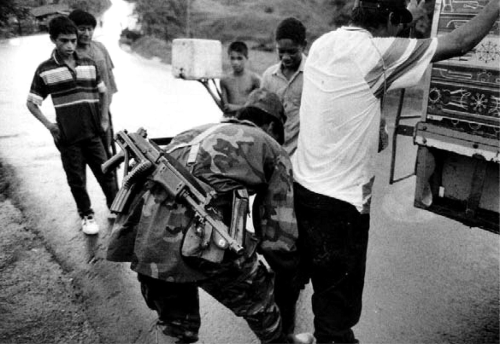
Colombian soldier searches for guns and drugs at a rural roadblock.
Movement toward the formal commercialization of the Russian military–something along the lines of China's People's Liberation Army–is taking place. But whether the process is formalized and legitimized or continues clandestinely, the exodus of arms is likely to continue. Consider the weapons that Russian gangs deploy: Four criminals arrested in Tambov had 17 assault rifles, an assault rifle with an under-the-barrel grenade launcher, 11 other grenade launchers, five grenades, 13 pistols, an industrial explosive device, and more than 800 cartridges of ammunition. 5
Illegal guns are also being shipped into Russia. One of the most bizarre incidents involved several officials of the Russian embassy in Finland. Acting on information received in August 1996, the Moscow Regional Directorate for Combating Organized Crime identified eight former and current embassy employees, including the first secretary, who had bought more than 200 firearms and more than 5,000 rounds of ammunition in Helsinki and smuggled them into Russia using diplomatic immunity to proceed unhindered through customs controls. 6
South of the border
Russia is not the only simultaneous market for and supplier of weapons. The United States, for example, is often the destination for smuggled weapons, but it is also the source of most of Mexico's illegal firearms. While some guns are smuggled into Mexico via the same routes–and by the same organizations–that smuggle drugs into the United States, other weapons are carried into Mexico by individual gun dealers.
Whatever their source, however, the increasing availability of weapons has contributed significantly to the growing violence of Mexico's drug traffickers. Some observers consider the influx of weapons part of the “Colombianization of Mexico”–but Mexico still has some way to go to match Colombia's estimated one million guns legally held by private citizens and another five million illegal ones.
In one respect, however, the two countries are very similar: Not only are weapons proliferating, but potential customers are also proliferating. As in many other countries, consumers of illegal weapons include criminal organizations and drug traffickers, insurgent and paramilitary groups, ethnic movements, terrorist organizations, and private security organizations.
A form of currency
The money to buy weapons often comes from drug sales. The Tamil Tigers, for example, trafficked in drugs to fund their separatist struggle in Sri Lanka. In the conflicts in the Balkans in the early and mid-1990s, there were frequent reports of drugs-for-arms swaps. In South Africa, the widespread availability of illegal weapons obtained from the surpluses built up during the political struggle over apartheid and the endemic insurgencies in southern Africa have contributed significantly to one of the world's highest rates of violent crime, which has cast a significant shadow over the prospects for stability, security, and prosperity in the postapartheid era. Weapons have become a virtual currency, bartered for other illicit commodities such as drugs.
Guns also facilitate other crimes–carjackings and armed robberies, for instance, which have become frequent occurrences: The South African Police Service reported 13,011 vehicle hijackings in 1997. During the first six months of 1998 there were 7,073 cases, for a 10.6 percent increase. The September 1998 quarterly crime report concluded that “the circulation of illegal firearms in South Africa … has to have a direct influence on the increasing trend of vehicle hijackings and violent crime in general.”
The globalization of banking
Offshore financial centers and bank secrecy jurisdictions can ease the financial side of black market transactions. Switzerland is not as attractive as in the past, but Swiss banks were used in the “Battaglia case,” which involved illegal arms supplied to Bosnia and Iraq. Switzerland has moved to clean up its banking system, but other jurisdictions have filled the gap. The global financial system offers multiple opportunities for rapid and anonymous fund transfers, for the creation of front companies to be used as a cover for illicit arms deals, and as a haven for the proceeds of crime and shady dealings, as bankers seek deposits irrespective of their source.
In large parts of the Caribbean, one of the main concentrations of offshore financial jurisdictions, there is little effort to implement due-diligence or know-your-customer rules, even if these rules are nominally in effect. Jurisdictions usually do not want to earn a reputation for being so dirty that they frighten off “clean money” (tax-evasion dollars, for instance). But within this broad constraint they have no compunction about the inflow of the profits from drug traffickers or gun merchants. A decade after the collapse of BCCI (the Bank of Commerce and Credit International), which was used by drug traffickers, arms merchants, intelligence organizations, and money launderers, the offshore financial world remains an important facilitator of criminal activity.
The black market in arms has to be seen as one of a range of criminal markets that have been facilitated by globalization, the vast growth of international trade, and the development of a truly global financial system. The real driving factors, however, are ethnic and regional conflict, the growth of lawlessness, and the rise of criminality in states with limited capacities for effective governance. Until these underlying dynamics are dealt with and criminal synergies significantly reduced, the prospect for making a major dent in the black market in armaments is negligible.
Footnotes
1.
Rachel Ehrenfeld, “The Sicilian,” New Republic, June 29, 1992, p. 14.
2.
Graham H. Turbiville, “Organized Crime and the Russian Armed Forces,” Transnational Organized Crime, vol. 1, no. 4 (Winter 1995), pp. 57-104.

4.
Ibid.
5.
Natalya Galushkina, “Investigation: What Do You Want, a Pistol or a Grenade Launcher?,” Rabochaya Tribuna, March 7, 1998, pp. 1-2.
6.
Ibid.