




Abstract

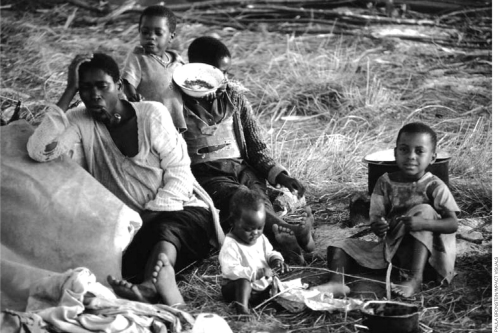
Rwandan refugees at the Banako camp in Tanzania.
Inestled into my side corner seat in the cockpit, comfortably assured that I was not far from the evidence of illicit weapons in the back of the aircraft. As the plane–an old Britannia, a precursor to the modern jet–took off from the lakeside town of Kalemie in eastern Zaire, the French-speaking co-pilot and the British engineer were confident that our Belgian captain would safely navigate the short runway. I was an investigator on my way to a weapons depot near Kinshasa.
In a few minutes, the sole African member of the crew burst into the cockpit, a hazy, faint blue cloud of gas trailing him. He immediately locked the cabin door against the African “freeloaders” riding in the back, and stood pressed against it. He glanced at the pilot, who had sweat pouring off him. The engineer was already grabbing to see which of the oxygen masks were working. There were three for us to share. The plane made a sweeping right hand turn over the lake and headed back for a perilous landing.
The sounds of the passengers beating their hands against the cockpit door grew fainter. Straining for breath after inhaling my share of oxygen in the front, I was not even conscious of landing. I was hurled out the nose door and urged to head toward the beach.
Later, as we ate fresh fish grilled in the sand by the lake, the pilot blustered that instead of arms we had picked up canisters of toxic chloride (probably meant to be “dumped” in Kinshasa) that had released a poisonous gas once the air pressure dropped. No thought was given to those who perished in the back of the aircraft.
The gun runners
Arms traffickers working in the heart of Africa are renegades who may have cut their teeth in Vietnam, Afghanistan, or Angola. Or they may have been involved in their governments' clandestine Cold War activities, or in South Africa's apartheid government's destabilizing operations in southern Africa.
But when governments end their covert operations, the cargo companies, planes, and infrastructure of “front” companies are handed over lock, stock, and barrel to their operators. To these men (mainly Westerners, but not all; some are former Soviet agents), nothing can compete with the adrenaline fix of flying secret missions to rebels or pariah governments–except, perhaps, boasting and swapping war stories at the local bars. Then, too, their illicit enterprises are far more lucrative than legal employment in the commercial sector.
Over the past few years tracking arms networks, I spent a bit of time with the crew of the old Britannia aircraft. They often collected weapons from the former Soviet Union and Eastern Europe, trans-shipped them through airports like Ostende in Belgium or Burgas in Bulgaria, filed false flight plans to Cairo, Kinshasa, or Lagos, and “secretly” delivered their lethal cargoes to UNITA rebels in Angola and the Hutu perpetrators of the Rwandan genocide based in eastern Congo.
They carried with them maps and diagrams of various clandestine airfields and depended on their well-greased relations with rogue officials to ensure the secure off-loading of their merchandise. False manifests described their cargo as “farm machinery,” but they were rarely, if ever, subject to cargo inspections. Normally, traffickers are caught only if they fail to pay an expected bribe, if a fired or disgruntled crew member snitches, or if a plane crash exposes the weapons concealed in the hold.
Circuitous air routes, forged export licenses and bills of lading, and fictitious end-user certificates to show to unsuspecting officials are all standard. Even humanitarian organizations can be trapped, not always unwittingly, into ferrying weapons into conflict-riddled zones. Planes under the supervision of the World Food Program, the U.N. High Commission on Refugees, and nongovernmental relief organizations like Oxfam have been commandeered. Chinese arms industries' weapons shipments–labeled “farm implements”–are carried on the same Chinese ships that bring beans and tools to needy Great Lakes refugees.
Supplying the battle
Nowhere have these profiteers wreaked more havoc or caused more bloodshed than in the Great Lakes region of east/central Africa. After four years of the uncontrolled flow of small arms into Rwanda, Burundi, Uganda, the Democratic Republic of Congo (formerly Zaire), and Tanzania, more than 1.5 million people, mostly civilians, have been killed, and another six million have fled their homes. More than a hundred people continue to be killed each week in military or ethnic cleansing operations. Women and children have borne the brunt of army mutinies, ethnic slaughter, low-intensity conflict, and civil war. The number of human rights, relief, and development workers who die–whether from the indiscriminate exploding land mine or the targeted gunshot–is also rising.
The civil war continues in both Rwanda and Burundi. The liberation war of 1996-97 in Zaire ousted the military dictator Mobutu, but the renamed Democratic Republic of Congo (DRC) is engaged in warfare involving nearly a dozen African armies. At least four rebel groups are tearing apart the social fabric of Uganda, and western Tanzania has been destabilized by insurgents from Rwanda, Burundi, and the DRC. Violent local conflicts continue as well.
Then, too, there is in Central Africa a new generation of extremist military leaders, warlords, and strong men. Logic dictates that those who can provide arms or security rise more quickly to the top. More moderate political leaders have been forced to pursue the military option just to keep up.
Yet little attention is paid to how weapon suppliers fan the flames of the region's conflicts. It is much easier to blame ancient tribal hatreds or spontaneous bursts of the primordial propensity for bloodletting.
Looking the other way
One gun runner, “K,” was a Cold Warrior during the days when the U.S. embassy in Zaire was America's third largest. When I caught up with him for lunch at the American Cafe in Kinshasa, he was wearing a black patch over his eye and acting the part of the cool operator. He graphically detailed how he tried to use stolen travelers' checks to finance an arms delivery to the former Rwandan government army.
He had no qualms about violating an international arms embargo, nor did he care that his clients were accused of perpetrating the Rwandan genocide. Later, when the U.N. International Commission of Inquiry repeatedly asked the U.S. embassies in Zaire and Kenya for information on K's whereabouts, the embassies declined to cooperate, citing laws protecting the privacy of U.S. citizens. It also didn't hurt that K had been part of the former U.S. covert operation in support of Angola's UNITA rebels.
The United States is only one of the distant governments that wink at the arms traffic, particularly if it serves their own geopolitical games or balances out the political playing field. U.S. officials call the pursuit of the military agenda the “African solution to African problems.”
Traffickers give foreign governments plausible deniability. Neither France nor the United States wants to be caught red-handed providing direct military aid to client regimes or allies like Burundi, who have committed egregious human rights abuses, or to countries known to have invaded their neighbors, like Uganda and Rwanda.
But drawing the line between covert operations and black marketeering can be tricky. U.S. law enforcement officials were told to look the other way when their investigation of arms networks to the Great Lakes genocidaires overlapped with the activities of “protected” suppliers of the U.S.-sponsored, predominantly Christian-oriented Sudanese People's Liberation Army, which is fighting against the Islamic regime in Khartoum.
The culpability of foreign governments is threefold: they may directly authorize the covert supply of weapons and ammunition or their trans-shipment across their borders (acts of commission); they may turn a blind eye to their nationals who are engaged in illegal arms smuggling, military training, and mercenary activity (acts of omission); or they may be lax in striking against illegality and corruption (neglect). In the Great Lakes region, not a single foreign gunrunner that I have come across has been imprisoned for violating international or local laws, international humanitarian law, arms embargoes, or regional sanctions.
A U.S.-sponsored “evangelical missionary couple” flew military guns supplied by right-wing Americans and South Africans to the “anti-Communist” RENAMO rebels in Mozambique as late as 1994. I recently bumped into them in the Burundian capital of Bujumbura where, under cover of running a Christian medical clinic, they were giving military assistance to their ostensible religious believers. The sponsoring organization receives funds from the U.S. government development agency, USAID.
Foreign governments feed the myth that the region is so awash with weapons that no deterrent, monitoring, or enforcement effort is worth the trouble. But there is very little local production of small arms in Africa. Egypt and South Africa are the only significant weapons exporters–although there are some ammunition, land mine, and gun-assembly plants in Tanzania, Uganda, and Kenya.
It is the five permanent members of the U.N. Security Council who are facilitating most of the arms transfers into the Great Lakes region. Weapons stocks and other military equipment come predominantly from Russia, Eastern and Western Europe, China, South Africa, Egypt, North Korea, Israel, and Iran.
Thanks to privatization and the new global order, competition is robust, so small arms are cheap–a plus given the prevailing poverty in Africa. Cash is not required; guns can be bartered for stocks of coffee and tea, gemstones, gold, minerals, and crop futures.
To fatten their profit margins, arms traffickers may simultaneously smuggle toxic wastes, endangered species, drugs, fuel, even used clothing, cigarettes, and beer. The illicit trade goes hand in hand with mercenary outfits. Arms brokers can usually supply military advisers, trainers, soldiers, and security guards to just about any paying client.
Government investigators often cannot keep abreast of the smugglers because they simply move shop once they are scrutinized. Since I've known them, the company hiring the Britannia traffickers shifted several times, first from Kinshasa to Ostende in 1996, when trafficking became dangerous; and then again from Ostende to Britain in 1997, after the Belgian operations became notorious. Today the business is conducted from another continent altogether.
Because there are very few rules governing foreign business operations, large multilateral business firms do not even hide their support for military activities. When I was recently in Bujumbura, the Australian manager of a U.S.-and South Africa-based firm explained that his company supported the Congo rebellion because the new president, Laurent Kabila, had torn up a favorable mining concession agreement.
The deadly consequences
For the nongovernmental community, tracking arms suppliers has a variety of pitfalls: the ethical dilemma of working “under cover”; hanging out with the bad guys in seedy places rather than empathizing with victims; the physical danger of traveling within a conflict zone; the peril of exposing international crime rings; the costliness of lawsuits filed by arms networks with big money; and the alienation felt from policy-makers and government officials who might consider any disclosure controversial at best, incriminating at worst. Collecting prosecutable evidence is difficult, particularly because the black marketeers leave false paper trails.
Governments have little appetite for tackling the illicit arms trade to East/Central Africa largely because of its commercial benefit or use as a foreign policy instrument. Traffickers and government-sponsored operators know that the “intrigue” of their trade and the heightened sensitivity to the murkiness of their missions prevents researchers from following their trails. It is critical therefore to “demystify” the problem of weapons flows by illustrating that they can be traced.
Everywhere now in Central Africa groups of citizens want arms. One rural village leader told me, “If you give us guns, everyone from the village will join in a rebellion.” But other civilians seek arms as their only hope for survival. It is hard to imagine a darker scenario or a graver situation.
It is also hard to point to any place on the world map that is more volatile than the heart of Africa, the one region where outside observers believe genocide may rear its ugly head again. As long as there is no international attention paid to arresting arms suppliers or traffickers, peace negotiations and conflict resolution efforts will be rendered meaningless.
In the meantime, foreign governments continue policies of military adventurism and the arms profiteers are lured by the thrill of the war frontier in the Great Lakes region–both with the deadliest of consequences for Africa's innocents.