




Abstract
The United States leads the world in weapon sales and giveaways.
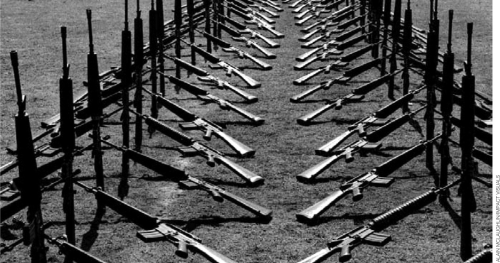
M-16s from El Salvador's Atlacatl Battalion–the U.S.-trained unit that massacred 800 civilians at El Mozote and murdered six Jesuit priests in San Salvador in 1989. The United States supplied El Salvador with 33,000 M-16s during the Reagan-Bush years.
Madeleine Albright does not like “the uncontrolled flow of arms, ammunition, and explosives into tense areas of the world.” Twice recently–in September before a special U.N. Security Council session on Africa, and in November at a gathering of the International Rescue Committee–the U.S. secretary of state assailed the “unregulated and illegitimate sale” of small arms. (Excerpts from her November speech are on pages 30-31.)
Secretary Albright's speeches may signify that U.S. policy is moving from a focus solely on crime-related illicit firearms trafficking to a concern about weapons shipments–whether legal or not–into “zones of conflict.” “This dirty business,” as she labeled it in her Security Council speech, “fuels conflict, fortifies extremism, and destabilizes entire regions. All of us whose nations sell such weapons, or through whose nations the traffic flows, bear some responsibility for turning a blind eye to the destruction they cause. And all of us have it in our power to do something in response.”
One can only hope that the administration's new-found concern about arms flows to unstable regions will extend beyond Central Africa–the focus of Albright's Security Council presentation. In her November speech, the secretary mentioned recent arms purchases in Afghanistan and Angola, as well as by actors in the Great Lakes region of Central Africa, as representative of the kinds of small arms sales that the administration finds problematic.
But after a genocide in Rwanda, chronic massacres in Burundi, and multinationally backed civil warfare in Congo, cutting off the arms supply is a bit of a no-brainer. Similarly, the logic of curbing the flow of weapons to extremist religious militants in Afghanistan and to obstructionist UNITA forces in Angola is unassailable.
Of course, the United States used to be a major patron of warring factions in all three places, which points to the biggest problem with the administration's policy–its practice of reacting to crises rather than thinking about the future impact of the weapons it is transferring. Embargoes are always levied after a war (or after an objectionable coup has occurred), but infantry weapons have extremely long lives. They usually outlive their original purpose and the government to which they were sent.
Transfers and transparency
There are four principle mechanisms for exporting small arms and light weapons: government-negotiated sales of newly manufactured arms, known as “Foreign Military Sales” or FMS; free or low-cost transfers of surplus U.S. military arms; sales negotiated directly by the arms manufacturer or a middleman; and government-run clandestine shipments. (Illegal exports, not covered here, are a fifth method.)
With the exception of covert arms-supply operations, the U.S. government openly reports its small arms shipments and license approvals. (All governments–all of them democracies–now expressing concern over the humanitarian impact of small arms proliferation should begin by providing similar information about their arms exports.)
Gifts that keep on killing∗
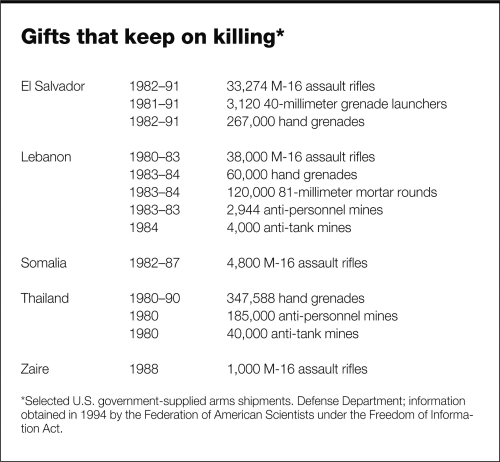
Selected U.S. government-supplied arms shipments. Defense Department; information obtained in 1994 by the Federation of American Scientists under the Freedom of Information Act.
If a deal will exceed $14 million–the threshold for congressional notification–transparency begins even before a U.S. government-negotiated contract is signed or an export license is granted. But small arms are relatively cheap, so only a few recent deals have been large enough to result in congressional pre-notification. In July 1997, for example, the Pentagon told Congress it planned to sell the Thai military 37,500 FN M-16A2 assault rifles, 4,700 M-4 carbines, 2,600 M203 grenade launchers, and spare parts and ammunition worth some $40 million.
Using the Freedom of Information Act it is possible to request and obtain data on past U.S. small arms supply. In addition, a law enacted in 1996 requires the Pentagon to make public an annual report to Congress detailing all FMS deliveries by country and weapon system during the preceding year. This report, known as the “Section 655” report, also includes a listing of the excess military equipment given away to each country. Since 1995, the Pentagon has given away more than 300,000 rifles, pistols, machine guns, and grenade launchers, including:
▪ 158,000 M-16A1 assault rifles (principally to Bosnia, Israel, and the Philippines).
▪ 124,815 M-14 rifles (principally to the Baltics and Taiwan).
▪ 26,780 pistols (principally to the Philippines, Morocco, Chile, and Bahrain).
▪ 1,740 machine guns (principally to Morocco and Bosnia).
▪ 10,570 grenade launchers (principally to Bahrain, Egypt, Greece, Israel, and Morocco).
Although U.S. giveaways are substantial, the vast majority of small arms are exported from the United States through direct commercial sales negotiated between U.S. companies or brokers and foreign buyers. The foreign customer may be a government entity (an interior ministry, justice ministry, ministry of defense, or national police), a corporation or person using the weapons for private security, or a gun vendor. Depending on the type of equipment, these sales are approved by either the State Department's Office of Defense Trade Controls or the Commerce Department's Bureau of Export Administration.
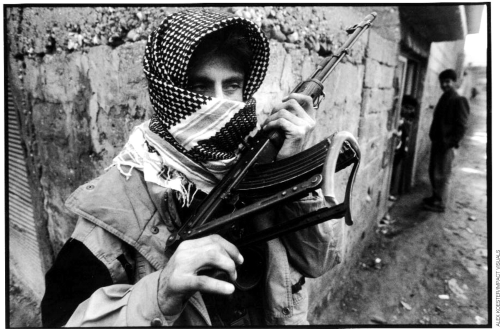
A Kurdish guerrilla on patrol in Cisre, Turkey.
The Section 655 report makes it possible to tally the vast quantities of small arms, light weaponry, and ammunition that the State Department clears for export. The report for 1996 lists in great specificity $470 million worth of small arms and ammunition that the State Department authorized manufacturers to export directly to foreign countries.
According to annual reports for 1995 and 1996, for instance, the Commerce Department approved 1,301 licenses to export shotguns, valued at more than $75 million in 1995 and $67 million in 1996. Taken together, these figures represent potential foreign sales of approximately 700,000 12-gauge shotguns.
Because other governments are not open about their light weapons shipments, it is not possible to rank the leading sellers in the global small arms trade; however, given the sheer magnitude of U.S. licenses and sales–in 1996 the State and Commerce Departments approved the export of more than $500 million worth of small arms and shotguns, and the Defense Department gave away 50,000 assault rifles and more than 10,000 grenade launchers–it is reasonable to assume that the United States dominates the small arms market just as it dominates the market for larger weapons systems.
The current client list
Small arms–and assault rifles in particular–are a staple of war, but they are also the principal symbol of state repression, used by police, internal security forces, and allied militias to intimidate or eliminate dissidents pressing for minority rights and/or democracy. Nevertheless, through 1997 (the latest year for which information is available), several of the countries receiving large quantities of small arms through U.S. surplus programs or buying U.S. weapons through commercial channels were engaged in conflict or had extremely poor records on human rights and democracy.
In recent years, for instance, Bahrain has received significant quantities of free machine guns, ammunition, and grenade launchers and grenades. At the same time, Bahraini government forces fired live ammunition and tear gas into crowds of demonstrators demanding the restoration of the parliament, which the ruling family dissolved in 1975. In addition to demanding some measure of representative democracy, protesters also pressed for freedom of speech, the release of political prisoners, and the return of deported dissidents. (U.S. government support for the regime is influenced by the fact that the 5th Fleet of the U.S. Navy is headquartered in Bahrain.)
Colombia, where more than 30,000 people have been killed in the past decade, is most assuredly a “zone of conflict,” and the majority of deaths can be attributed to right-wing paramilitaries operating with a wink and a nod from the military. Nevertheless, in 1997 the United States sent Colombian police and military forces a fresh shipment of “emergency” small arms to assist in the “war on drugs.” In addition, according to the latest Section 655 report, in 1997 U.S. companies were authorized to sell Colombian state entities more than 30,000 grenades, more than a million rounds of ammunition, 7,000 M-16 assault rifles, 375 submachine guns, and assorted shotguns and machine guns.
Other repressive or warring governments that took delivery of U.S.-supplied small arms, or received import authorization in 1997, include Morocco, Saudi Arabia, Israel, and Egypt.
The Clinton administration has announced two bans on the sale of small arms to U.S. friends or allies on human rights grounds. In February 1994, the State Department announced that it would deny licenses for the transfer of small or light arms and lethal crowd control items to Indonesia. Congress passed a law codifying the ban until certain human rights conditions are met; the ban is still in place.
The administration also banned light weapons sales to Turkey. According to a July 1997 State Department report to Congress on Turkey's use of U.S.-supplied weapons, “U.S. policy is to restrict the sale of arms that clearly could be used to repress a civilian population, such as small arms and violent crowd-control devices.”
Turkey's paramilitary Jandarama and the Turkish National Police–the forces most prominently cited in the commission of gross human rights abuses–had previously purchased M-16 and AR-15S assault rifles and M203 grenade launchers through State Department-licensed commercial sales. According to the report, the State Department has no resources available to monitor the end-use of U.S.-supplied weapons in Turkey, but “mission personnel have seen some of this equipment, which is still in service.”
Despite the announced ban, in 1997 the State Department approved the export to Turkey of more than $5 million worth of materials for the manufacture of ammunition, hundreds of carbines, and hundreds of pistols. In addition, the United States continues to sell bombers, helicopters, and other weapons to Turkey and–until Indonesia's recent economic crisis–to the Indonesian armed forces as well. It is unclear why militaries deemed unfit to import small arms should be recipients of heavier weapons. By buoying repressive regimes, these “big arms” transfers contribute to the quest for light weapons by insurgents.
A measure passed by Congress in November 1997–if implemented aggressively–would bar U.S. military aid and arms to abusive units within foreign militaries. The Pentagon and State Department often do not know, though, which military or police units are using U.S.-supplied arms. The necessary next step is the enactment of a “Code of Conduct” for all arms exports, which would establish firm human rights, democracy, and non-aggression criteria. Such a measure has been introduced in Congress each year since 1994. If enacted, it could help establish a more forward-looking framework for U.S. arms export policy in general, including small arms exports.
U.S. initiatives
It is a tragic truth of our times that in many places where it is impossible to find a wholesome meal or a warm bed, it is easy to find a gun or a grenade. In many countries, children come to believe that the road to respect comes not through the schoolbook, but the sidearm; not through responsible behavior, but through a rifle slung over the shoulder.
The world is awash in cheap and deadly arms. The result of this is greater risk that minor incidents will produce not only bloody noses, but dead bodies, and that regional arms races will feed cycles of escalating conflict.
For example, in Albania, chaos resulted when armory doors were thrown open [in 1997] and weapons spread like a rampaging disease throughout the country. The surge in crime, vigilante justice, and outright warfare brought Albania to the brink of collapse. …
There is no simple solution to the arms supply problem. The culprit is not the legitimate international trade in arms, nor the sale of individual weapons to sportsmen, collectors, businesspeople, and homeowners.
The problem is the unregulated and illegitimate sale of large quantities of weapons, often via middlemen, to places unknown, for purposes unasked, to end-users whose identities are not investigated. It is a trade carried out by profiteers, abetted by corruption, creating a bottomless armory for rogue militias, criminal empires, and bands of thugs.
This is a market that is bullish on death and bearish on the building blocks of a decent life. Consider that the warring parties in Afghanistan recently spent $200 million on weapons over a three-year period. For the same money, they could have built 400 rural hospitals to give health care to families who have never had it; or educated 200,000 Afghan young people from kindergarten through high school.
In Angola over the past four years, enough money has been spent on bullets to kill every man, woman, and child ten times. But somehow, no one can find the resources to provide food for the young or medicine for the ill.
In the Great Lakes region of Africa, fighting fueled by $90 million in small arms has not only diverted resources from developmental needs; it has created new demands for economic reconstruction and basic human subsistence that have already cost more than $2 billion.
Of course, small arms are not the root cause of conflict in these and other regions. We cannot ease every tension or prevent every fight. But we can help make bad situations better by doing more to ensure that arms do not fall into the wrong hands. We can help governments that want help to keep dangerous weapons off their streets. And we can make it harder for the forces of extremism and hate to get the weapons they need to carry out their destructive designs.
That is why the Clinton administration has taken significant steps to strengthen controls over the export and re-export of small arms. I have directed the State Department to increase scrutiny of export licenses to make sure that the named end-users are the real endusers. We have tightened our laws to prevent Americans from facilitating arms deals abroad that would be illegal at home. Our Customs Service has beefed up efforts to catch unlawful arms shipments. And Attorney General Reno has stepped up prosecutions of traffickers caught smuggling arms into Mexico.
The United States maintains one of the world's most stringent regimes to control the sale of small arms. But our record is far from perfect. And we cannot protect our own borders, or track our own sales, without partners.
In consequence, we are working with others to establish a set of “best practices” to regulate such transfers around the world. The first step requires making illegal the transactions we want to stop. In too many countries today, it is legal to re-export arms. It is legal to sell arms without knowing who the end-user might be. And it is legal for arms brokers to promote third-country deals that are illegal under national law. That is why last year we negotiated a convention at the Organization of American States that criminalizes the unregulated manufacture and sale of firearms and related materials.
The convention requires that every member nation establish a system to license and track firearms sales. And it requires that firearms be marked, so that they can be traced from one end of the hemisphere to the other.
We are working now to make those safeguards global, by negotiating a similar agreement at the U.N. Crime Commission. … We are also pressing to conclude an agreement to control the export of shoulder-fired missiles, which too many terrorist groups, criminal syndicates, and narco-trafficking organizations possess. We have learned from bitter experience that these weapons, which will fit in a ski bag, are very difficult to control once sold. They turn civilian airliners and humanitarian relief flights into easy targets. …
We have also proposed specific steps to curb the flow of weapons to Central Africa, where the easy availability of small arms is fueling a tragedy of vast proportions. We have urged nations to share information on arms shipments and proposed a voluntary moratorium on all arms sales that could fuel conflicts in the region. …
Taken together, these initiatives will give teeth to the international rules that already exist, and create new and stronger tools to address a problem that threatens us all.
We care about halting the unregulated flow of arms to troubled regions because it is right and because it is smart. We all benefit when conflicts are prevented, tensions are kept under control, and people are allowed to live their lives in security and peace.
When good guns go bad
A state's record of physical control over previously supplied small arms should also be considered when deciding whether to approve export licenses or to make arms grants. Many U.S.-origin small arms enter into illegal circulation. In 1994, foreign governments reported 6,238 unlawfully acquired U.S.-origin firearms to the Bureau of Alcohol, Tobacco and Firearms (BATF). More than half–3,376–were found in Mexico. According to President Clinton's statement at the signing of an Organization of American States treaty in November 1997, in 1996 alone the BATF received approximately 30,000 requests to trace weapons used in crimes. These weapons were almost certainly sold legally in the first place, either domestically or abroad, and were later transferred to a third party in contravention of U.S. law.
The law
Four laws govern small and light arms exports from the United States:
Theft of weapons from U.S. military depots is a significant source of blackmarket arms within and from the United States, and it is reasonable to assume that arms sold through the Foreign Military Sales program are equally, if not more, vulnerable to theft and/or diversion. Allegations have long persisted, for example, that the Thai government–whether through negligence or official policy–was diverting U.S.-supplied (and other) light arms to Khmer Rouge combatants in neighboring Cambodia. In December 1993, one of several Khmer Rouge arms depots on Thai soil was inadvertently exposed to the press, and U.S.-designed weapons were photographed in the arsenal. 1 The practice allegedly continues on an ad hoc basis today, although pared down significantly in the past few years. Meanwhile, some of the M-16 assault rifles and other light weapons that flowed into Cambodia have been moved back through Thailand to rebels fighting the military government in Burma.
The U.S. government rarely conducts end-use checks on weapons it has exported, relying instead principally on good faith. According to an August 1997 White House report on end-use monitoring of FMS shipments, “Whether a minor item, which is readily available commercially [small arms, for example] or a high technology weapon system, each defense item transfer must be preceded by formal agreement with appropriate end-use and retransfer restrictions.”
“Security Assistance Offices,” located in U.S. embassies around the world, are charged with in-country management of weapons sales programs, including oversight of end use. However, there is no indication that any routine or surprise end-use inspections are undertaken to assure physical control and non-transfer. A rare congressional oversight hearing, held in 1994, revealed that from 1989 to 1993 the State Department approved 108 licenses for the export of more than $34 million worth of small arms to Mexico, but performed only three follow-up inspections to ensure that the weapons were in the intended hands.
Covert operations
Precisely because of their unaccountable nature, covertly supplied weapons feed directly into the global black market. Transfers of these arms are, of course, meant to fuel armed conflict; they are generally intended to destabilize and topple governments.
Washington engaged liberally in covert operations throughout the Cold War, but the Reagan administration brought the practice to high art. The medium-term impact of the 1980s massive “secret” arms supplies is devastating. Today–a decade after Reagan-era transfers–Pakistan, Afghanistan, Angola, and parts of Central America are virtual arms bazaars, with destabilizing and deadly consequences.
The “secret” U.S. arming of various mujahideen factions fighting in Afghanistan against Soviet invaders began in 1979. Before it ended in 1991, the CIA had shipped, via Pakistan, some 400,000 AK-47 assault rifles; an undisclosed quantity of Stinger portable antiaircraft missile launchers and missiles; vast quantities of Italian-made anti-personnel mines; 40-50 Swiss-designed anti-aircraft guns; Egyptian mortars; “Blowpipe” surface-to-air missiles from Britain; 100,000 Indian rifles; and from Turkey, 60,000 archaic rifles, 8,000 light machine guns, and more than 100,000,000 rounds of ammunition.2
It is the Stinger missiles that have caused successive U.S. administrations the most heartburn. In her November speech, Secretary Albright said, “We have learned from bitter experience that these weapons, which will fit in a ski bag, are very difficult to control once sold. They turn civilian airliners and humanitarian relief flights into easy targets.”
As a result, the administration has been pressing other governments through the “Wassenaar Arrangement,” a fairly moribund export control forum in the Netherlands, to limit transfers of “MANPADS”–man-portable air defense missiles, in Pentagon parlance.
While this goal is most welcome, the lesson that making short-term alliances with insurgents can be unsound policy appears to have been lost. Guerrilla forces often lack a chain of command or the authority structure sufficient to ensure physical control of any weap-on–not just missiles capable of shooting passenger jets out of the sky.
The use of covert military supply operations has greatly diminished in the 1990s, and yet calls to “destabilize” the regimes in Iran and Iraq persist. Most recently, Congress has authorized nearly $100 million to propel the overthrow of Saddam Hussein. Arms supply and training of warring Kurdish factions are included in the plan. It has also been reported that the United States is covertly supplying arms to forces opposing the Sudanese regime.
Given their record of unintended and disastrous policy consequences, covert operations should be forgone and an international norm established against government backing for armed insurgency. At a gathering of 21 governments in Oslo last July, the Canadian foreign ministry floated the idea of a treaty banning small arms transfers by governments to non-state actors. The proposal received little public support, but the British government has endorsed it.
Final shots
In light of the threats posed by the illicit traffic in arms and the humanitarian threat posed by arms flows into conflict zones, the administration should address the issue more thoroughly and consistently. Ultimately, the administration must decide whether it wants to be the leader in small arms sales or in initiatives to reduce the suffering and the crime engendered by the free flow of arms.
If it is to be the latter, a policy of reflexive approval of large shipments of light arms to security forces and private actors in friendly states around the world must give way to a new, more restrictive norm. The determining factor for export of small arms should be the intended government's record of physical control and responsible use of past small-arms shipments. In addition, the U.S. government can take greater care to ensure non-diversion of the arms it supplies or authorizes, including careful analysis of enduser documentation, realistic assessment of the needs of the recipient government, and spot checks to guard against illegal re-export.
If the White House and State Department truly hope to reduce humanitarian suffering and crime, there are three initiatives that should be added to their retinue of policy proscriptions:
Curtailing the arms flow to all zones of conflict; embargoing small arms to repressive regimes (and including in this embargo all exports overseen by the Departments of Commerce, State, Defense, and by the intelligence agencies); and ending the covert supply of arms to insurgent forces.
These measures would demonstrate that Madeleine Albright's small-arms speeches last September and November were more than mere words.
Footnotes
1.
Craig Etcheson, “Punish Thai Military Over Khmer Rouge Aid,” Asian Wall Street Journal Weekly, June 27, 1994; “Wimon Promises Stricter