




Abstract
Millions of the assault rifles now in the hands of the world's killers started out as legal weapons.
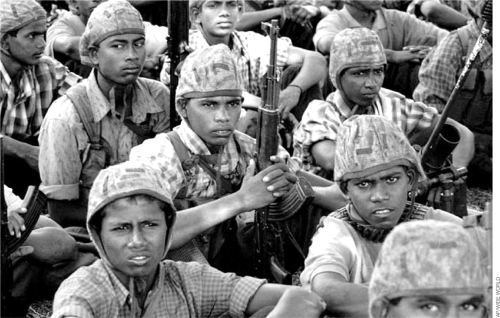
August 12, 1996: A group of youthful rebel recruits listening to lectures at a Tamil Tigers training camp at Vakarai village, Sri Lanka.
Smith & Wesson, a Connecticut-based handgun manufacturer, used an exhibit of its wares at an April 1867 Paris exhibition to jumpstart its sales in Europe. When the Russian government ordered 20,000 Model-3 .44 revolvers (which could be loaded and unloaded more rapidly than earlier guns), it spurred additional orders from rival nations. These European purchases helped Smith & Wesson weather the severe downturn in U.S. demand following the Civil War boom.
At least since the days of that 1867 exhibit, exports have been important to small arms manufacturers. Similarly, economic motives are of growing importance today, even though a few years ago it was primarily geopolitical reasoning that lay behind foreign sales. Then as now, however, the small-arms market has relied on two pillars: military and civilian demand–or, put another way, state and non-state demand.
Legal but problematic
Although they have been overshadowed by the firepower, range, and technological dazzle of intercontinental missiles, jet fighters, and combat tanks, small arms are the weapons of choice in many of today's conflicts–internal struggles rather than wars between sovereign nations.
These weapons belong to a well-established class manufactured by a mature industry, but there is little information about the numbers of small arms and light weapons being produced, transferred, or stockpiled. And the lack of good data is merely the beginning of the problem.
Small arms are the orphans of arms control. Throughout the Cold War years, arms control and disarmament efforts focused exclusively on major weapons systems. In consequence, there are no internationally accepted norms or standards regarding small arms. Their production, trade, and possession are essentially unmonitored and unregulated–subject to the ups and downs of demand rather than international policy.
Belatedly, and spurred by growing pressure from human rights, humanitarian, and other nongovernmental organizations, governments are scrambling to address the dangers of the global dispersal of small arms. However, most of the emphasis is on cracking down on illegal transfers. The Organization of American States, for instance, passed a convention in November 1997 designed to “prevent, combat, and eradicate the illicit manufacturing of and trafficking in firearms, ammunition, explosives, and other related materials.”
A growing list of intergovernmental organizations is joining the bandwagon: the European Union, the Council of Europe, the G-8, NATO, the Organization for Security and Cooperation in Europe, the Organization of Economic Cooperation and Development, the Wassenaar Arrangement, the World Customs Organization, the World Bank, and a variety of U.N. bodies have all kicked off efforts to address and curb the illicit trade in small arms.
Although these initiatives are important and overdue, there is a danger that legal transfers–those approved by a government and not in apparent contradiction of international law–will be let off the hook. Despite the rising concern about the “excessive and destabilizing accumulation and transfer” of small arms (the language used by the U.N. Panel of Governmental Experts on Small Arms), the legitimacy of officially approved sales is rarely challenged.
But legal sales–whether conducted by governments or by commercial concerns with the approval of governments–spread huge quantities of small arms around the world. This is true even if we exclude clandestine transfers from consideration. And because a weapon produced and sold legally may at some later time become an illegal weapon, the dividing line between legal and illegal sales can be murky.
It is not always clear what happens after an initial transfer. First, weapons may be stolen from a military or police depot and fed into the black market–something that seems to happen with alarming frequency in many countries around the world.
Second, they are sometimes re-exported to a secondary recipient without permission from the original seller. The U.S. State Department recently determined, for instance, that semi-automatic pistols and rifles sold to European firearms dealers often end up in places like Rwanda, the former Yugoslavia, Algeria, and Turkey, or in the hands of East European criminal gangs.
Third, the legal-illegal threshold may also be crossed in the licensed manufacture of arms. In the late 1980s, South Korea violated the terms of a license to produce U.S.-designed M-16A1 assault rifles by churning out greater quantities than permitted and exporting them without U.S. approval.
Fourth, entirely unauthorized copies are manufactured. The Bonn International Center for Conversion's yearbook, Conversion Survey 1997, explained that the Soviet Kalashnikov assault rifle was adapted by Israel and sold to other countries under the name Galil; the Galil in turn was license-produced as the R-4 by South Africa.
Fifth, political upheaval in a recipient country can turn past weapon deliveries from a routine transaction into a sudden cause for concern. This was the case with U.S. small arms supplied to regimes in Vietnam, Ethiopia, and Somalia. For all these reasons, legal transfers need to be understood as part of the problem. They not only add mightily to the weaponization of the planet, they indirectly feed gray and black markets as well.
Complex structures
Both the supply and demand sides of the market for small arms are broader and more complex than those for major arms; they involve larger numbers of manufacturers, dealers, supply networks, and customers. Major conventional weapons are usually procured only by the armed forces of sovereign states, although opposition forces may also seek some heavier weapons. The demand for small arms, however, is influenced not only by a state's military and paramilitary organizations, but also by guerrilla groups, organized crime, law enforcement agencies, growing numbers of private security firms, and individual citizens.
Private individuals in most societies are permitted to own a variety of small arms–rifles or handguns–for hunting, sport, collecting, or personal security reasons. The U.N. International Study on Firearm Regulation, a 1997 survey of nearly 50 countries representing two-thirds of the world's population, found that few countries impose a complete ban on civilian ownership of firearms–just four countries in the case of rifles, seven in the case of handguns. Nine nations have no prohibitions whatsoever. Similarly, the manufacture, import, and export of firearms is fairly liberal. The U.N. survey lists 26 countries that export firearms to foreign countries for civilian use; 43 reported imports of firearms. It is illegal in five countries to import any type of firearms for civilian use, but 11 countries have no prohibition.
Although military forces have traditionally had access to more powerful small arms than police forces or private citizens, this distinction is being blurred. Police forces are being militarized–acquiring firearms with greater firepower, partly through transfers of surplus military equipment. Private security forces are growing, and individuals are acquiring more powerful guns. (This change is taking place only with regard to the firearms side of the light-weapons category; higher-end items like light mortars and shoulder-fired missiles remain principally in military hands.)
The scope of international trade
No one knows the true magnitude of the international small arms trade. The U.S. Arms Control and Disarmament Agency (ACDA) estimates that the global trade in small arms and ammunition accounts for perhaps 13 percent of the total conventional arms trade, meaning that about $3 billion worth of small arms and light weapons are shipped across borders each year. By comparison, the illegal trade has been estimated at anywhere from $2 to $10 billion. Michael Klare, a small-arms expert based at Hampshire College in Massachusetts, points out that ACDA's estimate excludes transfers of machine guns, light artillery, and anti-tank weapons that could legitimately be considered part of the light-weapons category. Including these weapons, the small-arms trade could be $6 billion per year.
Although these are very rough estimates at best, it is clear that huge quantities of small arms–probably millions of units–are transferred each year. Moreover, these figures are for military-type weapons only. The civilian market for firearms involves very large numbers. According to the Bureau of Alcohol, Tobacco, and Firearms, in the United States alone some three to five million handguns, rifles, and pistols are offered for sale each year.
Although no worldwide data are available, anecdotal evidence leads many analysts to believe that the demand for and trade in small weapons continues to be robust and may even be accelerating–in marked contrast to the plummeting trade in major weapons systems since the late 1980s.
Because there are no production and trade figures, no one knows how large global stockpiles of small arms and light weapons really are. A figure that has found a measure of acceptance is 500 million military-style firearms in worldwide circulation. Ed Laurance of the Monterey Institute of International Studies estimates that more than 100 million rifles are currently in the hands of combatants or in military depots.
In all likelihood, civilian-type small arms–handguns and rifles–number in the hundreds of millions as well. The U.N. International Study on Firearm Regulation found that in 33 reporting countries, official figures listed a total of 34 million firearms held by private citizens. This is clearly an extremely conservative count. South Africa's official figure, for instance, is 3.5 million, yet there may be another five to eight million unregistered weapons. There may be seven million registered firearms in Canada, but a total of 21 to 25 million firearms in all.
How many small-caliber arms are in civilian hands in Russia (official figure: 3.6 million) is anybody's guess; anecdotal evidence suggests that vast numbers of military-style weapons are “leaking” from the country's stockpiles.
Not included in the U.N. survey are countries like the United States and China. In the United States, anywhere from 190 million to 250 million firearms are believed to be in circulation.
Throughout the Cold War, the small-arms supply network was running in high gear. The two superpowers provided their friends with vast quantities of light arms, either at heavily discounted prices or for free–and most of these weapons are still in circulation today. As Michael Klare wrote in Light Weapons and International Security: “Even today, the arsenals of many countries in Asia, Africa, and the Middle East are replete with guns, mortars, and rockets provided by the United States and the Soviet Union in the 1950s, 1960s, 1970s, and 1980s.”
Klare believes that anywhere from 10 to 20 percent of the $62 billion worth of U.S. military grants given between 1955 and 1994 consisted of small arms and light weapons. The Soviet Union, too, is believed to have given large quantities of small arms to its allies. In fact, the Soviet-made Kalashnikov assault rifle (AK-47/AK-74) has been sold around the world in such massive quantities that it has become the symbol of the small-arms trade. It is believed that anywhere from 35 to 70 million units have been manufactured since World War II. But the wide range in estimates underscores how little we know.
Today, the United States continues to provide light weapons as part of its standard military assistance programs. In Central and Latin America, it does so through anti-narcotics programs. But since the end of the Cold War, the impetus has shifted from geopolitical motivations to economic interest. Grants are more and more being supplanted by commercial sales, either by government agencies or by private companies. By all indications, large quantities of arms continue to be transferred. In “Foreign Policy in Focus,” Lora Lumpe, now with the International Peace Research Institute in Oslo, points out that in 1996 alone, the U.S. State and Commerce Departments approved $530 million worth of small arms exports by private companies.
Unfortunately, detailed data for other important exporters are not available. But it is clear that producers in other countries make significant sales. Companies like Heckler & Koch (Germany), Fabrique Nationale Herstal (Belgium), Schweizerische Industrie Gesellschaft (Switzerland), Steyr-Daimler-Puch (Austria), Beretta (Italy), and Israeli Military Industries are important manufacturers of both military and civilian small arms. Among the most important producing and exporting countries are Germany, Italy, Belgium, Switzerland, Austria, the Czech Republic, and Israel. Their pistols, rifles, and machine guns have been acquired by armed forces the world over.
Surplus sales
Another important source–for both legal and illegal transfers–are surplus stocks. When the post-Cold War armies of both the East and West began to shrink, many governments decided to pass on excess equipment to allies and friends, usually at low or no cost. The argument advanced in favor of this practice is that it is cheaper to give these weapons away than to bear the costs of storing and guarding or dismantling them.
Popular models∗
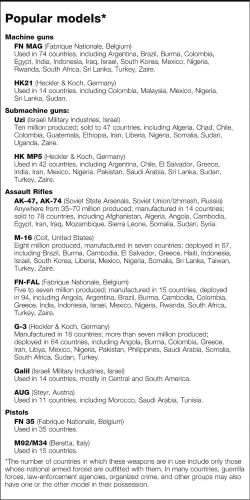
The number of countries in which these weapons are in use include only those whose national armed forced are outfitted with them. In many countries, guerrilla forces, law-enforcement agencies, organized crime, and other groups may also have one or the other model in their possession.
But governments may come to regret this narrow cost-benefit calculus. Western countries certainly have the wherewithal to withdraw surplus arms rather than feed a market that attracts even less scrutiny than the export of newly produced weapons. For Russia, on the other hand, surplus sales are part of a desperate struggle for survival.
In one of the largest of these transfers, Germany gave Turkey 304,000 formerly East German Kalashnikovs and 106 million rounds of ammunition. The United States routinely gives away surplus weapons through the Excess Defense Articles program. From 1990 through 1996, according to Paul Lansu of the International Secretariat of Pax Christi in Belgium, that included 200,000 machine guns. Lora Lumpe reports that in recent years the Pentagon's surplus small arms have gone to Mexico, Latvia, Taiwan, Bosnia, Israel, the Philippines, and Thailand.
Although the end of East-West rivalry has given new impetus to shedding excess equipment, the sale of surplus arms is not new. Since the 1950s, the U.S. government has given away or sold at discount almost three million surplus military firearms to allies such as South Korea, South Vietnam, Iran, and Turkey.
New producers
The ability to manufacture major weapons is limited to a fairly small number of advanced industrial countries, but small-arms production is far more widespread. This is the result of both growing numbers of license agreements and an increase in unauthorized copying through reverse engineering. The U.N. Institute for Disarmament Research in Geneva identified nearly 300 companies in 52 countries that manufactured small arms and related equipment in 1994–a 25 percent increase in the number of countries since the mid-1980s.
According to Michael Klare, licensed production is taking place in at least 22 developing countries, 16 of which are also exporting the small arms they churn out. Prominent among them are Brazil, Chile, Egypt, Iran, South Africa, Turkey, India, Indonesia, North and South Korea, Pakistan, and Singapore. Klare wrote in the April 1997 issue of Current History that the Belgian FN-FAL assault rifle, for instance, is being produced under license in 10 countries–Argentina, Australia, Austria, Brazil, Canada, India, Israel, Mexico, South Africa, and Venezuela. Lora Lumpe adds that Turkey is now able to satisfy most of its small-arms needs through domestic production based on U.S. designs.
In addition to licensed production, new models of weapons are introduced that are essentially based on existing, proven models. As Jane's Infantry Weapons points out, recently introduced assault rifles produced by Croatia, South Africa, and China may be “traced back to the venerable Kalashnikov.”
Old technology, new technology
One of the reasons that so many countries can relatively easily enter small-arms production (but not necessarily squeeze out a profit) is that the technology is well-established. The first rifle was invented almost 500 years ago, and although the eighteenth, nineteenth, and twentieth centuries have witnessed important inventions and breakthroughs, the industry is mature. “The basic infantry rifle has yet to be redefined,” as Terry Gander and Charles Cutshaw of Jane's Infantry Weapons put it.
Most of the small-arms trade is in weapons based on decidedly old technology, but new capabilities continue to be incorporated. The U.S. Army, for instance, announced in 1998 that by 2006 it will field a new assault rifle (the “Objective Individual Combat Weapon” or OICW) that will “shoot around corners,” pack more lethal power than earlier models, shoot reliably over longer distances, and offer more precision through night-vision scopes, laser range-finders, thermal imagers, and a variety of electronic devices. Russian, French, Belgian, and German companies, too, are pushing the envelope.
Most manufacturers cannot survive by supplying the military market alone. For instance, the U.S. armed forces expect that their current small arms procurement needs will be met by 2003 and the OICW will have a relatively small production run. In the aftermath of the Cold War, many manufacturers have placed their hopes on commercial sales–and on selling arms to police and other law enforcement agencies.
Following the reunification of Germany, the German government canceled its contract with Heckler & Koch for a futuristic G-11 assault rifle; the company subsequently became a subsidiary of Royal Ordnance of Britain. Belgium's Fabrique Nationale has been struggling with huge debts since the 1980s, requiring large-scale financial assistance from the government. In 1990, it was taken over by French tank manufacturer GIAT (which also bought Manurhin, a French firearms company).
While the global market in small arms appears to be robust, there are important shifts within that market: the military demand for small arms is not as strong as it once was, but internal wars and conflicts, rising crime, and the urge among communities and individuals to arm themselves for personal safety or to protect their business assets have set the stage for strong commercial and police demand for small arms. Analyzing these trends, Ernie Regehr of Project Ploughshares comments in the Armed Conflicts Report 1998 that “perhaps the most prominent distinguishing feature of contemporary warfare is not that it is a case of the militarization of civil conflict, but rather a case of the demiltarization of armed conflict. …
“Civilians are the primary victims of war, but they have also become the principal combatants. Modern combat technology–notably small arms and light weapons–has made war-fighting available to the untrained as well as the trained, the amateur and the professional alike.”