




Abstract
Meige syndrome is a neurological disorder discovered by Henry Meige a French neurologist. The initial clinical manifestations are blepharospasm in both eyes and the characteristic facial appearance of tiger face lines. The patient displays an abnormal facial expression. Trauma, psychological, endocrine, and pharmacological factors may play a role in secondary Meige syndrome. Here we describe these clinical signs with pictures.
Keywords
Dear editor,
In 1910, French neurologist Henry Meige reported the first account of 10 patients with involuntary closure of eyelids [1], including one patient whose blepharospasm was caused by the involuntary contraction of the mandibular muscles. Simultaneously, he named this group of symptoms as Meige syndrome, also known as Meige’s syndrome, using his surname.
Meige syndrome is a group of extrapyramidal diseases, classified as primary and secondary. The exact etiology and pathogenesis of primary Meige syndrome are still unknown. Secondary Meige syndrome may be caused by a variety of events, such as trauma, psychology, endocrine, and pharmacological factors, leading to an imbalance of the neurotransmitters in the brain (especially of acetylcholine and dopamine).
Blepharospasm is the first symptom of Meige syndrome accounting for 76%–77% of the cases [2]. Most patients present with bilateral onset, whereas a few present with unilateral onset, rapidly progressing to the contralateral side. Before the onset of blepharospasm, it often manifests as eyelid irritation, such as dry eyes, photophobia, and increased blinking. When blepharospasm occurs, the orbicularis oculi muscle experiences tonic or clonic contraction, which are manifested as abnormal facial midline muscle contraction in some patients and complete closure of both eyes in some patients [3]. The frequency of blepharospasm often ranges from low to high, and the duration ranges from a few seconds to 20 minutes. The continuous contraction leads to functional “blindness” if left untreated. The patient also exhibits conscious discomfort in the eyes, frequent blinking, weakness in opening the eyes, and numbness of the facial skin, in addition to clinical signs of blepharospasm. Therefore, people with Meige syndrome often need to pull up their upper eyelids with their hands and are afraid to go out or cross the street alone. Meanwhile sleep and other non-motor symptoms, such as depression, sleep impairment, excessive daytime sleepiness and low self-esteem, were seen in patients [4].
According to Sabesan in 2008, the facial expressions of patients with Meige syndrome are prominent forehead line, brow line, stiff face, lip dysfunction, pronounced mental wrinkles, and dimples [3]. The typical features of Meige syndrome are blepharospasm and oromandibular dystonia, which is accompanied by complex movements of facial and neck muscles, mouth, jaw, tongue, and pharynx [5 –7], as the condition advances. Manifestations of blepharospasm include mouth contraction, yawning, involuntary mouth opening and pouting, teeth grinding, showing teeth, raising eyebrows, frowning, and other abnormal movements that cause the patient’s facial expressions to be weird. We coined the term “tiger face” to describe these peculiar and characteristic facial signs (Fig. 1).
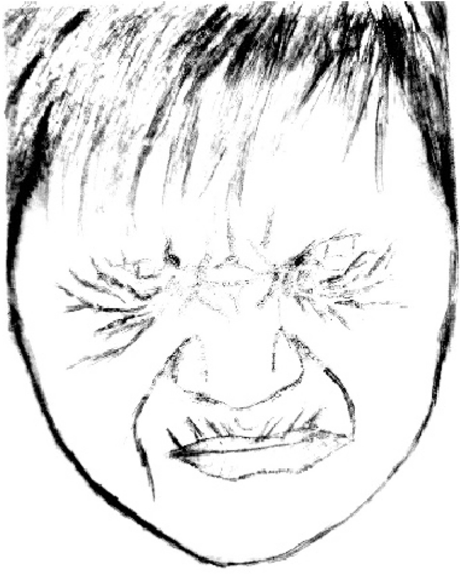
Frontal view of the face of a patient with Meige syndrome showing involuntary frequent blinking, prominent forehead lines, glabellar lines, involuntary closure of eyelids, teeth-grinding, stiff face and other abnormal movements, which are usually on both sides.
Other disorders, except for Meige syndrome, do not display this distinctive “tiger face”. As a result, visualizing the description makes it easier to identify other clinically perplexing diseases, such as hemifacial spasm (Fig. 2).
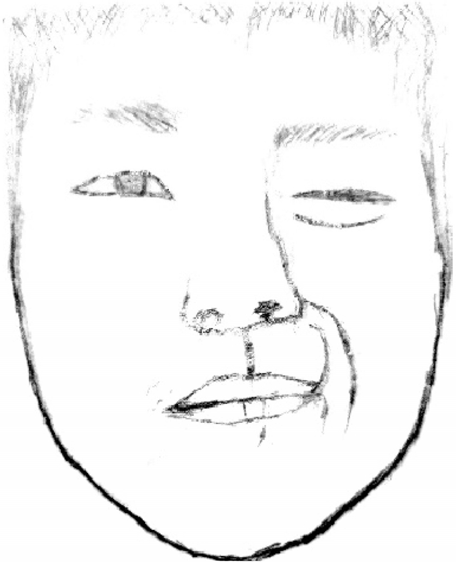
Frontal view of the face of a patient with hemifacial spasm showing involuntary twitching of facial and mouth muscles, skewed mouth and eyes that are difficult to close, which are usually on one side.
Footnotes
Conflict of interests
All contributing authors report no conflict of interests in this work.