






Abstract
The family Crabronidae (order Hymenoptera) includes excavating and hunting wasps of more than 9,009 species within 249 genera that are distributed globally, especially in the tropics. The objective of this research was to improve the knowledge of the occurrence of the family Crabronidae in Mexico from a review of the scientific literature and to provide data on species of importance in biological control. The results revealed that 769 species representing 99 genera have been reported in Mexico. With the current review, 8.5% of the species known worldwide were found to be present in the country and the list of species was increased by 32%. The genera Cerceris and Trypoxylon had the highest number of species, 130 species and 58 species, respectively. The Mexican states of Baja California Norte, Sonora and Tamaulipas have the highest number of Crabronidae species. A total of 211 species were added to the list of Crabronidae in Mexico. Twelve genera and eight species of Crabronidae used as biological control agents of various pests were recognized. Further research on the diversity of this group of insects is suggested, given the importance that crabonids have as predators and natural enemies of insect pests that affect economically important crops.
Introduction
Mexico is a shelter of 10 to 12% of the total species reported in the world and is one of the main mega-diversity countries, along with Brazil, Peru, Colombia, Indonesia, and China (Toledo 1988; Mittermeier and Goettsch 1992; González 2006; SEMARNAT 2008; Sarukhán et al. 2009; Martínez-Meyer et al. 2014). Such diversity includes an estimated 125,585 species of invertebrates, most of which are insects (SEMARNAT 2008). According to Morón and Valenzuela-González (1993) and Luis et al. (2000), 110,000 species of insects have been reported in Mexico, which involves 6,000 species of Hemiptera, 20,000 species of Diptera, 35,000 species of Coleoptera, and between 20,000 and 30,000 species of Hymenoptera (Michener 2000; Griswold et al. 2006).
The order Hymenoptera includes many species of ecological and economic importance (Fernández 2000; Della 2003; Guzmán 2014; Myartseva et al. 2014, 2015). Predatory wasps included in the superfamily Apoidea are distinguished because of their diversity of habits and behavioral complexity, ranging from solitary to eusocial species. Apoidea are advanced aculeates considered the most economically important insect group in the biological control (Brothers and Finnamore, 1993) and pollinators. The taxonomy of Apoidea is complicated due to the size of the insects, the relative scarcity of literature in some regions of the world, and the morphological similarity among closely related species (Ruíz et al. 2010).
The taxonomical criteria to separate groups vary according to different authors. For example, Bohart and Menke (1976) mentioned 11 subfamilies within the family Sphecidae, but further studies have elevated these subfamilies to the family level within the superfamily Apoidea (Gauld and Bolton, 1988). Finnamore and Michener (1993) classified these wasps into nine families grouped in the series Spheciformes, whereas Melo (1999) proposes four families, plus the family Apidae within the superfamily Apoidea. These four families are Ampulicidae, Crabronidae, Heterogynaidae, and Sphecidae, within the sphecoid wasps (Spheciformes) (Melo 1999), now apoid wasps. Moreover, Pulawski (2021) considered only the families Ampulicidae, Apidae Crabronidae, Heterogynaidae and Sphecidae.
About 8,000 species are known in Ampulicidae, Crabronidae, Heterogynaidae, and Sphecidae (Bohart and Menke 1976; Finnamore and Michener 1993). In the family Crabronidae, Pulawski (2022) cited about 9,106 species representing 249 genera and eight subfamilies, mainly from the tropics. The family Crabronidae represents 89% of the species present in the Americas from the apoid wasps, followed by Sphecidae (8%) and Ampulicidae with 2% (Table 1). The family Heterogynaidae have only been recorded in the Old World (Amarante, 2006; Pulawski, 2022).
Previous studies of Crabronidae in Mexico recorded 558 species and 80 genera of crabronids (Horta et al. 2013), whereas Ruíz et al. (2002) listed 463 species, and Amarante (2002) reported 511 species. Such studies indicate that the families Crabronidae, Sphecidae, and Ampulicidae account for 8% of the species distributed in the Americas, highlighting Crabronidae as the most diverse family. This study aimed to update the number of species of the family Crabronidade in Mexico and provide data on species with potential use as biological control agents.
Materials and methods
A review of the available literature on the occurrence of the family Crabronidae in Mexico was conducted. This review included revising books, documents, and publications of scientific bases in the Journal Citation Reports (JCR), Latindex, and Scielo. Also, it involved other sources, such as reports of local studies in Mexico and databases available worldwide (Scullen 1972; Bohart and Menke 1976; Bohart 1990, 1993, 1997, 2000; Antropov 1999; Ohl 1999; Leclercq 2000, 2002a, 2002b, 2007; Fernandez 2001; Amarante 2002, 2005; Finnamore 2002; Ruiz and Coronado 2002; Ruiz et al. 2002; Genaro 2006; Holliday and Coelho 2006; Nemkov 2006; Horta et al. 2007, 2013; Holliday et al. 2009; González et al. 2010; Looney et al. 2014; Vanoye-Eligio et al. 2014; Cancino et al. 2015; Rosa 2015; Ruíz-Cancino 2015; Vanoye-Eligio et al. 2015; Mokrousov and Popov 2016; Discovery Life 2018; GBIF 2018; Pulawski 2022; Rosa and Melo 2020). The main criterion for the selection of species was that the record for Mexico is determined at the species level and preferably the place of collection in the different investigations. Any omission of relevant literature available was not intentional. In this study, we followed the classification of Melo (1999).
Results
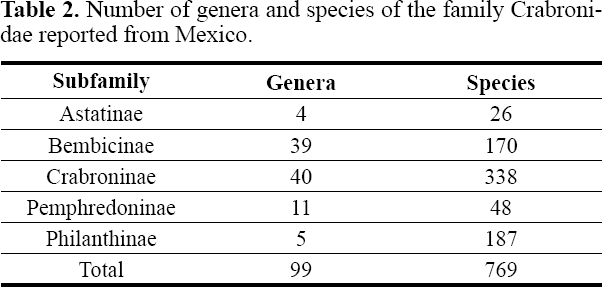
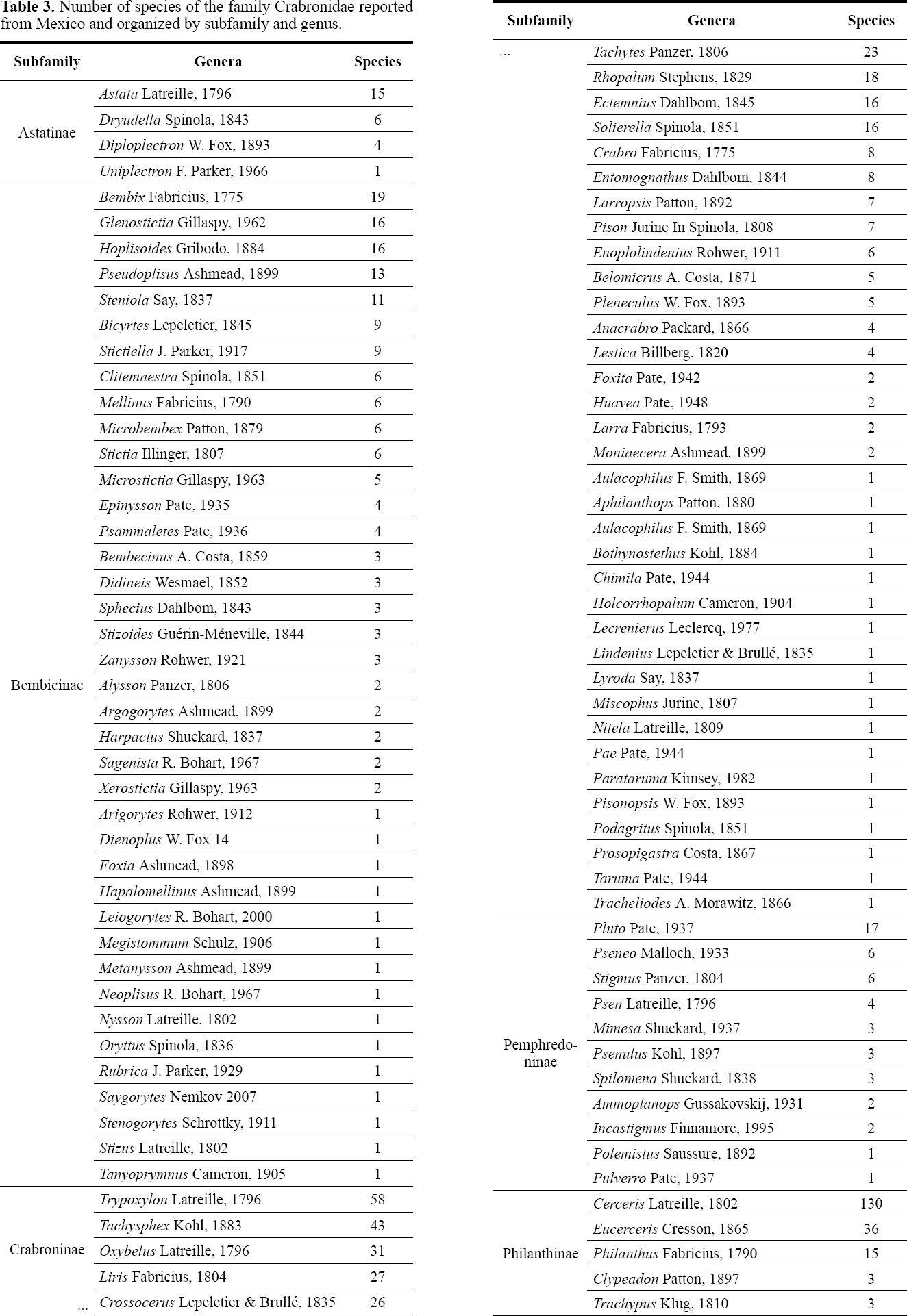
According to the reviewed literature, a total of 769 species representing 99 genera of the family Crabronidae are reported in Mexico (Table 2, Supplementary File). The subfamilies Crabroninae and Philanthinae exhibited the highest numbers of species, with 338 and 187 species, respectively. The genera
Number of species of the superfamily Apoidea including the family Crabronidae reported in Mexico, the Nearctic and Neotropical regions, and worldwide (Bohart and Menke 1976; Finnamore and Michener 1993; LaSalle and Gauld 1993; Wasbauer1995; Fernández 2000, 2002; Ruiz et al. 2002; González 2006; Pitts et al. 2006; Horta et al. 2007, 2009, 2013; Morrone and Márquez 2008; Pulawski 2022; Orr et al. 2021).
Number of genera and species of the family Crabronidae reported from Mexico.
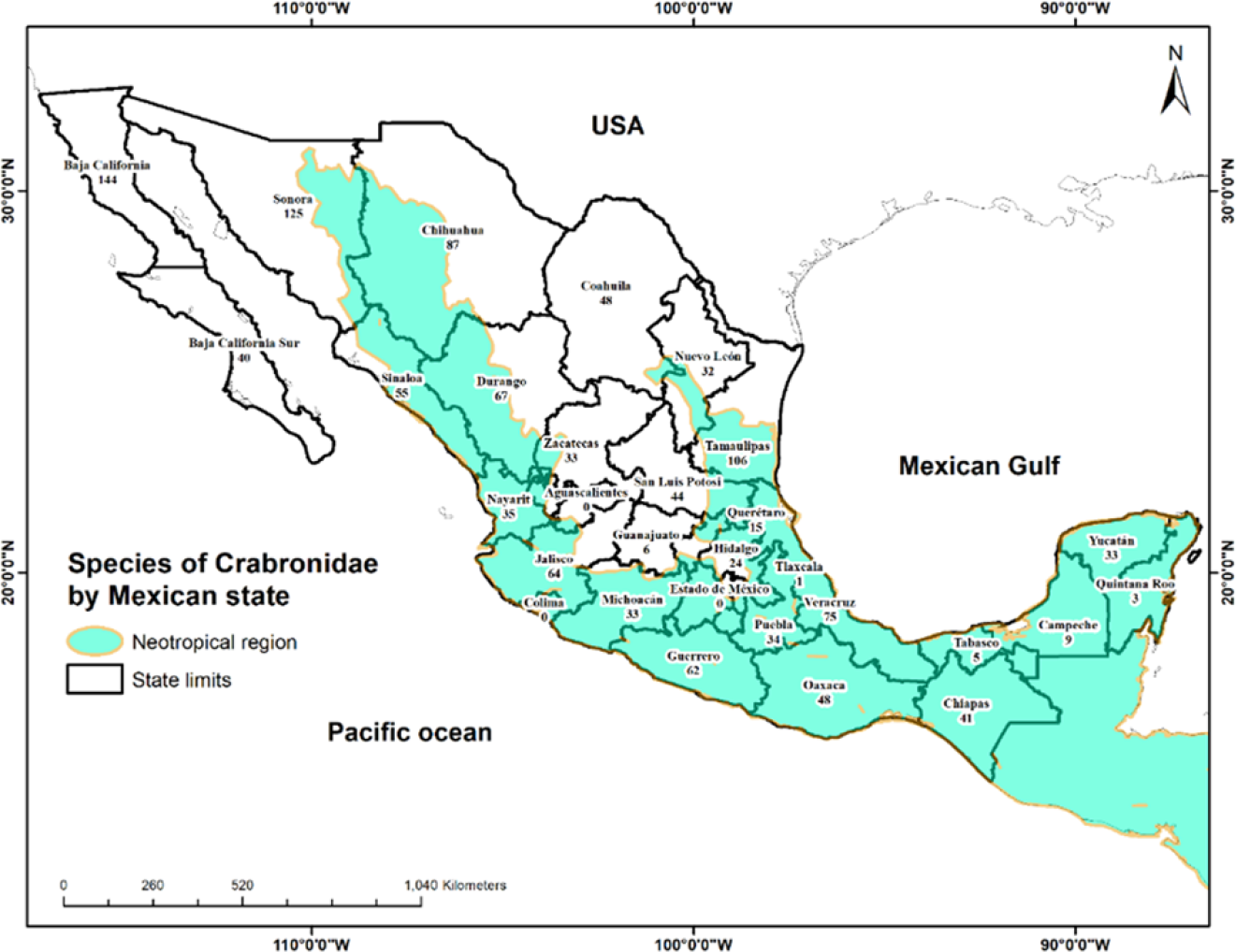
Numbers of Crabronidae species by state in Mexico.
Regarding the agroecological importance, the genera
Number of species of the family Crabronidae reported from Mexico and organized by subfamily and genus.
Discussion
The 769 species of Crabronidae reported from Mexico account for 8.5% of the total species reported worldwide (Pulawski 2022). Our report of 769 species also represents a 32% increase in the number of species previously provided by Horta et al. (2013), who listed 558 species and 80 genera. Other previous reports were 511 species by Amarante (2002) and 463 species by Ruiz et al. (2002). Also, the study provides evidence of 11 genera and seven species present in Mexico that are recognized as biological control agents.
At the subfamily level, the Crabroninae had the most significant number of species in Mexico (338 species) (Tables 2, 3, Supplementary File), which coincides with other studies worldwide (Ruiz et al. 2002; Horta et al. 2013; Pulawski 2022). According to Pulawski (2022), the diversity ranking of subfamilies of Crabronidae places Crabroninae as the most diverse subfamily, followed by Bembicinae and Philanthinae. However, in our review, Philanthinae and Bembicinae were the second and third most diverse subfamilies, respectively. Five genera (
The states of Baja California Norte, Sonora, and Tamaulipas in the north of Mexico had the highest number of species with 144, 125, and 106 species, respectively. One explanation of this might be that the number of studies on Crabronidae is higher in this region than in other states of Mexico. In addition, another possible determining factor in the number of species of this family is the vegetation present in these states of the country, which have large plains and plains with hills forming part of the Sonoran and Chihuahuan desert (Gutiérrez-Ruacho et al. 2012). In these states the vegetation is varied, being the transition between the mountain vegetation and the vegetation of arid zones (Hernández et al. 2005). Toledo (1995) mentioned that these transition areas between various types of vegetation are rich in biodiversity. In addition to the above, the dominant vegetation in these areas is a desert scrub, which has open spaces that favor the abundance and richness of the family Crabronidae (Rzedowski and Huerta 1994; Comas et al. 2009; SEMARNAT 2011).
This vegetation is characterized by thorny vegetation such as cactus and bromeliads and shrubs that ranged from 3 to 5 m high and in semi-desert pasture. Such environmental conditions provide open spaces preferred by wasps, as observed by Comas et al. (2009). Indeed, the species diversity of Crabronidae declines in closed or canopied habitats. Hymenoptera associated with open environments exploits the herbaceous plants and shrubs to provide food and nesting resources. Candia and Máyida (2005) found that structural differences between the arboreal strata and shrub vegetation influence the abundance and species richness of Crabronidae. In this regard, Genaro (2009) reported that nests of species of
Of the 769 species reported from Mexico, records of 487 species (63%) provide information on state locations where they were collected, while reports on the remaining 282 species (27%) did not indicate specific locality data (Supplementary File). Overall, this review addressed the current knowledge of the diversity of species and its distribution of Crabronidae species in Mexico.
Regarding the use of insects in the natural control of pest insects, in agriculture, one of the objectives is to maintain biodiversity and promote the regulation of the abundance of harmful organisms, through predation, parasitoidism, parasitism and competition between species to reduce damage to crops (Brito and Camacho 2007). Agricultural and forest crops and other plant species of interest to humans offer excellent opportunities to develop integrated pest management programs, since there is a diversity of harmful and beneficial insect species in them that are in ecological balance and with healthy populations (León 2005). Pest insects limit the production of different crops. Ayala et al. (2013) mentioned that the damage they cause in crops is due to different environmental factors, the phenology of the crop and the habits of the pest insect, including the biological characteristics of the pest (Reséndiz et al. 2016). In biological control, parasitoids are the most widely used natural enemies of insect pests, as they play a fundamental role as natural regulators. Parasitoid wasps (Hymenoptera) constitute one of the most diverse orders of the class Insecta, which are used as natural control against insect pests (Llave 2015). Regarding predatory wasps, these have acquired great importance as predators of harmful organisms that affect agricultural crops, due to the pedotrophic behavior of these wasps, which includes several species of insects, caterpillars and spiders, and their nesting habits are variable, constructing them on different surfaces; in addition, there are wasps with solitary and social habits, which are considered to have important ecological characteristics which can help design conservation strategies and use in biological control (Brito and Camacho 2007; Meléndez-Ramírez et al. 2021). Hence, the use of Crabronidae species in the biological control of pests in forestry and agriculture has been important, since at least 22 cases have been documented for this purpose worldwide. In the subfamily Philanthinae, 10 species have been recorded (
In Mexico, of the crabronid species for the purposes of induced or natural biological control that have been documented, seven species belonging to three genera have been recorded (
Conclusions
The results suggest that crabronids are a group of wasps with high species richness in Mexico, which is promoted by the combination of Nearctic and Neotropical elements that characterize this part of the Americas. This work added a total of 211 species to the Crabronidae species list and recorded seven species that have been used in the natural biological control of pests that affect the forestry and agricultural sector; however, given the ecological and economic importance of this group of insects, more research is needed on the diversity and biology of these wasps. Finally, it is important to highlight that despite the efforts that the scientific community worldwide makes by proposing species of insects as natural pest control agents, currently the main method of insect pest control is based on the use of chemical insecticides, which are of immediate action, because they have been effectively adapted. However, the use of broad-spectrum chemical pesticides negatively affects both beneficial and harmful insects, including those with great potential in natural pest control.
Origin and Funding
Author Contribution
Conflict of Interest
Ethical approval