






Abstract
In the present study, the nest architectural patterns, elemental analysis and their behavior were carried out in three wasp species:
Introduction
The name wasp applies for 2 paired winged insects of the order Hymenoptera and suborder Apocrita, and is indicated when the insect is neither a bee nor an ant.
1
Some wasps are solid black or dark blue but the most have red, orange, or yellow wings with many markings and stripes are also common. The majority of 20,000 species are solitary, but one family Vespidae includes both social and solitary forms. Social forms include the hornet wasp,
In social wasp colonies, there are usually three castes, the egg-laying queens (one or more per colony), the workers (sexually undeveloped females) and the drones (males). Social wasps build nests of a coarse, papery material or masticating wood fibers. In the temperate regions, a colony lasts a single season, with the drones and workers dying in the fall. The mated queens take shelter during the winter, and then in spring they lay eggs and start new colonies. In the tropics, colonies continue indefinitely, dividing when they grow very large.
3
The
Wasps sting to defend themselves or their colony. Stinging involves the injection of protein venom that causes pain and other reactions. Wasps can sting more than once because they are able to pull out their stinger without injury to themselves. When stinging by a wasp or bumblebee occurs, the stinger is not left in the skin. Most people have only local reactions to wasp stings, although a few may experience more serious allergic reactions. Local, non-allergic reactions range from burning, itching, redness, and tenderness to massive swelling and itching that may last up to a week. 5
Even in monogynous colonies headed by a singly mated queen, worker reproduction of males is inhibited by worker policing. 6 In Vespinae, no queen replacement occurs, and the colonies are monogynous. However, when new queens appear, they leave their nests during the late summer and mate with males. The queens then seek out sites for winter, such as under loose bark, in rotted logs, under siding or tile, and in other small crevices and spaces, where they become dormant. These queens become active the following spring when temperatures are warm. They search for favorable nesting sites to construct new nests. They do not reuse old nests. 7
Mansehra is located at the Eastern border of the Khyber Pakhtunkhwa (KP), 244 km away from Peshawar and 190 km away from Islamabad. It is bounded in the north by Battagram and Kohistan districts, in the east by Muzaffarabad district of Azad Jamu and Kashmir, in the south by Abbottabad and Haripur districts and in the west by Buner and Shangla districts. This city is a major stop for tourists on the Karakoram highway that leads to China. Diverse fauna of wasps have been found in Mansehra including Braconidae, Chrysididae, Chalcididae, Eurytomidae, Pompilidae, Pteromalidae, Scoliidae, Sphecidae, Sphingidae, and Vespidae. 8 The objectives of the present study were to study differences in the architectural patterns of the nests of three wasp species, their social behaviors, and parental care of their offspring.
Materials and Methods
Observation for architectural patterns of wasp nests
Three species of the wasps and their nests were collected from the different sites: Hazara University (n = 7), Baffa Mera Chotal (n = 5) and Hassa Balakot (n = 6) located in Mansehra, Pakistan. The visits (1 visit at 1 place per day for 3 months) were made in order to observe construction of architectural patterns, and to collect materials.
Elemental analysis
Different nests building material samples (n = 6) were ground into fine powder, kept in sterilized vials and labeled accordingly: outer and inner part of the nest of
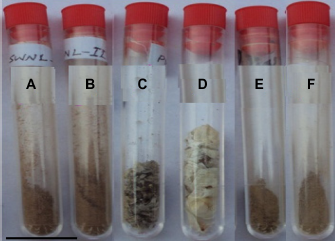
Powder prepared for the XRD analysis of outer and inner part of the nests of the hornet wasp,
Observation of social behavior and parental care
The visits (1 visit/1 place/day for 3 months) were made to collect nests of the wasps where an active nest was found. Attempts were made to provoke adults to defend by prodding them with the tip of a stick or a comparable instrument. These visits were carried throughout the colonial cycle. Defensive behavior was videotaped including departures, arrivals, collecting of food, and collecting of nest building materials. 10
Results
Three wasp species,
Comparison of architectural patterns of three wasp nests
We observed wasps to build their nests in a systematic and architectural pattern. It was found stelocyttarous (insect's nest supported by one or more pillars: petiolated) calyptodomus (concealed nest) in
Hornet wasp, Vespa velutina (Lepeletier)
The spherical nest of
Paper wasp, Polistes flavus (Cresson)
The nest of
Mud dauber wasp, Sceliphron formosum (Smith)
The small pitcher nest of
Comparison of elemental analysis of three wasps nests samples
The analysis by XRD shows the amount of elements with descending order in outer and inner parts of nest of
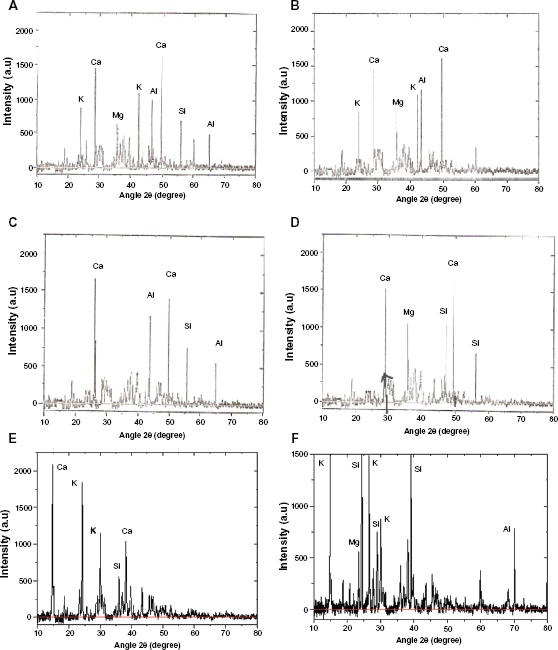
Comparison of elemental analysis by XRD of the outer and inner parts of the nest of the hornet wasp,
Comparison of social behavior of three wasp species
During the present study, there were three social casts found in each wasp species. Social behavior of wasps showed strong foraging, defensive behaviors, pseudo-attack, subsequent erratic flight, wing buzzing, mandibular pecking, abdominal pumping and abdominal twisting. Many workers were seen busy with their duties, ie, collecting building materials, foraging, constructing the nest and caring for offspring. A single queen was present for laying eggs. Many drones were permanently present on duty around the nest. Since their main job is to mate with the queen, males typically die soon after mating, but they showed strong defensive behavior when anything disturbed the nest or the area around the nest.
Hornet wasp, Vespa velutina (Lepeletier)
In the opening of the
In the hornet wasp,
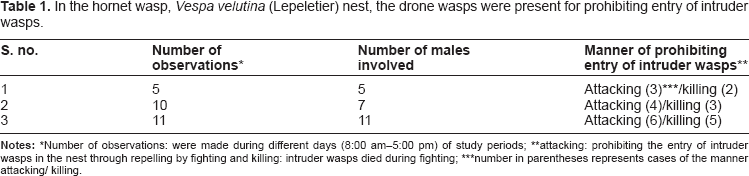
Number of observations: were made during different days (8:00 am–5:00 pm) of study periods;
attacking: prohibiting the entry of intruder wasps in the nest through repelling by fighting and killing: intruder wasps died during fighting;
number in parentheses represents cases of the manner attacking/ killing.
The queen lays five eggs in a small comb protected by several layers of papery material. She forages for wood fibers that are chewed and mixed with saliva to form new layers for her nest.
Paper wasp, Polistes flavus (Cresson)
Mud dauber wasp, Sceliphron formosum (Smith)
Comparison of parental care of three wasp species
During the present study, the parental care of three wasp species was recorded. When the queen found a suitable location to start a new nest with 20–30 cells, wood fibers were chewed and mixed with saliva before the laying of eggs began. The queen created a single cell at the end of a petiole; six more cells were then added around this to create the hexagonal shape of the nest cells. Once the eggs were hatched, wasp larvae were molted within the brood cells. When ready they would spin a silk cap over the top of the cells and then pupate into adult worker wasps. All workers were busy with their duties, collecting building materials, foraging, constructing the nest and caring for offspring. Parental care by workers was observed by introducing a pen camera during video making, and afterward by breaking the nests. Each nest consisted of one queen, who was differentiated via her large size. It was observed that she was paired with one drone, and the rest may have been sterile worker wasps as they were small in size compared with queen, and were never observed to mate with drones. Throughout the summer, new queens and fertile male drones were produced. It was not observed whether each female mated with one or more male. After mating, these new queens hibernated through the winter, and were ready to start a new nest in the spring. Meanwhile,
Discussion
In the present study, nest building activities, social behavior and parental care were examined in three wasp species,
Wilson 9 reported that elemental analysis by XRD was used to determine chemical composition of wasp nests constituents. In the present study, the same technique was used. The major constituents in the nest were calcium, silicon, magnesium, aluminum and potassium. Peaks in the diffractive grams showed different levels of these constituents (Fig. 2). In both studies, calcium was present in the highest frequency in the constructed materials. Its presence depends upon materials collected from surrounding areas. However, it is responsible for water-resistance and strengthening of the nests, as well as repelling of predators/parasites from the nests.
Foster and Ratnieks 13 observed the colonies of social hymenoptera and reported that male production was undertaken by queens or unmated workers. Karsai et al 12 examined complexity and specialization in task partitioning at both individual and colony levels. Consistent with models of Oster and Wilson, 14 it was predicted that in small wasp colonies, risk tolerance and behavioral flexibility of individual workers would be preferred, whereas wasp species characterized by large colonies should rely upon a high rate of exploration and exploitation of the environment by numerous small specialized worker wasps. In the present study, each nest was found in a different location, demonstrating that each species builds their nest in a unique environment. Some of the nests had small colonies and others had large colonies, reflecting findings reported by Foster and Ratnieks 13 , Karsai et al 12 and Oster and Wilson 14 .
Matsuura et al
2
reported that the
Hermann and Dirks
15
showed that in
Rossi and Hunt 17 reported that the wasps collected their food from fields of different crops like rice, cotton, and wheat. Raw materials from the cotton field were used to construct their nests. In the present study, it was observed that the wasps collected their food from different fruit markets. Such materials and foods were easily available in the areas surrounding the wasp nests.
Defensive behavior studied by Eberhard
18
in
Owen
1
observed a pseudo attack in
Conclusion
It was concluded that the social behavior of
Author Contributions
Conceived and designed the experiments: FP. Analyzed the data: FP, MS. Wrote the first draft of the manuscript: FP, MS. Contributed to the writing of the manuscript: FP. Agree with manuscript results and conclusions: FP, MS. Jointly developed the structure and arguments for the paper: FP, MS. Made critical revisions and approved final version: FP. All authors reviewed and approved of the final manuscript: FP, MS.
Funding
Author(s) disclose no funding sources.
Competing Interests
Author(s) disclose no potential conflicts of interest.