






Abstract
There is extensive research of the Ephemeroptera communities taxonomy and ecology in the Andean region of Colombia. However, other regions such as the Orinoquia have been insufficiently studied. From this region, in the Meta department, four species have been registered: Varipes lasiobrachius Lugo-Ortiz & McCafferty, Coryphorus aquilus Peters, Miroculis (Atroari) colombiensis Savage & Peters and Tricorythopsis rondoniensis (Dias, Cruz & Ferreira). The main objective of this study is to report for the first time for this region the species: Mayobaetis ellenae (Mayo), Hydrosmylodon primanus (Eaton), Haplohyphes baritu Domínguez, Camelobaetidus edmundsi Dominique, Mathuriau & Thomas and Nanomis galera Lugo-Ortiz & McCafferty.
Introduction
The Ephemeroptera order is represented by approximately 3,500 species grouped in 460 genera and 42 families of which the Baetidae, Leptophlebiidae and Leptohyphidae families represent the greatest diversity in the Neotropic with approximately 473 described species (Barber-James et al. 2013; Dominguez and Dos Santos 2013; Barber-James 2014; Salles et al. 2016).
In South America there are 570 reported species (Domínguez and Dos Santos, 2013), of which, approximately, 86 are known in Colombia (Dias et al. 2009; Domínguez et al. 2012; Forero-Céspedes et al. 2014; García et al. 2013; Gutiérrez and Reinoso-Flórez, 2010; Gutiérrez, et al. 2013; Gutiérrez and Llano 2015; Hoyos et al. 2014; Molineri, 2014; Molineri et al. 2011; Motta-Díaz et al. 2012; Rozo and Salinas 2016; Salinas et al. 2011; Salinas et al. 2013; Salinas et al. 2012; Vinasco-Mondragón and Zúñiga, 2016; Zúñiga et al. 2014; Zúñiga et al. 2015; Zúñiga and Torres-Zambrano 2015). In the country, the Baetidae, Leptophlebiidae and Leptohyphidae families represent more than 70 % of the Ephemeroptera order diversity. Most of these reports of these families are found in the Amazonas department and the Andean region (Zuñiga et al. 2004; Dias et al. 2009; Salinas et al. 2012).
Despite the taxonomic and ecological importance of their Ephemeroptera communities (Bauernfeind and Moog 2000; Prat et al. 2009), regions like the Colombian Orinoquia have been among the least studied (Dias et al. 2009; Zúñiga and Torres-Zambrano 2015; Dias et al. 2016). At present, only four species had been reported for this region: Varipes lasiobrachius Lugo-Ortiz & McCafferty, 1998, Coryphorus aquilus Peters, 1981, Miroculis (Atroari) colombiensis Savage & Peters, 1983 and Tricorythopsis rondoniensis (Dias, Cruz & Ferreira, 2009).
In order to extend the knowledge of Ephemeroptera fauna diversity and distribution in Colombia, the objective of this article is to report for the first time for the Colombian Orinoquia the species: Mayobaetis ellenae (Mayo, 1973), Hydrosmylon primanus (Eaton, 1892), Haplohyphes baritu Domínguez, 1984, Camelobaetidius edmundsi Dominique, Mathuriau & Thomas, 2001 and Nanomis galera Lugo-Ortiz & McCafferty, 1999.
Material and methods
The collection of Ephemeroptera was done in the Orotoy river (Meta), which has an altitude range between 1,620 and 240 masl and a riverbed length of 53 km. The upper and middle zones of the river have the qualities of a mountain river and the rest of the basin is described as an eastern cordillera piedmont river and low plain river (Caro et al. 2011). Hence, more areas of the stream prevail with rapids than backwaters. Most of the riverbed is composed of pebbles and a soft sandy clay substrate, with an average depth of 0.54 meters. The basin is covered in secondary vegetation and has characteristics of the plain foothill forest with a significant alteration of the longitudinal and transversal continuity because of the expansion of areas for the establishment of productive activities related to the tourism, livestock and the production of hydrocarbon, palm oil and, rice.
The collection was completed during a hydrological cycle between 2010 and 2011 with 17 sampling stations located along the river (Fig 1). Nymphs were collected with a 350 micron aquatic entomological net and fixed in 96 % ethanol. On the other hand, the variables physical and chemical were measured in situ: temperature, pH, conductivity and oxygen dissolved in the sampled sites. The species diagnosis was based on Domínguez et al. (2006) and Hoyos et al. (2014). The examined specimens were deposited in the University of Caldas Entomological Collection of the Biology Program, in Manizales, Colombia (CEBUC – Colección Entomológica del Programa de Biología de la Universidad de Caldas).
Results
Camelobaetidius edmundsi Dominique, Mathuriau & Thomas, 2001 (Fig. 2A)
Camelobaetidius edmundsi Dominique et al. 2001: 19; Domínguez et al. 2006: 129; Cruz et al. 2012: 2; Salinas et al. 2012: 202.
Mayobaetis ellenae (Mayo, 1973) (Fig 2B)
Baetis sp. 1 Roback, 1966: 137; Baetis ellenae Mayo, 1973: 285; Berner 1980: 190; Moribaetis (Mayobaetis) ellenae Waltz & McCafferty, 1985: 240; Mayobaetis ellenae: Lugo-Ortiz & McCafferty, 1996: 369; Domínguez et al. 2006: 163; Cruz et al. 2012: 1; Salinas et al. 2012: 203.
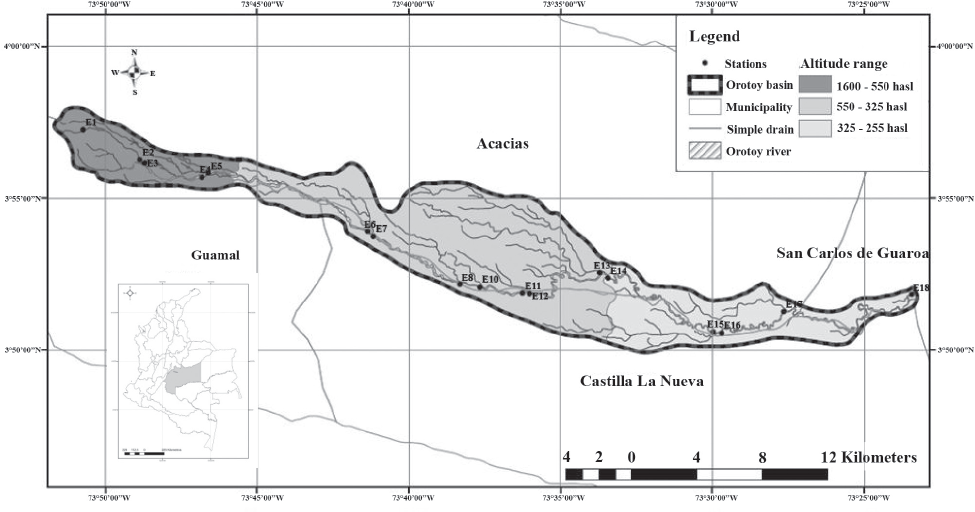
Map Orotoy river basin of the Meta department (Colombia), location of sampling stations.
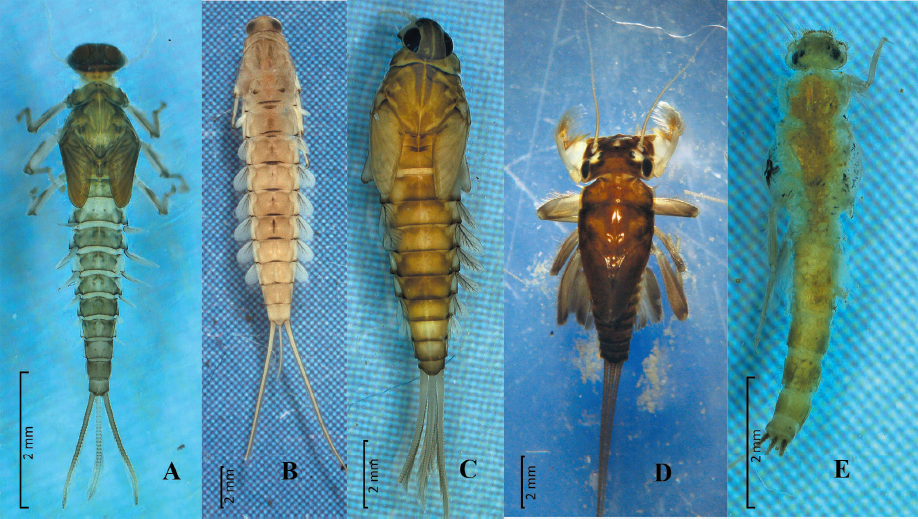
Nymphs, dorsal view.
Nanomis galera Lugo-Ortiz & McCafferty, 1999: 100.
Thraulus primanus Eaton, 1892: 7; Kimmins 1934: 342; Traver 1947: 149; Traverella primana Traver, 1960: 5; Allen 1973: 1292; Flowers 1992: 37; Traverella primanus Edmunds, 1950: 551; “Traverella” primana Flowers & Domínguez, 1991: 49; Hydrosmilodon primanus Flowers & Domínguez, 1992; Hydrosmilodon primanus Salinas et al. 2013: 1.
Haplohyphes baritu Domínguez et al. 1994: 97; Lugo-Ortiz & Mccafferty 1995: 169; Molineri 1999: 29; Molineri, 2003: 4; Hoyos et al. 2014: 132. Haplohyphes furtiva Domínguez, 1984: 108; Domínguez et al. 1994: 98; Molineri 1999: 29; Molineri 2003: 4. Haplohyphes furtivus [sic]; Lugo-Ortiz & McCafferty, 1995: 169.
Conclusion
The Orinoquia is one of the regions of greatest water wealth of Colombia; however, in spite of this, few studies of aquatic communities and, especially, insects exist. With the reports in the present article, the number of known species in this region increased from four to nine. Hence, it contributed to knowledge of the order Ephemeroptera for the Meta department and the Orinoquia region, and expanded the known distribution of the species in Colombia.
Acknowledgements
To the Environmental Science Institute of Colombia Orinoquia (ICAOC) of the University of the Llanos, for facilitating the biological material collected in the agreement DHS 169-09 subscribed between the University of the Llanos and the Colombian Petroleum Company (ECOPETROL). To Marcio Baquero for his work with the map.