An up-to-date key to the species of the genus Agriocleptes is given to separate all the known taxa. A checklist with the known distribution records is given, as well as a synonym list.
The Apiomerinae subfamily is characterized by an apical notch on the anterior tibiae for the reception of the tarsi, although in Micrauchenus Amyot & Serville, 1843 it is reduced; reduced anterior tarsi; anterior tibiae usually longer than femora and somewhat curved, sometimes with dense erect pubescence (Maldonado et al. 1993).
The genus Agriocleptes Stål, 1866 has a Neotropical distribution and has eight described species (Maldonado 1990; Forero and Giacchi 2001). Within the subfamily Apiomerinae, Heniartes Spinola, 1837 is the only genus resembling Agriocleptes, but the latter has the head longer than the pronotum, the corium with waxy secretions, the membrane not completely dark but with some pale areas, and the middle tibia not so recurved (Wygodzinsky 1947; Costa Lima et al. 1948); all these characteristics separate it from Heniartes.
Recently, Forero and Giacchi (2001) synonymyzed Agriocleptes zischkai Wygodzinsky, 1953 under A. wygodzinskyi Prosen and Martínez, 1953, a species from Cochabamba, Bolivia. Unfortunately, a key to facilitate separation of the species of Agriocleptes was not feasible because the original description of A. salvatorianus Carcavallo and Martínez, 1960, a species from Colombia, was unavailable. Now with the paper of Carcavallo and Martínez (1960) at hand, is possible to give an up-to-date key to the species of the genus, also, a checklist of the species within the genus, their synonyms, and their known distribution.
Species included
Stål (1866) erected the monotypic genus Agriocleptes that included only A. albosparsus (Stål, 1854). Wygodzinsky (1946) redescribed the genus and added two new species: A. schubarti and A. stali. Later Wygodzinsky (1953) described four new species: A. bahianus, A. bergi, A. diectrichi and A. zischkai. At the same year, Prosen and Martínez (1953) described A. wygodzinskyi. Some years later, Carcavallo and Martínez (1960) described A. salvatorianus, a new species from Colombia. Recently, Forero and Giacchi (2001) synonymyzed A. zischkai under A. wygodzinskyi. No further species has been described after A. salvatorianus, neither no new information about this genus has been mentioned anywhere (Maldonado 1990).
Color pattern and male genitalia characters are used for the separation of species within Agriocleptes (Wygodzinsky 1946, 1953). Although male genitalia is very useful in various groups of Reduviidae to separate species (Coscarón 1983; Maldonado and Santiago-Blay 1992; Jurberg and Galvão 1997; Gil-Santana and Alencar 2001), in Agriocleptes the male genitalia is rather homogenous within species-groups and somewhat different between them (Wygodzinsky 1953), and so not so useful to identify particular species. Color pattern, in contrast, is very constant within species (Wygodzinsky 1953) and helpful to distinguish them.
Key to the species of Agriocleptes
Wygodzinsky (1946) gave a key to separate three species, and later he gave a key to separate seven species (Wygodzinsky 1953). Nevertheless, one of the species keyed in the latter was recently synonymyzed (Forero and Giacchi 2001), and a new species was described later (Carcavallo and Martínez 1960) without including any key to accommodate it. The key presented below is based mainly on Wygodzinsky's key (1953).
1. Anterior pronotal lobe completely, or mostly, orange or reddish……………………………. 2
— Anterior pronotal lobe completely brownish-black or deep black…………………………… 7
2. Antennae completely darkened…………………….. 3
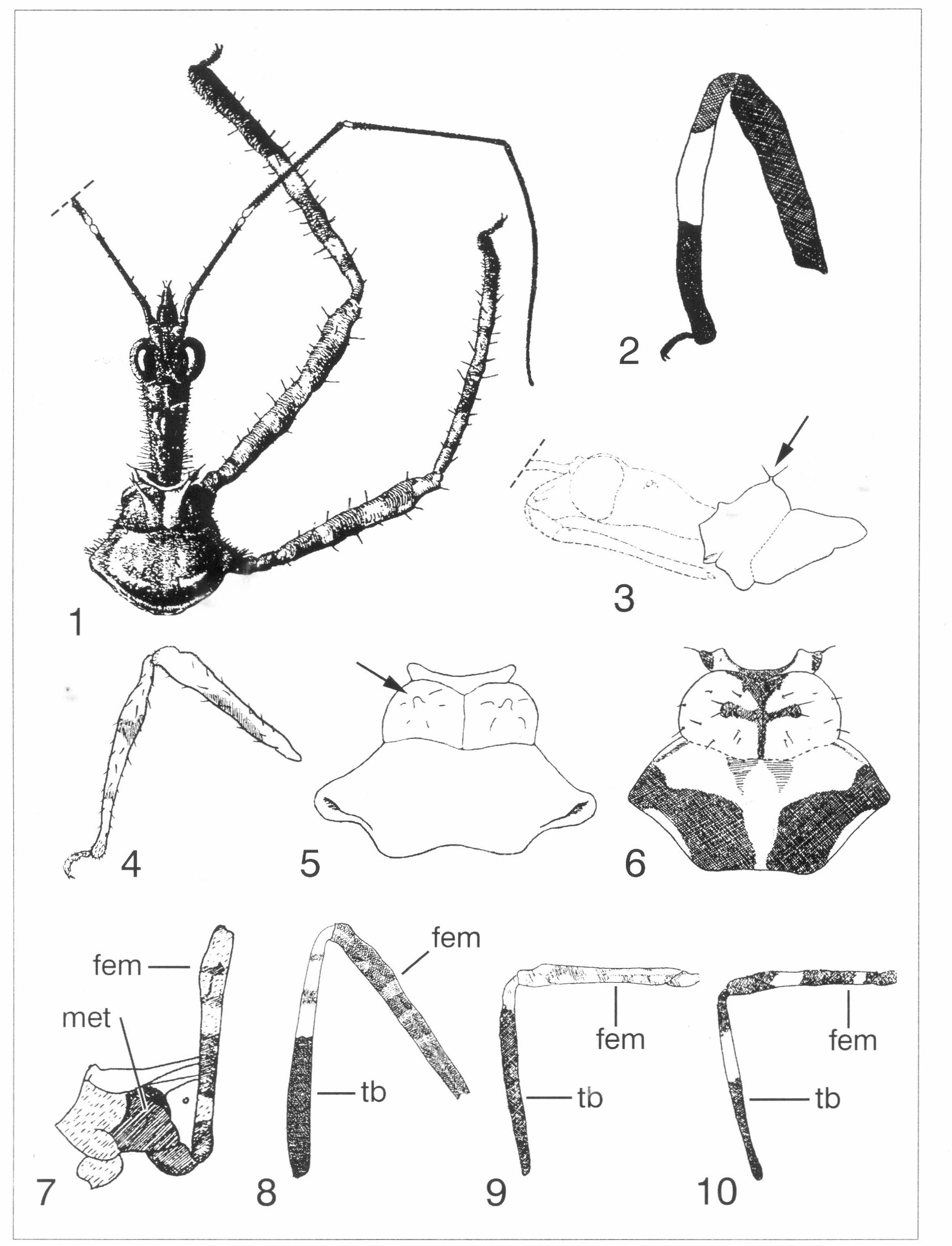
— Base and apex of some antennae segments pale (Fig. 1)…………………………………………………………. 4
3. Femora uniformly darkened (Fig. 2); vertical processes of anterior lobe of pronotum short, not longer than wide at base (arrow, Fig. 3)……. A. schubarti
— Femora yellowish brown with pale annuli (Fig. 4); vertical processes of anterior lobe of pronotum slightly broadened and rounded at apex, teat-like (arrow, Fig. 5)……………………. A. salvatorianus
4. Anterior pronotal lobe with a black crosslike design, posterior pronotal lobe with two darkened markings near its posterior margin (Fig. 6)……. A. dietrichi
— Neither anterior nor posterior pronotal lobe with dark markings………………………….. 5
5. Metapleura and posterior coxae much darker than the anterior and median ones; femora with a wide sub-basal dark annuli (Fig. 7)………………….. A. bahianus
— Metapleura and posterior coxae not conspicuously darker than anterior and median ones; femora with a different color pattern………………………………………………………… 6
6. Base of tibiae yellowish, with conspicuous deep dark annuli; femora yellowish with dark annuli (Fig. 1); pleura mostly reddish with diffuse dull brown areas ……………………………………… A. albosparsus
— Base of tibiae practically yellowish, just with two not so well defined, slightly darker annuli; femora uniformly light brown, with diffuse yellowish annuli (Fig. 8); meso and metapleura deep brownish-black…………………………………… A. stali
7. Tibiae with pale bases; femora light brown with dark annuli not so conspicuous (Fig. 9)……………………………………………………. A. bergi
— Tibiae, each with one large basal dark annuls; femora black, with one or two pale annuli (Fig. 10)……. A. wygodzinskyi
Morphology and color patterns of Agriocleptes species. 1: Head, pronotum and legs of A. albosparsus (left anterior and medium legs are not shown; left antennae segments partially shown) [after Wygodzinsky (1946)]. 2: Medium leg of A. schubarti [after Wygodzinsky (1946)]. 3: Pronotum of A. schubarti, lateral view (punctuated head to show position in relation to pronotum, antennae not shown) [after Wygodzinsky (1946)]. 4: Posterior leg of A. salvatorianus [after Carcavallo and Martínez (1960)]. 5: Pronotum of A. salvatorianus, dorsal view [after Carcavallo and Martínez (1960)]. 6: Pronotum of A. dietrichi, dorsal view [after Wygodzinsky (1953)]. 7: Metapleura and posterior femur of A. bahianus [after Wygodzinsky (1953)]. 8: Anterior leg of A. stali [after Wygodzinsky (1946)]. 9: Posterior leg of A. bergi [after Wygodzinsky (1953)]. 10: Posterior leg of A. wygodzinskyi [after Wygodzinsky (1953)]. Abbreviations: fem, femur; met, metapleura; tb, tibia.
Checklist of the Agriocleptes species
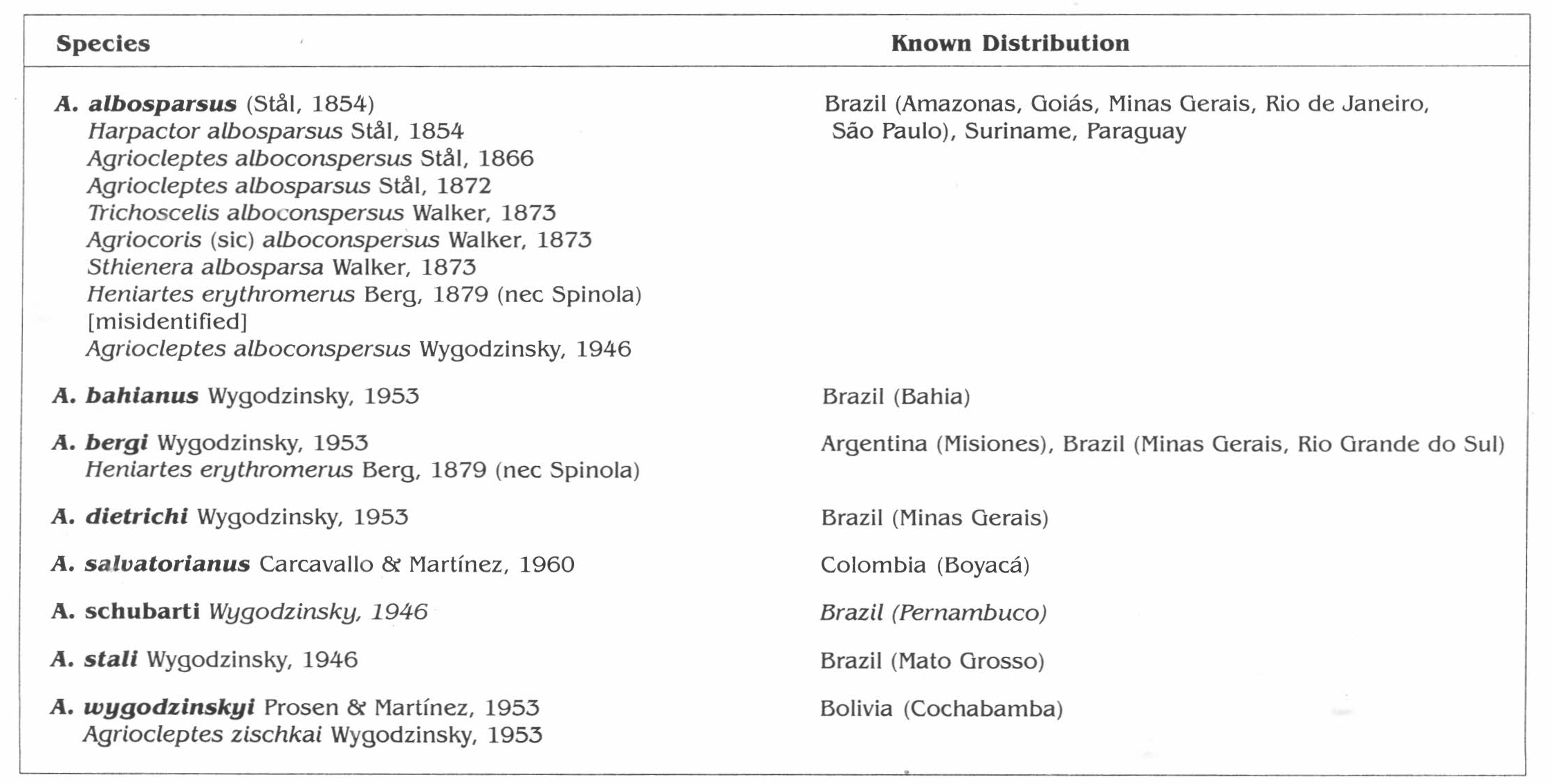
The checklist (Fig. 11) is based on the material examined by Wygodzinsky (1946, 1953) and Carcavallo and Martínez (1960). Synonyms follow Maldonado (1990) and Forero and Giacchi (2001).
Checklist of the Agriocleptes species.
Footnotes
Acknowledgements
I am grateful to Hélcio R. Gil-Santana who kindly facilitated a copy of the obscure paper with the original description of A. salvatorianus, and thus made possible the construction of this key. Paulina Muñoz de Hoyos and an anonymous reviewer offered useful suggestion for the improvement of the manuscript.
References
1.
CarcavalloR. U.MartínezA.1960Un nuevo Agriocleptes de Colombia (Hemiptera: Reduviidae: Apiomerinae)Revista de la Cátedra de Microbiología y Parasitología, Buenos Aires28893135
2.
CoscarónM. C.1983Revisión del género Rasahus (Insecta, Heteroptera, Reduviidae)Revista del Museo de la Plata (N. S.) (Secc. Zool)1313675138
3.
Costa LimaA. DAHathawayC. R.Campos SeabraC. A.1948Sôbre algumas espécies de Apiomerinae representadas nas nossas coleções (Hemiptera: Reduviidae: Apiomerinae)Memórias do Instituto Oswaldo Cruz454761772
4.
ForeroD.GiacchiJ. C.2001A new synonymy in the genus Agriocleptes (Heteroptera: Reduviidae: Apiomerinae)Revista Colombiana de Entomología273-4205206
5.
Gil-SantanaH. R.AlencarJ.2001Sobre o gênero Veseris Stål, 1865, com Eurylochus Torre-Bueno, 1914, como sinônimo novo e chaves para identificação (Hemiptera, Reduviidae, Sphaeridopinae)Entomología y Vectores8195104
6.
JurbergJGalvãoC.1997Hermanlentia n. gen. da tribo Triatomini, com um rol de espécies de Triatominae (Hemiptera, Reduviidae)Memórias do Instituto Oswaldo Cruz922181185
7.
MaldonadoC. J.1990Systematic catalogue of the Reduviidae of the World. Special edition of the Caribbean Journal of ScienceUniversity of Puerto Rico, Mayagüez, Puerto Rico694
8.
MaldonadoC. J.Santiago-BlayJ. A.1992A new species of the Neotropical genus Sphaeridops Amyot & Serville, 1843 (Sphaeridopinae: Reduviidae)Proceedings of the Entomological Society of Washington944508511
9.
MaldonadoC. J.Santiago-BlayJ. A.PoinarG. O.1993Apricrenus fossilis gen. & sp. n. (Heteroptera: Reduviidae: Apiomerinae) from Dominican amber (lower Oligocene-upper Eocene)Entomologica scandinavica242139142
10.
ProsenA. F.MartínezA.1953Una nueva especie de Agriocleptes (Hemipt. Reduviidae, Apiomerinae)Misión de Estudios de Patología Regional Argentina2483-845356
11.
StålC.1866Bidrag till Reduviidernas kännedomÖfversigt af Kongl. Vetenskaps-Akademiens Förhandlingar9235302
12.
WygodzinskyP.1946Contribuição ao conhecimento do gênero Agriocleptes Stål, 1866 (Apiomerinae, Reduviidae, Hemiptera)Revista Brasileira de Biologia62149157
13.
WygodzinskyP.1947Contribuição ao conhecimento do gênero Heniartes Spinola, 1837 (Apiomerinae, Reduviidae, Hemiptera)Arquivos do Museu Nacional411164
14.
WygodzinskyP.1953Contribuição ao conhecimento dos gêneros Heniartes Spinola, 1837 e Agriocleptes Stål, 1866 (Apiomerinae, Reduviidae, Hemiptera)Revista Brasileira de Biologia134369380