






Abstract
Considering the important roles of pollinators in ecosystem services, their identification and studies of their behavior would be extremely important to efforts directed towards their preservation and management. With the aim of examining the diversity and behavior of the floral visitors to Campomanesia adamantium (Cambessédes) O. Berg ("guavira") and how they act in the pollination process, a total of 31 species belonging to the orders Hymenoptera (79.30 %), Coleoptera (11.34 %), Diptera (9.1%), and Hemiptera (0.24 %) were identified. Among the Hymenoptera, africanized Apis mellifera, Brachygastra lecheguana, and Trachymyrmex sp. were considered dominant. Foraging was most intense between 07:00 and 10:00 h, with decreased activity after 13:00 h. The insects visited the plants in search of pollen and nectar, with pollen being the principal resource offered. Among the pollinators, africanized Apis mellifera stood out due to their behavior, frequency of visitation, abundance (being responsible for 53.24% of all floral visits), and their constant presence on C. adamantium flowers during the entire observation period. Other insects (wasps, ants, and coleopterans) were associated with floral tissue predation.
Introduction
Cerrado (Neotropical Savanna) vegetation has the richest vascular plant flora on the planet (except for some Tropical Forest regions) (Eiten 1994), with wide structural and compositional variations due to regional differences in soils, climate, and topography (Oliveira-Filho et al. 1989). Strategies contemplating the conservation of this biome point to the importance of maintaining regional water, biodiversity and biotic resources, as well as direct social, economic and health benefits – which include honey, wood products, ornamental, medicinal and fruiting plants (Godoy and Bawa 1993; Godoy et al. 1993).
Many cerrado plants are used by humans for food, including members of the Myrtaceae family, which comprises approximately 140 genera and more than 3000 species worldwide (Joly 1993; Ribeiro 1999). One species of this family, Campomanesia adamantium (Cambessédes) O. Berg, locally known as "guavira" or "guabiroba", is a characteristic element of the Cerrado biome, producing fruits that are consumed "in natura" or processed by local inhabitants (Avidos and Ferreira 2000).
The pollinators of the Myrtaceae family are highly diversified, and plant taxa with non-specialized flowers are visited by a wide range of animals, principally bees (Beardsell et al. 1993; Proença and Gibbs 1994; Nic-Lughadha and Proença 1996). Floral visitation, however, is not in itself sufficient for an animal to be considered an effective pollinator, as that role depends on the fulfillment of certain criteria: 1. The numbers of pollen-vector species that visit the flowers; 2. The frequency with which each visiting species comes into contact with the anthers and stigmas; 3. The frequency of visits that result in pollen deposition on the stigmas of the flowers; 4. The numbers of pollen grains deposited per visit to a given flower, and during subsequent floral visits, favoring (or not) genetic flow; 5. The quantities of pollen removed from the anthers and subsequently deposited on the stigmas; 6. The rates of fruit and seed production, per visit, for each visiting species; and, 7. Intrinsic features of the plant, such as pollen viability and the existence (or not) of self-compatibility (Fenster et al. 2004, Polatto et al. 2012.
There is strong evidence from pollination studies that interactions between plants and their pollinators are the result of the convergent evolution of floral attributes in relation to selective pressures exerted by pollinators (Johnson et al. 1998; Fenster et al. 2004; Goldblatt et al. 2004; Perez et al. 2006; Alcantara and Lohmann 2010; Curti and Ortega-Baes 2011).
Fenster et al. (2004) characterized floral specialization as a situation in which the flowers of a given species are foraged 75% of the time (or more) by a single functional group of floral visitors.
Johnson and Steiner (2000) noted that persistent plants, such as perennial species or those capable of vegetative reproduction, should be more resistant to the risks inherent in specialization, while plants with short life-cycles would be expected to be more generalist in nature. Plants with specialist requirements would be more vulnerable to the loss of some of their pollinators as they depend on smaller numbers of pollinator species, while generalist taxa would be more resistant to similar reductions (Bond 1994) - raising concern that persistent anthropogenic ecosystem impacts would result in the collapse of the pollination systems of the former (Bond 1994; Kearns et al. 1998)
Reductions and the degradation of natural areas tend to eliminate places used for wildlife nidification and reduce the availability of resources necessary for bee survival – thus directly influencing their diversity and population sizes. The identification of floral visitors and the elucidation of their roles as effective pollinators of native plant species will be extremely important in defining adequate management strategies and reducing impacts related to their scarcity. As such, we evaluated the diversity and behavior of the floral visitors to C. adamantium, their activities, and the processes involved in the success (or not) of their pollination activities.
Materials and methods
The present study was undertaken in a four hectare fragment of Cerrado vegetation in the Carambola Farm, in the municipality of Ponta Porã, Mato Grosso do Sul State, Brazil (22°36′29.61"S 55°37′08.69″W).
Floral visitors were recorded on randomly chosen and fully flowering individuals of C. adamantium during the last two weeks of September and first week of October/2011. Floral visitors were collected during the first 15 min of every hour between 06:00 and 19:00, and then sacrificed for latter identification. During the remaining 45 min of each hour we evaluated visitor behavior on the flowers of 10 different plants. Observations were always undertaken between 1.5 and 2.0 m from the flowers, using binoculars, to reduce interference with visitor activities (modified from Polatto and Alves-Junior 2008), Captured specimens were took to the Apiculture Laboratory (LAP) at the Environmental and Biological Sciences Faculty (FCBA) at the Grande Dourados-MS Federal University (UFGD), and identified by consulting the specialized literature and/or specialists, and later stored at the Biodiversity Museum - Museu da Biodiversidade da Faculdade de Ciências Biológicas e Ambientais (MuBio) there.
Visitor behaviors were characterized, following Silberbauer-Gottsberger and Gottsberger (1988), as: a) "exclusive", when only a specific taxa successfully executes pollination in a given plant species; b) "principal", when a certain group of animals pollinates a given plant species with greater efficiency than other groups; c) "additional", when a certain pollinator occasionally pollinates a given species (thus being third in importance).
The faunal analyses (in terms of abundance, frequency, constancy, and dominance) were performed following Silveira-Neto et al. (1976), Thomazini and Thomazini (2002), and Polatto et al. (2012).
Abundance classes were defined after determining the confidence intervals (CI) for the median numbers of individuals collected per species during the day, at both 5 % and 1 % degrees of probability (Kaps and Lamberson 2004), establishing the following classes: va = very abundant (numbers of individuals of the same species, greater than the upper limit of the CI at 1 %); a = abundant (numbers of individuals between the upper limits of the 5 % and 1% CI); c = common (numbers of individuals within the 5 % CI); d = disperse (number of individuals between the lower limits of the 5% and 1% CI); and, r = rare (number of individuals less than the lower limit of the 1% CI).
To establish frequency classes, we determined the CI for the mean number of individuals collected per species at a 5 % probability level (Kaps and Lamberson 2004), these being: vf = very frequent (frequency greater than the upper limit of the 5% CI); f = frequent (frequency within the 5 % CI); and, nf = not frequent (frequency less than the lower limit of the 5% CI), following Thomazini and Thomazini (2002) and Polatto et al. (2007).
We evaluated the percentages of collections that included a given species, calculating constancy using the formula: C = (n° of collections of species X / total nº of collections) x 100, and establishing the following classification: constant = species constancy greater or equal to 50%; accessory = variable constancy, between 25 % and 49%; accidental = constancy inferior to 25%.
A species was considered dominant when its relative frequency value, in relation to the other foraging insects, exceeded 50% of the limit calculated by the formula: D=(1/total nº of species collected) x (100) (Silveira Neto et al. 1976). According to Kato et al. (1952) and Silveira Neto et al. (1976), dominant species have the capacity to modify, to their own benefit, environmental factors, and provoke the appearance or disappearance of other organisms.
Results and discussion
Our study demonstrated the existence of a wide variety of insect visitors to C. adamantium flowers, with the significant presence of wasps (Brachygastra lecheguana, Latreille 1824), ants (Trachymyrmex sp.), flies (Muscidae), and Coleoptera (Diabrotica speciosa, Germar 1824) (Table 1).
A total of 802 individuals representing 31 species were collected while foraging on C. adamantium flowers, belonging to the following orders: Hymenoptera (79.30 %), Coleoptera (11.34 %), Diptera (9.1 %), and Hemiptera (0.24 %). Among the Hymenoptera, africanized Apis mellifera (L. 1758) (Hymenoptera: Apidae), B. lecheguana (Hymenoptera: Vespidae), and Trachymyrmex sp. were considered dominant (Table 1).
Among the effective pollinators of C. adamantium were Examalopis sp., Xylocopa sp., and Africanized A. mellifera.
Visitation was observed from the earliest observation hours until early evening; no visitation was observed after 18:00. The mean daily luminosity was 10.3 Klux, which partially coincided with the period of greatest floral visitor activity (Fig. 1).
Floral anthesis in C. adamantium begins at approximately 05:00, with the frequencies of foraging insect visits increasing from 06:00 until 10:00, with its peak between 09:00 and 10:00 - followed then by constant reductions in visitation (Fig. 1) that are probably related to quantitative decreases in floral rewards resulting from high foraging intensity during earlier hours of the day (Roubik 1989; Fidalgo and Kleinert 2007; Polatto et al. 2007, 2012).
Analyses of the floral visitors captured on C. adamantium flowers between September and October/2011 at the Carambola Farm, in the municipality of Ponta Porã-MS, Brazil. vf = very frequent; F = frequent; Va = very abundant; C = common; W = constant; Z = accidental; Y = accessory; D = dominant; ND = not dominant.* Effective pollinators.
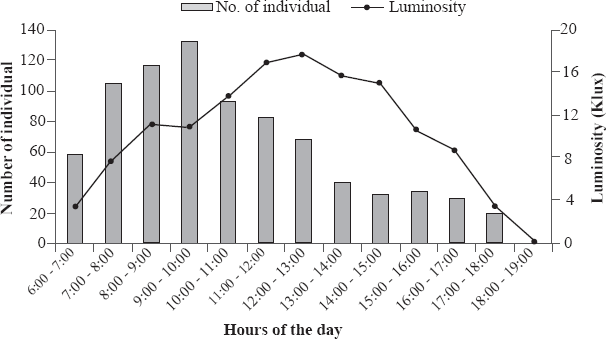
Average luminosity values (Klux) and the absolute frequencies of insects captured on C. adamantium flowers (during their peak flowering times) during hourly collection intervals at the Carambola Farm, in the municipality of Ponta Porã-MS, Brazil.
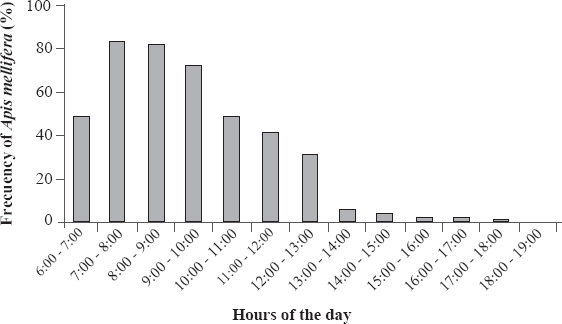
Relative frequencies of A. mellifera visits to Campomanesia adamantium flowers (during the peak flowering period) at different hours of the day, at the Carambola Farm in the municipality of Ponta Porã-MS, Brazil.
Apis mellifera bees visited the flowers in greater numbers, and spent more time on them, than other insects, with various individuals often foraging together on the same plant. As these insects moved within the flower, the ventral regions of their thorax and abdomen would enter into contact with the stigma. They collected pollen from the anthers with rapid movements of their legs, while simultaneously spreading significant quantities of pollen on the flower. Africanized bees visited 4 to 5 flowers per plant, facilitating pollen exchange between flowers of the same individual (i.e. geitonogamy); the close spacing of the plants are likewise allowed bees to forage on numerous individuals and facilitate cross-pollination (i.e., xenogamy). Those bees started foraging on the flowers at 06:00 h, with peak activity between 07:00 and 09:00 h (Fig. 2).
Silva and Pinheiro (2007) studied four species of Myrtaceae (Eugenia uniflora L., Eugenia punicifolia (Humb. Bonpl. & Kunth) DC, Eugenia neonitida Sobral, and Eugenia rotundifolia Casar) and reported similar behavior patterns for A. mellifera, with foraging initiating near 05:30 h and peaking between 06:00 and 07:00 h.
Almeida et al. (2000) studied the pollination success of various Campomanesia species in terms of A. mellifera activity, and determined that the species of that plant genus depended on these bees for effective pollination. According to the observations and commentaries of those authors, A. mellifera directly competes with native bees that would otherwise have exclusively undertaken pollination activities. No other bee species were observed on any plant at the same time as A. mellifera, indicating dominance due to their superior numbers, and suggesting that this dominance was not due to their aggressiveness in relationship to other bees (as no aggressive behavior was observed). Malerbo et al. (1991) observed that the frequencies of native bees visiting Myrciaria cauliflora (Mart.) O. Berg. ("jabuticabeira") flowers increased as A. mellifera visitation decreased.
Fidalgo and Kleinert (2009) reported that A. mellifera modified the foraging patterns of other insects on the flowers of some species of Myrtaceae, with the presence of those bees on Myrcia multiflora (Lam.) DC significantly reducing the numbers of other insects collecting pollen; the visits of other species were also noticeably more rapid, and they left the flowers whenever the Africanized bees approached. Minussi and Santos (2007), on the other hand, reported that native species of Trigona sp. and three species of Halictidae were not inhibited by the presence of A. mellifera, even attacking invader species that approached the squash (Cucurbita maxima, L) and broccoli (Brassica oleracea var. capitata) flowers they were visiting.
Examalopsis sp. bees were constant visitors (2.11%) (Table 1) to C. adamantium flowers and are considered effective pollinators due to their floral behavior, as they always came into contact with the reproductive structures of the flowers while foraging - even though their visitation frequency classifies them as "additional pollinators". These bees were observed to approach C. adamantium flowers when A. mellifera bees were not present, but they did not demonstrate invasion behavior or interrupt their activities when Africanized bees approached.
Bees of the genus Xylocopa demonstrated low visitation frequencies on "guavira" flowers (0.24 %) (Table 1) but did intensively collect pollen, with large quantities of pollen being observed adhering to their bodies. Those insects frequently came into contact with the reproductive structures of the flowers while collecting pollen, thus favoring pollination, and their habit of visiting two to three inflorescences on the same plant would facilitate pollination by geitonogamy.
Ants did not demonstrate any pollination behavior, utilizing C. adamantium only for resting and herbivory; Trachymyrmex sp. was the dominant visiting species (5.86%) (Table 1) and was encountered during all of the collection periods demonstrating herbivorous behaviors on all floral structures.
Pacheco et al. (1989) considered the genus Trachymyrmex as a "pest" in Eucalyptus sp. plantations as they damaged shoot buds. Mayhe-Nunes and Jaffe (1997), however, disagreed with the hypothesis that Trachymyrmex species were prejudicial to those plantations, as the members of that genus rarely removed living plant parts.
Trachymyrmex sp. was observed cutting all types of floral components on C. adamantium and, on some occasions, even harvesting all of the plant structures – leaving only bare branches.
Many wasps would visit the flowers to (apparently) consume their nectar, while others would consume the floral buds. The latter behavior was observed with B. lecheguana, damaging the floral buds and provoking their eventual rotting and abscission, to the point of occasionally causing damage to overall plant development.
Four species of Diptera were observed visiting the flowers of C. adamantium: three species of the family Syrphidae, and one species of Muscidae. Muscidae was dominant among them (Table 1), being observed moving over the entire surface of the flower in search of nectar, and coming into contact with both dehiscent anthers and receptive stigmas.
Several diptera species can act as pollinators as well as floral resource thieves (e.g., Proctor and Yeo (1973), Sazima (1978), Larson et al. (2001).
As examinations of the dipterans did not reveal any pollen grains adhering to their bodies, it is not likely that there was significant pollen transfer between flowers of the same plant (geitonogamy) or cross pollination (xenogamy) as a result of visits by those flies to C. adamantium. Autogamy might be favored through their contacts with the reproductive structures of a single flower, with occasional transfers of autogamic pollen. Previous tests of self-pollination in C. adamantium, however, did not result in fruiting (personal observation), so the flies are apparently acting only as floral resource thieves.
Nine species of Coleoptera were observed visiting C. adamantium flowers, with D. speciosa being dominant (3.61 %) (Table 1). These insects were present during all of the survey hours, with the greatest visitation frequencies between 10:00 and 11:00 (Table 2) – demonstrating herbivory on the stamens and leaves. They apparently did not contribute to pollination as they would destroy the plants' reproductive structures, and no pollen grains were observed adhering to their bodies.
Diversity of the insects captured during the peak flowering period of Campomanesia adamantium flowers at the Carambola Farm, in the municipality of Ponta Porã-MS, Brazil.
Conclusions
Campomanesia adamantium offers its floral visitors pollen and nectar rewards.
According to the faunal analysis, Hymenoptera are the predominant visitors to C. adamantium flowers, with three species being considered dominant: africanized A. mellifera, B. lecheguana, and Trachymyrmex sp.
Among the effective pollinators of C. adamantium are africanized A. mellifera, Examalopis sp., and Xylocopa sp., as judged by their behaviors on the flowers.
Wasps, ants, and Coleoptera are associated with herbivorous activities and apparently do not contribute to effective pollination.
The behavior of A. mellifera as an effective pollinator of C. adamantium, and its nature as a dominant species, indicates an effective adaptation of this exotic bee to "guavira" flowers. The intense activity of this bee species has apparently completely supplanted all of the native pollinators of "guavira", or otherwise extremely reduced their activities. As the dominant species, they can modify environmental impacts to their own benefit, provoking the appearance or disappearance of other organisms – and, in this case, completely dominate the foraging area.
The low frequencies of native bee visits, however, may also be related to intense anthropogenic modifications that have impacted the region, reducing possible nidification sites and foraging opportunities for these bees through the transformation of native forests into pasture lands or agricultural areas, with concomitant burning, plowing, and agrotoxin applications.
Footnotes
Acknowledgements
The authors would like to thank Professor MSc. Felipe Varussa de Oliveira Lima of the Faculdade de Ciências Biológicas e Ambientais of the Universidade Federal da Grande Dourados for identifying the bees; Professora Dra. Adelita Maria Linzmeier of the Faculdade de Ciências Biológicas e Ambientais of the Universidade Federal da Grande Dourados for identifying the Coleoptera; Mcs. Tiago Henrique Auko for identifying the wasps; Professor Dr. Leandro Pereira Polatto of the Universidade Estadual de Mato Grosso do Sul (UEMS) for his valuable suggestions during the development of this work; and the Coordenação de Aperfeiçoamento de Pessoal de Nível Superior (CAPES) for awarding the grant.